Wednesday 26 January 2011
European Water Vole - Star of Stage and Screen
The
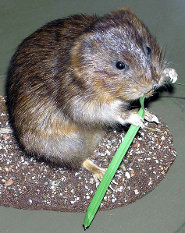
European water vole (
Arvicola terrestris) was considered a separate species from
Arivicola amphibius until 1857. At that time the two were found to be the same species and is generally referred to as
Arivicola amphibius. It is found all over Great Britain, north and central Europe and in parts of Russia digging nests in the banks of streams, slow moving rivers and other waterways. Their nests have many rooms, and some are used for food storage for the long winter.
The cute aspect and busy nature of the water vole has captured the imagination of authors and their public. Ratty, the main character in The Wind in the Willows by Kenneth Grahame was actually a water vole. Also, in Stella Gibbons’ comic novel and film Cold Comfort Farm one of the characters talks to water voles throughout the story.
They prefer to live in thick riparian vegetation which protects them from predators when they are above ground. They don’t like trampled grass or trees where predators can hide. The
American mink was the main predator and almost hunted the voles to extinction (see also this
article). They are protected now in the UK and are on the International Union for Conservation of Nature (IUCN) list as Least Concern.
Water voles are commonly mistaken for rats and called water rats in some places even though they have fur on their ears, paws and tails and have short noses. They have chubby faces and bodies and are excellent swimmers and divers. They grow to 5.5-8.7 inches (140-220 millimeters) long plus a tail of 2.2-2.8 inches (55-70 millimeters). Adult water voles weigh from 5.6-12.3 ounces (160-350 grams). Babies must grow to 4.9-6.0 ounces (140-170 grams) to survive the first winter.
Pregnancy is 21 days and a litter may contain up to eight babies. Each one weighs about 0.4 ounces (10 grams). They open their eyes three days after birth and can expect to live two years. Most water voles do not live through a second winter.
They eat grass and plants that grow near water and sometimes bulbs, twigs, buds, roots and fruits. When there is no apparent reason, because there is enough food available, they can destroy the grass of a whole field like a plague. They will eat voraciously leaving it bare. They have even been known to eat frogs’ legs in Wiltshire, England. They do this possibly to make up for a lack of protein in their diet.
You can help spreading the word about this animal by liking it on facebook
Permanent Link
Monday 24 January 2011
The Annually Fruitful Gray Brocket
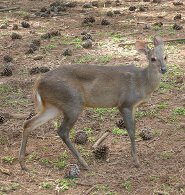
The
Gray brocket (
Mazama gouazoupira) deer has a grayish-brown coat, and the underside of its tail is white. When fully grown, gray brockets average a weight of 17 kg, or 37.4 lbs. They measure approximately 850 to 1050 mm, or 41.34 to 33.46 inches. Male gray brocket deer have antlers measuring from 70 to 100 mm. The gray brocket makes its home in Bolivia, Argentina, Colombia, Brazil, French Guiana, Ecuador, Peru, Guyana, Trinidad and Tobago, Suriname, Venezuela and Uruguay and prefer open areas, such as the thorn scrub in Venezuela and may be found in arid regions, swamplands, savannas, or on the borders of transitional forests.
The gray brocket deer reproduces year round. Does have been found pregnant and lactating simultaneously, and spotted fawns may be found all through the year. Gestation averages eight months. Generally only one offspring is born at a time, twins occur rarely.
The average lifespan of gray brocket deer is 13 years in the wild. Rarely seen in groups of three, they are solitary animals, preferring cover during the day and to feed in the open only at night. Female home ranges overlap, but male home ranges are exclusive.
Gray brocket deer communicate through scent-marking, including defecation, urination, thrashing, and forehead rubbing. Females and juveniles have been known to mark more often inside their home range than males, who usually mark outside their range. Other communication methods include posture, visual signals, physical contact, and some vocalizations.
Mostly frugivorous, gray brocket deer prefer fleshy fruits from bush-like trees during the wet season. They feed on tough fruit from the
Casesalpinia paraguarensis and the
Zyzyphus oblongifoia trees during the dry season. This fruit is dry and tough. In regions like the
Chaco, water is more scarce during the dry season, so the deer eat more bromeliad and cacti fruits, in addition to succulent roots and leaves, to fulfill their need for water. They also eat twigs, buds, flowers, bark, and tree or shrub leaves. Because of the type of food they eat, they disperse seeds from many plants. Due to predators’ reliance on these deer for food, they may affect predator populations.
Predators of gray brocket deer include
jaguars,
ocelots, domestic dogs,
mountain lions,
humans, and large raptors. They are listed on the IUCN Red List of Threatened Species as Data Deficient, which means there is inadequate information for directly assessing its risk of extinction.
Picture of the gray brocket by Gagea, licensed under
Creative Commons Attribution-Share Alike 3.0 Unported
You can help spreading the word about this animal by liking it on facebook
Permanent Link
Thursday 20 January 2011
Geoffroy's Bat - Winning the Survival Struggle?
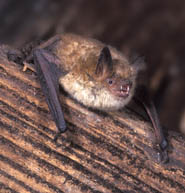
The
Geoffroy%u2019s bat (
Myotis emarginatus) is also known as Geoffroy’s Myotis. Geoffroy’s bat can be found in central and southern Europe, northwestern Africa, Caucasus and Levantine regions, and the eastern Mediterranean. Although plentiful in some parts of France, it is much rarer in the rest of Europe and appears on their species needing further research and protection. They mature in about a year and a half and start the cycle of having a pup of their own annually. An adult weighs about .011 kg and will live 23 years. Geoffrey’s bats live in large groups known as colonies or clouds. These can be as large as 1200 bats.
Endangered
Geoffroy’s bat has been listed as “Vulnerable” since 1996 and has a high risk of extinction according to the IUCN Red List of Threatened Species. The last assessment was in 2008 when it was considered of "least concern". In some areas populations experienced a significant decline between the 1960s to the 1990s.
More recent indications are that populations of Geoffroy’s Bat are growing in central Europe and at least close to stable in most other areas. It has even moved into new areas.
Locations and Habitat of Geoffroy’s Bat
This bat can make its home across a wide range, as it is adaptable and not restricted to a special habitat. Its biggest restriction is its specialized diet. It needs grassland where it can forage through scrub for spiders and flies. It will live anywhere from sea level to about 1800 m.
This species travels very little and is not known for migration. However there are some places it is seen only in the summertime. It tends to live underground, especially in the winter. During summer months it can also be found settled in the attics of buildings. Some African colonies reside in caves.
Geoffroy’s Bat’s Biggest Adversaries
Man is the Geoffroy’s Bat’s biggest threat.
Since Geoffroy’s Bat is found largely over agricultural landscapes, changes in agricultural activities can influence populations. Any large scale disturbance of the earth or removal of buildings can take away their homes. The African caves are being threatened by vandalism and fires. African traditional medical procedures also require the bat, and many are collected each year.
Picture of the Geoffroy’s Bat by Dodoni, licensed under
GNU Free Documentation License
You can help spreading the word about this animal by liking it on facebook
Permanent Link
Wednesday 19 January 2011
Bicolored Shrew - An Animal a Dentist Would Love
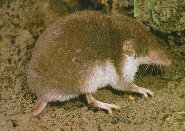
The
bicolored shrew (
Crocidura leucodon), also known as the white-toothed shrew, is a small mammal known by its distinctive coloring. The bicolored shrew is a medium to dark brown on its back and white or light gray on its underbelly. This difference in color is immediately obvious, as the variation is clearly defined.
However, those that look even further will notice that the bicolored shrew is equipped with bright, white teeth. Its teeth are such a stark white, not due to the shrew’s diet, but because its teeth lack natural pigmentation. These teeth are also sharp and tightly crowded together, even more so than other white toothed shrew species.
Besides their ability to impress any dentist, the bicolored shrew’s teeth are also put to good use. These animals are aggressive
carnivores that will feast on any small animal they can find. These shrews prefer to hunt small mammals, frogs, and lizards, but will eat insects if prey is scarce. The bicolored shrew also has a peculiar way of consuming their prey. Instead of going for the large, meaty portions of the body, bicolored shrews always eats their prey’s brain first. They will then eat the rest of their prey, leaving only unwanted limbs, skin, and tails.
While the bicolored shrew may sound frightening, it is actually fairly small. An adult shrew weighs 0.024 pounds, or 0.011 kilograms, and grows to about 3.82 to 5.24 inches, or 97 to 133 millimeters, in length.
Additionally, this shrew is native to Central Europe and prefers dry, temperate habitats. Bicolored shrews find their homes in woodlands and grasslands, where they are offered many places to hide. Shrews prefer to burrow and build tunnels under rock piles or thick brush, in order to disguise and protect their homes. Bicolored shrews will also make themselves at home in people’s gardens, farmlands, and farm buildings, frequently to the dismay of the inhabitants.
The bicolored shrew is plentiful in Central Europe and is currently not at risk for extinction. However, this animals does find itself hunted by a number of different animals, including snakes, owls, and other carnivorous mammals. Fortunately, those that want the opportunity to see the bicolored shrew, will not find it difficult, although they may want to keep a safe distance from this aggressive little mammal.
Picture of the bicolored shrew by Dodoni, licensed under
GNU Free Documentation License
You can help spreading the word about this animal by liking it on facebook
Permanent Link
Tuesday 18 January 2011
Red-chested mustached tamarin - A patient hunter
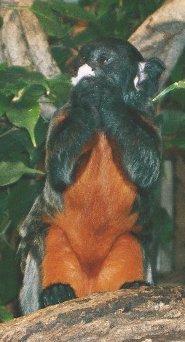
The
Red-chested mustached tamarin (
Saguinus labiatus) is a stealthy hunter that hides in bushes and patiently waits for frogs, snails, lizards, spiders and other insects to be within reach before it pounces and makes a meal of them. Its diet also consists of flowers, nectar and fruits.
The Red-chested mustached tamarin resides in the upper layer of the rainforests and swamps of Brazil and Peru. They often mingle and form groups with the Saddleback Tamarin, which is smaller in size. The Red-chested mustached tamarin weighs between 491 and 529 grams or 1.08 and 1.17 pounds. Its head and body ranges in length from 23 to 30 cm or 9.1 to 11 inches, and its tail length is 34 to 41 cm or 13 to 16 inches.
The most distinguishable features of the Red-chested mustached tamarin are also the reasons for its name. It has bright reddish hair on its stomach, along with white hair that surrounds its lips and nose, giving it a mustached look.
This tamarin is known for its long calls, which consist of individual syllables. It has been found that the acoustic structure of the call is different between each group. Studies on males and females of different groups have shown that the females can distinguish the calls of the males from their own population and responds to them differently than calls from an unfamiliar population.
The Red-chested mustached tamarin is not endangered and is listed as Least Concern. This is most likely due to the fact that much of the population lives in a remote area of the Brazilian Amazon and is not hunted in any great number; however, they are sometimes captured and kept as pets. They have no known major threats and are very adept at avoiding predators by carefully choosing their sleeping spots, usually in tree branches 12-18 meters (39 to 59 feet) above ground.
A female will be pregnant for almost 5 months and will usually give birth to twins. The babies are raised by the entire group, which is between 4 and 15 individuals, and are not weaned until they are almost 8 months old. The Red-chested mustached tamarin has a long lifespan, approximately 21 years.
Picture of the red-chested mustached tamarin by Zwoenitzer, licensed under
Creative Commons Attribution-Share Alike 3.0 Unported license.
You can help spreading the word about this animal by liking it on facebook
Permanent Link
Wednesday 12 January 2011
South African Fur Seal - A Gentle Giant

The
South African fur seal (
Arctocephalus pusillus) is a friendly and curious animal. These creatures live on the coasts South Africa and both coasts of Australia. They are also known as Cape fur seals, Australian fur seals, or Brown fur seals. Male South African fur seals can grow up to 7 ft (2.2 m) and weigh between 440 and 800 lbs (200-360 kgs). Females are smaller in size with their length going up to 5 ft (1.7 m) and average weight around 260 lbs (120 kgs).
Another way to tell the difference between males and females is their coloring. Males are darker in color than females. Males also have a mane that can show their age as it gets lighter as they get older. South African Fur Seal pups are born black and turn lighter as they get older.
South African fur seals can be found in large groups on rocky or sandy beaches, but they tend to be very independent when traveling. They typically pick rocky islands as their breeding sites in early November. The females are very particular when choosing their mates, basing their decision on how much territory the male candidate claims as his. When males arrive at the breeding site, they fight for territory to impress the females. Pups are born after a 12 month long gestation period. They are weaned over a period of another 12 months with females reaching sexual maturity at 3-4 years and males at 4-5 years.
Even though South African Fur Seal can seem intimidating because of their size, they are remarkably friendly animals. They feel very comfortable in water and even enjoy swimming along with divers. This gives people a great opportunity to bond with these gentle giants. When approached by people on shore, they can get a bit spooked. However, they will not attack. Their main source of food is fish, sometimes crustaceans, or even birds.
South African seals are protected in Australia by the Environment Protection and Biodiversity Conservation Act, passed in 1999, and in Africa by the Sea Birds and Seals Protection Act of 1973. Their greatest threats are great white sharks and
orca.
You can help spreading the word about this animal by liking it on facebook
Permanent Link
Tuesday 04 January 2011
Siberian Musk Deer - A Living Perfume Factory
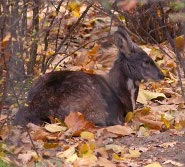
The
Siberian musk deer (Moschus moschiferus) weighs 15-38 lb (7-17 kg). The male of the species has canine teeth that can grow as long as 3 inches (8 cm) and extend below the lips. The short fur varies in color from chestnut to gray. It leans on its acute sense of hearing for almost every situation. Generally, it is a nocturnal creature. Within the area it considers to be home, it uses the same trails that connect its hiding areas, feeding regions, and areas for other activities over and over. It consumes an array of vegetation, including flowers, leaves, young grasses and shoots. It also dines on twigs, lichens and mosses, particularly in the winter season. If food is scarce, then it will chew the bark off a tree or stand on its hind legs to pick leaves. Excluding the female and the young offspring, the deer is solitary except for during the rutting season, at which time females live in small groups. The male leaves the upbringing to the female. Siberian musk deer strongly guard their territory. Male deer mark their territories with scent by rubbing the gland of their tail against stones and trees.
The Siberian musk deer likes to make its home in brushland and forest between altitudes of 8,500 and 11,800’ (2600 and 3600 m). The musk deer can be found in Siberia, northeast China, Mongolia, South Korea, Sakhalin Island, and North Korea. The musk deer population declined by an estimated 50% during the early 1990’s because of high demand for its natural musk, mostly in Japan, China, and Korea. The present population is not known, but it is certainly declining. Currently, the Siberian musk deer is an endangered species.
Overhunting of the male deer for its musk is the main reason for the population decline. Also, males and females that are too young for producing musk get captured in the traps intended for males 3 years of age or older. Disappearance of forest habitat also factors into the decline.
The musk gland of the male is similar in size to a clenched fist, and it is located between the umbilicus of the abdomen and the genitals. The musk from this gland is used to make perfume and soap and also for medicinal purposes in the Far East. The price of musk is high. In 1972 in Nepal, musk cost more than its weight in gold.
Picture of the Siberian musk deer by F. Spangenberg, 2005, licensed under
Creative Commons Attribution-Share Alike 3.0 Unported license.
You can help spreading the word about this animal by liking it on facebook
Permanent Link
Monday 03 January 2011
Bechstein's Bat - The Elusive Whispering Carnivore
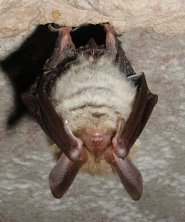
The
Bechstein's bat (
Myotis bechsteini) is uniquely difficult to detect, even in its usual broadleaf woodland habitat. This bat especially likes to roost in holes made by woodpeckers or other rock and tree crevices. The sound this species uses for echolocation is so quiet that it is often missed by the special radar equipment used to find
bats. This also gives the bat an advantage over its prey as well as its predators. The head and body length of this bat is 4.3-5.3 cm (1.69-2.09 in), the wing span is 25-35 cm (9.84-13.78 in) and the bat weighs 7-14 g (.25-.49 oz). The dorsal fur is light brown, while the ventral fur is pale grey to white. The prominent ears of a Bechstein's bat are small compared to some bats, but they are designed to pick up the slightest whispering of other bats and the faintest sound from its predator or prey.
This bat plays a huge role near the top of the forest food chain, especially pregnant or lactating females who eat two-thirds of their body mass of prey per night. A Bechstein's bat is carnivorous and eats mainly moths, spiders, flies, mosquitoes and beetles. This species flies low and forages for its food off the ground or tree branches.
Females give birth to one offspring in late June and the young bat does not fly until August. During summer males are solitary while females occupy holes in trees and raise their young communally. There is preferential grooming between a mother and her female young, establishing a strong bond among the females.
This species is found in southwest Asia and throughout Europe with the exception of the northern regions. The Bechstein's bat is located mostly in the southern areas of the UK, where it is very rare and named as a priority species for conservation in the Biodiversity Action Plan. Of all the bat species in Europe, the Bechstein's bat is listed for strict protection in the European Council Habitat Directive.
Every member of a woodland habitat is vital to the survival of many others. How do we help preserve this important part of our ecosystem? If we safeguard roosting sites, especially older trees and erect bat boxes in their habitats, we can help maintain existing populations of the Bechstein's bat.
You can help spreading the word about this animal by liking it on facebook
Permanent Link