Subscribe to
"Animal of the day"

AddThis Feed Button
Or subscribe by e-mail

Enter your Email


Powered by FeedBlitz

We hope that reader will gain an increased appreciation of the need for more conservation measure in order to protect the beautiful creatures that inhabit the earth. Our philosophy is that the more we learn about animals, the more we respect them and take better care of them. That is why we update this blog with new animals, We encourage you to syndicate our content by adding "animal of the day" to your own blog! (read more)

About us

Our mission is to get people excited about animals and their welfare by writing articles on these animals. We encourage people to comment on posts and share with others. Don't forget to subscribe to our feed.

Contact us
Copyright notice

Cutest pet ever - cutest pet contest

Funny animal videos and pictures

Swimming with manatees - harmful or helpful

Last Comments

Free (Fattest cat in th…): wow that i big cat!!!
milind joshi (Gaur - the tiger …): gaur is a very spi. anima…
jessiegirl (The Black Howler …): wow i have allso wrote a …
PATCAM (Mountain hare): ... this is the first tim…
Branden West (Mountain hare): I really like when people…
Free internationa… (Cuvier's gazelle): favoritenatureblogs.blogs…
sachin sharma (Bengal tigers in …): save this magnificant ani…
Jessica (Fattest cat in th…): The cat looks perfectly h…
jikka (Fattest cat in th…): the cat looks cute :)
Jakki (Fattest cat in th…): oh geese leave them alone…

Calendar

« March 2010
S M T W T F S
  1 2 3 4 5 6
7 8 9 10 11 12 13
14 15 16 17 18 19 20
21 22 23 24 25 26 27
28 29 30 31      

Archives

Next Archive Previous Archive

01 Mar - 31 Mar 2010
01 Feb - 28 Feb 2010
01 Jan - 31 Jan 2010
01 Dec - 31 Dec 2009
01 Nov - 30 Nov 2009
01 Oct - 31 Oct 2009
01 Sep - 30 Sep 2009
01 Aug - 31 Aug 2009
01 Jul - 31 Jul 2009
01 Jun - 30 Jun 2009
01 May - 31 May 2009
01 Apr - 30 Apr 2009
01 Mar - 31 Mar 2009
01 Feb - 28 Feb 2009
01 Jan - 31 Jan 2009
01 Dec - 31 Dec 2008
01 Nov - 30 Nov 2008
01 Oct - 31 Oct 2008
01 Sep - 30 Sep 2008
01 Aug - 31 Aug 2008
01 Jul - 31 Jul 2008
01 Jun - 30 Jun 2008
01 May - 31 May 2008
01 Apr - 30 Apr 2008
01 Mar - 31 Mar 2008
01 Feb - 28 Feb 2008
01 Jan - 31 Jan 2008
01 Dec - 31 Dec 2007
01 Nov - 30 Nov 2007
01 Oct - 31 Oct 2007
01 Sep - 30 Sep 2007
01 Aug - 31 Aug 2007
01 Jul - 31 Jul 2007
01 Jun - 30 Jun 2007
01 May - 31 May 2007
01 Apr - 30 Apr 2007
01 Mar - 31 Mar 2007
01 Feb - 28 Feb 2007
01 Jan - 31 Jan 2007
01 Dec - 31 Dec 2006
01 Nov - 30 Nov 2006
01 Oct - 31 Oct 2006
01 Sep - 30 Sep 2006
01 Aug - 31 Aug 2006
01 Jul - 31 Jul 2006
01 Jun - 30 Jun 2006
01 May - 31 May 2006
01 Apr - 30 Apr 2006
01 Mar - 31 Mar 2006
01 Feb - 28 Feb 2006
01 Jan - 31 Jan 2006
01 Dec - 31 Dec 2005
01 Nov - 30 Nov 2005
01 Oct - 31 Oct 2005
01 Sep - 30 Sep 2005
01 Aug - 31 Aug 2005
01 Jul - 31 Jul 2005

Animal posters
Animal pictures
Mammals.start4all.com
Animal diversity web
Recently extinct animals forum
PetLvr.com
Another chance to see
Happiness is a warm puppy

Miscellany

AddThis Feed Button

Sunday 27 September 2009 Red-Tailed Squirrels - Little Inhabitants of Costa Rica

Red tailed squirrelThe Red-Tailed Squirrel (Sciurus granatensis) belongs to the Sciuridae, a family of rodents. These squirrels are found in the damp and dense forests and have an orange colored tail. They are comparatively smaller than the other common squirrels we usually find in cities

This bushy-tailed squirrel is found in Costa Rica, Trinidad, Columbia, Tobago, Panama, Venezuela, and Ecuador. The back and sides of this short-haired, furry squirrel is reddish brown in color, but some squirrels have a darker colored skin. The color of the tail of most of the red-tailed squirrels is rust-red and some of them have a black-colored tip. This little squirrel is just 20-28 cm (without tail) and has a long and bushy tail. Its weigh at birth is around 10 g (0.022 lbs) and adult weight is 374 g (0.8 lbs). It is found particularly at higher altitudes around 2,941 meters from the sea level.

The red-tailed squirrel is a terrestrial animal and is found on the Pacific slopes, wet forests, and in the Caribbean areas on land and trees.

The red-tailed squirrel is found in the following parks:

  • Robert & Catherine Wilson Botanical Garden

  • Arenal Volcano National Park

  • Corcovado National Park

  • Braulio Carrillo National Park

  • La Amistad National Park

  • Irazú Volcano National Park

  • Caño Negro National Wildlife Refuge

  • Braulio Carrillo National Park

  • Cahuita National Park

  • Tortuguero National Park

  • La Amistad National Park

  • Rincón de La Vieja National Park

  • La Selva Biological Reserve

  • Poás Volcano National Park

  • Monteverde Cloud Forest Reserve


These squirrels are arboreal squirrels and are generally found in primary and secondary forests of South America and Costa Rica where the land is moist and wet at the altitude of 2500 m (8200 feet). The most common places where these squirrels can be seen in plenty are the cloudy forests of Costa Rica. Many of them can be observed in and around the cities of Costa Rica and San Gerardo de Dota. Since these areas are hubs of apple orchards, these areas house a number of local birds and squirrels that feast happily on the apples.

In different geographic parts, these red-tailed squirrels vary in color, but all of them have partly or wholly red tails. The upper part of the red-tailed squirrel population found in Costa Rica is olive brown while their lower part is rusty orange in color. Although, in appearance, they look alike, the Variegated Squirrels (S. variegatoides), their counter parts, also found in Costa Rica, have tails with grizzled gray color.

Although these red-tailed squirrels thrive on apples, they happily feed themselves with other fruits as well. They enjoy eating hard nuts and other large seeds, leaves, twigs, flowers, eggs of tree frogs, and insects. These squirrels are quite territorial while the males lead a nomadic life and are not defensive like their females. You can see both the sexes enjoying the abundant mountain apples in the forests of Costa Rica and its surrounding areas.

Picture of the red-tailed squirrel by Eva Hejda from http://fotos.naturspot.de/, licensed under Creative Commons Attribution ShareAlike 2.0 Germany
You can help spreading the word about this animal by stumbling it by pressing this link StumbleUpon

Add your thoughts about this animal - Permanent Link

Friday 18 September 2009 Bottlenose dolphins - Smarter than Humans?

Bottlenose dolphinWhen most people think of dolphins, the image that will appear in their minds is that of the bottlenose dolphin (Tursiops truncatus), the best known member of the Delphinidae family. Their fame is largely due to the popularization of this species through the media, in films and long running successful television shows, such as Flipper. Bottlenose dolphins are also commonly seen performing tricks for large audiences in marine parks.

Bottlenose dolphins are two to four meters (6.6 to 13.2 feet) in length when adult and weigh anywhere from 150 to 650 kilograms (330 to 1443lbs), with males typically being larger than females. Bottlenose dolphins are gray in color, with a lighter under-belly, which is frequently revealed when they playfully leap out of the water.

The bottlenose dolphin can be found in most regions of the world, except in polar waters, which are too cold for these dolphins. They are found both near the shore and out at sea, with those living offshore generally growing to a larger size.

While solitary bottlenose dolphins are not unheard of, these creatures tend to live in groups known as pods. Pods range in size, most commonly being made up of 15 members but remarkably super-pods of over 1000 dolphins have been observed in the wild.

These aquatic mammals love to eat fish but their diet may also include shrimp, squid and eels. Bottlenose dolphins have evolved the ability to hunt using echolocation. They emit waves of high frequency sound from the melon organ on their head, collecting and analyzing the properties of the returning echo for any signs of nearby prey. Bottlenose dolphins also emit sound to communicate with other members of their species.

Bottlenose dolphins are widely thought to be one of the most intelligent members of the animal kingdom. Interestingly, their brain is even larger than that of humans. However, brain size does not correlate perfectly with intelligence, and many further studies have been used to try to determine the true level of dolphin intelligence.

It is the bottlenose dolphin's high intelligence, along with its echolocation ability that has made it such a useful ally in naval operations. The Navy Marine Mammal Program trains these animals to detect sea mines and enemy divers. Upon finding a mine the dolphin will report to its handler, who will then send the dolphin back out with a buoy with which to more specifically mark the location of the mine.

The success of bottlenose dolphins may be in no small part due to the high degree of genetic variation found in their gene pool. This renders bottlenose populations more resilient to disease, as there is likely to be at least a few individuals that by chance have a genetic make-up which renders them resistant to a new attacking pathogen, enabling them to replenish the population. However, the sheer scale of the genetic diversity of the bottlenose dolphin leads some scientists to conclude that it is not a single species at all.
You can help spreading the word about this animal by stumbling it by pressing this link StumbleUpon

two comments - Permanent Link

Sunday 06 September 2009 Jaguarundi - resembles an otter
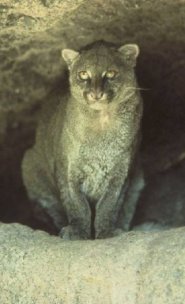
JaguarundiA Jaguarundi (Herpailurus yaguarondi) may not look like a cat in the traditional sense, and some people may say that it resembles an otter more than any cat. They can be found in Central America, states of South America all the way south to Argentina and very rarely, they could be seen in Texas and also New Mexico. The Jaguarundi's color goes from dark brown to a chestnut hue. Jaguarundis have short legs, small heads and weasel-like ears. Upon being born, a Jaguarundi is spotted, but would lose these marks when they reach 4 months.

They are genetically closer to the bigger felids, their chromosome number is 38, just like the jaguar, while small felids only hold 36 chromosomes. A Jaguarundi is usually seen in lowland territories with a dense cover, like forests and scrub areas. They are more often than not found near water (running water) and it is no wonder that they are excellent hunters of fish. They catch them with their front paws, but they eat other prey too.

They hunt during the day, but evidence exists that they also do hunt during the twilight periods. They climb well, but hunt mainly on the ground.

Although it is not hunted that much for their fur, their numbers are on the way down. This is principally caused by deforestation and habitat loss, which are the major reasons why so many animals become endangered (not just the cats).

Interesting fact: It is believed that they are likely to be the descendants of the Puma (ancestral), which originates from Asia.
You can help spreading the word about this animal by stumbling it by pressing this link StumbleUpon

two comments - Permanent Link


Animal of the Day
Subscribe to the
animal of the day
Enter your Email


Powered by FeedBlitz