Saturday 31 March 2007
Chinese water deer
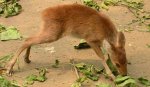 The Water Deer (Hydropotes inermis) is a usually solitary animal, besides the rutting months, and a good swimmer. There exist two subspecies: the Chinese Water Deer (Hydropotes inermis inermis) and the Korean Water Deer (Hydropotes inermis argyropus). Wild populations of escaped water deer live in the United Kingdom and in France. The water deer is considered a primitive member of the Cervidae family (Deer), because buck has large canine teeth and has no antlers, both evolved by other deer.
Picture of the waterdeer licensed under Attribution ShareAlike 2.0 License
You can help spreading the word about this animal by liking it on facebook
Permanent Link
Monday 19 March 2007
Guanaco
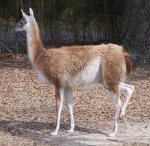
The
guanaco (Lama guanicoe) is a member of the Camelidae family, the Camelids. They are found in Bolivia, Peru, Ecuador, Chile, Argentina and Paraguay. They have double coats like llamas, one outer coat, the guard hair, and one inner coat, which is soft. Guanacos have been hunted for their meat and fur. It is believed that guanacos are the ancestors of the llama and alpaca.
Interesting fact: Guanacos can run as fast as 56 kilometers per hour!
Image by Geoffrey J. King, licensed under GFDL
You can help spreading the word about this animal by liking it on facebook
Permanent Link
Friday 16 March 2007
Golden Jackal
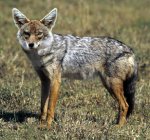
The
Golden Jackal (Canis aureus) is also called Common or Asiatic Jackal. They live from North and East Africa, Southeastern Europe and South Asia to Burma and prefer dry open lands. They are strictly monogamous and live in mating pairs and forage and hunt together, because this is much more successful. Golden Jackals scavenge by following lions for the leftovers of a kill. They are sometimes hunted for their fur, but are not threatened.
You can help spreading the word about this animal by liking it on facebook
Permanent Link
Wednesday 14 March 2007
Wildcat
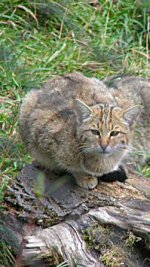 Wildcats
 (Felis silvestris) are found throughout Europe, Southwestern Asia and in the savannahs of Africa. Domestic cats are thought to be descended from a subspecies of the Wildcat, the African wild cat (
Felis silvestris lybica). Wildcats have camouflaged, grey-brown striped fur with bushy tails. Their fur is sof and short. They have five toes on their forefeet and four on their hind feed and their nails are retractable.
Interesting fact: In contrast to the domestic cat, wild cats will breed only once a year, the period depending on the local climate. The domestic cat, unhindered by local climate or nutrition can breed as much as 3 times a year.
Image of the wildcat by Martin Steiger, licensed under GFDL
You can help spreading the word about this animal by liking it on facebook
Permanent Link
Thursday 08 March 2007
Northern right whale dolphin

The
Northern Right Whale Dolphin (Lissodelphis borealis) are coloured black and white with no dorsal fin. Norhtern right whale dolphins look very much like Southern right whale dolphins, but can be distinguished (besides the difference in location) by the amount of white on their bellies. Souther right whale dolphins have much more white than Northern right whale dolphins. The Northern right whales live in the north pacific ocean, between Kamchatka and the United States, where they can travel in groups of an average size of 200 individuals, but can go up to 2000 individuals. They mostly feed on squid and lanternfish.
You can help spreading the word about this animal by liking it on facebook
Permanent Link
Friday 02 March 2007
Golden lion tamarin - one of the rarest animals in the world
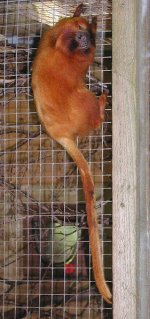
The
Golden Lion Tamarin (Leontopithecus rosalia) is endemic to Brazil. Golden lion tamarins live in the closed canopy, where they live 10 to 30 meters off the ground. They sleep in tree holes for protection. Golden lion tamarins are one of the rarest animals in the world, according to some environmentalists. Estimates are that there are only 1000 left in the wild. Its habitat has been destroyed and broken up by logging and agriculture. Because of this populations became isolated, which resulted in inbreeding, likely to result in extinction. To make things worse, there is only one breeding pair per group. The golden lion tamarin certainly is one of the most endangered primates on the planet. Reintroduction programs are successful, but the continuing destruction of its habitat gives less hope. It is hunted by birds of prey, large cats and snakes. The golden lion tamarin can become 15 years of age. Their diet consists of snails, spiders, eggs, birds, fruits, vegetables and small lizards.
Links
Range of the golden lion tamarin from Natureserve
You can help spreading the word about this animal by liking it on facebook
Permanent Link