Subscribe to
"Animal of the day"

AddThis Feed Button
Or subscribe by e-mail

Enter your Email


Powered by FeedBlitz

We hope that reader will gain an increased appreciation of the need for more conservation measure in order to protect the beautiful creatures that inhabit the earth. Our philosophy is that the more we learn about animals, the more we respect them and take better care of them. That is why we update this blog with new animals, We encourage you to syndicate our content by adding "animal of the day" to your own blog! (read more)

About us

Our mission is to get people excited about animals and their welfare by writing articles on these animals. We encourage people to comment on posts and share with others. Don't forget to subscribe to our feed.

Contact us
Copyright notice

Cutest pet ever - cutest pet contest

Funny animal videos and pictures

Swimming with manatees - harmful or helpful

Last Comments

Tima (Bottlenose dolphi…): J. David Smith, Ph.D., a …
Coda Plant (Pudu - smallest d…): Hey. I live in Northern C…
Michael Newton (Koala video): i love you mr. koala
Tohru (Asian Golden Cat): I hate them too! They are…
tiffany (Asian Golden Cat): i love this cat i’m doing…
BK (Nubian Ibex - The…): Magnificent animal, espec…
amanda (Long-nosed cusima…): thhisanimal is so so so s…
misscrient (Muskrats - Water-…): Third paragraph last sent…
rudy (Deer Mouse - The …): that is so cool ilove lea…
Nick (Fattest cat in th…): “The cat is not over fed.…

Calendar

« November 2009
S M T W T F S
1 2 3 4 5 6 7
8 9 10 11 12 13 14
15 16 17 18 19 20 21
22 23 24 25 26 27 28
29 30          

Archives

Next Archive Previous Archive

01 Nov - 30 Nov 2009
01 Oct - 31 Oct 2009
01 Sep - 30 Sep 2009
01 Aug - 31 Aug 2009
01 Jul - 31 Jul 2009
01 Jun - 30 Jun 2009
01 May - 31 May 2009
01 Apr - 30 Apr 2009
01 Mar - 31 Mar 2009
01 Feb - 28 Feb 2009
01 Jan - 31 Jan 2009
01 Dec - 31 Dec 2008
01 Nov - 30 Nov 2008
01 Oct - 31 Oct 2008
01 Sep - 30 Sep 2008
01 Jul - 31 Jul 2008
01 Jun - 30 Jun 2008
01 May - 31 May 2008
01 Apr - 30 Apr 2008
01 Mar - 31 Mar 2008
01 Feb - 28 Feb 2008
01 Jan - 31 Jan 2008
01 Dec - 31 Dec 2007
01 Nov - 30 Nov 2007
01 Oct - 31 Oct 2007
01 Sep - 30 Sep 2007
01 Aug - 31 Aug 2007
01 Jul - 31 Jul 2007
01 Jun - 30 Jun 2007
01 May - 31 May 2007
01 Apr - 30 Apr 2007
01 Mar - 31 Mar 2007
01 Feb - 28 Feb 2007
01 Jan - 31 Jan 2007
01 Dec - 31 Dec 2006
01 Nov - 30 Nov 2006
01 Oct - 31 Oct 2006
01 Sep - 30 Sep 2006
01 Aug - 31 Aug 2006
01 Jul - 31 Jul 2006
01 Jun - 30 Jun 2006
01 May - 31 May 2006
01 Apr - 30 Apr 2006
01 Mar - 31 Mar 2006
01 Feb - 28 Feb 2006
01 Jan - 31 Jan 2006
01 Dec - 31 Dec 2005
01 Sep - 30 Sep 2005
01 Aug - 31 Aug 2005
01 Jul - 31 Jul 2005

Animal posters
Animal pictures
Mammals.start4all.com
Animal diversity web
Recently extinct animals forum
PetLvr.com
Another chance to see
Happiness is a warm puppy

Miscellany

AddThis Feed Button

Tuesday 25 April 2006 Least chipmunk

Least chipmunk There are 23 species of chipmunk, of which the Least Chipmunk (Tamias minimus) is the smallest North American chipmunk. Its size ranges from 21.3 to 32.5 cm.They have three black with white stripes between them on their face and five on their back. They are hunted by owls, hawks, mustelids like the ermine, mink, marten and fishers. They do not hibernate, but do go into the state of "torpor".

Picture from Fall 2002, Taken by Rene Schwietzke, licensed under GFDL.

You can help spreading the word about this animal by stumbling it by pressing this link StumbleUpon

Add your thoughts about this animal - Permanent Link

Friday 21 April 2006 The Opossum Family

OpossumsMore than 60 different kinds of oppossums live in South America and 1 in North America, the Virginia opossum didelphis virginiana. The name opossum is sometimes shortened to possum, which actually is the name for an Australian group of marsupials. These are distinct from opossums which are only found in North and South America. The Virginia opossum is probably best know for its last resort to escaping predators, "playing possum". As a last resort it can fake death to lose interest of its predator. The Virginia opossum is the only marsupial living in the wild in the US. They come in different shapes and sizes. They are marsupials meaning that they have a pouch in which they can carry their young. They all belong to the family didelphidae. (more)
You can help spreading the word about this animal by stumbling it by pressing this link StumbleUpon

Add your thoughts about this animal - Permanent Link

Wednesday 19 April 2006 Tasmanian devil - largest carnivorous marsupial in the world

Tasmanian devil The Tasmanian Devil (Sarcophilus laniarius) is only found in the Australian island state of Tasmania. Head to body length can reach up to 65 cms and weighs around 8 kilograms, which makes it the largest carnivorous marsupial in the world. You can tell by the tail of a Tasmanian devil how healthy it is, because it stores fat in its tail. If a devil has a large tail it means it is healthy, if it is unhealthy it has a thin tail. When agitated the devil can emit a strong odor, equivalent of that of a skunk. If you correct the bite force for body size the devil has the strongest bite of any living mammal! (source)

Picture by Wayne McLean, licensed under Attribution ShareAlike 2.5

You can help spreading the word about this animal by stumbling it by pressing this link StumbleUpon

one comment - Permanent Link

Friday 14 April 2006 Clownfish from "Finding Nemo"

ClownfishThe Ocellaris Clownfish (Amphiprion ocellaris) is a populair aquarium fish and it also was the main character in the movie "Finding nemo". It lives in coral reefs around the world, seeking the protection of a sea anemone Heteractis magnifica. Predators of the Clownfish include brittle stars, wrasses, and other damselfish. The clownfish seeks protection from these predators by sticking close to the sea anemone, which in return gets its food with its poisenous tentacles from the clownfish drawing its predators. The sea anemone does not attack the clownfish, because of the mucus secreted by the clownfish...
You can help spreading the word about this animal by stumbling it by pressing this link StumbleUpon

four comments - Permanent Link

Thursday 13 April 2006 Striped dolphin

Striped dolphinThe Striped Dolphin (Stenella coeruleoalba) is an extensively studied animal. It lives in all the world's oceans, preferring the temperate and tropical waters (preferring 18-22 degrees celius, although they are spotted in waters ranging from 10 - 26 degrees celsius). They can reach lengths of up to 2.6 metres and can weigh around 160 kg and can reach 60 years of age.They travel in groups of more than 100 individuals, feeding on small fish and squid. Although numerous attempts, these dolphins cannot be kept in captivity, because of refusing to be fed. The total population is estimated to exceed two million individuals.
You can help spreading the word about this animal by stumbling it by pressing this link StumbleUpon

three comments - Permanent Link

Tuesday 11 April 2006 Human (homo sapiens)

homo sapiensWhether you like it or not, this entry is about you. You are a member of the human race (homo sapiens), the scientific name meaning "thinking man". You are a mammal, a primate, and share about 98.4% of the genes with a chimpanzee (did you know that the average human has more hair than the average chimp, they are just less visible?). There are two scientific theories, apart from religious beliefs, of the origins of contemporary humans. The first theory, the "out of Africa" theory, says that modern humans evolved in Africa and migrated to other parts of the world. The second theory, the "multiregional theory" on the other hand, says that modern humans evolved from independent human populations. There also is the "Toba catastrophe theory", which states that an eruption of a vulano took place 70 - 75 thousand years ago which caused a shift in temperature leading to a decrease of population of humans that existed at that time. This caused an acceleration of the differentiation of isolated human species, eventually leading to the end of all the other human species except for the branch that became modern humans. The "out of Africa" theory is the most popular around scientists, which states that humans originated 100 to 200 thousand years ago. The rate at which technology influences our lives is very high, (I could not have told several other humans about our origins 20 years ago, when nobody heared of the "internet"). As for your personal quest to the answers to the questions "where do we come from?" and "what is our goal in life?": good luck and take care :)
You can help spreading the word about this animal by stumbling it by pressing this link StumbleUpon

two comments - Permanent Link

Friday 07 April 2006 Horse

Horse The horse (Equus caballus) is one of ten species in the genus Equus (which includes zebras, donkeys, onagers, etc...). Horses have played an important role in history, they are used for transport, working the fields, warfare, etc... It is estimated that the domestication of horses began around 4500 BC, but there are competing theories. The Przewalski horse is the only living wild horse species on the planet today. Wild horses are different from feral horses in that they have never undergone domestication. Did you know mules are cross-breeds between a male ass and a mare and it is infertile? Recently breeders have cross-bred zebras with mares or female asses to produce "zebra mules" or "zorses", though the animals keep some of the nervous, difficult to handle nature of zebras. The difference between ponies and horses is only their size. The treshold is 1.47 m for an adult. It can happen that a pony is actually the child of a horse and vice versa.

Image by Farbenfreude, licensed under GNU Free Documentation License

You can help spreading the word about this animal by stumbling it by pressing this link StumbleUpon

Add your thoughts about this animal - Permanent Link

Tuesday 04 April 2006 Sand skink
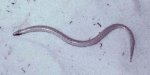
Sand skinkThe Sand skink (Neoseps reynoldsi) is a lizard occurring only in central Florida. Because of that it is often referred to as the Florida Sand skink. They have tiny forelegs with only one toe. Their hindlegs have two toes. Sand skinks feed on the larvae of beetles, termites and spiders. They were classified endangered in 1987, but because they are so difficult to detect, no one can give a good estimate of the total population. They usually remain beneath the surface at a depth of 5 - 10 centimers.
You can help spreading the word about this animal by stumbling it by pressing this link StumbleUpon

Add your thoughts about this animal - Permanent Link


Animal of the Day
Subscribe to the
animal of the day
Enter your Email


Powered by FeedBlitz