Subscribe to
"Animal of the day"

AddThis Feed Button
Or subscribe by e-mail

Enter your Email


Powered by FeedBlitz

We hope that reader will gain an increased appreciation of the need for more conservation measure in order to protect the beautiful creatures that inhabit the earth. Our philosophy is that the more we learn about animals, the more we respect them and take better care of them. That is why we update this blog with new animals, We encourage you to syndicate our content by adding "animal of the day" to your own blog! (read more)

About us

Our mission is to get people excited about animals and their welfare by writing articles on these animals. We encourage people to comment on posts and share with others. Don't forget to subscribe to our feed.

Contact us
Copyright notice

Cutest pet ever - cutest pet contest

Funny animal videos and pictures

Swimming with manatees - harmful or helpful

Last Comments

red (Disk Tetra - Hate…): How to breed the fish? Is…
alissa (Stump-Tailed Maca…): sooo cute
Anonymous (Shoebill - Swamp …): These are beautiul birds …
sugar glider info… (Greater Glider - …): They have large, protrudi…
Sabrina (Purple frog): wow, what a lovely frog. …
Organizari evenim… (Fattest cat in th…): :)) This is not funny! Re…
destiny (Ninja cat): hahah thats funny
sami (Bats - the only t…): is that true
Lexis.J (Ninja cat): So funny.He’s the top nin…
someone (Ninja cat): this is soooo cute!

Calendar

« February 2012
S M T W T F S
      1 2 3 4
5 6 7 8 9 10 11
12 13 14 15 16 17 18
19 20 21 22 23 24 25
26 27 28 29      

Archives

Next Archive Previous Archive

01 Feb - 28 Feb 2012
01 Jan - 31 Jan 2012
01 Dec - 31 Dec 2011
01 Nov - 30 Nov 2011
01 Oct - 31 Oct 2011
01 Sep - 30 Sep 2011
01 Aug - 31 Aug 2011
01 Jul - 31 Jul 2011
01 Jun - 30 Jun 2011
01 May - 31 May 2011
01 Apr - 30 Apr 2011
01 Mar - 31 Mar 2011
01 Feb - 28 Feb 2011
01 Jan - 31 Jan 2011
01 Dec - 31 Dec 2010
01 Nov - 30 Nov 2010
01 Oct - 31 Oct 2010
01 Sep - 30 Sep 2010
01 Aug - 31 Aug 2010
01 Jul - 31 Jul 2010
01 May - 31 May 2010
01 Apr - 30 Apr 2010
01 Mar - 31 Mar 2010
01 Feb - 28 Feb 2010
01 Jan - 31 Jan 2010
01 Dec - 31 Dec 2009
01 Nov - 30 Nov 2009
01 Oct - 31 Oct 2009
01 Sep - 30 Sep 2009
01 Aug - 31 Aug 2009
01 Jul - 31 Jul 2009
01 Jun - 30 Jun 2009
01 May - 31 May 2009
01 Apr - 30 Apr 2009
01 Mar - 31 Mar 2009
01 Feb - 28 Feb 2009
01 Jan - 31 Jan 2009
01 Dec - 31 Dec 2008
01 Nov - 30 Nov 2008
01 Oct - 31 Oct 2008
01 Sep - 30 Sep 2008
01 Aug - 31 Aug 2008
01 Jul - 31 Jul 2008
01 Jun - 30 Jun 2008
01 May - 31 May 2008
01 Apr - 30 Apr 2008
01 Mar - 31 Mar 2008
01 Feb - 28 Feb 2008
01 Jan - 31 Jan 2008
01 Dec - 31 Dec 2007
01 Nov - 30 Nov 2007
01 Oct - 31 Oct 2007
01 Sep - 30 Sep 2007
01 Aug - 31 Aug 2007
01 Jul - 31 Jul 2007
01 Jun - 30 Jun 2007
01 May - 31 May 2007
01 Apr - 30 Apr 2007
01 Mar - 31 Mar 2007
01 Feb - 28 Feb 2007
01 Jan - 31 Jan 2007
01 Dec - 31 Dec 2006
01 Nov - 30 Nov 2006
01 Oct - 31 Oct 2006
01 Sep - 30 Sep 2006
01 Aug - 31 Aug 2006
01 Jul - 31 Jul 2006
01 Jun - 30 Jun 2006
01 May - 31 May 2006
01 Apr - 30 Apr 2006
01 Mar - 31 Mar 2006
01 Feb - 28 Feb 2006
01 Jan - 31 Jan 2006
01 Dec - 31 Dec 2005
01 Nov - 30 Nov 2005
01 Oct - 31 Oct 2005
01 Sep - 30 Sep 2005
01 Aug - 31 Aug 2005
01 Jul - 31 Jul 2005

Animal pictures
Mammals.start4all.com
Animal diversity web
Recently extinct animals forum
Another chance to see

Miscellany

AddThis Feed Button

Monday 29 June 2009 Wild Asiatic Water Buffalo

Wild Asiatic Water BuffaloThe Wild Asiatic Water Buffalo (Bubalus bubalis) is an endangered species. True wild populations still live in Bhutan, India, Nepal and Thailand, while their domesticated counterparts are very widespread. They are large animals, standing 1.5 to 1.9 meters in height at the shoulder. Wild male water buffaloes can become 3 meters in length and weigh up to 1200 kilos, while their domesticated counterparts can weigh 250 to 550 kilograms. They can become 25 years of age in the wild.

The Wild Asiatic Water Buffalo is a social animal, with groups of 10 to 20 individuals, but also groups of 100 individuals have been observed.

Their diet mainly consists of grasses, herbs, aquatic plants, leaves and agricultural crops, The only predator in the wild is the tiger, but their main threats are habitat destruction and genetic pollution (breeding with their domesticated counterparts).

Interesting fact: Wild bulls are known to invade a domesticated herd, kill the domesticated bull (which is a lot smaller), and breed with the receptive females. The resulting offspring are less docile and too large to fit a farmer's equipment. Occasionally, the wild bull not only kills the domesticated bull, but also take over and drive off the owners, keeping the herd for himself.

Picture by yathin, licensed under Attribution-Noncommercial-No Derivative Works 2.0 license. You can help spreading the word about this animal by liking it on facebook

Permanent Link

Thursday 25 June 2009 Bush hyrax
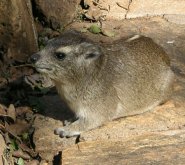
Bush hyraxThe Bush Hyrax (Heterohyrax brucei), otherwise known as the Yellow-spotted (Bush or Rock) Hyrax is a small mammal that is around 12-15 inches long (30-38 centimeters) and can weigh between 5 and 9 pounds (2.2-4 Kilograms) and has a distinctive coat of fur that is mottled with browns, yellows, and grays. It has short limbs, a black nose, short but alert ears, and large eyes. Their fur is made up of a short haired layer which protects them, and slightly longer coats which add to their colored looks. Their tail is nothing more than a small stump which is barely visible, and for a good size comparison think of an overweight bunny. The Bush Hyrax and its many subspecies are found throughout Africa, from Egypt to South Africa, and they prefer rocky terrains and mountainous areas, preferring elevations starting at sea level all the way to 13,000 feet (4,000 meters).

The Bush Hyrax’s species name is Heterohyrax brucei, and it belongs to the Genus Heterohyrax. It is the only species in this genus – however the species itself has 25 known sub-species that have been identified. The Heterohyrax belongs to the family Procaviidae, which has two other genere other than Heterohyrax – Procavia (the Cape Hyrax) and Dendrohyrax (The Tree Hyrax). The family Procaviidae belongs to the order Hyracoidea, in which there are no other families of living mammals. This order belongs to the superorder Afrotheria, which in turn belongs to the Infraclass Eutheria (placental mammals).

The Bush Hyrax, like all other Hyraxes have a very primitive self temperature regulation system that seems almost reptilian. They must bask in the sun to gain heat and then huddle together at night to retain heat. It is thought that the Hyrax has evolved very little from its origins. The Bush Hyrax lives mostly in arid areas, and can survive on very little water. The breeding season is uniformly in tune with the rainy season, and gestation (pregnancy) lasts up to eight months. The young mature quickly, and between one to five months of age they are weaned from their mothers.

They eat many types of vegetation and usually prefer bitter yams, which in the past have been used by humans to create poisoned arrowheads. When thicker meatier vegetation is scarce they will turn to grasses and other lesser vegetation to feed on. Because of their highly efficient kidneys they can subsist on very little water. Due to their smaller size, they are themselves the target of many predators, such as rock pythons, leopards, birds, and even some mongoose have been so brave. However they are vicious when threatened and will counter-attack savagely, biting anything and everything on the predator to save itself from being a meal.

The Bush Hyrax behavior is to have small family groups that huddle at night, and the groups are maintained by one dominant male, whose job includes territorial defense and maintenance. Often times, if the area is large enough, the male will have several small groups of females that he will control, in different but close areas. The remaining males who survive to leave and create their own groups usually live alone until this happens. Many may live solitarily their whole lives.

Interesting Facts about the Bush Hyrax:

  • The Bush Hyrax has been found in over 21 countries – and even one subspecies lives in Israel.

  • In times of famine the Bush Hyrax has been a food source for humans.

  • Currently the Bush Hyrax species is listed as a least-concern status by the IUCN

  • Within hours after being born, a baby Bush Hyrax can already move and follow its mother.


Picture of the bush hyrax by Buecherfresser, licensed under GFDL You can help spreading the word about this animal by liking it on facebook

Permanent Link

Monday 22 June 2009 Addax

AddaxThe Addax (Addax nasomaculatus) is a severely endangered species, and is listed as critically endangered with just 500 in the wild, and 800 in captivity, some of which are bred for trophy hunts. The Addax stands about a meter tall at the shoulder (three feet) and weighs about 60-100 kilograms (132-220 lbs), and has two twisted horns that can grow to 120 centimeters in length (47 inches). The Addax is usually white and sports a brownish fur on its chest, neck and head are brown - however in winter the coat changes color to brown. The tip of the nose is white and the nostrils are red. Finally they have a beard, or goatee, that is brownish in appearance, but varies from individual to individual. Their legs are strong and study, and their hoofed feet also sport a strong dewclaw that helps with walking through deep sands and soft ground.

The Addax belongs to the genus Addax - no surprises there - and the genus belongs to the subfamily Hippotraginae which contain the Oryx (for example the gemsbok) and the Antelope (for example an impala). The Hippotraginae subfamily belongs to the Bovidae family that contains bison and cows, along with many others. Finally Bovidae is in the order Artiodactyla, which all even toed ungulates belong to, like pigs and camels. However with recent advancements in molecular studies, cetaceans may also be related to the even toed ungulates, having evolved to go back to the sea.

The Addax lives in mostly arid desert terrain that supports many of their natural food sources such leaves from low trees, grasses, and whole bushes when available. Usually during the day the Addax will dig a shallow hole and lay in it until night. As a nocturnal species their eyesight is very well adapted, as is their hearing and smell. They will usually live in herds from two to twenty two or more. However, due to their population’s decline, they do not have the numbers to support the herds that once may have numbered in the hundreds. Their feeding habits have them wander far and wide to graze, and they will usually cover an extensive area each night in search of food, as they get all their water from their food.

The social structure of most herds was and still is based on age in the larger ones. The dominant oldest male will usually be found as the leader, and its experience in finding more places to graze and also better terrain are beneficial to the herds. They are usually found with both males and females in a given herd, and both have the same horn makeup - giving females an equal advantage in self defense. Currently efforts are under way to rehabilitate the populations of the Addox in Zoo based programs, with the hope of having the same success as the European Bison, which at one time was down to twelve individuals. With the Addax still numbering over a thousand it is hoped that there is enough genetic diversity to save the species and bring it back to its natural habitats to restore ecological order.

Interesting Addax Facts:

  • The biggest breeding program for the Addax exists at the Hanover Zoo in Germany.

  • Some from breeding programs have already been sent to Morocco and Tunisia.

You can help spreading the word about this animal by liking it on facebook
Permanent Link

Saturday 20 June 2009 Golden-rumped Elephant Shrew

Golden rumped elephant shrewThe Golden-rumped Elephant Shrew (Rhynchocyon chrysopygus) is named after its unique golden-hued fur at the rump's area. Just like its relatives, the snout of Golden-rumped Elephant Shrews are flexible and pointed. A Golden-rumped Elephant Shrew's coat is rough but glossy. A thick skin exists under the rump, and is three times as thick as the skin on the back's middle, and this forms as a kind of shield for the Golden-rumped Elephant Shrew. Experts and researchers say that this is a shield against the biting of another shrew when they fight.

They are found in coastal areas, and they would most probably be found in moist forest areas and in semi-deciduous forests. Actually, these shrews are among the biggest of the elephant shrew world. They are endemic to Kenya, but a scattering could be found in areas of Mombasa and the Somali border territories.

They are basically monogamous, couples reside in ranges and they are territorial when it comes to these homes. Diurnal in nature, they could sleep during the night at a nest on the forest ground. The Golden-rumped Elephant Shrew's diet consists of worms, insects, millipedes and even spiders. They of course forage on the forest/jungle floor via their flexible noses. When they are not busy eating, they could be very busy running for their lives though. A Golden-rumped Elephant Shrew has its share of predators, such as eagles, cobras and the black mambas.

Interesting fact: If you would be lucky to see one in actual movement, you might be impressed. These shrews can go to speeds reaching 25 kilometers/hr if chased by a predator. You can help spreading the word about this animal by liking it on facebook

Permanent Link

Monday 15 June 2009 Maned three toed sloth

Maned three toed slothThe Maned three-toed Sloth (Bradypus torquatus) is a sloth that comes from South America and is related to the other three-toed sloths of the South American variety. The Maned Sloth is about 50 centimeters in length (19 inches) and weighs about 4.5 kilograms (or 10 pounds). Unusual is its proportions of body parts, with very small eyes, small ears, and a tail that is hidden from view, along with a small head. Their fur is of interest as it has a fine undercoating of fur, but atop that is the outer coating which is a virtual ecosystem in its own right. The outer coating is usually infested and inhabited by moths, beetles, ticks, mites, algae and moss.

The Maned three-toed sloth belongs to the genus Bradypus, which has only four other species of three toed sloths and most are threatened or endangered. Bradypus belongs to the family of Bradypodidae, which has no other members but the genus Bradypus. Bradypodidae belongs to the suborder Folivora, which is the sloth in general, as it contains only one other family - Megalonychidae, or two-toed sloths. The full order than Folivora belongs to is called Pilosa, which also only has one other suborder - Vermilingua, otherwise known as anteaters.

The diet of the Maned three-toed sloth is that of an omnivore, eating buds off of trees or insects that happen to come its way. They spend the majority of their time in trees and seldom come down, unless they can not move to another tree from the tree they are on, or they need to get rid of waste. On the ground the sloth is almost helpless, as it can only crawl using its front limbs, and will drag the hind limbs behind it. Their primary defense is their fur, as it hides them from most predators, however failing that it is their sharp claws and strong arms - although the sloth is known for being very slow, it can react quickly when threatened. Additionally, they are excellent swimmers, and if they have the chance they will dive away from a potential threat and swim away - which is in stark contrast to their ability to move on land.

Gestation (pregnancy) lasts for five to six months, and then the young sloth will cling to its mother for the first four weeks of its life, gripping with its already highly developed claws. After the suckling is finished it will remain with its mother, usually riding on her back, for up to six months to learn the habits and feeding styles of the adult. Eventually it will venture out on its own, where it can live for up to twelve years in the wild - barring it being cut down with a tree or shot by poachers for its meat or as a trophy.

The Maned three-toed Sloth is an endangered species, and is close to being listed as Critically Endangered, mostly due to deforestation and destruction of its natural habitat. Due to the mass slash and burn policies to create land for farming or grazing cattle the Maned three-toed Sloth is now restricted to only a few habitats, one being in Brazil, and spread around the areas surrounding northern Brazil. To compound this problem, the sloth is generally hunted for meat or trophy sport, creating a spiral of de-population that could soon make the species extinct.

Some interesting facts about the Maned three-toed Sloth

  • Due to its ‘upside down’ lifestyle the Maned three-toed Sloth has fur that is ‘backwards’ in that instead of being directed from the back down to the abdomen, it is directed from the abdomen to the back.

  • Sloths are related to Anteaters, and also because they are in a super-order (Xenartha) they are related to armadillos, the extinct glyptodonts (super armadillos), the extinct pampatheres (giant armadillos) and several extinct sloth species (including the ground sloth that may have gone extinct in 1500 AD, and the giant sloths that grew taller than 17 feet).

You can help spreading the word about this animal by liking it on facebook

Permanent Link

Thursday 11 June 2009 Kowari

KowariThe Kowari (Dasycercus byrnei) is a small carnivore marsupial that lives in the central areas of Australia that have dry grasslands and also the deserts. It is similar in appearance to a mouse or a gerbil, however it is known as a very efficient predator of spiders, insects, small lizards, and other small animals. It grows to 18 centimeters (7 inches) in length and has a 14 centimeter (5.5 inch) long tail. They are light on their feet, very quick, and are usually a molted brownish ash color, with a lighter underbelly, and the same light to white fur on their legs. They have large ears, eyes, and an excellent nose, and can track prey and strike with lightning speed.

The Kowari is a part of the genus Dasyuroides, which it is the only member of. They are a part of the tribe Dasyurini which contains many other species and genus, such as the Qualls, the Kaltula, Masupial Shrews, and Tasmanian Devil. The tribe belongs to the subfamily Dasyurinae which has one other tribe besides Dasyurini. This belongs to the family Dasyuridae which is furthermore in the Infraclass Marsupialia. They share this infraclass with six other living orders, and two known extinct orders.

The Kowari lives in burrows that it can dig for itself, or that it will steal from others, or also that is abandoned, and is known mostly as a ground dweller. However the Kowari is known for being an exceptionally talented climber when the chance to do so presents itself, and it is especially adept at scaling large rocks. In addition to being an adept climber, it can also jump straight up from the ground to 45 centimeters in the air (18 inches). The Kowari has no real set on whether it is a loner or if it lives with others, as both have been observed. Their burrows can become complex as more live in the same one, and serve as a hiding place for most the day. As mostly a nocturnal creature, it will sometimes very rarely be seen out during the day; however some have been observed hunting in broad daylight, but mostly they come out to bask in the sun and use sand bathing as a form of cleaning behavior.

They have a set breeding period in the winter months of Austrailia, being between may and October, with a usual gestation (preganancy) time of around a month, and the litter will have between four and six newborns. Because of the short length of time it takes for gestation and maturity, it is possible for females to have two litters in a single winter. Weaning takes place after three months, and the young are adults within eight months after birth, however they live independently right after weaning from the mother’s pouch. The lifespan is between three to six years, while the maximum age for fertility seems to be around four years of age.

Interesting facts about Kowari:

  • The Kowari has no need to find a source of water as long as there is food - it gets all of its moisture from prey.

  • The Kowari may hunt small birds in addition to lizards and insects.

  • The Kowari is a species at risk of extinction due to habitat loss and possibly disease, and is listed as Vulnerable in the IUCN


Picture of the kowari by Kořínek Milan, licensed under GFDL You can help spreading the word about this animal by liking it on facebook

Permanent Link

Sunday 07 June 2009 Baird's tapir

Baird's tapirThe Baird's Tapir is a species of Tapir and is one of the three that is found in Central America, and is the largest land animal in Central America. Weighing in at an impressive 240-400 kilograms (525-880 lbs) the Tapir is a force to be reckoned with for any predator that might try to attack it (with the exception of man). Baird’s Tapir has a unique cream colored marking on its face and throat, while also have a darker spot on its cheeks. Its body has short black hair over a dark skin for added protection when it hides, if it hides; their legs are short and very powerful, allowing for the Tapir to run as fast as a human can when in the forest, and are well suited for moving through the brush and obstacles that they may encounter. It has a prehensile nose, and looks somewhat like a large boar; however the nose is reminiscent of an elephants (with a much shorter length). They have small tails that really don’t do much at all. Overall they are excellent swimmers and have been known to favor water and go diving to the bottom to search for soft plants when water is available to them. Their communication between distances is usually in the form of a kind of whistling call, and they can certainly pick up very faint sounds with excellent hearing.

The behavior of Baird’s Tapir is in line with its smaller cousins, as it prefers to forage for food, and it uses its specialized nose as a tool to gather up food and place it into the mouth, along with grasping leaves from trees it may otherwise be unable to reach. Gestation time (pregnancy) lasts for more than a year, usually extending to 390 days. Because they are such a large mammal they will usually only have one offspring per pregnancy, however in rare cases it as been observed that two have been born at the same time. The young tapir will stay with its mother for at least six months, and will usually stay as long as eight, by which time it has grown rapidly and reached a near adult size. When Baird’s Tapir is still young, or newborn, it has white stripes, spots, and is a bright reddish color.

Baird’s Tapir belongs to the genus Tapirus, which has three other species of Tapir. Tapirus belongs to the family Tapiridae, in which it is the only genus alive today. The family Tapiridae belongs to the order Perissodactyla, which is all the odd toed ungulates, such as the horses and the rhinoceroses, and many other extinct species. Today, Baird’s Tapir is listed as endangered, and is currently under threat of extinction due to the actions of humans. Because of their long gestation time, a loss of a sing Baird’s Tapir becomes a problem, as that means one less Tapir to breed, and one more that will take more than a year to replace. Because of habitat loss they are isolated more and more from other populations, making genetic shallowing a real threat to the species’ survival. They are hunted and poached in spite of laws (which are not enforced most of the time) and their meat traded on the black market. Their numbers continue to decline as does their viable habitat and their ability to move around to other areas.

Interesting Facts about Baird’s Tapir:

  • Baird’s Tapir is a very shy animal, and will run away rather than confront a human or perceived threat, unless harassed and cornered.

  • When threatened or alarmed, the animal will let it be known by stamping a foot very hard against the ground as a method to ward off the threat and to defend itself.

  • Their mouth is exceptionally powerful. There has been one documented incident in which a zookeeper was perceived as a threat by the animal, which then bit the zookeeper. It had such a powerful bite that it severed her arm.


Picture og the Baird's tapir by Sapphic, licensed under GFDL You can help spreading the word about this animal by liking it on facebook

Permanent Link

Tuesday 02 June 2009 Alpine pika

Alpine pikaThe Alpine Pika (Ochotona alpina) is a species of Pika that is found in the mountains of Russia, Kazakhstan, and Mongolia. The Alpine Pike in general usually weighs in at 5 ounces, and is 7 inches long. It is known for living in cold climates, and only in the mountainous areas of the three countries listed; it has small short legs, round ears, no tail that is visible, and has very sharp curved claws used for foraging and digging. The Alpine Pika feeds mostly on plant stems, and during the summer months when the weather is favorable it will gather food to store during the winter time. Because of the its unique patterned fur, it can spend its time warming on rocks with little threat of a predator spotting it. This behavior is seen most the time, so that additional warmth can be gained as the months grow colder.

Pikas have exceptionally good hearing, and very acute eyesight, and when gathering or sunning, they will emit a warning if a predator is seen. This warning is in the form of a high pitched whistle, which travels far, and is detected by other pika’s excellent hearing. They live mostly in very rocky mountainsides, and use the existing layout to build shelters, but many times if there is no alternative they will dig a burrow to use. Like rabbits, the pika has an unusual and what could be seen as unsavory habit. After eating a meal a pika will excrete a green pellet-like fecal dropping - and then consume it again for the additional nutrition, resulting in a final harder pellet that is disposed of.

The Alpine Pika belongs to the subgenus of Pika and the genus of Ochotona, which is in the family Ochotonidae, and the order of Lagomorpha. Lagomorpha contains within it three known families, with Ochotonidae being the Pikas, Leporidae being rabbits and hares, and one other extinct family of large pikas - which had only one modern survivor that was hunted to extinction in the 1700s. The Alpine Pika usually has a litter of young between 25 to 30 days after pregnancy with five or less young at a time. They are very sensitive to temperature change, and can tolerate cold better than heat - and may be a prime indicator of global warming as few will survive longer than an hour in temperatures above 75 degrees Fahrenheit (23 degrees Celsius).

The behavior involving the foraging and gathering of grasses is interesting, in that the Alpine Pika seems to plan exactly what it needs and how to build a sufficiently warm burrow. When they gather fresh material, they leave it outside to dry out - and when sufficiently dry will move it in to their burrow to create the bedding and food supply for winter, building up a significant supply as pikas are not a hibernating species. They continue to do this until there is no more left, or the temperatures prohibit it in a sudden extreme cold snap. When a Pika leaves its material out to dry, occasionally another will be opportunistic and take advantage of the situation - stealing the dried or drying grass for itself. Then ensuring fight may attract a predator.

Some interesting facts about Alpine Pikas:

  • Some Alpine Pikas will share their burrows with snow finches (actually a species of sparrow), who will help build it during the summer and fall.

  • In general the pika is sometimes known as the whistling hare, because of its high pitched whistle it uses during warnings about predators and invaders.


Drawing of the alpine pica taken from the German book 'Brehms Tierleben', Small Edition 1927 You can help spreading the word about this animal by liking it on facebook
Permanent Link