Subscribe to
"Animal of the day"

AddThis Feed Button
Or subscribe by e-mail

Enter your Email


Powered by FeedBlitz

We hope that reader will gain an increased appreciation of the need for more conservation measure in order to protect the beautiful creatures that inhabit the earth. Our philosophy is that the more we learn about animals, the more we respect them and take better care of them. That is why we update this blog with new animals, We encourage you to syndicate our content by adding "animal of the day" to your own blog! (read more)

About us

Our mission is to get people excited about animals and their welfare by writing articles on these animals. We encourage people to comment on posts and share with others. Don't forget to subscribe to our feed.

Contact us
Copyright notice

Cutest pet ever - cutest pet contest

Funny animal videos and pictures

Swimming with manatees - harmful or helpful

Last Comments

Tima (Bottlenose dolphi…): J. David Smith, Ph.D., a …
Coda Plant (Pudu - smallest d…): Hey. I live in Northern C…
Michael Newton (Koala video): i love you mr. koala
Tohru (Asian Golden Cat): I hate them too! They are…
tiffany (Asian Golden Cat): i love this cat i’m doing…
BK (Nubian Ibex - The…): Magnificent animal, espec…
amanda (Long-nosed cusima…): thhisanimal is so so so s…
misscrient (Muskrats - Water-…): Third paragraph last sent…
rudy (Deer Mouse - The …): that is so cool ilove lea…
Nick (Fattest cat in th…): “The cat is not over fed.…

Calendar

« November 2009
S M T W T F S
1 2 3 4 5 6 7
8 9 10 11 12 13 14
15 16 17 18 19 20 21
22 23 24 25 26 27 28
29 30          

Archives

Next Archive Previous Archive

01 Nov - 30 Nov 2009
01 Oct - 31 Oct 2009
01 Sep - 30 Sep 2009
01 Aug - 31 Aug 2009
01 Jul - 31 Jul 2009
01 Jun - 30 Jun 2009
01 May - 31 May 2009
01 Apr - 30 Apr 2009
01 Mar - 31 Mar 2009
01 Feb - 28 Feb 2009
01 Jan - 31 Jan 2009
01 Dec - 31 Dec 2008
01 Nov - 30 Nov 2008
01 Oct - 31 Oct 2008
01 Sep - 30 Sep 2008
01 Jul - 31 Jul 2008
01 Jun - 30 Jun 2008
01 May - 31 May 2008
01 Apr - 30 Apr 2008
01 Mar - 31 Mar 2008
01 Feb - 28 Feb 2008
01 Jan - 31 Jan 2008
01 Dec - 31 Dec 2007
01 Nov - 30 Nov 2007
01 Oct - 31 Oct 2007
01 Sep - 30 Sep 2007
01 Aug - 31 Aug 2007
01 Jul - 31 Jul 2007
01 Jun - 30 Jun 2007
01 May - 31 May 2007
01 Apr - 30 Apr 2007
01 Mar - 31 Mar 2007
01 Feb - 28 Feb 2007
01 Jan - 31 Jan 2007
01 Dec - 31 Dec 2006
01 Nov - 30 Nov 2006
01 Oct - 31 Oct 2006
01 Sep - 30 Sep 2006
01 Aug - 31 Aug 2006
01 Jul - 31 Jul 2006
01 Jun - 30 Jun 2006
01 May - 31 May 2006
01 Apr - 30 Apr 2006
01 Mar - 31 Mar 2006
01 Feb - 28 Feb 2006
01 Jan - 31 Jan 2006
01 Dec - 31 Dec 2005
01 Sep - 30 Sep 2005
01 Aug - 31 Aug 2005
01 Jul - 31 Jul 2005

Animal posters
Animal pictures
Mammals.start4all.com
Animal diversity web
Recently extinct animals forum
PetLvr.com
Another chance to see
Happiness is a warm puppy

Miscellany

AddThis Feed Button

Tuesday 22 April 2008 African golden cat

An African golden cat (Profelis aurata) is a medium-sized cat, and it weighs about 18kgs on average. Under captivity it has shown that its base fur color can change, from one stage to another over time, depending on the age and external factors. Its underside of the chest and chin are ordinarily light-colored, and in rare cases, pure white.

The head of an African golden cat has light spots around the eyes. In the 60s, studies were done, and these showed that various colors of the African golden cat (red, brown, silver) were found in equal measure in most areas of their habitats, but the distinctive spots at the back were confined to West Africa.

Primarily, the habitat of the African golden cat is at the Tropical Rain Forest belt running across the equator in Africa. Some experts contend that the African golden cat opts to stay in virgin forests, but some experts say they are comfortable in secondary forests. Owing to the fact that they live in very thick forests, very scant information has been provided concerning lifestyle and biology. Again, some scientists say that these cats are solitary and crepuscular (moving in twilight hours), but then, there had been sightings that contradict at least part of this. Some individuals were seen hunting for prey in broad daylight, but of course, it could have been that rare exception.

The diet of these cats is made up of duikers, antelopes, rodents, birds and even poultry.

Interesting fact: They are not only little-known as far as the scientific world is concerned, they are also mysterious. Young monkeys had been reported to have been captured, and it strongly insinuates that they may be terrestrial, but they can also navigate the low branches of the jungle's canopy, and that they are good climbers too.
You can help spreading the word about this animal by stumbling it by pressing this link StumbleUpon

four comments - Permanent Link

Friday 11 April 2008 Fishing cat

Fishing catUnlike popular belief, not all cats dislike water. The Fishing Cat (Prionailurus viverrinus), not to be confused with the Fisher, is a strongly-built cat, having short feet and a big head. Fishing Cats have a olive-gray pelage with black spots. The back has a pronounced white center spot. Akin to the flat headed cat, the claws are shortened, yet the Fishing Cat has less established teeth. They can be found in mangrove swamps, creeks, oxbow lakes and reed beds of Bangladesh, Bhutan, Brunei Darussalam, Cambodia, China, India, Indonesia (Java, Sumatra), Lao People's Democratic Republic, Malaysia (Peninsular Malaysia), Myanmar, Nepal, Pakistan, Sri Lanka, Thailand and Viet Nam.

The gestation of the Fishing Cat is around 60+ days, the female Fishing Cats gives birth to one to four kittens. They eyes of the young open after the sixteenth day. Weaning is about 4 to 6 months old, and this young would attain adult size when it is around 9 months of age. At the tenth month, it would be independent from the parents.

Longevity of this cat in captivity is about 12 years on average. It is believed that they are loners, but there were observations that the male Fishing Cat is sometimes helping with the rearing of the newborns.

Most of what they eat are just fish (surprisingly), and they can catch them in a number of ways. They mimic insects by lightly tapping the water, so fish think there are insects on the water, attracting them. They can either swim and rush after it, or they could scoop it out using the paws. They could also go after mollusks, crustaceans, snakes and frogs. Next to that, they are know to include civets, wild pigs, dogs, goats, poultry and rodents in their diet.

The Fishing cat is listed as vulnerable, they are threatened by hunting and habitat loss. Wetland areas have been cleared by humans to make room for farmland and road, also pollution from industries make Fishing cats sick. But there is hope, fishing cats appear to adapt well to suburban habitats.

Interesting fact: The Fishing Cat can use its short tail as a rudder while swimming.

Picture of the Fishing cat by Opencage, licensed under Creative Commons Attribution ShareAlike 2.5
You can help spreading the word about this animal by stumbling it by pressing this link StumbleUpon

two comments - Permanent Link

Thursday 03 April 2008 South American sea lion
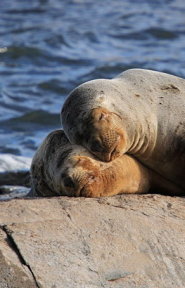
South American Sea LionThe South American Sea Lion (Otaria byronia), also known as the Southern sea lion, varies in size from one individual to another. Males can reach up to 300 kilograms while the females are half of that. The adult holds a dark brown back and the chest is lighter-shaded. A male South American Sea Lion's mane is lighter in color than the female's.

They could be sighted at the offshore islands of South America, North Peru and even parts of Ecuador. Their estimated numbers are as follows: 30,000 at Peru, 90,000 at Argentina and 3,000 at Falkland islands. At Brazil, just a few hundreds exist.

The female South American Sea Lions reach sexual maturation at four to six years, while the males reach it in five to six years. Pups are born just 3 days after the female's arrival in the nesting grounds (called rookeries). The male newborns average weight is 13.7kgs, while the females are 12.3kgs at average. Females (the parent) would usually mate about a week after birth, then, the feeding cycle would commence. The pups start swimming after a month, and when they reach 2 months old, they are already capable swimmers.

In the 19th and 20th centuries, they were hunted excessively, and it depleted a great part of their numbers. Furthermore, he salmon fishing line of Chile has caused these sea lions to get entangled in the nets. In the mid 90's, the Chilean government banned the "destruction" of the South American Sea Lion for five straight years.

There is another reason for the decline of their numbers, and this one is not to be blamed on mankind: the El Nino. At Peru and Chile, it had been reported that the El Nino of 97-98 greatly cut down the overall numbers of these animals.

Interesting fact: The less "courageous" males unable to set up territories have been observed to assault undefended females, and the pups too. In some cases, they would try to mate with it, killing it inadvertently.

Picture of the Mother South American sea lion and pup by Carlos Ponte, licensed under GFDL
You can help spreading the word about this animal by stumbling it by pressing this link StumbleUpon

one comment - Permanent Link

Tuesday 01 April 2008 Javan stink badger

Javan stink badgerThe Javan Stink badger (Mydaus javanensis)is confined to an isolated distribution at the Indonesian territories of Java, Sumatra, North Natuna, and Borneo. On the average, they stay at an elevation of 2100 meters. They are known to inhabit shallow underground burrows, but in Borneo, it's a different story. They could stay inside caves (at high elevations).

If ever there is such a thing as a GENUINE BADGER, the Javan Stink badger is the one. Once upon a time, they were confused with skunks due to their colorations, but at present, the experts have corrected the mistake.

The Javan Stink badger's color could go from dark black to brown-black, but they have a white mark at the top of the head, the eyes are tiny, and they have vestigial pinna- earflaps that is. Javan Stink badgers are squat, small, pointed but flexible snouts and short tails. It has been proved that the Javan Stink badger holds a well-developed scent gland (anal).

Reproduction-wise, the female gives birth to 2 to 3 newborns, a litter is reared in the underground shelter. Basically, they are nocturnal, and it is at night that they feed. In the day, one would stay at the burrow. These tunnels are about 6 feet in length, and the bedding part has a diameter of many feet- and these they try to hide. To conceal their shelters, they put twigs at the entrances.

Diet of these badgers: worms, insects and also plant matters. The known attackers of these badgers are the javan-hawk eagles, the civets (particularly the Viverridae) and tigers. If it is under attack, or when it feels under attack, one would raise the tail, then let go of a foul, milky green product, and this secretion could indeed be emitted with accuracy, as per the observations.

Interesting fact: This has been noted- dogs could be asphyxiated by the secretion, that or if hit in the eye, could get blinded.
You can help spreading the word about this animal by stumbling it by pressing this link StumbleUpon

Add your thoughts about this animal - Permanent Link


Animal of the Day
Subscribe to the
animal of the day
Enter your Email


Powered by FeedBlitz