Friday 23 February 2007
Order monotremata
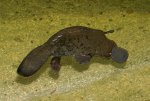
The order of
monotremes (Monotremata) consists of all mammals (5 species in total) that lay eggs instead of giving birth to live young. Unlike the difference in their reproductive system, they share some similarities with other mammals: they are warm-blooded, have a relatively high metabolism, produce milk for their young, have a single bone in their lower jaw and have 3 middle ear bones (
source). Monotremes have a lower body temperature than other mammals, the short-beaked echidna can 'turn off' its body regulating mechanism to keep its energy during colder weather. Today, all living members of Monotremata live in Australia and New Guinea.
Interesting fact: The name 'Monotreme' means 'single opening', because members of the order of Monotremata all just have one opening when other female mammals have three (vagina, the urethra, and the anus).
Picture of the platypus by Stefan Kraft, licensed under GFDL
You can help spreading the word about this animal by liking it on facebook
Permanent Link
Wednesday 21 February 2007
Binturong
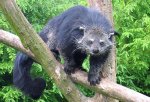
The
Binturong (Arctictis binturong) lives in South-east Asia. Despite all its other names like 'Asian Bearcat', 'Malay Civet Cat', 'Palawan Bearcat' or 'Bearcat', it is actually a species of civet. Due to habitat destruction and poaching for its fur or for medicine, the Binturong is endangered. They are nocturnal and sleep on branches. They are slow moving arboreal animals feeding mainly on fruit.
Interesting fact: The scent of Binturong musk smells like warm popcorn and cornbread.
Another interesting fact: Female Binturongs are believed to be capable of timing the birth of their young, called 'Embryonic diapause'.
photo taken by: Tassilo Rau, licensed under GFDL
You can help spreading the word about this animal by liking it on facebook
Permanent Link
Monday 19 February 2007
Order Tubulidentata
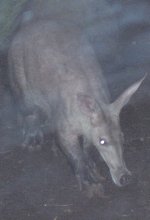
The order
Tubulidentata only contains one animal, the Aardvark, is a medium-sized nocturnal, solitary animal, native to Africa. Adults have only molars at the back of the jaw as teeth, the other teeth fall out. Its diet consists almost only on ants and termites and the only fruit it eats: cucumber. With its front legs, the Aardvark digs out termites and ants and it uses them to create burrows. It lives in the sub-Saharan desert and is not threatened. 'Aardvark' is the first word in most English dictionary.
Picture of the Aardvark licensed under GFDL
You can help spreading the word about this animal by liking it on facebook
Permanent Link
Sunday 18 February 2007
Pygmy hippopotamus
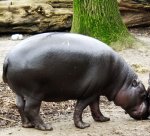
The
Pygmy Hippopotamus (
Hexaprotodon liberiensis) lives in the swamps of western Africa, hence the scientific name,
liberiensis meaning 'from liberia'. It weighs about 180 kilograms and are less aquatic than the
giant hippopotamus and is half as tall. The Pygmy Hippopotamus lives a solitary, secretive life, hiding in swamps, and is primarily nocturnal, feeding from 3 pm to midnight on aquatic plants, fallen fruits, grasses, and leaves. They move along tunnels, cleared paths, and canals, which are also used by other Pygmy Hippos. Because of their secretive lifestyle at night, little is known about their social structure. They can become 30 to 50 years of age. The Pygmy Hippopotamus is listed as 'vulnerable'.
Picture the pygmy hippopotamus licensed under GFDL
You can help spreading the word about this animal by liking it on facebook
Permanent Link
Tuesday 13 February 2007
Leopard cat
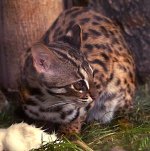
The
Leopard Cat (Prionailurus bengalensis) lives in South-east Asia. Its size and fur color differs largely depending on the region. In Indonesia, the leopard cat is as large as a domestic cat, while in the eastern part of China and Russia, it can grow as large as 60 - 90 centimeters long with a 30 - 40 centimeter long tail. It lives in forests near the water.
The leopard cat is a solitary animal and sleeps in caves or hollow trees and is an excellent climber. It hunts at night on birds, rodents, bats, hares or domestic poultry. In the wild, they can become 10 - 15 years of age.
Picture of the leopard cat by F. Spangenberg - Der Irbis, licensed under GFDL
You can help spreading the word about this animal by liking it on facebook
Permanent Link
Monday 12 February 2007
Domestic sheep
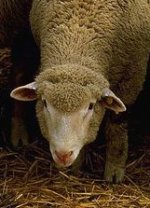
The
domestic sheep (Ovis aries) descends from the Mouflon, and in 2003 evidence is proposed that Ovis aries first got domesticated about 9000 BC in Iraq and has been a source of meat, milk, wool and hides since then. There still exist two populations of wild Mouflons: the Asiatic Mouflon and the European Mouflon, although the last may be feral as some sources suggest. The domestic sheep has a highly developed herding or flocking instinct, there is no leader among the sheep. This is quite an advantage, as a shepherd is able to control a large group of sheep. Ovis Aries has a complex stomach system which allows it to digest highly fibrous food that many other mammals cannot. Estimates are there are over 1 billion sheep in the world. The Oklahoma State University has an excellent page with all
different breeds of sheep (282).
Links
Breeds of livestock - Oklahoma State University
You can help spreading the word about this animal by liking it on facebook
Permanent Link
Friday 02 February 2007
Parti-coloured Bat
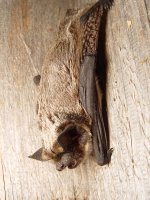
The
Parti-coloured Bat (Vespertilio murinus) lives in parts of Western and Central Europe and parts of Asia and is
Vesper bat. They can grow up to 6.4 centimeters and their wing span can range up to 33 centimeters. Parti-coloured bats can become twelve years of age. Their diet includes mosquitos, flies and moths. After twilight these bats use their ultrasonic sounds to catch their prey 10 to 20 meters above the ground.
Picture of the parti-coloured bat by Mnolf, licensed under GFDL
You can help spreading the word about this animal by liking it on facebook
Permanent Link