Saturday 29 December 2007
Black-footed Ferret
Black-footed Ferrets (Mustela nigripes) are the only kind of ferret endemic to North America. Black-footed Ferrets have long necks, with black spots on their face and feet and tail. A typical Black-footed Ferret weighs from 0.9 kg to 1.36 kg and are about 45 centimeters in length, with a 15 centimeter tail.
The Black-footed Ferret spends almost all its time under the ground. At night, they hunt prairie dogs but here is the fascinating part. This is one of those very rare cases where a predator-prey could suddenly switch places. Prairie dogs could attack as a pack and target a ferret.
The Black-footed Ferret was almost considered as extinct way back in the mid 80s, but fortunately, they were reintroduced from captured systems. A great deal of what we know now about these ferrets come from researches done (1964-74) on a group at South Dakota.
Canine distemper has been discovered in ferrets, and ferrets kept as a pet need to be vaccinated for ti.
Interesting fact: As of today, the total population of black-footed ferrets in the wild is over 600 individuals in the United States. The IUCN still classifies them as extinct in the wild, but this is due to the last update to the assessment having been in 1996 when the species was indeed only surviving in captivity.
You can help spreading the word about this animal by stumbling it by pressing
this link
- Permanent Link
Sunday 23 December 2007
Bearded Pig - smallest torso and largest head of all pigs

The
bearded pig (
Sus barbatus) has the smallest torso and the largest head of all pigs, it is about 5 - 6 feet long and has a tail that is about 20 - 30 centimeters long. They are omnivores and are known to trail monkeys (
gibbons and macaques) to catch fallen fruit, scraps and offal. They exist in the wild on the islands of Malaysia, Sumatra and Borneo in Asia. Bearded Pigs inhabit rainforests, mangrove thickets, and secondary forests. It is the only species of pig which forms large groups to make long distance migrations. They get their name from the abundant winkers on its chin and several warts beneath its eyes. Their main predators are
tigers, leopards and pythons.
You can help spreading the word about this animal by stumbling it by pressing
this link
- Permanent Link
Friday 21 December 2007
Raccoon dog - night wandering raccoon

The
Raccoon Dog (
Nyctereutes procyonoides) is an omnivore native to Japan, the south-east of Siberia, and Manchuria, but they have also been sighted in Europe recently. During winter they hybernate, having fattened themselves during autumn on frogs, lizards, rodents, and even birds. They supplement their diet with seeds and berries. They are threatened by humans through hunting for their fur and urbanization. Its Greek scientific name
Nyctereutes procyonoides comes from nycto = night, ereutes = wanderer, procyon = raccoon, although it isn't a raccoon, it's closest living relatives being foxes. They grow to lengths of about 65 cm and can weigh up to 10 kilograms.
Image photographed by 663highland, licensed under GFDL.
You can help spreading the word about this animal by stumbling it by pressing
this link
- Permanent Link
Monday 17 December 2007
Japanese squirrel
Japanese squirrels (
Sciurus lis) are reddish grey and have tufted ears and bushy tails. In the Japanese language they are called 'risu', which is written with the Kanji characters for a chestnut and a rat.
The Japanese squirrel is distributed on the islands of Honshu, Shikoku, and Kyushu in Japan. Recently, populations on south-western Honshu and Shikoku decreased and those on Kyushu disappeared. One of the factors affecting to local extinction of this species seems to be forest fragmentation by human activities (
source).
You can help spreading the word about this animal by stumbling it by pressing
this link
- Permanent Link
Saturday 15 December 2007
Snow leopard

The
Snow Leopard (Uncia uncia) or Ounce
While the leopard and the snow leopard share the same broken-spot markings, the rosettes of the snow leopard are different, more like a
jaguar, which lives in South America. Its fur is both woolly and long, this serves as protection against the extreme harshness of the cold.The coloration of the Snow Leopard is smoky gray, with a sprinkling of yellow and brown at the sides. They have white fur on the chest and belly, while the head has tiny ears. Snow Leopards could reach 1.3m and weigh up to 70 kgs. Its proportionally long tail, is used to balance itself when traversing through steep, high and rocky terrain.
Ordinarily, it lives at elevations ranging from 2000m to 4000m, but to find one at lower heights is not impossible. A Snow Leopard could live in valley ridges, mountain passes and rocky outcrops.
The Snow Leopard is active during the twilight hours. Its diet consists of Bharal (it is a kind of sheep),
Markhor, goats, ibex, musk deers, birds, hares, marmots and other small rodents. Snow leopards often hunt alone, but then again, they hunt in pairs if the prey is too large. One would stalk the target, while the partner would go for the kill. It can defeat an animal thrice its size.
The newborns are born during the spring, the litter size ranges from 1 to 4, the average is actually two. These young come out after a gestation of around 100 days.
Interesting fact: The snow leopard can jump as far as 14 meters (46 feet).
Picture of the snow leopard by Bernard Landgraf, licensed under
GFDL
Range map of the snow leopard by Laurascudder, licensed under
GFDL
You can help spreading the word about this animal by stumbling it by pressing
this link
- Permanent Link
Wednesday 12 December 2007
Oriental Small-clawed Otter

The
Oriental Small-clawed Otter or Asian Small-clawed Otter (
Amblonyx cinereus)
The Oriental Small-clawed Otter is found scattered in Asia, specifically at freshwater wetlands or mangrove swamp areas. It has a dark umber pelage, a white chin/neck and a pink nose. Its sinuous body makes it a great aquatic creature, it could swim much faster (and go farther) than other aquatic creatures, say, a beaver. Oriental Small-clawed Otters opt to have quiet pools for its fishing or a quick bath.
An Oriental Small-clawed Otter lives on a diet that is made up of: mollusks, crustaceans, reptiles, mammals, birds, fish, snails and eels. As far as breeding is concerned, not much is known when it comes to those in the wild.The information that does exists comes from those observed in captivity. It does not seem that there exists a set breeding period, the Oriental Small-clawed Otter achieves mating maturity at 2 years old, the male would do its courting.
An Oriental Small-clawed Otter's whiskers are sensitive to the pressures of water, and these whiskers help them in finding prey in unclear water.
The beautiful coats of these otters have become so popular for us (mankind), and expectedly, the population of these otters went down drastically over the last two centuries. It is in fact, a source of wonderment to a lot of people, that they are still surviving in today's world.
Interesting fact: the Oriental Small-clawed Otter is the smallest species of otter in the world
Picture of the Oriental small clawed otter by
ArtMechanic, licensed under the
GNU Free Documentation License
You can help spreading the word about this animal by stumbling it by pressing
this link
- Permanent Link
Wednesday 05 December 2007
Pichi

The
pichi (Zaedyus pichiy), also known as the 'Dwarf Armadillo', lives in southern most portion of South America (South Argentina, Chile). They have very small ears, well developed claws and a dark brown armor with whitish lateral edges and a yellow tail. They dig burrows, but can be found above ground during the day and night. They are primarily nocturnal and solitary creatures and can enter a state of
torpor in the winter.
They dig shallow holes for shelter and to protect them from predators. When they are threatened, they pull their arms and legs inside their armor, so that their armor touches the ground. This way a predator cannot get to the softer underbelly.
Their diet consists of insects, plant matter, carrion, worms and have also been seen eating rodents and lizards
Interesting fact: Pichis have a variable body temperature of about 24 to 35 degrees Celsius
You can help spreading the word about this animal by stumbling it by pressing
this link
- Permanent Link
Saturday 01 December 2007
Water Opossum or Yapok

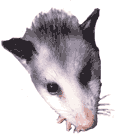
The Water Opossum (Chironectes minimus) or
Yapok can be found in many parts of the globe, just to mention some: South Mexico, Colombia, Guianas, Venezuale, parts of Brazil and Peru. The natural habitat of these animals range from subtropical up to tropical territories, and also near freshwater streams. It is not impossible to find Water Opossums at high-altitude areas. The hair covering of a Water Opossum is quite unusual, the fur is a combination of black and gray. Usually, the crown and the muzzle are predominantly black, with a pale band at the forehead. A Water Opossum's ears are round, and on top of the eyes are bristles. They are real water dwellers, their fur being water-repellent and not only that, they have webbed feet which makes it possible for them to swim quickly. These yapok's forefeet are not webbed, but have claws and long fingers. Male and females both have a a pouch, and for the females, they have a mechanism that seals the pouch, as this protects their young. The latter would be able to go on without oxygen for many minutes when they are underwater.
Life expectancy for these opossums is not known exactly, in captivity lifespan was recorded of up to 3 years. The Water Opossum is basically anti-social and a "loner". Usually, they reside in subterranean places but in the daytime, they utilize a ground nest composed of either leaves or grass. Their diet consists of shrimps, crayfish, frogs and fruits.
They are not listed as endangered. However, they are indeed rare but whether this is due to its nocturnal way of living or their population is really small, even experts could only speculate.
Interesting fact They are the only kind of opossum that can move/survive in aquatic environments.
You can help spreading the word about this animal by stumbling it by pressing
this link
- Permanent Link