Subscribe to
"Animal of the day"

AddThis Feed Button
Or subscribe by e-mail

Enter your Email


Powered by FeedBlitz

We hope that reader will gain an increased appreciation of the need for more conservation measure in order to protect the beautiful creatures that inhabit the earth. Our philosophy is that the more we learn about animals, the more we respect them and take better care of them. That is why we update this blog with new animals, We encourage you to syndicate our content by adding "animal of the day" to your own blog! (read more)

About us

Our mission is to get people excited about animals and their welfare by writing articles on these animals. We encourage people to comment on posts and share with others. Don't forget to subscribe to our feed.

Contact us
Copyright notice

Cutest pet ever - cutest pet contest

Funny animal videos and pictures

Swimming with manatees - harmful or helpful

Last Comments

red (Disk Tetra - Hate…): How to breed the fish? Is…
alissa (Stump-Tailed Maca…): sooo cute
Anonymous (Shoebill - Swamp …): These are beautiul birds …
sugar glider info… (Greater Glider - …): They have large, protrudi…
Sabrina (Purple frog): wow, what a lovely frog. …
Organizari evenim… (Fattest cat in th…): :)) This is not funny! Re…
destiny (Ninja cat): hahah thats funny
sami (Bats - the only t…): is that true
Lexis.J (Ninja cat): So funny.He’s the top nin…
someone (Ninja cat): this is soooo cute!

Calendar

« February 2012
S M T W T F S
      1 2 3 4
5 6 7 8 9 10 11
12 13 14 15 16 17 18
19 20 21 22 23 24 25
26 27 28 29      

Archives

Next Archive Previous Archive

01 Jan - 31 Jan 2012
01 Dec - 31 Dec 2011
01 Nov - 30 Nov 2011
01 Oct - 31 Oct 2011
01 Sep - 30 Sep 2011
01 Aug - 31 Aug 2011
01 Jul - 31 Jul 2011
01 Jun - 30 Jun 2011
01 May - 31 May 2011
01 Apr - 30 Apr 2011
01 Mar - 31 Mar 2011
01 Feb - 28 Feb 2011
01 Jan - 31 Jan 2011
01 Dec - 31 Dec 2010
01 Nov - 30 Nov 2010
01 Oct - 31 Oct 2010
01 Sep - 30 Sep 2010
01 Aug - 31 Aug 2010
01 Jul - 31 Jul 2010
01 May - 31 May 2010
01 Apr - 30 Apr 2010
01 Mar - 31 Mar 2010
01 Feb - 28 Feb 2010
01 Jan - 31 Jan 2010
01 Dec - 31 Dec 2009
01 Nov - 30 Nov 2009
01 Oct - 31 Oct 2009
01 Sep - 30 Sep 2009
01 Aug - 31 Aug 2009
01 Jul - 31 Jul 2009
01 Jun - 30 Jun 2009
01 May - 31 May 2009
01 Apr - 30 Apr 2009
01 Mar - 31 Mar 2009
01 Feb - 28 Feb 2009
01 Jan - 31 Jan 2009
01 Dec - 31 Dec 2008
01 Nov - 30 Nov 2008
01 Oct - 31 Oct 2008
01 Sep - 30 Sep 2008
01 Aug - 31 Aug 2008
01 Jul - 31 Jul 2008
01 Jun - 30 Jun 2008
01 May - 31 May 2008
01 Apr - 30 Apr 2008
01 Mar - 31 Mar 2008
01 Feb - 28 Feb 2008
01 Jan - 31 Jan 2008
01 Dec - 31 Dec 2007
01 Nov - 30 Nov 2007
01 Oct - 31 Oct 2007
01 Sep - 30 Sep 2007
01 Aug - 31 Aug 2007
01 Jul - 31 Jul 2007
01 Jun - 30 Jun 2007
01 May - 31 May 2007
01 Apr - 30 Apr 2007
01 Mar - 31 Mar 2007
01 Feb - 28 Feb 2007
01 Jan - 31 Jan 2007
01 Dec - 31 Dec 2006
01 Nov - 30 Nov 2006
01 Oct - 31 Oct 2006
01 Sep - 30 Sep 2006
01 Aug - 31 Aug 2006
01 Jul - 31 Jul 2006
01 Jun - 30 Jun 2006
01 May - 31 May 2006
01 Apr - 30 Apr 2006
01 Mar - 31 Mar 2006
01 Feb - 28 Feb 2006
01 Jan - 31 Jan 2006
01 Dec - 31 Dec 2005
01 Nov - 30 Nov 2005
01 Oct - 31 Oct 2005
01 Sep - 30 Sep 2005
01 Aug - 31 Aug 2005
01 Jul - 31 Jul 2005

Animal pictures
Mammals.start4all.com
Animal diversity web
Recently extinct animals forum
Another chance to see

Miscellany

AddThis Feed Button

Friday 29 October 2010 The Antelope Jackrabbit: Large Ears And High Leaps

Antelope JackrabbitThe Antelope jackrabbit (Lepus alleni) is a species of North American hare. Known for its ability to make high leaps, and ears that are especially large, the mammal is named after the fast, long-legged antelopes of Africa.

Antelope jackrabbits can run as fast as 45 miles (72 km) per hour, and can jump as high as five-feet (1.5 m) and as far as 22-feet (6.7 m). The Antelope jackrabbit watches for predators from almost any angle; its large eyes are placed high and back enough to provide almost a 360-degree view. Predators include coyotes, rattlesnakes, bobcats and cougars. Once spotted and chased, the Antelope jackrabbit will race from its enemy, purposely flashing its white rump to confuse the predator.

Weighing between nine to 10 pounds (4.5 kg), the Antelope jackrabbit ranges from 18 to 24-inches (45 to 60 cm) in length, with a tail up to four inches (10 cm). The whitish ears, which grow as long as eight inches, help regulate body temperature by either transferring heat back to the air as needed or maintaining body warmth in cold weather. The ears also become erect when the Antelope jackrabbit is alarmed.

The Antelope jackrabbit is commonly found in northern Mexico and Arizona in the United States, and has been observed along the border of New Mexico and portions of southeastern California. Due to its stable population, the Antelope jackrabbit is not considered at risk of endangerment. Its natural habitat is grasslands at moderate elevations or deserts where grass grows under shrubs.

Because it is nocturnal, the Antelope jackrabbit spends the day resting, usually in the shade of grass, brush or cactus where temperatures are lower than the open desert. Blending in with its surroundings, the jackrabbit uses camouflage to evade detection.

Herbivorous, the Antelope jackrabbit eats green grass, desert vegetation and cactus pads, usually feeding at dusk and dawn. The Antelope jackrabbit will stand on its hind legs to reach higher branches of vegetation such as mesquite. Cacti routinely serves as a moisture source, as water is not available nor actively needed.

The breeding season runs from January to October, with a gestation period of roughly 42 days and the possibility of seven litters per year. Litter sizes average from one to five. Unlike rabbits, which are born blind, the Antelope jackrabbit young are born fully haired and with eyes open. Young are also born able to hop. You can help spreading the word about this animal by liking it on facebook

Permanent Link

Thursday 28 October 2010 Soemmerring's Gazelle - Once the Most Abundant Gazelle, Now Nearing Endangered Status
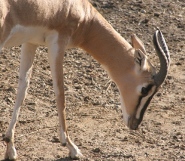
Soemmering's gazelleThe Soemmerring's Gazelle (Gazella soemmerringii) were once the most abundant Gazelle on the African continent, moving about in large herds of several hundred. Today, they can be found in small groups between 5 and 20, often intermingling with herds of hartebeest, oryx, and domesticated camels. Both CITES and IUCN have listed the Soemmerring's Gazelle as a vulnerable species due to a 30% decline over 3 generations (21 years). Current estimates are that the decline will continue at a rate of about 10% per year. The likeliest cause of the decline is the loss of habitat to domestic grazing, hunting, and regional political unrest.

Soemmerring's Gazelle have a tawny brown coat interrupted by patches of white around the head, covering the belly, inside the legs, and over the rear end. Three black stripes extend from the top of the skull to the nose, with one covering each eye and the other centered on the bridge of the nose. The horns grow back over the skull in a lyre shape, are ridged, and can grow up to 22 inches (58 cm) long. Adults can measure 4-5 feet (120-150 cm) in length, 2.3-3 feet (85-92 cm) high at the shoulders, and weigh from 70-100 pounds (35-45 kg).

The Soemmerring's Gazelle inhabit lightly forested steppes and savannas on the Horn of Africa, from Eastern Sudan through Ethiopia, Eritrea, Djibouti, and Somalia. Food sources include acacia, brush leaves, grass, and herbs, and are known to migrate with the rainy season to ensure sufficient food is available. As a large herbivore they are food sources for several large predators, including the cheetah, lion, leopard, hyena, Cape hunting dog, and python. The primary defensive measure against predators is the ability to run and leap through the air for considerable distance at high speeds, up to 50 mph (80 kph).

Although the horns can be used for defense as well, most of the wear and tear visible on the horns of older males is from territorial disputes with other males. During the period from September to November males will mate with receptive females while walking together, with the male continuing to walk after mounting with his two hind legs. Gestation is 199 days, or about 6-1/2 months, so that the birth of a single infant occurs during the rainy season when food and water is plentiful. The young are weaned after 6 months, reach sexual maturity in 1.5 years, and live for up to 14 years.

Picture of the Soemmerring's Gazelle by , licensed under GFDL You can help spreading the word about this animal by liking it on facebook

Permanent Link

Wednesday 27 October 2010 Coypu - a Web-Footed Rodent

CoypuThe Coypu (Myocastor coypus), a large rodent herbivore, was originally found in South America although it has been introduced to various other regions such as Africa, Europe, Asia, and North America. It was introduced predominantly for its fur. Although they were initially believed to be a valuable species, they have become largely invasive through their destructive burrowing. The animal is typically found near rivers in burrows surrounding the water and eats primarily river plants.

The coypu looks similar to a beaver or a gigantic rat and has often been mistaken for muskrats although the muskrat is significantly smaller. The animal weighs between 5 to 9 kilograms or 11 to 20 pounds with a body between 40 to 60 centimeters or 16 to 24 inches. Their tails measure approximately 30 to 45 centimeters or 12 to 18 inches in length. The coypu has dark brown outer fur which is quite coarse and softer fur underneath. The animal is quite unique due to its white muzzle as well as its peculiar hind feet, which are distinctly webbed. In addition, female coypu have nipples which are located high on their body so that they are able to feed the young while floating.

The coypu has become extinct in many of their natural, native habitats due to hunting. Because of this, farms were established during the 19th and 20th centuries. The initial farms were established in Argentina and were later introduced in Asia, North America, and Europe. However, these fur farms have not been successful and most of the animals have been released back into the wild creating problems in the surrounding habitats due to the coypu’s excessive eating of plants, burrowing, chewing of tires and paneling on homes, as well as the destruction of irrigation systems. They are not currently considered to an endangered species. Predators of the coypu exist both on land as well as in the water. Their primary predators include alligators, red wolves, and well as wild cats.

Although they are not currently considered an overall endangered species, they do undergo periods of population reduction particularly during harsh winters. The animal is not very resilient in the cold and often undergoes frostbite in their tails which can cause infection and, potentially, death. Because of this, there are areas in which the animal has become extinct including parts of Scandinavia. However, during mild winters, the animals survive quite well particularly in areas of the northwestern United States.

Picture of the coypu by J. Patrick Fischer, licensed under the Creative Commons Attribution-Share Alike 2.5 Generic license. You can help spreading the word about this animal by liking it on facebook

Permanent Link

Tuesday 26 October 2010 Lyle's Flying Fox - Buddhist Refugees
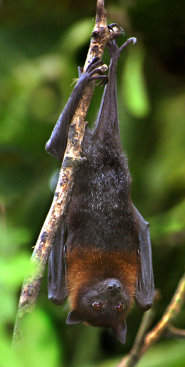
Lyle's flying foxLyle%u2019s Flying Fox (Pteropus lylei) belongs to the large family of mammalian old world fruit bats or flying foxes. The Spanish name is Zorro Valador De Lyle. As the common name suggests fruit bats live on nectar, pollen, blossoms, and fruit, and for this reason their habitats are limited to tropical and subtropical regions of the world. Old world fruit bats are the largest bats in the world, with wing spans up to 6 feet (1.8 meters) and weighing as much as 2.2 pounds (1.5 kg). By comparison, the size of Lyle’s flying foxes is about mid-sized within the fruit bat family.

Lyle’s flying foxes will colonize trees in large groups, where they nest and suckle their young during the day. At night they depart to forage for food and have been known to travel 40 miles away to find food. Rather than using echolocation as their insectivore cousins do, fruit bats rely on well-developed visual and olfactory senses.

The habitat of Lyle’s flying foxes is limited to Thailand, Cambodia, Viet Nam, and the Yunnan Province of China. Even though little is known about populations within China, Lyle’s flying foxes have been listed by IUCN as vulnerable or one step away from being considered endangered. Until recent hunting restrictions were put into place, fruit bats were considered a delicacy and were hunted legally. Hunting still occurs in some places, but habitat degradation and destruction has also contributed to the 30% population decline over the past 15 years (three generations). In Thailand and Cambodia, Lyle’s flying foxes are considered pests and are not protected except on temple grounds. For this reason, large, noisy colonies of Lyle’s flying foxes can be found colonizing the trees over some Buddhist temples in Cambodia and Thailand. Up to 11 colonies are known to exist in Thailand and the largest contains close to 3000 individuals.

The size of fruit bats can be truly startling when first encountered at night by strangers to tropical climes and has resulted in reports of vampire bats or flying pterodactyls, but unless you’re a fruit or flower, or smell like one, you have little to fear. Okay, a little fear is appropriate. Over the past 10 years or so several research studies have found that fruit bats, including Lyle’s flying foxes, are hosts for emerging viruses that can infect and kill livestock and humans.

Picture of the Lyle's flying fox by Malene Thyssen, licensed under GFDL You can help spreading the word about this animal by liking it on facebook

Permanent Link

Monday 25 October 2010 Carp Bream - European Bottom-Dwellers
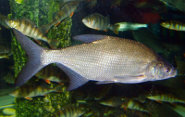
Carp breamThe carp bream (Abramis brama) is an abundant fresh-water fish commonly found at the bottoms of fresh-water canals, lakes and ponds, and on some river bottoms. Their silvery gray body is flat with a high back, and gray or black fins. Older fish may have a bronze color, especially if living in clear water. Adult carp bream can range in size from 12" to 22" (30-55 cm), and weigh between 4 and 9 pounds (2-4 kilograms).

The carp bream is an widespread European and Asian species not currently threatened. Their home range is that part of Europe north of the Pyrenees and the Alps, stretching north to the southern reaches of Scandinavia, and east through the Balkans to those areas around the Aral, the Caspian, and the Black Seas.

Carp bream live in schools on the bottoms of lakes and rivers. At night, they feed close to shore, and, during the day, on sandy bottoms in clear water. The carp bream's small protracting mouth digs through mud and silt for larvae, gastropods, and bivalves on which to feed, and nibbles on plankton and water plants. A large carp bream may even eat other small fish. Carp bream themselves are eaten by perch and pike.

Bottom overfeeding may result in food shortages, and the young fish in the school may have to resort to filter feeding with their gill rakers, catching small aquatic crustaceans called water fleas for food. But, as the carp bream reach adulthood, their gill rakers grow far enough apart that they are no longer able to feed on this abundant prey, resulting in a natural limit on the carp bream's size for those that feed mostly on water fleas.

The carp bream sexually mature around the age of three years. Spawning occurs for the carp bream April to June. Males patrol and protect territories where females lay their many eggs upon the leaves and stems of water plants. Over a week or two, the eggs develop into fish larvae, and then into slender young fish, who detach from the plants, and live as youngsters in the "water column," the vertical length of water stretching from the surface to the bottom. The young carp bream do not become full-fledged bottom-dwellers until they are at least several months old. At that point, they achieve the body and color of the adult carp bream, and begin bottom-feeding. You can help spreading the word about this animal by liking it on facebook

Permanent Link

Tuesday 19 October 2010 Spiny Mouse: A Fragile Tail
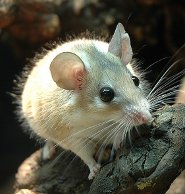
Spiny mouseThe Spiny Mouse (Acomys spinosissimus) is a small mammal, specifically a species of rodent of the Muridae family. It lives alone, or in small groups, inhabiting deserts, rocky terrain or dry woodlands. It is a nocturnal creature, but it does come out in early morning or late afternoon, keeping to the shadows. It is found in northeastern South Africa and the neighboring countries to the north and east: Malawi, Tanzania, Botswana, Mozambique, Zimbabwe, Zambia, and the Democratic Republic of the Congo.

The name Acomys spinosissimus literally means "sharp-pointed mouse," a reference to the stiff thick hairs that stand out from its back. It has large black eyes and enormous rounded ears, both well-suited for nocturnal activities. Like almost all other mice of the genus Acomys, the spiny mouse has a white or creamy underbelly; unlike most other mice of the genus, its upper body is reddish-gray. On the average, a spiny mouse is 6.7" (17 cm) long, including a tail that, by itself, is about 3" (8 cm) long. The average weight of a spiny mouse is just under one ounce, or about 28 grams.

The spiny mouse's tail is covered with sparse coarse fur, and can break off rather easily. It is thought that this fragility is a defense against predators, who, upon grabbing a spiny mouse by the tail, would then be left with only the tail. Unlike a similar predator defense found in some lizards, the tail of the spiny mouse does not grow back.

The spiny mouse eats seeds, green leaves, snails, insects, and millipedes. Predators who prey on the spiny mouse are the small wild cats, the mongoose, and various birds of prey native to South Africa, such as owls, eagles, falcons, hawks, harriers, and secretary birds.

The lifespan for a spiny mouse is anywhere from four to seven years. Spiny mice reach sexual maturity about two months after birth. Females can conceive at any time during the year. Once a female spiny mouse is pregnant, she gestates for about forty days before she gives birth. Most litters contain two or two pups, but some litters have been seen with six. Spiny mice are born with their eyes open, leave the nest at the age of three days, and are weaned in a little over a month. A female can conceive and produce up to twelve litters in a year, which is one reason the spiny mouse is not an endangered species.

Picture of the spiny mouse by Marcel Burkhard, licensed under the Creative Commons Attribution-Share Alike 2.0 Germany license. You can help spreading the word about this animal by liking it on facebook

Permanent Link

Monday 18 October 2010 The Blue-Fronted Amazon Parrot - colorful and camouflaged

Blue-fronted amazonThe blue-fronted amazon (Amazona aestiva) is a medium to large sized parrot, indigenous to south and central America. It is known for its bright green coloration, with a bright blue colored markings above the ceres or beak area. Around the head, the color may consist of bright yellow markings. Many people prefer to own this type of parrot for its excellent ability to speak and to mimic sounds. It also makes a good companion with proper training.

In the wild, the blue-fronted amazon tends to dwell in tropical rain forest regions of south and central America, where it strips the bark of trees to keep its hook bill trimmed. It populates regions of Brazil and Argentina in abundance. Its diet in the wild mainly consists of seeds and fruits. The size of the blue-fronted amazon is generally between 12-15 inches (30-38 cm) from the top of its head to the tip of its tail.

Although amazon parrots are excellent at dodging predators in the wild, they can become prey to larger birds. Amazons do not become captured by predators very frequently however, due to the fact that they tend to perch in high trees and their green coloring is an excellent camouflage.

As a pet, the blue-fronted amazon may bond with one person exclusively, if it has been hand-raised and hand fed from a baby. If this bird is cared for properly and given a balanced and nutritional diet that includes fruits, vegetables, grains and protein, it should have a lifespan of about 50-60 years or more.

The blue-fronted amazon becomes sexually mature at about four or five years of age. These types of parrots generally mate for life, and will choose one partner for a lifetime. A clutch of babies typically consists of one to three.

Although this breed of parrot has been domestically bred in the United States for many years, it is considered to be an endangered species in its natural habitat of central and south America. Importing and smuggling this parrot from their native country is illegal and may pose certain health risks. Breeders who raise blue-fronted amazons in the States typically place an identification band on the bird's leg. This is to establish the bird is a domestically bred, and not wild-caught parrot.

These parrots are considered to be highly intelligent creatures. This is another attribute which makes them so desirable as pets. They are easily bored and need constant mental stimulation in the way of toys and a large cage or play gym perch. Most blue-fronts which are kept as pets prefer to spend time interacting with their owners and love to perch on a shoulder.

It should be noted that if kept as a pet, there are certain hazards that need to be avoided. Like all parrots, the blue-fronted amazon should never be given chocolate or avocado to eat, as it can be toxic or even lethal to them. Teflon or non-stick pots and pans which overheat can also pose a health risk factor and be toxic to pet parrots as well.

Picture of the blue-fronted amazon by Matthew Watts, licensed under the Creative Commons Attribution-Share Alike 2.0 Generic license. You can help spreading the word about this animal by liking it on facebook

Permanent Link

Friday 15 October 2010 Speke's Gazelle, The Gazelle With A Loud Nose
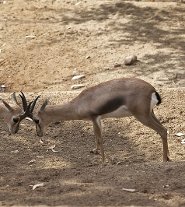
Speke's gazelleThe Speke's Gazelle (Gazella spekei) is among the smallest of the Gazelles, reaching a length of 90.5 to 100.5 cm, equal to just over 3 feet, a height of about 50-60 cm, equal to 1.6 to 2 feet, and they weigh in at about 15 to 25 kg, or 33 to 55 pounds. The upper body is a brownish tan color, which is separated from the white belly by a black stripe. The unique folds on its nostrils inflate when excited, and are responsible for the loud resonant calls the Speke's Gazelle makes when threatened. Another unique behavior to the Speke's Gazelle is the blend of jumping, bouncing, and running they do when frightened.

The Speke's Gazelle has become endangered mainly because their grazing areas are often taken over by domestic livestock, and the range it covers has no protected areas so the threat of extinction will continue. The black stripes around the eyes reduce glare, and are bordered by white stripes, thus giving the animal a painted face appearance. Speke's Gazelles are found only on the horn of Africa, primarily in Somalia and some in neighboring Ethiopia. Like most animals living in a hot and dry scrubland environment, it is mostly active in the early morning and late evening hours, feeding on leaves, herbs and grass while resting during the day. The Speke's Gazelle can survive without water for some time, a useful adaptation in their harsh semi-desert environment.

Both male and female Speke's Gazelles have horns, males have longer curved horns while females have smaller straight horns. The Speke's Gazelle is on the menu of several predators including the Leopard, Hyena, Lion, Python, and Cheetah, thus the young lie hidden and motionless in the brush until they are weaned at about three months. After a pregnancy of about 7 months, a single young is born among herds of about 12 to 20 animals, and Speke's Gazelles usually live about 12 years. Herds are composed of either a dominant male with his breeding harem covering an area of half to 2 square miles, or the bachelor herd of young and juvenile males.

Picture of the Speke's gazelle by Sanjay Acharya, licensed under the Creative Commons Attribution-Share Alike 3.0 Unported license. You can help spreading the word about this animal by liking it on facebook

Permanent Link

Thursday 14 October 2010 The European SeaBass - One of Europe's Most Important Fish
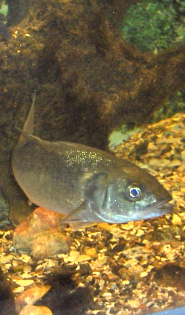
European seabassThe European SeaBass (Dicentrarchus labrax) or Morone labrax or sea dace, is a popular eating fish throughout Europe. The European seabass lives primarily in the ocean however, it does occasionally make its way into fresh or brackish waters. Its popularity as a food fish has ensured that it has many ways throughout the different countries where it is consumed. In Spain, it is referred to as lubino or robalo. In Northern Italy it is called branzino, while other regions of Italy refer to it as spigola or ragno. Those who enjoy European seabass in Greece call it by a different name - lavraki. In English speaking areas, it is often referred to as Mediterranean seabass. No matter what it is called, this fish is a very popular eating fish that is consumed throughout Europe.

Adult European seabass have two dorsal fins, silver sides, and a white belly. Juvenile fish have black spots on the back and sides, which sometimes leads to confusion between this species and other related seabass. The operculum, or bony covering protecting the gills, is serrated and spined for protection. These fish reach an adult size of approximately 1 meter (3.3 feet) long and 15 kilograms (33.3 pounds) in weight. Mostly a night hunter, this fish feeds largely on cephalopods and crustaceans.

As noted above, European seabass is typically found in ocean waters, including the eastern Atlantic Ocean, the Mediterranean Sea, and the Black Sea. It is frequently found in lagoons, estuaries, coastal waters, and rivers throughout Europe.

Currently, the primary predator of European seabass is commercial fisherman. Due to its popularity among anglers, many countries have had to limit the amount of this fish caught and consumed. In the United Kingdom, major conservation efforts limit the size of fish, the number that can be caught in a day, and the season in which fishing is allowed. Italians interested in protecting this species have undergone an intensive breeding program to increase numbers. Some recreational fishermen have created groups to help protect this species, as well.

In an attempt to increase production of this species without leading to its extinction, many countries in Europe have started farming fish. Farming seabass is popular throughout Spain, Croatia, Greece, and other European countries. The annual farming production of European seabass is 60,000 tons, which reflects how popular it is among consumers.

Picture of the european seabass licensed under GFDL You can help spreading the word about this animal by liking it on facebook

Permanent Link

Wednesday 13 October 2010 The Indian Flying Fox - The Little Fox That Is Really a Big Bat
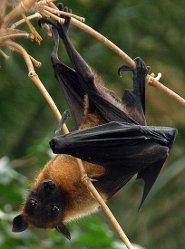
Indian flying foxThe Indian flying fox (Pteropus giganteus) looks a lot like a cute little red fox with wings. In fact, take away the leathery wings, and the fact that they sleep hanging upside down and it could be possible to forget that the Indian Flying Fox is really a bat. Their delicate, pointy ears, long, thin nose, lush red coat and soulful black eyes have a distinctive appeal that easily resembles the fox they are named after. It’s great size, relative to bats, also helps shape the features that make it more fox-like in appearance. The Indian flying fox has a broad wingspan of up to 130 cm (51.2 inches) from tip to tip and can weigh as much as 2 kilograms (4.4 pounds).

The Indian flying fox is native to the southern Asian continent, most notably in the countries of Bangladesh, China, Myanmar, Nepal, Bhutan, Maldives, Sri Lanka, Pakistan and, of course, India. While their numbers are on the downfall, they are still a common species in their native habitats.

The Indian flying fox spends its life in colonies numbering in the hundreds and even thousands. They prefer locations close to open fields, water sources or where there are a variety of flowers. These areas provide the best sources of their main food source which are fruits and berries. The sizes of the colonies are constantly fluctuating depending on the season. They are larger during rainy seasons that force the bats inside and keep them from spreading out in search of food, and smaller during hot, dry summer months. The Indian flying fox has a five month gestation period and spends an additional five to eight months with its mother. They are mature at two years of age when it becomes an adult member of the colony.

The Indian flying fox doesn’t have many natural enemies in the wild. Man is its greatest nemesis. It is a member of the fruit bat family, and often considered a nuisance, or vermin in their native land because of their widespread numbers and because deforestation has forced the flying mammals toward more urban roosting areas. The Indian flying fox is also hunted in countries such as Pakistan for its fat, thought to have medicinal qualities.

In spite of their great size, and the fact that bat folk-lore tends to make them fearsome creatures, the Indian flying fox is not the least bit dangerous. They do not feed on humans and prefer to stay clear of them. However, they can cause great destruction to orchards and vineyards.

Picture of the Indian Flying Fox by Fritz Geller-Grimm, licensed under the Creative Commons Attribution-Share Alike 2.5 Generic license. You can help spreading the word about this animal by liking it on facebook

Permanent Link

Tuesday 12 October 2010 The Spinifex hopping mouse - A Determined Migrator
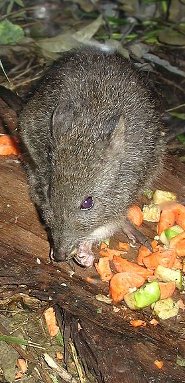
Spinifex hopping mouseThe Spinifex hopping mouse (Notomys alexis), which also goes by the name Tarkawara, is indigenous to western and central Australia. Their population is centered in arid regions such as the sand dunes, the spiniflex sand flats for which the animal is named, as well as melaleuca and mulga flats. They prefer dry environments and can migrate up to 15 kilometers during periods of intense rain.

The hopping mouse is similar in appearance to its relative, the Northern hopping mouse, and is slightly larger than the typical house mouse. It measures between 95 and 115 millimeters or 3.7 to 4.5 inches from head to the end of their body with the average weight being 35 grams or 1.2 ounces. The mouse has longer hind legs than the average mouse as well as shortened forelimbs with a longer than average tail, approximately 140 millimeters or 5.5 inches in length. Their fur is a fawn color with grey around the mouth as well as in the space between the ear and eye. Their hair is significantly courser and blacker on the back with the tail having very little fur.

The Spinifex hopping mouse lives in burrows which are typically located about 10 inches beneath the surface. The chamber in which the animals live is usually quite large and is lined with plant matter as well as small sticks. The mouse is largely nocturnal and leaves the den at night. They forage for food individually and eat a diet consisting primarily of seeds, green shoots, roots, as well as small invertebrates. They move with their body extended, almost completely horizontal, with their tail fully extended.

The Spinifex hopping mouse breeds primarily in the spring although they are able to do so throughout the year. The gestation period is quite short, approximately 40 days but can vary depending on whether or not the pregnant mouse is still nursing its previous litter. The litter can vary in size with the average being 3 babies. After the babies are born, they remain in the den when the family goes to forage for food. Sexual maturity is obtained without 2 ½ months.

The usual predators of the hopping mouse are owls, dingoes, red foxes, and feral cats. The population can vary greatly with the population booming after rain and occasionally spreading out into different areas with the population decreasing during times of drought. Despite this, the species is currently not considered endangered. You can help spreading the word about this animal by liking it on facebook

Permanent Link

Monday 11 October 2010 Antarctic fur seal - Nature's Deep Sea Diver

Antarctic fur sealThe Antarctic fur seal (Arctocephalus gazella), formerly called the Kerguelen fur seal, is an amazing animal that has been observed remaining underwater for up to ten minutes and diving to depths of two-hundred and fifty meters. However, most of the time the seals only stay under for two to three minutes and descend three or four meters.

The Antarctic fur seal's ability to prop itself up into a standing position upon its front flippers is one of its distinguishing characteristics. Most pups are born black in color, eventually turn silver-gray, and then gradually become brown as an adult. Some seals have lighter-colored fur. It has a lifespan of approximately 15 to 20 years. Adult females are approximately 1.2-1.4 meters (3.9-4.6 feet) in length and weigh 25-55 kilograms (55-121 pounds), adult males are approximately 1.6-2.0 meters (5.2-6.6 feet) in length and weigh 90-210 kilograms (198-463 pounds).

The Antarctic fur seal lives in the Antarctic Ocean, and comes ashore to reproduce. The seals reproduce on islands which are free of ice, located along the Antarctic Polar Front. The majority of the species reproduces along the coasts of the island of South Georgia. However, the species has a wide range and has been observed as far away as Brazil.

Male seals are approximately four times larger than the females, and are extremely territorial. The seals have a breeding season that runs from November to January. Each female has one pup per year.

Antarctic fur seals subsist primarily on a diet of krill, fish, and squid. They have been known to consume sea birds, and nursing females almost exclusively eat krill. Predators of Antarctic fur seals include orcas, leopard seals, and humans. The primary danger from people comes in the form of entanglement when man-made debris becomes wrapped around the neck of the seal, and it strangles or drowns.

In the early 1900s, the species was nearly extinct. There were only a few hundred Antarctic fur seals left due to massive over-hunting by people. Thanks to protective legislation, the population has rebounded, and by some estimates may have reached four or five million in the year 2000.

Antarctic fur seals are protected by the Convention for the Conservation of Antarctic Seals (CCAS), the Antarctic Treaty, and the national legislation of countries within its habitat. It is listed as an Appendix II species by the Convention on International Trade in Endangered Species of Wild Fauna and Flora (CITES).

Picture of the Antarctic fur seal by Jerzy Strzelecki, licensed under GFDL You can help spreading the word about this animal by liking it on facebook

Permanent Link

Friday 08 October 2010 Vulturine Guineafowl - Poor Flyers, Excellent Runners

Vulturine guinea fowlThe Vulturine Guinea fowl (Acryllium vulturinum), also known as the Royal Guinea fowl, is the largest species of non-extinct guinea fowls. They range in length from 50.8 to 52.8 centimeters or 20 to 24 inches. In weight, they can vary although there is no data indicating what these ranges may be.

The animal is mostly found in areas of eastern Africa particularly in the tropical regions of Ethiopia, Tanzania, Uganda, Kenya, and Somalia. It is located primarily in areas of dry tall grass with sparse trees. The animals are primarily found in high areas as they prefer to roost out of reach of predators. The animals feed predominantly on seeds, tubers, roots, small reptiles, grubs, as well as small invertebrates, vegetables, and fruits. Their predators are mostly hawks and they escape these, unlike most birds, by running quite well through the brush.

The animal gets its name from its vulture like features, mainly its long neck and small head which are both devoid of feathers. The breast of the bird is a bright cobalt blue with the rest of the body being predominantly black and splattered with white. The females do not differ significantly in appearance from the males although they are typically somewhat smaller than their male counterparts. The bird usually reaches sexual maturity at the age of 2 and has an average lifespan of 15 years. The vulturine guinea fowl (acryllium vulturinum) is currently not on the list of endangered species.

There are several unique characteristics of the vulturine guinea fowl including, for one, their ability to run at great avian speeds. In fact, they rarely have the need to fly except when flying to their nocturnal roosts. Another interesting aspect of the animal is that the sexes are practically indistinguishable from each other as they both have the same physical characteristics as well as coloring. The guinea fowl is also able to reproduce extensively with hens laying up to 40 eggs per season with the shells of the eggs being quite thick and difficult to damage. In some cases, multiple vulturine guinea fowl hens share the same roosting nest. When the birds are hatched from the eggs, they are almost fully developed and are able to fly within only a few days of birth. The animals tend to be very aggressive and will attack each other should they be competing for food or roost areas in trees.

Picture of the Vulturine Guineafowl, by Manfred Werner, licensed under GFDL You can help spreading the word about this animal by liking it on facebook

Permanent Link

Thursday 07 October 2010 The Rohu Fish - Nature's Sacred Delicacy

RohuThe Rohu (Labeo rohita) is a freshwater fish of the carp family Cyprinidae that is also commonly called the Ruee, Rui or Tapra. Known to put up a strong and long fight when caught on a hook, this fish is considered to be a sacred delicacy to be eaten at all special occasions in some regions of India.

Rohu can be found throughout South Asia and South-East Asia in the weedy, slow flowing or standing waters of lakes and rivers. They have very few natural predators in these waters except when they are small fledglings. Before reaching a juvenile stage they are often consumed by turtles, water breathing insects and other types of larger fish.

The types of food this fish prefers to eat changes with age. In its early stages the diet consists mainly of zooplankton. As it grows it then prefers more phytoplankton and eventually feeds on phytoplankton and submerged plants as an adult. They also have a fondness for bread, which is the most common bait used for catching them on a hook.

Rohu are generally solitary and reach maturity between two and five years. Its spawning areas are most often in the shallow waters of flooded rivers. They are a colorful fish defined by an upper body of dark scales, a lower body and belly that is golden brown and fins that are bright red. One of their most defining features is a large, oval gaping mouth ringed by thick lips. They can live up to ten years in the wild, growing to a maximum length of 200 cm (78.74 inches) and a whopping 45 kgs (99.21 pounds) in weight. They are now widely cultured in ponds and on fish farms, but do not breed well in calm waters so induced spawning often becomes necessary.

The texture of the fish is white, non-oily and the bigger the size of the fish the tastier it is. Rohu are heavily consumed throughout all areas in which they are found and prepared in a variety of ways. The roe is especially sought after as a delicacy and praised for its unique flavors. In many cases, the roe is also considered sacred and is most often fried and served hot as an appetizer at special ceremonies.

Picture of the Rohu by Khalid Mahmood, licensed under GFDL. You can help spreading the word about this animal by liking it on facebook

Permanent Link

Wednesday 06 October 2010 Red-Fronted Gazelle - Beautifully Painted

Red-fronted gazelleThe Red-fronted gazelle (Gazella rufifrons) is a type of gazelle typically found throughout Africa, from Senegal to Ethiopia. Their primary habitat is in open areas that include brush and vegetation south of the Sahara. They live in a banded area that begins just south of the Sahara and stretches down to Togo. The Red-fronted gazelle is known for living in open habitats, and can sometimes be found near areas cultivated by humans. Since the Red-fronted gazelle requires more water than most species of gazelle, they must migrate seasonally each year in search of water supplies. During the wet season of the desert, the gazelle migrate north for water. When the dry season begins, they head south to avoid the drought.

The physical features of the Red-fronted gazelle are what make the animal unique. As the name implies, this species of gazelle has a red forehead with distinct cream-colored lines that run from the eyes to the nose. They also possess a white ring around their eyes. These features make the gazelle instantly recognizable. Typically, the Red-fronted gazelle has a body length of 105-120 cm (3.5-4 ft) and a weight of 20-35 kg (44-77 lb).

The diet of the Red-fronted gazelle usually consists of grasses, vegetation, and leaves. For this reason, they can often be found in grasslands and savannas just below the Sahara desert line. They usually live in small groups of two to six gazelle, with numbers rarely reaching higher than fifteen. Reproduction occurs throughout the year, and young animals are kept hidden in order to avoid predators. Males often mark their breeding grounds with dung or scents in order to keep other males away from their territory. Calves are born one at a time after a gestation period of roughly six months.

Unfortunately, the Red-fronted gazelle population is declining. The most common natural predators of the Red-fronted gazelle include the cheetah, the Cape hunting dog, lions, pythons, and hyenas. At the moment, the Red-fronted gazelle is considered to be a vulnerable species, and may already be extinct in some African countries. However, it is not so close to extinction that it is of serious concern. The population of the Red-fronted gazelle is being monitored in order to see if the population will increase or decline in the coming years.

Picture of the Red-fronted gazelle by Andrzej Barabasz, licensed under GFDL. You can help spreading the word about this animal by liking it on facebook

Permanent Link

Tuesday 05 October 2010 Rhim Gazelle - The Desert Nomad

Rhim gazelleThe Rhim gazelle (Gazella leptoceros) has become the species of gazelle that is most adapted to the desert environment. Found throughout the Sahara desert, these gazelle roam around looking for spots of vegetation in order to survive. Throughout the years, they have adapted to live in the harsh desert environment. Their pale coats reflect the rays of the sun to prevent overheating, and their hooves enable them to walk on sand. The Rhim gazelle is often found in the countries of Egypt, Algeria, Chad, Libya, Niger, and Tunisia. They are known for their distinct horns, which in males are very large (30-41 cm / 1-1.3 feet long) and S-shaped. In females, the horns are much smaller, only about 20-38 cm, or 8-15.2 inches in length. These horns have given them the nickname "slender-horned gazelle."

Other key physical characteristics of the Rhim gazelle include its pale color. It is the palest of all of the gazelle species, and it usually has a cream colored or yellow-white coat. This helps to reflect the harsh rays of the desert sun. They also have a faint flank stripe and faint markings on the face. The Rhim gazelle also has reddish stripes that run from the eyes to the nose. Typically, their body length is between 100-110 cm (3.3-3.6 ft) and they weight roughly 20-30 kg (44-66 lb.) by adulthood.

Groups of these gazelles can be found throughout the desert, and are typically composed of two to twenty animals at a time. The Rhim gazelle travels as a nomad, mainly feeding during the early morning or late at night to get the dew off of vegetation. Their diet consists mainly of leaves, grass, and other vegetation that can be found in the desert. They are highly adapted to desert life, and hardly ever need to drink water. Most of their water comes from dew found on grass and leaves in the early morning.

Right now, the Rhim gazelle is considered an endangered species. Their primary natural predators include the cheetah, hyena, lion, leopard, and the Cape hunting dog. The Rhim gazelle has also suffered from a loss of habitat and hunting in recent years. Efforts are being made in national parks to continue the species in a confined habitat until they can be released into their natural environment.

Picture of the rhim gazelle by FisherQueen at the Cincinnati Zoo, licensed under GFDL You can help spreading the word about this animal by liking it on facebook

Permanent Link

Monday 04 October 2010 The Big-Eared, Bushy-Tailed Blandford's Fox

Blandford's foxThe Blandford%u2019s fox (Vulpes cana), is the second smallest of the fox-like canids. It weighs between 0.9-1.5 kg, or 1.98-3.31 lbs. The length of the head and body is about 42 cm, or 16.5 inches, and the tail length is between 28-30 cm, or 11-11.8 inches. The Blandford’s fox has a very bushy tail and large ears that overwhelm its slender body. The Vulpes cana has a cat-like appearance and demeanor. The muzzle is pointed and has a black stripe starting at the eye and reaching to the top lip. It has a soft coat of rusty brown, grey, and black. The throat and belly are creamy white. Its tail usually has a black tip, though sometimes it has a white one. A black band extends from the neck down the body and tail. The ears are dark brown. These foxes are considered rare, but because of their extreme habitat, not much is known of them. The IUCN classifies the Blandford’s fox as “Vulnerable” because of small population size and data deficiency. Its threats include disease, loss of habitat, and the red fox.

Blandford’s foxes are monogamous. Males and females forage separately. Males and females use neighboring dens while raising young and separate dens for the rest of the year. Breeding can occur from January to February, but in captivity, it can occur until April. Gestation is 50-60 days, and litters include one to three pups. The pups feed only on milk until they are two months old, at which time they will begin accompanying their parents as they forage. At the age of four months, they begin to forage alone. Parents do not take food back into the den.

Blandford’s foxes spend a lot of time in dry riverbeds, where they feast on invertebrates, dead animals, birds, and tree fruit. They make their dens in natural caves and crevices, because they cannot dig their dens. Their life span is about four or five years. Death may come via old age or rabies, or they may fall prey to the red fox. It is possible that they are preyed upon as well by leopards, golden eagles, and eagle owls.

In Arabia, they are found only in the mountains of Saudi Arabia, Oman, Yemen, and United Arab Emirates. They will avoid areas where the red foxes reside. They are also found in the Middle East, Egypt, and throughout Western Asia.

Picture of the Blandford's Fox by Eyal Bartov, licensed under GFDL You can help spreading the word about this animal by liking it on facebook

Permanent Link

Saturday 02 October 2010 African Darter - The Riverside Snakebird

African darterThe African Darter (Anhinga rufa), also known as the Snakebird, is an animal unique to sub-Saharan Africa. It is known for its very long neck and its unique swimming style. The African Darter gets the nickname "Snakebird" because it swims similar to the way a snake slithers. Its head is above water while swimming, which is a different style from many birds worldwide. The African Darter is typically found in tropical wetlands, and they spend a lot of time sitting beside bodies of water, particularly in areas where mangroves are prominent. The African Darter is fond of shallow, still waters and usually swims with its head above water. Unlike many birds, the feathers of the African Darter are not waterproof, and the bird must dry its feathers before taking flight. For the most part, these birds lead a sedentary lifestyle. These birds are fairly large, with a body size reaching close to 80 centimeters and weight close to 1400 grams. In imperial units, this is equal to roughly 30 inches or three pounds.

African Darters typically live in groups of ten to fifty birds at a time, sometimes with colonies reaching one hundred birds in size. Breeding can be a seasonal affair, but birds can mate at any time during the year. The breeding grounds is normally on a nest platform constructed by the birds. The platforms can be found in trees or on islands near the water. Usually, birds lay nests of around three to six eggs at a time. After breeding, some birds may go through a flightless period of time, although this is not universal within the species.

Since the African Darter spends a lot of time in and around shallow bodies of water, its diet is composed primarily of amphibious animals. They mainly eat fish, frogs, crustaceans, or molluscs. These birds are able to eat fish and other foods from either saline or freshwater environments.

In some areas, the population of the African Darter has declined in recent years. This is due to pollution and destruction of the environment. It also has natural predators, including the tawny eagle, the African fish-eagle, and the harrier-hawk. However, these threats are not so great that the species is becoming endangered. The African Darter population is very widespread and numerous, and for the moment it is not an endangered species.

Picture of the African darter by Susann Eurich in Chobe N.P. (Botswana), licensed under GFDL You can help spreading the word about this animal by liking it on facebook

Permanent Link

Friday 01 October 2010 Grant's Gazelle -The Contrary Migrator

Grant's gazelleThe Grant's gazelle (Gazella granti), a species of gazelle, roams the grasslands from Tanzania to Ethiopia, Sudan, as well as along the coast of Kenya. The animal stands between 76 and 91 centimeters or 30 to 36 inches from bottom of the hooves to the shoulder blade and its weight ranges from 45 to 65 kilograms or 100 to 145 pounds. They are differentiated from other species of gazelles by their lyre shaped horns.

The Grant's gazelle lives in the open plains as well as in the low shrublands. The gazelle tends to avoid high grasses as this compromises their ability to spot their predators. Along with most other animals in the ungulate family, they are migratory but migrate in the opposite direction of most African animals. Instead of moving towards water, the Grant's gazelle can survive on vegetation without access to water. They get most of the water from the plants which they consume. They eat primarily brush and shrubs during the summer months and oats and crispy plants during the remainder of the year. The predominant predators of the Grant's gazelle are cheetahs, although the cheetah has been known to prefer the Thomson's gazelle. Other predators include the African wild dog, jackals, as well as humans.

The male gazelles are quite territorial and they gather all of the females that enter into their territories into their herd. When the female gazelle is estrous, the male will guard the females and prevent other males from mating with the females in their herd. Single male gazelles live in herds of young adolescent bucks as well as bucks which do not have their own territories. In order for a male to be permitted to enter a group, they must perform power displays. However, male gazelles, unlike the females, are permitted to leave the herd at any point they choose.

The Grant's gazelle becomes sexually mature at the age of 18 months. When sexually mature, the male gazelle will determine whether or not a female is in estrous and, if she is, he will mate with her. After the female becomes pregnant, the gestation period lasts for approximately 198 days.

This species of gazelle is not endangered although they are no longer present in some areas in which they used to live. Major issues include hunting as well as the removal of their natural habitat. They largely live within nature reserves and, if these nature reserves were to be depleted, the species may unfortunately become endangered.

Picture of the Grant's gazelle by Ikiwaner, Ngorongoro crater, licensed under GFDL You can help spreading the word about this animal by liking it on facebook

Permanent Link