Subscribe to
"Animal of the day"

AddThis Feed Button
Or subscribe by e-mail

Enter your Email


Powered by FeedBlitz

We hope that reader will gain an increased appreciation of the need for more conservation measure in order to protect the beautiful creatures that inhabit the earth. Our philosophy is that the more we learn about animals, the more we respect them and take better care of them. That is why we update this blog with new animals, We encourage you to syndicate our content by adding "animal of the day" to your own blog! (read more)

About us

Our mission is to get people excited about animals and their welfare by writing articles on these animals. We encourage people to comment on posts and share with others. Don't forget to subscribe to our feed.

Contact us
Copyright notice

Cutest pet ever - cutest pet contest

Funny animal videos and pictures

Swimming with manatees - harmful or helpful

Last Comments

Tima (Bottlenose dolphi…): J. David Smith, Ph.D., a …
Coda Plant (Pudu - smallest d…): Hey. I live in Northern C…
Michael Newton (Koala video): i love you mr. koala
Tohru (Asian Golden Cat): I hate them too! They are…
tiffany (Asian Golden Cat): i love this cat i’m doing…
BK (Nubian Ibex - The…): Magnificent animal, espec…
amanda (Long-nosed cusima…): thhisanimal is so so so s…
misscrient (Muskrats - Water-…): Third paragraph last sent…
rudy (Deer Mouse - The …): that is so cool ilove lea…
Nick (Fattest cat in th…): “The cat is not over fed.…

Calendar

« November 2009
S M T W T F S
1 2 3 4 5 6 7
8 9 10 11 12 13 14
15 16 17 18 19 20 21
22 23 24 25 26 27 28
29 30          

Archives

Next Archive Previous Archive

01 Nov - 30 Nov 2009
01 Oct - 31 Oct 2009
01 Sep - 30 Sep 2009
01 Aug - 31 Aug 2009
01 Jul - 31 Jul 2009
01 Jun - 30 Jun 2009
01 May - 31 May 2009
01 Apr - 30 Apr 2009
01 Mar - 31 Mar 2009
01 Feb - 28 Feb 2009
01 Jan - 31 Jan 2009
01 Dec - 31 Dec 2008
01 Nov - 30 Nov 2008
01 Oct - 31 Oct 2008
01 Sep - 30 Sep 2008
01 Jul - 31 Jul 2008
01 Jun - 30 Jun 2008
01 May - 31 May 2008
01 Apr - 30 Apr 2008
01 Mar - 31 Mar 2008
01 Feb - 28 Feb 2008
01 Jan - 31 Jan 2008
01 Dec - 31 Dec 2007
01 Nov - 30 Nov 2007
01 Oct - 31 Oct 2007
01 Sep - 30 Sep 2007
01 Aug - 31 Aug 2007
01 Jul - 31 Jul 2007
01 Jun - 30 Jun 2007
01 May - 31 May 2007
01 Apr - 30 Apr 2007
01 Mar - 31 Mar 2007
01 Feb - 28 Feb 2007
01 Jan - 31 Jan 2007
01 Dec - 31 Dec 2006
01 Nov - 30 Nov 2006
01 Oct - 31 Oct 2006
01 Sep - 30 Sep 2006
01 Aug - 31 Aug 2006
01 Jul - 31 Jul 2006
01 Jun - 30 Jun 2006
01 May - 31 May 2006
01 Apr - 30 Apr 2006
01 Mar - 31 Mar 2006
01 Feb - 28 Feb 2006
01 Jan - 31 Jan 2006
01 Dec - 31 Dec 2005
01 Sep - 30 Sep 2005
01 Aug - 31 Aug 2005
01 Jul - 31 Jul 2005

Animal posters
Animal pictures
Mammals.start4all.com
Animal diversity web
Recently extinct animals forum
PetLvr.com
Another chance to see
Happiness is a warm puppy

Miscellany

AddThis Feed Button

Friday 29 September 2006 Blue whale - the largest animal ever !

Blue whaleThe blue whale (Balaenoptera musculus) was hunted almost to extinction until hunting was outlawed in 1966, and today humans still disturb these beautiful underwater giants. With the increase of the noise from ships and military sonar, blue whales have a hard time communicating with each other. Read about it on National Geographic. Furthermore, they are threatened by illegal whaling, pollution and fishing nets. The world population is estimated between 3,000 and 4,000 (source). They are considered an endangered species. Yesterday i saw an episode of Genographic Project on National Geographic, about the evolution on whales. According to the Genographic project, all cetaceans descended from a wolf-like creature. But a little search on google shows a lot of different views, including the hippopotamus. Did you know adult blue whales are about the same size as a boeing 737 ?

Boeing 737

Boeing 737 photographed by Benny Bartels.

Blue whale

Blue Whale skeleton outside the Long Marine Laboratory of the University of California, Santa Cruz

Permission is granted to copy, distribute and/or modify the image of the skeleton of the blue whale shown above and the image of the boeing 737 under the terms of the GNU Free Documentation License
You can help spreading the word about this animal by stumbling it by pressing this link StumbleUpon

one comment - Permanent Link

Sunday 24 September 2006 Greater Bilby
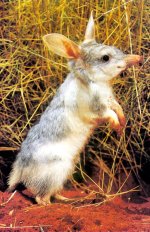
BilbyThe Greater Bilby (Macrotis lagotis) is a marsupial, wearing its pouch backward to prevent any dirt coming in while digging. The other species in the genus Macrotis, the Lesser Bilby is extinct since the 1950s, because of fur trapping and the introduction of foxes and competition with introduced rabbits. The Greater Bilby is a nocturnal animal which live under the ground in burrows. Its diet consists of insects and their larvae which they search by digging small holes about 10 centimeters deep. They do not need to drink water as they get that from their food. Their numbers greatly declined because of the same reasons as the extinction of the Lesser Bilby. Bilbies have a long muzzle, characteristic to bandicoots and very long ears. There have been succesful reintroduction programs of the Bilby in Western and Southern Australia once rabbits, cats, and foxes are removed.

Links

Queensland government Environmental Protection Agency - Bilby

You can help spreading the word about this animal by stumbling it by pressing this link StumbleUpon

one comment - Permanent Link

Friday 22 September 2006 Coyote - slender brother of the wolf

Coyote The coyote (Canis latrans) can only be found in North America. Besides the raccoon, it is one of few animals that increased their population with human settlement. They are occupying territories formerly owned by wolves and are feeding on garbage in urban areas. Despite their underfed appearance, that is just the way they look, much smaller than the gray wolf, their close relative. Coyotes can hybridize with gray wolves and domestic dogs. Watch a movie on coyotes here.
You can help spreading the word about this animal by stumbling it by pressing this link StumbleUpon

Add your thoughts about this animal - Permanent Link

Monday 18 September 2006 Crab-eating macaque

Crab-eating macaqueThe Crab eating macaque (Macaca fascicularis) lives in South-east Asia. It is also known for the fact that it is one of the monkey species flown into space. Despite its name, it practically is an omnivore and eats anything it can get its hands to. Its diet is composed of fruits and seeds by 60 - 90%. Where crab-eating macaques live close to humans, this omnivorous behavior will become a problem and the macaque is seen as a crop-raider and a litterer, pushing over garbage cans to look into them for food. The Crab-eating Macaque's native range is the widest of any monkey. Partly because the wild harvest of macaques for medical testing has ended, because these are captive-bred now... Depending on the source, they are "near threatened" or "Lower Risk - Not Threatened".

Image by Andrew Lih, licensed under ShareAlike 2.0.

You can help spreading the word about this animal by stumbling it by pressing this link StumbleUpon

Add your thoughts about this animal - Permanent Link

Monday 11 September 2006 Desert cottontail - quite the athlete

Desert cottontailThe Desert cottontail (Sylvilagus audubonii) is found mainly in arid regions, giving it the common name desert cottontail. This species is somewhat less productive than are others in the genus; desert cottontails produce only about 5 litters per year. Once startled, it may freeze, or run to hide. The Desert cottontail has more athletic ability than the others in its genus, Sylvilagus, having the ability to swim and to climb trees and brush piles.
You can help spreading the word about this animal by stumbling it by pressing this link StumbleUpon

Add your thoughts about this animal - Permanent Link

Sunday 03 September 2006 Steller's sea cow

Stellers sea cowSteller's Sea Cow (Hydrodamalis gigas) is an extinct mammal from the order Sirenia in the animal kingdom, which also includes the manatee and dugong. It got its name from the man who discovered it, Georg Steller. The Steller's Sea Cow was hunted to extinction in the 18th century, only 30 years after its discovery. It was slaughtered for its meat and leather. It could way up to 11,000 kilograms. The Steller's sea cow did not have any teeth and did not need to, as it ate algae and sea grass. Herds included juveniles, as well as adult males and females. Juveniles were kept in the center of the herd to protect them. Steller (its discoverer) noted that the animal was monogamous and the pair bond was quite strong. He also noted that the sea cow could only be submerged for about four to five minutes. This makes the sea cow an easy target for hunters.

From wikipedia on the Steller's sea cow: "There are still sporadic reports of sea cow-like animals from the Bering area, the Arctic, and Greenland, so it has been suggested that small populations of the animal may have survived to the present day. This remains so far unproven."

The thumbnail of the Steller's sea cow is not quite clear, Click here for a larger version of the drawing of a Stellar's Sea Cow circa mid 18th century.

You can help spreading the word about this animal by stumbling it by pressing this link StumbleUpon

nine comments - Permanent Link


Animal of the Day
Subscribe to the
animal of the day
Enter your Email


Powered by FeedBlitz