Subscribe to
"Animal of the day"

AddThis Feed Button
Or subscribe by e-mail

Enter your Email


Powered by FeedBlitz

We hope that reader will gain an increased appreciation of the need for more conservation measure in order to protect the beautiful creatures that inhabit the earth. Our philosophy is that the more we learn about animals, the more we respect them and take better care of them. That is why we update this blog with new animals, We encourage you to syndicate our content by adding "animal of the day" to your own blog! (read more)

About us

Our mission is to get people excited about animals and their welfare by writing articles on these animals. We encourage people to comment on posts and share with others. Don't forget to subscribe to our feed.

Contact us
Copyright notice

Cutest pet ever - cutest pet contest

Funny animal videos and pictures

Swimming with manatees - harmful or helpful

Last Comments

Tima (Bottlenose dolphi…): J. David Smith, Ph.D., a …
Coda Plant (Pudu - smallest d…): Hey. I live in Northern C…
Michael Newton (Koala video): i love you mr. koala
Tohru (Asian Golden Cat): I hate them too! They are…
tiffany (Asian Golden Cat): i love this cat i’m doing…
BK (Nubian Ibex - The…): Magnificent animal, espec…
amanda (Long-nosed cusima…): thhisanimal is so so so s…
misscrient (Muskrats - Water-…): Third paragraph last sent…
rudy (Deer Mouse - The …): that is so cool ilove lea…
Nick (Fattest cat in th…): “The cat is not over fed.…

Calendar

« November 2009
S M T W T F S
1 2 3 4 5 6 7
8 9 10 11 12 13 14
15 16 17 18 19 20 21
22 23 24 25 26 27 28
29 30          

Archives

Next Archive Previous Archive

01 Nov - 30 Nov 2009
01 Oct - 31 Oct 2009
01 Sep - 30 Sep 2009
01 Aug - 31 Aug 2009
01 Jul - 31 Jul 2009
01 Jun - 30 Jun 2009
01 May - 31 May 2009
01 Apr - 30 Apr 2009
01 Mar - 31 Mar 2009
01 Feb - 28 Feb 2009
01 Jan - 31 Jan 2009
01 Dec - 31 Dec 2008
01 Nov - 30 Nov 2008
01 Oct - 31 Oct 2008
01 Sep - 30 Sep 2008
01 Jul - 31 Jul 2008
01 Jun - 30 Jun 2008
01 May - 31 May 2008
01 Apr - 30 Apr 2008
01 Mar - 31 Mar 2008
01 Feb - 28 Feb 2008
01 Jan - 31 Jan 2008
01 Dec - 31 Dec 2007
01 Nov - 30 Nov 2007
01 Oct - 31 Oct 2007
01 Sep - 30 Sep 2007
01 Aug - 31 Aug 2007
01 Jul - 31 Jul 2007
01 Jun - 30 Jun 2007
01 May - 31 May 2007
01 Apr - 30 Apr 2007
01 Mar - 31 Mar 2007
01 Feb - 28 Feb 2007
01 Jan - 31 Jan 2007
01 Dec - 31 Dec 2006
01 Nov - 30 Nov 2006
01 Oct - 31 Oct 2006
01 Sep - 30 Sep 2006
01 Aug - 31 Aug 2006
01 Jul - 31 Jul 2006
01 Jun - 30 Jun 2006
01 May - 31 May 2006
01 Apr - 30 Apr 2006
01 Mar - 31 Mar 2006
01 Feb - 28 Feb 2006
01 Jan - 31 Jan 2006
01 Dec - 31 Dec 2005
01 Sep - 30 Sep 2005
01 Aug - 31 Aug 2005
01 Jul - 31 Jul 2005

Animal posters
Animal pictures
Mammals.start4all.com
Animal diversity web
Recently extinct animals forum
PetLvr.com
Another chance to see
Happiness is a warm puppy

Miscellany

AddThis Feed Button

Sunday 29 April 2007 Musky rat-kangaroo

Musky Rat-kangarooThe Musky Rat-kangaroo (Hypsiprymnodon moschatus) is the smallest kangaroo that has been most recently classified in the Hypsiprymnodontidae family along prehistoric rat-kangaroos. Some earlier scientists classified it as a Hypsiprymnodontinae subfamily belonging to the Potoroidae family. It generally dwells in the dampest areas, near rivers and creeks, of tropical rainforests in northeast Australia and New Guinea. It inhabits no other places but the lowlands and up to 1200 meter- highlands of the Wet Tropics. This terrestrial marsupial nests on a dwelling of dried fern and leaves usually in a Lawyer Vine clump.

The Musky Rat-Kangaroo is the smallest among macropods. The length is an average of about 230 millimeters and the weight about 520 grams, making the creature the smallest among all kangaroos. Its size is like a big guinea pig or a lot smaller brushtail possum or rabbit. Its closest modern-day living relatives are the wallabies and kangaroos. Aside from being the smallest, it is also considered as most primitive among macropods, with features similar to those of ancestors that resembled possums. This marsupial is the kangaroo family's only remaining member that retained a prehensile tail, which measures about 145 millimeters. The tail is scaly and bare, and it reminds one of glossy leather. Like possums and unlike kangaroos, it also has an opposable digit and first toe on its hind foot, enabling it to climb up fallen trees and branches. This marsupial can also have more than just one young in its pouch unlike the single baby trait of a kangaroo.

It feeds mainly on fruits and seeds at daytime. The Musky Rat-Kangaroo plays a vital role as a dispersal agent in the regeneration of plants in rainforests. It also eats small invertibrates. Its stomach, however, is simpler than those of its macropod relatives.

Interesting fact: Unlike kangaroos that jump on two legs, the musky rat-kangaroo hops like a bunny on all of its four legs. It pushes its longer hind legs in front outside its shorter fore legs when galloping.

Picture by PanBK, licensed under GFDL

You can help spreading the word about this animal by stumbling it by pressing this link StumbleUpon

Add your thoughts about this animal - Permanent Link

Friday 27 April 2007 Southern Right Whale Dolphin

The Southern Right Whale Dolphin (Lissodelphis peronii), in German, it is 'Südlicher Glattdelphin', in French it's 'Dauphin aptère austral'. Among the sea creatures, they are very recognizable. They have a "patented" black/white facade and the absence of the fin (back is the black side). Newly-born individuals are dark grey, then the hues would change after its first year of existence.

A Southern Right Whale Dolphin can be found in any of the following areas: the Chatham Islands, Great Australian Bight, Tasman Sea and other parts of the globe. However, the Southern Right Whale Dolphins remains on temperate aquatic habitats, with the most number of records at the Antarctic Convergence territory. A Southern Right Whale Dolphin is rarely seen near lands, but records also show that they have been found in coastal areas off Chile and near New Zealand.

The Southern Right Whale Dolphin can travel very quickly and they do it via a set of long, low jumps. If you would see one in motion, you'll get the impression that it is bouncing and not swimming. When they move, they cause very little disturbance on the water, the Southern Right Whale Dolphin exposes just a fraction of the head/back when going up for air. Belly-flopping, slapping at the sides, lobtailing...all of these actions have been noted. A dive could be from six minutes upwards. They have different mindsets when it comes to moving, others opt for a close approach, while others would veer away from sea vehicles.
You can help spreading the word about this animal by stumbling it by pressing this link StumbleUpon

Add your thoughts about this animal - Permanent Link

Friday 27 April 2007 Spectral Tarsier

Spectral tarsierThe Spectral Tarsier (Tarsius spectrum) is a member of the Tarsier family and living on the island of Sulawesi, Indonesia, and is also reffered to as 'Sulawesi Tarsier'. It is about 25 centimeters long and weighs 94–154 grams. They sleep in hollow trees, palm trees, or thick vines. Spectral Tarsiers are not very social animals, they encounter each other only once in a while during the night when they feed on insects. During the day they sleep most of the time and socially interact only a short time of the day. They are polygamous, female spectral tarsiers give one birth a year and the gestation period lasts 190 days.

Interesting fact: The Spectral Tarsier is a world record holder: it has the largest eye to body size ratio of all mammals.

Picture of the Spectral Tarsier by Bwmodular, licensed under GFDL

You can help spreading the word about this animal by stumbling it by pressing this link StumbleUpon

two comments - Permanent Link

Thursday 26 April 2007 Baiji

Baiji.jpgBaiji (Lipotes vexillifer), was found in the China's Chang Jiang river, and also at the lower areas of Quintangjiang River. They are 'functionally extinct', meaning that they are alread extinct, or that there are no Baiji to save the species from extinction. Baiji are freshwater dolphins. Consistent with the body of dolphins, they have streamlines forms. A Baiji has rounded flippers, beak-like snouts and totally devoid of hair. Eyes are small but operational, the blowholes are shaped elliptically. Baijis possess a combination of colors, blue-gray mixed with white. These dolphins possess no forestomach, but the main stomach is made up of 3 compartments.

The female Baiji measures on the average from 1.85 m to 2.53 m, weighing at anything from 64kgs to 167. The males on the other hand would be from 1.41 m to 2.16 m, weight's range is from 42 to 125 kgs.

The breeding period of the Baiji only occurs every 2 years, and their mating period goes to a peak during autumn and spring. The reproductive maturity of the distaff side is from 3 to 8 years, the same goes to the male side.

Their longevity could reach up to 24 years, but that is in the wild. These dolphins ordinarily go in pairs, and they could join up with other pairs, forming a set of about ten. During nighttime, they stay in territories of slow current, but they are classified as diurnal. They use echolocation as a means of navigation and search for food, and in communicating, they whistle to each other. Their diet consists of fish, and they probe the bottom using their impressive beaks. A typical dive is very brief, not exceeding 20 seconds.

The Baiji has been labelled by China as a national treasure "of the first order".

Interesting fact: Many times before, the fat of dead Baijis was utilized for medicinal objectives and the flesh was eaten.

Picture of the baiji by Alessio Marrucci, licensed under GFDL
You can help spreading the word about this animal by stumbling it by pressing this link StumbleUpon

Add your thoughts about this animal - Permanent Link

Thursday 26 April 2007 Vaquita

The Vaquita (Phocoena sinus) goes by so many names, among them are Gulf of California Harbor Porpoise, Cochito and Gulf of California Porpoise. Most common however is Vaquita, a porpoise that weighs an average of 55 kgs. The females are a bit bigger. At a typical Vaquita's mouth are 34-40 teeth, with a slender physique. The Vaquitas' body (slender) is thought of to help heat dissipation.

One could see a Vaquita alone or with others. Just like other phocoenids, a Vaquita utilizes sonar to communicate and to move about. A Vaquita could be found at the Gulf of California in the undeep areas. They live in warm aquatic habitat. The Vaquita can stand the changes in temperature of the Gulf of California, which range from 14 to 36 degrees celsius. Their diet mainly consists of bony fish and squids.

They reach sexual maturity around 3 to 6 years, and they give birth seasonally. Gestation time frame is 10.6 months. The males engage in mating with as many of their females as they could. Ovulation of the female does not happen annually, thus, giving birth every year is not possible. At present, they are now categorized as critically endangered, just hundreds are still alive. These porpoises get entangled from fishing equipment, like the nets for shrimps. These sea animals are also constantly at risk due to a case of mistaken identity, they are very similar to the size of a seabass-like called Totoabo, and the hunting for the latter remains present. As such, both kinds of animal are under threat.
You can help spreading the word about this animal by stumbling it by pressing this link StumbleUpon

Add your thoughts about this animal - Permanent Link

Thursday 26 April 2007 Indus river dolphin

Indus river dolphinThe Indus River dolphin (Platanista minor) is listed as 'endangered', experts/researchers think that there are still (give or take) 1,100 of them. Still, for the record, it is the 2nd most threatened freshwater dolphin, and the decline over the years could be attributed to various causes. Just to mention a few: poaching, water pollution, destruction of their natural habitat and those getting stranded. When the irrigation system of the Indus commenced, the dramatic decline of these dolphins began.

Indus River dolphins are recognized by the long beak, circular belly, stocky physique, tiny dorsal fin and the big flippers...and speaking of the eyes, they are called "blind river dolphins", their eyes do not have a lense, yet, just like many of their relatives, echolocation helps them position themselves. (Echolocation is the sound sensory process that makes them capable of locating prey even in the mud).

An Indus River dolphin navigates on one side, they could even move in shallow water, something like 30 centimeters deep. In moving as such, this is how they go: after about half to a full minute, when the Indus River dolphin is running out of breath, it breaks out of the surface. It rotates (upright) to get in oxygen, rotate again by ninety degrees and then return under the surface (a pretty elaborate performance, even for dolphins).
You can help spreading the word about this animal by stumbling it by pressing this link StumbleUpon

Add your thoughts about this animal - Permanent Link

Thursday 26 April 2007 Ganges river dolphin

Also called 'susu', the Ganges River Dolphin (Platanista gangetica) can range from 2.3 up to 2.6 meters in length, and the distaff side is usually bigger than the male ones. Coloration are gray to black, but with a lighter shade present at the ventral part. Its tail fluke has an impressive width of 46 centimeters, end to end. Ganges River Dolphins have sloped foreheads and dorsal fins - which is not that obvious to the human eye.

Neck flexibility is something the Ganges River Dolphin does not have, and its eyesight is also bad. They are not capable of building images in their retinas. Still, this dolphin could detect light and go after prey via echolocation process. They are known to swim at any part of the day, and while at it, they ceaselessly produce sounds (they never get tired, in both the swimming and the noise-making).

Groups of three up to ten members have been seen in the past, but more often than not, "alone" is the apt word for the Ganges River Dolphin. Longevity is quite impressive, it is thought of by many researchers that it could reach 26 years, but that naturally, is the average.

These animals are primarily found in the India, Nepal, Bhutan, and Bangledesh in the Ganges, Brahmaputra, Meghna, Karnaphuli, and Hoogli river systems. In dry seasons, they are inclined to migrate, leaving places where the temperatures go up drastically. Not only the temperatures, but also the salinity of the water.

The Ganges River Dolphin consists mainly of fish and shrimps. According to IUCN, these dolphins are now 'vulnerable.

Interesting fact: Why are Ganges river dolphins called "susu"? Answer: this is very close to the sounds (sneeze-like) they produce when breathing.
You can help spreading the word about this animal by stumbling it by pressing this link StumbleUpon

Add your thoughts about this animal - Permanent Link

Thursday 26 April 2007 Mountain Pygmy Possum

Mountain Pygmy-possum (Burramys parvus) is actually Australia's biggest pygmy-possum, out of 5 breeds. That is not to say that its bulk is impressive, on the contrary, the lack of size IS impressive. One could just fit in right inside your palm. The mouse-like creature has a grey fur, long tail, flexible front feet, back feet built for gripping purposes, and pronounced teeth.

Mountain Pygmy-possums can only be found in certain localities of Australia, namely: alpine/sub alpine parts above 1400 meters, in NSW and Victoria. The typical Mountain Pygmy-possum resides in crevices of rocks. They feed during the night. During trying times, they gather reserves by eating principally Bogong moths, but in more favorable times, they would eat plant seeds too.

There are very few marsupials which hibernate, and the Mountain Pygmy-possum is one of those. In hibernating, their metabolic rate is cut down by around 98%. They are known to hibernate for at least 3 weeks, in the coldest months.

The Mountain Pygmy-possum is not safe from extinction at present. Predators such as wild cats and foxes are of course, an ever-present danger to them. Then, there is the destruction of their habitat due to human factors/actions (like skiing, resort developing). Owing to the fact that these possums need a level (snow) of 1 meter (no less), any climate transformation has great impact on their survival.

Interesting fact: These possums were considered extinct until they were found at a ski chalet, sometime in the mid 1960s.
You can help spreading the word about this animal by stumbling it by pressing this link StumbleUpon

one comment - Permanent Link

Thursday 26 April 2007 Vietnam leaf-nosed bat

The Vietnam leaf-nosed bat (Paracoelops megalotis) is known thanks to just one specimen, and only God knows if man would chance upon a second one anytime in the future. They are recognized by their very big ears, rounded in the top area. A lot of scholars/experts assert that they may be extinct by now, but that is just speculation at best.

Vietnam leaf-nosed bats belong to Hipposiderinae, and this in turn has eighty-one species. These bats are unique, as they are the singular representatives of Paracoelops, a genus. Going back to the physical attributes, the Vietnam leaf-nosed bat's muzzle is characterized by a leaf-like extension of skin, and this is speculated to be of sensory functions for them. Head's top is a shiny yellow, but its ears are brown, of the light shade.

The Vietnam leaf-nosed bat has not been analyzed at depth, and as such, almost everything falls under the realm of guesses and speculations. Chances are though, experts cannot be wrong when they say that the Vietnam leaf-nosed bat is nocturnal. These bats capture insects (at flight) via echolocation, and this means ultrasonic sounds given out from the nose or mouth.

There are those that live in the woodlands, but aquatic environments are not impossible, for there exist so many kinds of insects in there. That is about it, let us go through the salient points (rather, what should be the salient points if the data are there)- population trend is unknown. Mating processes: basically unknown too. It is sad to think that this would remain to be one of the "grand mysteries" of the animal world, but who knows...somebody might just discover something, somewhere?

However, there is a relative that is known, the Riversleigh Leaf-nosed Bat, which frequents limestone dwellings. This is a rare creature that is still present in Riversleigh territory.

Interesting fact: Generally, bats' fossils records are scant, and to date, there is no fossil of this particular bat.
You can help spreading the word about this animal by stumbling it by pressing this link StumbleUpon

Add your thoughts about this animal - Permanent Link

Thursday 26 April 2007 Sumatran Striped Rabbit

The Sumatran Striped Rabbit (Nesolagus netscheri) is very close to extinction. According to world experts, Sumatran Striped Rabbits are now standing as the globe's rarest rabbit.

A Sumatran Striped Rabbit lives in Sumatra's Barisan Mountains. Due to their isolation, very little data have been accumulated as far as they are concerned. One thing is for sure though, they are creatures of the night, letting day hours slide by as they hide in burrows. The Sumatran Striped Rabbit resides in what is called Sundaland Biodiversity Hotspot. This hotspot is also the environment for thirteen other critically threatened breeds of animals. The Sumatran Striped Rabbit warns its kind in moments of threats by thumping on the ground.

It has a striped covering, usually the fur is decorated with brown stripes. They have colorless underbellies, fiery tails, and the body weighs around one and a half kilograms. Whether by laziness or fear from predators, they do not go out to look for their foods. What they do is simple: staying under a tree, surviving on plants growing just around them, that means leaves/stalks.

Litter size ranges up to 6 offsprings in a birth. Longevity could run up to close to a decade.

Interesting fact: Just some months ago, this kind of rabbit was photographed, and it was just the 3rd time that this striped rabbit was viewed by the human eye. Third time in 35 years.
You can help spreading the word about this animal by stumbling it by pressing this link StumbleUpon

Add your thoughts about this animal - Permanent Link

Thursday 26 April 2007 Northern Hairy-nosed Wombat

Northern Hairy-nosed Wombats (Lasiorhinus krefftii) are basically terrestrial, and they live above and under ground. A typical Northern Hairy-nosed Wombat could be found on semi-arid areas, grasslands and the woods.

Some people might call them "ugly", but they are heavily-built. The body averages 1 meter, and its head is big. On record, they are among the globe's biggest burrowing creatures. Both sexes of the Northern Hairy-nosed Wombat are covered with brown coat, a soft kind of covering. Northern Hairy-nosed Wombats possess long whiskers coming from the nose area.

Unlike other animals whose reproduction periods go all the way from January to December, the Northern Hairy-nosed Wombat only has a single mating period. A Northern Hairy-nosed Wombat ordinarily gives birth to a solitary offspring.

It is a loner kind of creature, and as such, very difficult to observe if not under captivity. It is known though, that they build big and elaborate tunnels in sand areas. As the roof for these tunnels, they use roots. This is the fascinating part: individuals seldom utilize the same tunnel simultaneously, but they use burrows owned by past generations of wombats.

They are nocturnal, but that is not to say they hide from the sun's rays. They sunbathe in the early hours of the day, but they stay near their tunnels.

Interesting fact: For the longest time, these wombats have been hunted, its fur holds high market costs.
You can help spreading the word about this animal by stumbling it by pressing this link StumbleUpon

Add your thoughts about this animal - Permanent Link

Thursday 26 April 2007 Riverine Rabbit

A Riverine Rabbit (Bunolagus monticularis) usually weighs about 1.9 kilograms, and have a white ring around the eye area and a black mark going from the mouth's end over the cheeks. They are found near the bodies of water of Cape Province (South Africa). Riverine Rabbits are basically nocturnal and here is something you'll find either funny or amusing. We all know what the expression 'breed like rabbits' means right? It does not apply to this species of rabbit. A Riverine Rabbit's birth season is between August up to May, and want to know they have just one young, two per year is actually very rare (this could also be a reason, not for the decline of their numbers, but it does not help at all). Their mating system is polygamous in nature.

Way back in 1902, the first Riverine Rabbit became known to the scientific world. They were seen many times from that particular year up to 1948, but after that, all sightings stopped. Then, they were seen again in 1979, it makes us all wonder where they all hid during that interim.

Just like so many other kinds of animals, their numbers are on the decline. Changes in agriculture lead to habitat damage/losses, and this remains to be the principal threat to these rabbits. Not just that though, lumber industry and grazing of livestock, attacks from stray dogs also contribute to this sad decline.

The Riverine Rabbit is in essence a browser, it eats leaves and flowers. During the wet season, they also survive on grass.

This rabbit is the singular African rabbit whose females make underground burrows for the newborns. It is a nest made of fur and grasses.

Interesting fact These rabbits produce 2 kinds of droppings, yes, 2 kinds. Nighttime, droppings are hard like pellets, while in daytime, they are soft. These soft droppings are re-ingested.
You can help spreading the word about this animal by stumbling it by pressing this link StumbleUpon

Add your thoughts about this animal - Permanent Link

Thursday 26 April 2007 Long-eared Jerboa

Long-eared Jerboas (Euchoreutes naso) are found at the Palearctic region. They opt to stay in sand-filled valleys populated by low bushes, and they could also be found in semi-desert areas. The long-eared Jerboa has also been found in the Qing-Zang Plateau, which is cold and high.

The Long-eared Jerboa is layered with short hair, its upper parts possess a combination of red and yellow. Its belly is white, while the feet are covered with bristly hair. Their incisors are white and thin.

The breeding period of the Long-eared Jerboa occurs twice per season, and this mating act happens right after one has awoken from hibernating. The average number of young ranges from two to six. Very little is known when it comes to how they take care of their young. What is actually known is that the female parent nurses the newborns until the weaning period.

They are presumed to be principally nocturnal, just like their relatives. Specific manners of communicating with each other have not been established, still, it is not farfetched to assume that just like their cousins, they engage in dust bathing, which can be considered a kind of chemical communication. These jerboas' hearing insinuates that they utilize vibrations to talk to one another.

Little owls are considered as one of the most common predators of these jerboas.

Interesting fact: They are capable of eating flying insects. The long-eared Jerboa utilizes sounds to pinpoint the location of the prey. After which, they do a very quick leap to catch the flying prey.
You can help spreading the word about this animal by stumbling it by pressing this link StumbleUpon

Add your thoughts about this animal - Permanent Link

Thursday 26 April 2007 Tonkin snub-nosed monkey

The Tonkin Snub-nosed Monkey (Pygathrix avunculus) weighs approximately 15 kgs (male), and they are located in subtropical lowlands and forests on limestone territory. The Tonkin Snub-nosed Monkey is endemic to some parts of North Vietnam, and in 1947, it was alleged that the only occurrences were from a Song Koi River area (forests). In the late eighties, experts thought they were extinct. However, sightings resumed in 1989 or thereabouts.

Still, it cannot be denied that their numbers are on the way down, and this is caused mainly to the loss of their abode due to hunting and ground-cultivation. If the experts are to be believed, at least seventy percent of the original habitat of the Tonkin Snub-nosed Monkeys had been annihilated. The fact is, from 1996 to 2004, the IUCN has categorized the Tonkin Snub-nosed Monkey as Critically Endangered. Commercial acquisition of bamboo is also a contributor to this annihilation.

Foods of the Tonkin Snub-nosed Monkey are basically leaves, and this includes bamboo leaves, and fruits also. The fruits are consumed basically during the autumn days.These monkeys are arboreal, and there had been no reports that they could navigate through water.

The social organization of these monkeys is basically a single-male clique. Every group is made up of that one male, then many females plus their young. Norm-wise, the size is about fifteen individuals, but that is far from being conclusive. These groups congregate at sleeping places and while feeding. Sometimes, they journey as a "pack".

At present, is has been estimated that less than 300 of these monkeys are still existing. They have been given the strongest priority (conservation) in the IUCN/SSC Asian Primate Action Plan, although if it came too late, would be very hard to determine.

Interesting fact: Males without a regular social group would form a "stag' group, meaning to say, an all-male congregation.
You can help spreading the word about this animal by stumbling it by pressing this link StumbleUpon

Add your thoughts about this animal - Permanent Link

Thursday 26 April 2007 Lumholtz's Tree-kangaroo

Lumholtz's tree kangaroo In general, tree-kangaroos hold special body traits that allow them to live up in the trees, and these are: unusually long tail, stronger limbs in front, bigger hind legs, curved claws and "spongy soles" which help them to grip well when climbing any tree. The Lumholtz's Tree-kangaroo (Dendrolagus lumholtzi) may be the smallest of its kind, while the Bennett's Tree Kangaroo is among the biggest. A Lumholtz's Tree-kangaroo head, face, shoulder, upper back, parts of the hindfeet, front paws, belly area, and a part of the tail are brown and black. Its lower back has a light-coloured covering, and Lumholtz's Tree-kangaroos have a fur running at the forehead's area, serving as a - just like a basketball player- a sweat band. Its ears are both rounded and short, while the undersurface of its body and the inside of the legs are a mix of grey and yellow. The male Lumholtz's Tree-kangaroo holds an orange hue at the belly, but this is a seasonal thing. Principally, these kangaroos are leaf-consumers, but they sometimes survive on flowers and fruits, if they are in a rainforest territory. Experts have also noted that a Lumholtz's Tree-kangaroo could eat leaves of lantana/wild tobacco, which are both invasive plants.

We are all used to reading an animal (whatever it may be), as either diurnal or nocturnal, but this kangaroo is something else. they fall under 'cathemeral'. This principally means they are active (intermittent) within the 24-hour frame of a day. In a brief sleeping session...of around an hour, its head just sinks within its chest, that or between the feet, all depends on where the kangaroo is. The experts have a strong hypothesis, and it is an intelligent one. As an end-product of low-energy diet, requirement of oneself to eat consistently prevents them from a longer sleeping period (it reminds me of some friends actually).

Interesting fact: These kangaroos are able to move their hind feet in independent fashion, and tree-kangaroos in fact, are the singular kangaroos which could navigate backwards...
You can help spreading the word about this animal by stumbling it by pressing this link StumbleUpon

Add your thoughts about this animal - Permanent Link

Thursday 26 April 2007 Banded Linsang

The Banded Linsang (Prionodon linsang)

The word "Linsang" comes from Malay, and it means animal, this particular Linsang resides in Southeast Asian territories. The Banded Linsang is magnificent to look at, slender, with a thin head, pronounced snout and a coat that is not overflowing. Overall hue of this covering is pale, but it is not impossible to see some Banded Linsangs with dark spots. The ringed tail is quite thick and its claws are retractile. The coat is soft and velvety, and the spots found at the back of this animal blend together, forming 5 bands, irregularly-shaped.

A typical Banded linsang's body/head are measured at about .38m, the tail about the same length. The Banded Linsang is solitary, nocturnal in the wild, and they live in trees (but of course, they go down on certain occasions). You'll be very surprised if you see one living off a tree. This Linsang could move very fast at ground level, and it is a strong predator when it comes to tiny insects/vertebrates. In hunting, their bodies move like a snake, disguised by their coverings. Their diet mainly consists of lizards and birds, rats and squirrels...those are their favorites.

The reproduction period takes place twice a year, those are in August and February. Female Banded Linsang produces 2 or 3 newborns in a burrow or a shelter from a tree, and these newborns would only open the eyes after more or less 20 days. The male newborns leave after just a short time after weaning, and why this is so...even the experts can only speculate. (This is still one of the more mysterious creations from the animals' world.)

Lastly, these linsangs also make appearances in Indonesia and Malaysia...but those are the spotted linsangs.

Interesting fact: These linsangs are among the rarest in the world of civets.
You can help spreading the word about this animal by stumbling it by pressing this link StumbleUpon

Add your thoughts about this animal - Permanent Link

Wednesday 25 April 2007 Dusky Antechinus

Dusky antechinus Dusky Antechinus (Antechinus swainsonii) is a carnivorous marsupial belonging to the Dasyuridae family. It is also called the Swainson's Antechinus. It occurs in the Australian mainland's southeast coastal regions from southwestern Victoria to southeastern Queensland and can be found in the island of Tasmania too. They nest either in ground vegetation or thick litter of leaves on forest floor or in a hollowed log in areas of sclerophyll forests and rainforests. It is a terrestial marsupial.

Although it is just of typical size, the dusky antechinus is already the largest among the species of antechinus. The body of this marsupial has a length of around 121 centimeters. The average weight for males is 65 grams, and sexual dimorphism is present as females have an average of only 41 grams. It looks like a shrew or a mouse, complete with long tail. The dusky anthechinus has two forms, a pale one and a darker form. However, both forms with fur color ranging from black to dark grey are still visibly darker compared to its distant relatives. The color of this animal becomes even darker on its feet, sides, and anal area.

Like many marsupials, this animal is a solitary nocturnal creature. It spends the day alone in its nest and hunts for food at night. As a carnivore, it devours invertebrates like insects and worms with an intense appetite and also hunts small birds, mice, skinks and lizards. When it eats a bony meal like a mouse or a bird, it has a strange habit of neatly turning the skin of its prey inside out in the process of devouring it. Its diet is supplemented by nectar, flowers, and some vegetable matter.

The dusky antechinus, like its swamp antechinus relative, has a distinguished copulation biology that happens for a short period during winter. The testosterone level of the male rises, and this drives him into a sexual frenzy. As a matter of fact, it competes on a very high intensity level with other males for female partners. In three weeks time, due mainly to high stress brought by physiological changes during copulation, all males die. After a gestation of four weeks, between six and eight babies are born to the females.

Picture from wikimedia, licensed under GFDL

You can help spreading the word about this animal by stumbling it by pressing this link StumbleUpon

two comments - Permanent Link

Tuesday 24 April 2007 hairy-eared dwarf lemur

The Hairy-eared Dwarf Lemur (Allocebus trichotis) is a nocturnal primate, the only member of the genus Allocebus of the family Cheirogaleidae. This species is endemic to Madagascar. Hairy-eared Dwarf lemur has been found at the nature reserves of Mananara, Zahamena, and Vohidrazana in Madagascar. This species lives originally in the primary lowland rainforests.

The hairy-eared dwarf lemur is one of the smallest primates with a weight of only 80 to 100 g (3 -3.6 oz) and a length of 30 cm. It has a galago-like ear. This could mean that it is, together with other cheirogalieds, more closely related to the galagos and lorises than to the lemurs. This species has a relatively longer tongue than the Microcebus and Cheirogaleus specie. The overall pelage color for Hairy-eared Dwarf lemur is gray. It has a brown tail and a face with a white stripe running from the rostrum or nose to between the eyes as well as dark rings surrounding its eyes. Its ears have tufts of brown while its teeth structure and claws are sharp.

It was observed in captivity that males and females tend to groom each other by removing dead skin and parasites before leaving their nest at night. The hairy-eared dwarf lemur leaps frequently among branches of trees, they have been observed to leap more often than members of the genera Cheirogaleus and Microcebus. Although they typically forage and feed alone at night, these lemurs live in social networks with overlapping ranges, and they have occasional contacts mainly based on vocalizations and scent marking during the night. Due to small body size, most vocalizations are relatively high-pitched small-contact, alarm, threat, and range defense.

Interestingly, the hairy-eared dwarf lemur is one of the world's rarest mammals. This species was assumed to be extinct because no specimen had been seen from 1875 until 1966. It was rediscovered in 1966 on the east coast of Madagascar near Mananara. In 1989, two live members were found in the same vicinity, south of the Mananara River. As of 1997, it was still known only from eastern Madagascar near Mananara. The status has been changed from Critically Endangered to Endangered in 1996 due to the discovery of new subpopulations.

The hairy-eared dwarf lemur is trapped and eaten by local inhabitants. Deforestation of its habitat for agriculture and logging is also another reason why it has decreased in population.

You can help spreading the word about this animal by stumbling it by pressing this link StumbleUpon

twelve comments - Permanent Link

Sunday 22 April 2007 Screaming hairy armadillo (Chaetophractus vellerosus)

The Screaming Hairy Armadillo (Chaetophractus vellerosus) is a burrowing mammal that belongs to the family of Dasypodidae. It is found in the western regions of Bolivia and northwestern areas of Argentina, especially in Monte Desert. It digs burrows in the desert, preferably in sloping sand dunes and also in savanna, grassland, and even scrub forests. The burrows are about a meter deep and extend to about several meters in length to protect the armadillo from the excessive heat of the sun.

The Screaming Hairy Armadillo has a built-in protective armor just like other armadillos. This is a shell composed of scutes or plates of thin bones. This armor includes the head shield, the shield on the neck's back between its ears, and the carapace protecting its back, shoulders, rump, and sides. Its carapace has a banded part with 6 to 8 bands movable from a total of 18. More hair, however, grows on the Screaming Hairy Armadillo compared to other species of armadillos. These hairs protrude outward from the body armor's scales. The animal's belly and limbs are full of light brown or whitish hairs. Meanwhile, the head and body length of this animal is from 220 to 400 millimeters, and the weight is 84 kilograms on the average. The length of its tail is from 90 to 175 millimeters. Females are usually smaller than males, but both of them become heavier by winter because of accumulated fat.

Interestingly, it is nocturnal during summer to escape the sun's heat. It solely leaves its burrow and searches for food at night. The armadillo is an omnivore, and its diet consists mainly of plants and insects, particularly beetles. In winter, it mainly feeds on vegetation, but in summer, it eats even snakes, rodents, lizards, and some other small vertebrates. It breeds in autumn with a gestation period that may last between 60 and 75 days. It usually produces two litters with both females and males becoming sexually mature after 9 months.

Interesting fact: The Screaming Hairy Armadillo, aside from its screaming hairs, emits a very loud squeal when threatened, hence its name.

You can help spreading the word about this animal by stumbling it by pressing this link StumbleUpon

one comment - Permanent Link

Friday 20 April 2007 Eastern avahi
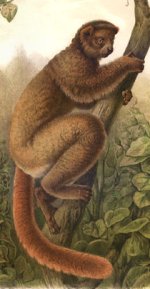
AvahiThe Eastern Avahi (Avahi laniger) is a woolly lemur that lives on Madagascar. They weigh between 600 - 1300 grams and can reach lengths between 30 and 45 centimeters. They belong to the family Indriidae, which also includes the Indri. The Eastern Avahi is similair to the Indri in feeding behavior, both eat the leaf blade, not the midrib or petiole. They live in the same areas. This is possible due to the difference in activity times, the Eastern Avahi is nocturnal, while the Indri is diurnal. Avahis mate for life, stay with each other and raise their young as a family. Avahis live in the trees. When on the ground, avahis stand erect and move with their hands in the air just like sifakas.

Picture from the book "Planche IX. Alfred Grandidier (1875-1921) In: Histoire physique, naturelle et politique de Madagascar. Volume XX. 1892, Paris: Hachette et Cie."

You can help spreading the word about this animal by stumbling it by pressing this link StumbleUpon

Add your thoughts about this animal - Permanent Link

Monday 09 April 2007 Eurasian Badger - master of the "sett"
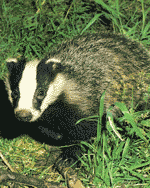
eurasian badger The large underground catacombs in which they live are called "setts". Badgers (Meles meles) inherit these setts from their parents, who inherited them from theirs and so forth. It is believed that some setts are actually centuries(!) old. Although studying badgers is difficult, as they mostly live underground, researchers in england excavated a sett to reveal a massive 879 meters of tunnels, 50 chambers, and 178 entrances. They estimated that its construction required the removal of 70 tons of soil! (source)

You can help spreading the word about this animal by stumbling it by pressing this link StumbleUpon

Add your thoughts about this animal - Permanent Link

Friday 06 April 2007 Pygmy rabbit
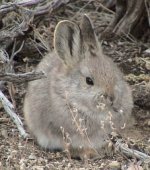
Pygmy rabbitThe Pygmy Rabbit (Brachylagus idahoensis) is the smallest rabbit species in North America and can easily fit inside one's hand palm. The pygmy rabbit is only one of two rabbits in America which diggs its own burrows and does it extensively, with interconnecting chambers. They can be found at elevations of 1,370 to 2,135 meters (in Nevada) and 1,520 to 1,615 meters (in California). The Pygmy Rabbits' diet consists mainly of sagebrush. Predators of the pygmy rabbit are bobcats, coyotes, weasels, badgers, owls and foxes, but also humans. The IUCN lists the Pygmy rabbit as 'near threatened', certain subspecies are near extinction.

Links

Animal Diversity web on Brachylagus idahoensis
Wikipedia
PacificBio.org on the Washington Pygmy rabbit

You can help spreading the word about this animal by stumbling it by pressing this link StumbleUpon

four comments - Permanent Link


Animal of the Day
Subscribe to the
animal of the day
Enter your Email


Powered by FeedBlitz