Subscribe to
"Animal of the day"

AddThis Feed Button
Or subscribe by e-mail

Enter your Email


Powered by FeedBlitz

We hope that reader will gain an increased appreciation of the need for more conservation measure in order to protect the beautiful creatures that inhabit the earth. Our philosophy is that the more we learn about animals, the more we respect them and take better care of them. That is why we update this blog with new animals, We encourage you to syndicate our content by adding "animal of the day" to your own blog! (read more)

About us

Our mission is to get people excited about animals and their welfare by writing articles on these animals. We encourage people to comment on posts and share with others. Don't forget to subscribe to our feed.

Contact us
Copyright notice

Cutest pet ever - cutest pet contest

Funny animal videos and pictures

Swimming with manatees - harmful or helpful

Last Comments

Tima (Bottlenose dolphi…): J. David Smith, Ph.D., a …
Coda Plant (Pudu - smallest d…): Hey. I live in Northern C…
Michael Newton (Koala video): i love you mr. koala
Tohru (Asian Golden Cat): I hate them too! They are…
tiffany (Asian Golden Cat): i love this cat i’m doing…
BK (Nubian Ibex - The…): Magnificent animal, espec…
amanda (Long-nosed cusima…): thhisanimal is so so so s…
misscrient (Muskrats - Water-…): Third paragraph last sent…
rudy (Deer Mouse - The …): that is so cool ilove lea…
Nick (Fattest cat in th…): “The cat is not over fed.…

Calendar

« November 2009
S M T W T F S
1 2 3 4 5 6 7
8 9 10 11 12 13 14
15 16 17 18 19 20 21
22 23 24 25 26 27 28
29 30          

Archives

Next Archive Previous Archive

01 Nov - 30 Nov 2009
01 Oct - 31 Oct 2009
01 Sep - 30 Sep 2009
01 Aug - 31 Aug 2009
01 Jul - 31 Jul 2009
01 Jun - 30 Jun 2009
01 May - 31 May 2009
01 Apr - 30 Apr 2009
01 Mar - 31 Mar 2009
01 Feb - 28 Feb 2009
01 Jan - 31 Jan 2009
01 Dec - 31 Dec 2008
01 Nov - 30 Nov 2008
01 Oct - 31 Oct 2008
01 Sep - 30 Sep 2008
01 Jul - 31 Jul 2008
01 Jun - 30 Jun 2008
01 May - 31 May 2008
01 Apr - 30 Apr 2008
01 Mar - 31 Mar 2008
01 Feb - 28 Feb 2008
01 Jan - 31 Jan 2008
01 Dec - 31 Dec 2007
01 Nov - 30 Nov 2007
01 Oct - 31 Oct 2007
01 Sep - 30 Sep 2007
01 Aug - 31 Aug 2007
01 Jul - 31 Jul 2007
01 Jun - 30 Jun 2007
01 May - 31 May 2007
01 Apr - 30 Apr 2007
01 Mar - 31 Mar 2007
01 Feb - 28 Feb 2007
01 Jan - 31 Jan 2007
01 Dec - 31 Dec 2006
01 Nov - 30 Nov 2006
01 Oct - 31 Oct 2006
01 Sep - 30 Sep 2006
01 Aug - 31 Aug 2006
01 Jul - 31 Jul 2006
01 Jun - 30 Jun 2006
01 May - 31 May 2006
01 Apr - 30 Apr 2006
01 Mar - 31 Mar 2006
01 Feb - 28 Feb 2006
01 Jan - 31 Jan 2006
01 Dec - 31 Dec 2005
01 Sep - 30 Sep 2005
01 Aug - 31 Aug 2005
01 Jul - 31 Jul 2005

Animal posters
Animal pictures
Mammals.start4all.com
Animal diversity web
Recently extinct animals forum
PetLvr.com
Another chance to see
Happiness is a warm puppy

Miscellany

AddThis Feed Button

Friday 31 March 2006 Killer whale - Largest predator of mammals

orca A Killer whale (Orcinus orca) is named 'killer whale', not because it kills humans, but because it kills other whales. They inhabit all oceans, but are most numerous in the Arctic ocean and the Antarctic. Sightings in warm waters are less frequent, but do occur. Killer whales migrate along with other species, on which they hunt, or even pack ice. Despite their beautiful appearance they are not considered an endangered species. Estimates in studies range from 70,000 to 180,000 in the Antarctic.

The killer whale is the largest predator of mammals that exists on earth today. Male killer whales average 5.8 to 6.7 m and weigh between 3,500 and 5,500 kg. Orcas can swim as fast as 48.4 kilometers per hour, making them the second fastest mammal. Toothed whales are social animals, orcas (killer whales) travel in social units called pods, containing one adult male, several adult breeding females and a number of sub-adults of both sexes. Sizes may vary from as few as 4 to as many as 40. There is an occasional exchange of members between pods, especially during breeding season. They have an extremely varied diet, as far as animals living in the oceans are concerned, ranging from fish to birds, seals and even other whales.

Some researchers believe killer whales sleep using only one brain hemisphere at a time. The orca in the picture is spyhopping, researchers debate its purpose. Some say it is to spot seals or boats. Some say it is part of their tactics when two or more orcas help each other catching seals.

References

Seaworld Infobooks
Orca on Wikipedia

You can help spreading the word about this animal by stumbling it by pressing this link StumbleUpon

three comments - Permanent Link

Tuesday 28 March 2006 Bactrian camel - drinking 120 litres of water at a time!
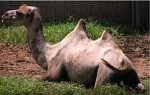
bactrian camel The Bactrian camel (Camelus bactrianus) is native to the steppes of eastern Asia. As we all know a camel has two lumbs, and a dromedary has one. Contrary to popular belief, the lumbs are not used to store water for travelling in dry areas.

From Wikipedia: "Camels are well known for their humps. They do not store water in them as is commonly believed. Their humps are a reservoir of fatty tissue, while water is stored in their blood. However, when this tissue is metabolised, it is not only a source of energy, but yields through reaction with oxygen from the air 1111 g of water per 1000 g of fat. This allows them to survive without water for about two weeks, and without food for up to a month."

Compared to the dromedary, it is built for a more harsh life in the desert, the dromedary being taller an faster. A Bactrian camel can drink as much as 120 (!) litres of water at a time... The wild Bactrian camel population was first discovered by Przewalski, the same man who gave his name to the Przewalski horse.

Thanks to Thomas for pointing out that Camels do not store water in their humps.

Bactrian camel photographed by Jcwf, licensed under GNU Free Documentation License

You can help spreading the word about this animal by stumbling it by pressing this link StumbleUpon

one comment - Permanent Link

Friday 24 March 2006 Red necked wallaby

Red necked wallabyThe Red-necked Wallaby (Macropus rufogriseus), being one of the largest wallabies, can easily be mistaken for a kangaroo... The Red-necked Wallaby does things on its own, although it operates in loose groups, known as mobs, and often sharing common feeding areas. They feed in the night and in the late afternoon, they graze on grass and herbs close to forest for shelter.

Image licensed under GFDL

You can help spreading the word about this animal by stumbling it by pressing this link StumbleUpon

Add your thoughts about this animal - Permanent Link

Wednesday 22 March 2006 False Killer Whale (Pseudorca crassidens)

False killer whale The False Killer Whale (Pseudorca crassidens) is one of the larger oceanic dolphins in the order of cetaceans. Its name indicates a resemblance with the much more widely known Killer whale or Orca. The False Killer whale, just like the orca, attacks and kills other cetaceans. Living in groups of 10 - 50 animals, the False Killer whale is a social animal, and a fast swimmer. It can grow to 6 meters in length, it can weigh as much as 1,500 kg and can live for about 60 years. The behavior and populations of the False killer whale have not been studied as intensively as the Orca, and the total population is unknown. For a range map click here.
You can help spreading the word about this animal by stumbling it by pressing this link StumbleUpon

Add your thoughts about this animal - Permanent Link

Tuesday 21 March 2006 Common Brushtail Possum - the largest possum

brushtail possum The Common Brushtail Possum (Trichosurus vulpecula) is the largest among the possums. Possums are native to Australia and can often be found near humans and in cities as they are capable of adapting. Common Brushtail Possums are nocturnal and are known for their nocturnal raid of gardens and kitchens. In cities they are seen as pests, especially for the loud hissing of the male Common Brushtail, which will definately keep you awake. When settlers begin introducing Common Brushtail Possums for the fur industry in New Zealand (only having the bat as a native mammal at the time) they couldn't imagine that someday 60 million possums would roam the island! This is especially harmful to the native vegetation.
You can help spreading the word about this animal by stumbling it by pressing this link StumbleUpon

one comment - Permanent Link

Friday 17 March 2006 North American Porcupine - second largest rodent in North America.

porcupineThe North American Porcupine, also called the Canadian Porcupine (Erethizon dorsatum) is the second largest rodent on North American soil. The largest rodent in North America is the beaver. The North American Porcupine is part of the New World porcupines, which are much less nocturnal than the Old World porcupines. Still, they are most active at night and resting in trees during hot summer days... Its natural predators are Wolverines, Fishers and Coyotes.
You can help spreading the word about this animal by stumbling it by pressing this link StumbleUpon

three comments - Permanent Link

Wednesday 15 March 2006 Order Rodentia (rodents) - roughly half of all mammals are rodents

Rodentia Did you know that roughly half of all mammals (2000+) species are rodents? What is also very interesting is that rodents are the only placental order except for bats to reach Australia without human introduction... The members of the order Rodentia differ in size and shape. The African Pygmy Mouse is as small as 6 cms in length and weighs only 7 grams. The Capybara is the largest rodent and can weigh up to 45 kg (100 pounds). Rodents can be found anywhere in the world except Antarctica.

Image: Apodemus sylvaticus by Pethan October 9, 2005 The Netherlands, licensed under Attribution 2.5

You can help spreading the word about this animal by stumbling it by pressing this link StumbleUpon

one comment - Permanent Link

Sunday 12 March 2006 Monito del monte - burn down your house when you see one

Monito del monte The Monito del monte (Dromiciops gliroides), meaning "little mountain monkey" is also know by the names "Colocolo" or "Chimaihuén". It lives in South America, mostly in Chile and Argentina. They are once believed to belong to the Didelphimorphia, but actually are in an order of their own. Monitos del Monte are mostly carnivorous, feeding on insects and intervertebrates, occasionaly some fruit. They are especially known for their ability to double their body weight in a week (!). They do this when it is time to hybernate. Native people with superstition are scared of the Monitos del monte and have even burnt down their houses when they saw one inside...

Picture copyright by Jaime E Jiménez

You can help spreading the word about this animal by stumbling it by pressing this link StumbleUpon

one comment - Permanent Link

Wednesday 01 March 2006 Sperm whale - largest living toothed animal!

Sperm whale The Sperm whale (Physeter catodon) is believed to be the largest toothed animal living today on earth. It has gotten its name because scientists thought they found a milky white substance in its head and they mistakenly thought it was sperm, although actually it was a kind of whale oil. A male sperm whale's head is about one-third of its total length. The part of its scientific name "macrocephalus" means "long head". The brain of this magnificent animal is the largest ever recorded: 7 kg! The tail (see picture) is triangular in shape and lifted very high when going for a deep dive...

Some world records of the Sperm Whale:

  1. Largest known toothed creature ever.
  2. Deepest dive by a mammal (sperm whales have been found in depths of 2,200 (7,200 feet) meters, tangled in telegraph cables).
  3. Largest brain of any living creature on Earth. The brain of a mature sperm whale weighs 7 kg (15 pound), though there have been specimens with 9 kg (20 pound) brains.
  4. Thickest skin. On back and head, sperm whale's skin (not including subcutaneous fat) is sometimes up to 35 centimeters (14 inches) thick.

    (source Wikipedia)

You can help spreading the word about this animal by stumbling it by pressing this link StumbleUpon

two comments - Permanent Link


Animal of the Day
Subscribe to the
animal of the day
Enter your Email


Powered by FeedBlitz