Saturday 22 August 2015
Naked Mole Rat - More Than Meets The Eye
The
naked mole rat (
Heterocephalus glaber) is a
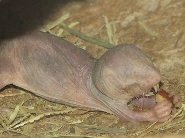
rodent, known for its burrowing and is indigenous to East Africa. The mole rat possesses a number of characteristics which allow it to survive in underground and harsh environments.
The average naked mole rat is between 3 to 4 inches (8 to 10 centimeters) in length and weighs between 1.1 and 1.2 ounces (30 to 35 grams). They have small eyes, poor sight, and have legs that are quite short and thin. They are also able to move backward and forward at the same quick pace and have large teeth that allow them to dip. The term "naked" comes from the fact that they have very little hair and gray-pink skin.
The species is highly adapted to situations in which oxygen is limited within tunnels of their habitat. The lungs are small and their blood is greatly able to bond oxygen. They have very low metabolic and respiration rates. During periods of drought and hunger, the metabolic can decrease further to about 25% of its normal level.
The naked mole rat lives predominantly in the dry tropical grasslands in East Africa with large concentrations being concentrated in Somalia, Kenya, and southern Ethiopia. Groups of around 80 individual mole rats (although it can be as few as 20 and as many as 200) live within a complex burrowing system within the African desert. These tunnel systems can be quite long, between two to three miles in length.
There is a complex hierarchical structure where one queen and between 1 and 3 males reproduce, the other naked mole rats are workers and sterile. Dimorphism exists between the males, two forms of workers (tunnel digging/gathering and soldiers), and the breeding males. The breeding males and the queen can keep up their relationship for several years. The queens can live for a period of between 13 and 18 years and are quite hostile towards other females. Upon the death of the queen, another female will become queen in her place.
The naked mole rat mostly eats large tubers that they find underground during their mining exhibitions. However, they are also known for eating their own fecal matter. One tuber, depending upon its size, can feed a colony for several months or years as they only eat the inside of the tuber. They leave the outer parts so that the tuber is able to regenerate.
Naked mole rats are currently not a threatened species. Although their living conditions are tough, they are a widespread species.
Naked mole rats help in cancer research, because they never get cancer (
read here).
You can help spreading the word about this animal by liking it on facebook
Permanent Link
Tuesday 07 July 2015
Northern Pudu - the World's Smallest Deer
The Northern Pudu (
Pudu mephistophiles) is the world's smallest deer. This little inhabitant of the Andes Mountains weighs in at only 3 to 6 kg, or 7 to 13 pounds. The Northern Pudu lives and plays across
Columbia,
Ecuador, and
Peru. They prefer to stay in the higher elevations of the Andes Mountain range. Most of them live at least 2000 meters above sea level. The climate here is a temperate rainforest, with a wet winter and arid summer.
What Do They Look Like?
These little deer have a stocky body and slim legs. They average 32 - 35 cm, or 13 - 14 inches tall. They are approximately 85 cm or 33 inches long. They are slightly larger than a small house dog or a large cat. They have a Southern branch of the family that lives in Chili and Argentina. This species is slightly larger. Their fur is thick, stiff and lays close to the body. They range in color from a reddish brown to a darker brown. The males sport backward curving antlers that do not split.
How Do They Survive?
The Pudu is a solitary animal interacting socially only to mate. They are nocturnal by nature and thrive on leaves, shrubs, sprouts, blossoms and bark. They do not eat meat. They are adept at climbing, jumping and sprinting which helps them evade predators. They tend to move slowly and purposefully through the lush climate, utilizing dense vegetation to hide. Predators include owls, foxes, and large wild cats.
How Many Young Do They Have?
Mating season is short, lasting from April to May each year. Once done they return to their solitary existence. The female Pudu carries her young six to seven months. Most mothers have only one baby, but twins do occur with some regularity. Pudu young will stay with their Mommas for between 8 - 12 months before heading out on their own. Most of them have an average lifespan of 8 - 10 years.
Why Are They Endangered?
The Pudu is listed as vulnerable on the ICUN red list. The main causes of death are disease, loss of habitat, and over hunting. The Pudu is prone to become infected with various types of worms such as the round worm and heart worms. The worms multiply rapidly overcoming their small bodies. Loss of habitat has lead to a decline in mating and death from road accidents. Adding to the problem are hunters. The Pudu is eagerly sought due to the skill needed to track and kill them. Conservationist are working to restore and preserve the habitat for these precious little deer.
You can help spreading the word about this animal by liking it on facebook
Permanent Link
Friday 03 July 2015
Guatemalan Black Howler Monkey
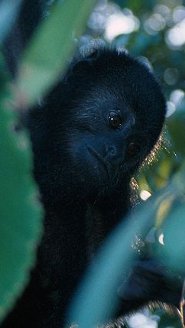
The endangered
Guatemalan Black Howler (
Alouatta pigra) (sometimes called the Yucatan Howler or Yucatan Black Howler) is one of many species of howler monkey, which is what is known as a ‘New World’ monkey. Its range is throughout the Yucatan Peninsula, and includes the areas of Mexico, Belize, and of course Guatemala. The Guatemalan Black Howler prefers to live in very lush areas, mostly sticking to all types of rain forests such as the semi-deciduous, lowland and evergreen. Of its cousins and relatives, the Guatemalan Black Howler is the largest, and is also one of the largest ‘New World’ monkeys (which include marmosets, owl monkeys, sakis, spider, and woolly monkeys). It weighs in at 25 lbs on average in males (11-12 kg) and 14 lbs for the females (6-7 kg). Their fur is usually black and their tails are very long, and prehensile (meaning it can grab and be used to hang from branches with). They also have specialized teeth for their diet of mostly leaves, along with the males possessing a larger hyoid bone located near the vocal chords, which enables their loud calls.
The Guatemalan Black is a diurnal howler, which means it is active during the day and it sleeps at night, as well as being arboreal, meaning it dwells in the trees most of its life. They are a social species that lives in groups up to ten members strong, which helps in alerting, foraging, and general upkeep through grooming. Some groups can be as large as sixteen, while larger groups are plausible, however at these sizes it is unlikely to function as well as a smaller group. Their diets consist of mostly leaves, and fruits, however they will snack on a flower here and there and their favorite tree of all is the breadnut, which provides most food during some seasons.
Not a particularly active species, the Guatemalan Black Howler would rather lounge about during the day; eating takes up a quarter of the day while moving locations for eating consists of only about a tenth of their daily activity. The rest of the day is devoted to socializing and grooming, with some other random antics. Females are old enough to have offspring by four years of age, while males may take up to eight years to reach maturity, and their total life-spans are an average of twenty years.
The Guatemalan Black Howler’s binomial name (its species and genus) is Alouatta pigra, the Alouatta’s as a genus make up most of the Howler Monkeys, which are the largest of the New World Monkeys with but a few possible exceptions. Alouatta is home to all of the howler monkeys (ten species and ten subspecies), and belongs to the subfamily Alouattinae. Alouattinae belongs to the family Atelidae which is one of the four families of New World Monkeys; this includes the howler monkeys, along with spider monkeys, woolly monkeys, wooly spider monkeys, and Yellow-tailed Woolly Monkeys. Atelidae belongs to the Parvorder Platyrrhini, which contains all New World Monkeys, and includes
Marmosets and Muriquis. Platyrrhini belongs to the infraorder Simiiformes, or ‘higher primates’, and this includes all New World and Old World monkeys from South America and Africa, and includes gibbons, great apes, and the family Hominidae of which we are members. Simiiformes belongs to the Suborder Haplorrhini, otherwise called dry-nosed primates; this includes all of the higher primates as well as
Tarsiers. Haplorrhini belongs to the Order Primates, which is all related apes, monkeys, lorids, galagos, lemurs and human ancestors. Primates are in the class of Mammalia of the phylum Chordata in the Kingdom of Animalia.
Fact
The Guatemalan Black Howler is sympatric with another species, the
Mantled Howler. Sympatric means that they share the same niche and territory, and encounter each other in the wild, they are also closely related.
Warning
The Guatemalan Black Howler is an Endangered Species, and is close to being classified as Critically Endangered if nothing is done to curb the loss of the species. In the next 30 years the IUCN expects to see a population loss of over 60%, making this species on the more endangered alive today. Major threats are habitat loss, poaching, and capture for use as ‘pets’.
You can help spreading the word about this animal by liking it on facebook
Permanent Link




 Stumble It!