Subscribe to
"Animal of the day"

AddThis Feed Button
Or subscribe by e-mail

Enter your Email


Powered by FeedBlitz

We hope that reader will gain an increased appreciation of the need for more conservation measure in order to protect the beautiful creatures that inhabit the earth. Our philosophy is that the more we learn about animals, the more we respect them and take better care of them. That is why we update this blog with new animals, We encourage you to syndicate our content by adding "animal of the day" to your own blog! (read more)

About us

Our mission is to get people excited about animals and their welfare by writing articles on these animals. We encourage people to comment on posts and share with others. Don't forget to subscribe to our feed.

Contact us
Copyright notice

Cutest pet ever - cutest pet contest

Funny animal videos and pictures

Swimming with manatees - harmful or helpful

Last Comments

Tima (Bottlenose dolphi…): J. David Smith, Ph.D., a …
Coda Plant (Pudu - smallest d…): Hey. I live in Northern C…
Michael Newton (Koala video): i love you mr. koala
Tohru (Asian Golden Cat): I hate them too! They are…
tiffany (Asian Golden Cat): i love this cat i’m doing…
BK (Nubian Ibex - The…): Magnificent animal, espec…
amanda (Long-nosed cusima…): thhisanimal is so so so s…
misscrient (Muskrats - Water-…): Third paragraph last sent…
rudy (Deer Mouse - The …): that is so cool ilove lea…
Nick (Fattest cat in th…): “The cat is not over fed.…

Calendar

« November 2009
S M T W T F S
1 2 3 4 5 6 7
8 9 10 11 12 13 14
15 16 17 18 19 20 21
22 23 24 25 26 27 28
29 30          

Archives

Next Archive Previous Archive

01 Nov - 30 Nov 2009
01 Oct - 31 Oct 2009
01 Sep - 30 Sep 2009
01 Aug - 31 Aug 2009
01 Jul - 31 Jul 2009
01 Jun - 30 Jun 2009
01 May - 31 May 2009
01 Apr - 30 Apr 2009
01 Mar - 31 Mar 2009
01 Feb - 28 Feb 2009
01 Jan - 31 Jan 2009
01 Dec - 31 Dec 2008
01 Nov - 30 Nov 2008
01 Oct - 31 Oct 2008
01 Sep - 30 Sep 2008
01 Jul - 31 Jul 2008
01 Jun - 30 Jun 2008
01 May - 31 May 2008
01 Apr - 30 Apr 2008
01 Mar - 31 Mar 2008
01 Feb - 28 Feb 2008
01 Jan - 31 Jan 2008
01 Dec - 31 Dec 2007
01 Nov - 30 Nov 2007
01 Oct - 31 Oct 2007
01 Sep - 30 Sep 2007
01 Aug - 31 Aug 2007
01 Jul - 31 Jul 2007
01 Jun - 30 Jun 2007
01 May - 31 May 2007
01 Apr - 30 Apr 2007
01 Mar - 31 Mar 2007
01 Feb - 28 Feb 2007
01 Jan - 31 Jan 2007
01 Dec - 31 Dec 2006
01 Nov - 30 Nov 2006
01 Oct - 31 Oct 2006
01 Sep - 30 Sep 2006
01 Aug - 31 Aug 2006
01 Jul - 31 Jul 2006
01 Jun - 30 Jun 2006
01 May - 31 May 2006
01 Apr - 30 Apr 2006
01 Mar - 31 Mar 2006
01 Feb - 28 Feb 2006
01 Jan - 31 Jan 2006
01 Dec - 31 Dec 2005
01 Sep - 30 Sep 2005
01 Aug - 31 Aug 2005
01 Jul - 31 Jul 2005

Animal posters
Animal pictures
Mammals.start4all.com
Animal diversity web
Recently extinct animals forum
PetLvr.com
Another chance to see
Happiness is a warm puppy

Miscellany

AddThis Feed Button

Tuesday 30 September 2008 Neotropical River Otter

Neotropical River OtterMass: 5 to 15 kg (11 to 33 lbs)
Length: 36 to 66 cm (14.17 to 25.98 in)

The Neotropical River Otter (Lontra longicaudis) resides in swamps, streams, lagoons and lakes in Mexico and parts of South America (especially Brazil, Bolivia, Paraguay and Uruguay). It is the most widespread of the Lontra genus.

If you have seen a North American river otter, then you could easily imagine a Neotropical River Otter, for they are quite alike in appearance. However, the Neotropical River Otter is shorter, around the mouth, the areas are white, its body is long and circular. Neotropical River Otters possess a soft wool-like undercoat that is layered with guard hairs, the latter maintains dryness to the undercoat when it is wet. Unlike seals, the Neotropical River Otter does not have an insulating layer of fats, but instead they depend on this fur for dryness and warmth.

Its head is both round and flat, ears placed low, the muzzle is just short and whisker-filled. The neck is also short, it has eyes which are widely-spaced. The best description for the nose of a Neotropical River Otter would be trapezoid-like.

The back legs are longer than the front ones, allowing them to swim adequately. If an otter is relaxed and swimming slowly, it could be seen paddling using all 4 paws, but if it is engaged in fast swimming (for example, being pursued, or chasing a prey), short paws are maintained close to its sides, the tail acts as a propeller. Its nostrils/ears could be closed when one is submerged.

Their diet mainly consists of mollusks and fish, but they are what we call opportunistic eaters, they can also eat birds, small reptiles or mammals.

This otter has no set breeding period, and just like its relative otters, a delayed implantation prior to breeding might occur. A newborn is born fully furred, but the eyes are shut, and these would open after approximately 44 days.

Interesting fact: One marks by scent via the leaving of feces on places like bridges or logs, and you know why? Experts believe this is an advertisement of one's gender.

Picture of the Neotropical River Otter © 2006 Carla Antonini, licensed under Attribution-ShareAlike 2.5
You can help spreading the word about this animal by stumbling it by pressing this link StumbleUpon

Add your thoughts about this animal - Permanent Link

Friday 05 September 2008 Bushy-tailed Woodrat
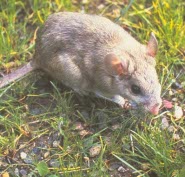
Bush tailed woodratA Bushy-tailed Woodrat (Neotoma cinerea) can be found in North America, ranging from arctic Canada down to northern Arizona and New Mexico, and as far east as the western portions of Nebraska and the Dakotas. The Woodrats can be recognized by their big ears and its bushy tail. Its back is pale gray with a mix of brown, with white underneath.

They are also called packrats and are known to be capable of building stick homes within caves and crevices. If you are wondering where the word "packrat" comes from, a Bushy-tailed Woodrat's house holds items brought in from the outside, such as glass, pine cones, cardboards, plastic odds and ends, wire...you name it.

The territory of the woodrats is small, and a long time back, it was thought by experts that they would not go away farther than 60m from their nests. However, recent studies assert that the female can go as far as 500m. Basically, a typical woodrat is solitary, nocturnal and strongly protective of its own territories. Most facets of its behavior is thought to be a by-product of predation, and they have a lot to escape from. Weasels, black bears, bobcats, hawks and so many others, of course...that includes man.

Their diet consists of a variety of ingredients. In dry locations, they can survive on succulents, but in woody habitats, they consume a lot of woody vegetation. A Bushy-tailed Woodrat gets all of the water it needs from the foods it consumes. As prey, they are the main food source for Spotted Owls, an endangered species.

Interesting fact: These woodrats get enticed by shiny things, they often get them from camps or other establishments. So, if you are camping in one of their territories, watch out!
You can help spreading the word about this animal by stumbling it by pressing this link StumbleUpon

Add your thoughts about this animal - Permanent Link


Animal of the Day
Subscribe to the
animal of the day
Enter your Email


Powered by FeedBlitz