Subscribe to
"Animal of the day"

AddThis Feed Button
Or subscribe by e-mail

Enter your Email


Powered by FeedBlitz

We hope that reader will gain an increased appreciation of the need for more conservation measure in order to protect the beautiful creatures that inhabit the earth. Our philosophy is that the more we learn about animals, the more we respect them and take better care of them. That is why we update this blog with new animals, We encourage you to syndicate our content by adding "animal of the day" to your own blog! (read more)

About us

Our mission is to get people excited about animals and their welfare by writing articles on these animals. We encourage people to comment on posts and share with others. Don't forget to subscribe to our feed.

Contact us
Copyright notice

Cutest pet ever - cutest pet contest

Funny animal videos and pictures

Swimming with manatees - harmful or helpful

Last Comments

red (Disk Tetra - Hate…): How to breed the fish? Is…
alissa (Stump-Tailed Maca…): sooo cute
Anonymous (Shoebill - Swamp …): These are beautiul birds …
sugar glider info… (Greater Glider - …): They have large, protrudi…
Sabrina (Purple frog): wow, what a lovely frog. …
Organizari evenim… (Fattest cat in th…): :)) This is not funny! Re…
destiny (Ninja cat): hahah thats funny
sami (Bats - the only t…): is that true
Lexis.J (Ninja cat): So funny.He’s the top nin…
someone (Ninja cat): this is soooo cute!

Calendar

« February 2012
S M T W T F S
      1 2 3 4
5 6 7 8 9 10 11
12 13 14 15 16 17 18
19 20 21 22 23 24 25
26 27 28 29      

Archives

Next Archive Previous Archive

01 Jan - 31 Jan 2012
01 Dec - 31 Dec 2011
01 Nov - 30 Nov 2011
01 Oct - 31 Oct 2011
01 Sep - 30 Sep 2011
01 Aug - 31 Aug 2011
01 Jul - 31 Jul 2011
01 Jun - 30 Jun 2011
01 May - 31 May 2011
01 Apr - 30 Apr 2011
01 Mar - 31 Mar 2011
01 Feb - 28 Feb 2011
01 Jan - 31 Jan 2011
01 Dec - 31 Dec 2010
01 Nov - 30 Nov 2010
01 Oct - 31 Oct 2010
01 Sep - 30 Sep 2010
01 Aug - 31 Aug 2010
01 Jul - 31 Jul 2010
01 May - 31 May 2010
01 Apr - 30 Apr 2010
01 Mar - 31 Mar 2010
01 Feb - 28 Feb 2010
01 Jan - 31 Jan 2010
01 Dec - 31 Dec 2009
01 Nov - 30 Nov 2009
01 Oct - 31 Oct 2009
01 Sep - 30 Sep 2009
01 Aug - 31 Aug 2009
01 Jul - 31 Jul 2009
01 Jun - 30 Jun 2009
01 May - 31 May 2009
01 Apr - 30 Apr 2009
01 Mar - 31 Mar 2009
01 Feb - 28 Feb 2009
01 Jan - 31 Jan 2009
01 Dec - 31 Dec 2008
01 Nov - 30 Nov 2008
01 Oct - 31 Oct 2008
01 Sep - 30 Sep 2008
01 Aug - 31 Aug 2008
01 Jul - 31 Jul 2008
01 Jun - 30 Jun 2008
01 May - 31 May 2008
01 Apr - 30 Apr 2008
01 Mar - 31 Mar 2008
01 Feb - 28 Feb 2008
01 Jan - 31 Jan 2008
01 Dec - 31 Dec 2007
01 Nov - 30 Nov 2007
01 Oct - 31 Oct 2007
01 Sep - 30 Sep 2007
01 Aug - 31 Aug 2007
01 Jul - 31 Jul 2007
01 Jun - 30 Jun 2007
01 May - 31 May 2007
01 Apr - 30 Apr 2007
01 Mar - 31 Mar 2007
01 Feb - 28 Feb 2007
01 Jan - 31 Jan 2007
01 Dec - 31 Dec 2006
01 Nov - 30 Nov 2006
01 Oct - 31 Oct 2006
01 Sep - 30 Sep 2006
01 Aug - 31 Aug 2006
01 Jul - 31 Jul 2006
01 Jun - 30 Jun 2006
01 May - 31 May 2006
01 Apr - 30 Apr 2006
01 Mar - 31 Mar 2006
01 Feb - 28 Feb 2006
01 Jan - 31 Jan 2006
01 Dec - 31 Dec 2005
01 Nov - 30 Nov 2005
01 Oct - 31 Oct 2005
01 Sep - 30 Sep 2005
01 Aug - 31 Aug 2005
01 Jul - 31 Jul 2005

Animal pictures
Mammals.start4all.com
Animal diversity web
Recently extinct animals forum
Another chance to see

Miscellany

AddThis Feed Button

Wednesday 29 September 2010 The Sitatunga, Nature's Snorkel Diver

SitatungaThe sitatunga (Tragelaphus spekii) is an antelope native to the swamps of Central Africa. The animal's habitat is mainly in southern Sudan, Cameroon and the Democratic Republic of Congo, but also extends into parts of Botswana, Kenya, Zambia, Uganda, Gabon and Tanzania. Body length is about 115 to 170 centimeters (3.5 to 5 feet) with a shoulder height of 75 to 125 centimeters (2.2 to 4.1 ft.). The animal's tail length is about 30 to 35 centimeters (12 to 14 inches). Weight ranges from about 40 to 120 kilograms (90 to 260 lb.) Males tend to be larger than females.

While there is some variation in coloring, the sitatunga is usually brown with males tending to be darker and females taking more of a reddish hue. Both sexes have white markings on the body and face. Males have a mane and twisted horns which can reach almost a meter in length. The sitatunga has long, splayed hooves which are ideally suited to its habitat, allowing it to walk in swampy conditions without sinking into the mud.

The sitatunga is unusual among antelope species in that it is quite at home in water. In its native habitat the animal is often seen taking to the water to avoid predators, and individuals have been known to sleep underwater with only their nostrils showing above the surface. This type of "snorkel" behavior is an adaptation to the hostile environment in which the sitatunga lives, since water often provides the only refuge from leopards and wild dogs.

The swamp is an abundant source of food, so sitatungas need only small home ranges. They often make feeding pathways through the water plants, eating reeds, bullrushes and sedges. They will also venture out of the swamps and eat grasses, fruits and tree bark in the adjacent forests. They are sometimes active during full day or on moonlit nights, but their time of greatest activity is in twilight (dawn or dusk).

Sitatungas are social to some extent. Females are sometimes seen forming herds, but males often have a solitary lifestyle except at mating season.

Their greatest threat is human activity. In parts of Africa the animal is a vital source of protein to indigenous peoples, but there is also much sport hunting for trophies. The sitatunga's habitat is being constantly reduced as growing human populations convert more of the swamp into agricultural land. Other predators that threaten the sitatunga are pythons, crocodiles, leopards and lions.

Picture of the sitatunga by Ivanhoe, Boekarest Zoo, licensed under Creative Commons Attribution-Share Alike 3.0 Unported license. You can help spreading the word about this animal by liking it on facebook

Permanent Link

Tuesday 28 September 2010 The Malayan Tapir - One of Nature's Most Primitive Large Mammals

Malayan tapirThe Malayan tapir (Tapirus indicus) most closely related to rhinoceroses and horses, lives primarily in parts of Indonesia, Thailand and Malaysia. It has also been found to inhabit Vietnam, Cambodia and Laos. Of the four species of tapirs, it is the largest. Its habitat consists of swamps, lowlands, rainforests and hill forests near bodies of water. The diet of Malayan tapirs consists of grass, leaves, twigs, aquatic plants and fruits from low-lying shrubs, with a preference for green shoots.

Malayan tapirs grow 6-8 feet long (1.8 to 2.4 m), are 3-3.5 feet in height (90 to 107 cm) and weigh 550-700 pounds (250 to 320 kg). Females are often larger than males. They are known for their markings, which includes a mostly black body with a large area of white that resembles a saddle. The tips of their ears are also white. These markings help protect the tapir from predators, such as tigers, leopards and humans, as they mistake the tapir for a rock instead of prey. They also have short stubby tails and long noses. Their feet are unique in that the front feet each have four toes, while the back ones each have three. Their eyesight is poor, but they compensate by being able to hear and smell very well.

The Malayan tapir breeding season occurs from April-June. The gestation period is 13 months, with females giving birth to one calf every two years on average. Baby tapirs are born with brown hair and white stripes and spots, which aids in their camouflage. They can live up to 30 years and mature between 3-4 years of age, although they are fully grown by 8 months of age.

Malayan tapirs are primarily, but not always, nocturnal. They often use the same paths to travel in search of food. They are good climbers, often traversing steep slopes and mountains during the rainy season. They are good swimmers. Similar to pigs, they like to bathe and wallow. They are seldom in packs, but are commonly found solitary, except in cases of a mother with its young.

Malayan tapirs were endangered in the 1980s up until 1994. It is now considered vulnerable. The population is decreasing due to overhunting and animal trade. More and more forests are clearing to make room for more agriculture, which results in many Malayan tapirs losing their habitat and dying.

Picture of the Malayan tapir by Sasha Kopf, licensed under GFDL You can help spreading the word about this animal by liking it on facebook

Permanent Link

Monday 27 September 2010 The Black Rat - and its 'tall tails'!
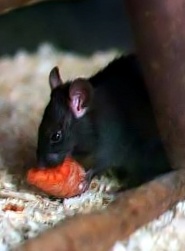
Black ratThe Black Rat (Rattus rattus) is also known as ship rats, house rats and roof rats. They have acquired these names because of their preferences for inhabiting large ships and nesting in high places such as trees and the upper floors of buildings. These rats thrive in areas inhabited by humans and are found on every continent (thanks to their instinct for ‘stowing away’), near coastal areas. Tropical regions are where they flourish but some data shows that they have been able to adapt to colder climates; this being due to the fact that Norway rats have pushed them out of many of their original habitats. This species rarely swims and is not found in aquatic areas or sewers, preferring instead, forests, agricultural areas, grasslands and any place that supports their mainly vegetarian diet.

Males of the species are often heavier and longer than females and are not solely identified by being black in color; in fact, the rats can be brown, white, grey or agouti. They weigh between 70-300 grams (2.5-10.6 ounces) and are 16-22 centimeters (6.3-8.7 inches) in length. Interestingly the tail of a black rat almost always measures longer than the rat’s body, at about 19 centimeters (7.5 inches) in length.

The species mainly eats fruits, vegetables, grains and vegetation but is an omnivore and has occasionally been known to eat insects or invertebrates. It needs only 15 grams (.52 ounces) of food and 15 milliliters (.51 fluid ounces) of water a day to survive. Its predators consist of house cats, birds and other carnivorous animals. This species of rat is plentiful in many areas and therefore, is not in any way endangered.

Female rats will produce up to 5 litters per year with the gestational period ranging from 21-29 days. Breeding occurs year round and the young are made independent from their mothers between 3 and 4 weeks of age. They begin reproducing at 3 to 5 months old. Males do not have much to do with raising the young as they move from one female to another, mating. Nests, which are made out of sticks and leaves and sometimes found in burrows, are tended by the females.

Black rats are very vocal animals and are known for stripping bark off trees and contaminating human food sources. However, they are probably best known for being the animals that carried the fleas which spread the bubonic plague.

Picture of the black rat by Liftarn, licensed under GFDL You can help spreading the word about this animal by liking it on facebook

Permanent Link

Friday 24 September 2010 The Maori Wrasse - A Colorful, Inquisitive Tropical Fish

Maori wrasseThe Maori wrasse (Ophthalmolepis lineolata) is an oceanic fish that inhabits the coral reefs, rocky coasts and sandy, weedy bays off eastern and southern Australia. It also thrives in New Zealand waters, notably in Nelson Bay. The Maori wrasse is noted for its striking colors and "friendliness" toward humans, which some believe could lead to ecological complications.

Colors change with age. Females and young fish are reddish-orange or crimson, fading in color intensity on the underside. Males, which are larger, feature side stripes and blue markings about the body and head. These markings remind of the tattoos common among the Maori culture of New Zealand, hence the name.

More than 400 species of wrasses have been identified in the world's oceans. Most swim tropical and temperate waters. They generally prefer relatively shallow coral and rocky environs, although in cooler waters, Maori wrasses may be found at depths of 60 meters (197 feet).

The fish grow as long as 47 centimeters (18 inches) and weigh as much as .9 kilograms (2 pounds). They are not at all skittish. Divers easily can approach closely and take pictures. In fact, Maori wrasses often follow swimmers and divers through the water. It has been suggested Maori wrasses are as curious about humans as humans are about them.

The classification "Maori wrasse" has been applied to numerous fish, and Ophthalmolepis lineolata has been confused with similar species. For example, the Humphead wrasse (Cheilinus undulatus) also has been dubbed "Maori wrasse." The Humphead is the largest species in the wrasse group. Ophthalmolepis lineolata may be distinguished as the "southern" Maori wrasse. It has been called the Maori parrotfish, Australian Maori wrasse, Rainbow-fish and simply Maori - but some of those names, too, have been confused.

Wrasses have sharp front teeth and crushing molars along the throat, employed to fragment prey. Wrasses eat mollusks, crustaceans and other invertebrates of different sizes. The Maori wrasse feeds on benthic (ocean floor) invertebrates. Wrasses are the victims, in turn, of larger predator fish such as sharks, barracudas and eels.

Maori wrasses regularly are brought up as a by-catch by coastal net fishers. In some areas, regulations prohibit commercial use; regulations vary by wrasse species. The Maori wrasse is used a bait fish and is exported as an aquarium fish. Certain other species of wrasses are considered edible delicacies.

While not endangered presently, Maori wrasses face long-term threats resulting from reef deterioration.

Picture of the Maori wrasse by Richard Ling from NSW, Australia, licensed under the Creative Commons Attribution-Share Alike 2.0 Generic license. You can help spreading the word about this animal by liking it on facebook

Permanent Link

Thursday 23 September 2010 The Large-Spotted Civet - One of India's Rarest Mammals

Large-spotted civetThe large-spotted civet (Viverra megaspila) actually resembles a dog, unlike other civets, which resemble cats with spots and long noses. They are known as one of the rarest animals in the world. The large-spotted civet weighs 18-20 lbs. (8-9 kg) and is 30-33.5 inches (76-85 cms) in length. It has a dull grayish white coat with black spots and vertical stripes. The tail has five white rings, black bands and a black tip.

The large-spotted civet's original habitat was the evergreen rain forests below the Western Ghats and the wooded plains and hill slopes of southwest India, specifically Malabar and Travancore. Many occurrences of large-spotted civets in the past 30 years have been in valleys and cashew plantations. Cashew plantations provide important cover. They are not weeded and are densely populated with grasses and shrubs. It is believed that large-spotted civets are dependent on shallow waters for survival.

Not much is known about the reproduction and behavior of large-spotted civets. Female large-spotted civets average 2-3 babies per litter. They are often found alone, since they are known for being aggressive toward each other. They are nocturnal, hiding in dense cover during the day and foraging for food at night. They have never been seen in trees and seem to forage exclusively on the ground. Their diet consists of small animals, fish, reptiles, eggs and vegetables. Their only known predators are humans, who capture large-spotted civets to obtain musk for use in perfumes. They are also occasionally killed by hunting dogs.

Once very common in southwest India, large-spotted civets are now nearing extinction. There is said to be less than 250 large-spotted civets in existence. They have been considered critically endangered since 1979, but very few efforts have been made to preserve them. In a 1990 study involving India residents living near the habitats of the civets, only 10 percent were aware of its existence, with most of those trappers, hunters and civet breeders. Extensive deforestation in favor of planting rubber trees has contributed to the extinction of civets. Plus, they are known for preying on poultry, so many farmers kill them when they come into contact with them. You can help spreading the word about this animal by liking it on facebook

Permanent Link

Wednesday 22 September 2010 The Malayan Porcupine - An Elusive Asian Rarity
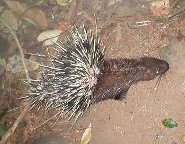
Malayan porcupineThe Malayan porcupine (Hystrix brachyura) is a rare and elusive creature that lives in many areas of Asia including but not limited to India, Malaysia, Nepal, and Vietnam. They are found living in altitudes from sea level to approximately 1,300 meters above sea level. With a usual life span of 20-27 years depending on environmental and encroaching human building and population factors, they can weigh from 1.7 pounds (0.760 Kg) to around 5.4 pounds (2.414 Kg) and can reach a length of 83.5 cm (32.9 inches) including their long tails. These animals are very shy and prefer to wander and forage for food at night. They are predominantly nocturnal and are rarely seen for any reason during the day unless threatened or sick.

With a huge habitat range of nearly the entire continent of Asia and even further into neighboring continents, the Malayan porcupine is one of the most widely yet sparsely spread out rodents on Earth. What makes the habitat of these creatures unique, however, is the type of terrain that they live in. They live in heavily wooded areas and make their dens in rocky areas of the ground. Malayan porcupines create burrows which lead into huge networks of tunnels beneath their surrounding habitats, allowing them to get around during the daytime without being exposed to sunlight. They live with other adults of their species and usually produce litters of two or three pups after a pregnancy of around 110 days.

The Malayan porcupine is covered at birth with soft quills which sharpen into rigid, hard quills upon reaching adulthood. This is the animal's defense mechanism and is effective to most predators and hunters that come after these porcupines. Though not predators themselves, they eat fruits, roots, nuts, and insects, as well as carrion (or dead animal matter).

In general, the Malayan porcupine is endangered because of over-hunting and human overpopulation into their habitats. There are tribes of people who eat them and who use their quills for decorative purposes. They are also hunted by feral cats, some types of wild hogs, and other predatory animals that live in the same region as they do. In some countries like Vietnam, their paws are considered good-luck charms just as rabbits' feet are in the United States. Without a little consideration and help from mankind, this unique species will become extinct very quickly. The International Union for Conservation of Nature ranks the Malayan porcupine as a vulnerable species with a high likelihood of facing extinction in the wild. This is due to the fact that they are hunted for their meat. They are also hunted to be displayed as decoration for their unique quills and coloring. You can help spreading the word about this animal by liking it on facebook

Permanent Link

Tuesday 21 September 2010 The Bulldog rat - The Mysterious, Extinct Creature of the Islands

Bulldog ratThe Bulldog rat (Rattus nativitatis) is an extinct species that once lived in the Indian Ocean area of Christmas Island. When the Bulldog rat was alive and thriving in the area, they were mostly found in the higher hills and forests of the area. They would have lived in smaller colonies in burrows among the roots of trees, or many times their home would be under hollow logs. Since bulldog rats were nocturnal, sunlight may make them seemed half dazed as it would almost blind the creature, which was why they burrowed deep into the ground.

The Bulldog rat was around 17 inches long or about 50 centimeters. The Bulldog rat had about a 2 centimeter thick layer of fat on their back. The weight of the creature is not really known, as they have been extinct for quite some time. However, most people theorize that they are near the size of rats that are found now.

The Bulldog rat is suspected to have become extinct in the time frame of 1901 to 1908. There are debates on the exact date. However, most researchers are in agreement that the extinction of this creature came from a disease that was spread to it by the black rats. These rats were infected by what the sailors brought with them. All though, it wasn't intentional, it did lead to the death of this species. These rats were first introduced to the island in 1887.

Given that there is such little information on the species, no one really knows the lifestyle of the creature, thus what they would have been known for is still a mystery. The diet of the Bulldog rat would have consisted of whatever it could find in the wilderness. It would be safe to assume that small insects and plants would have been in supply for these creatures. In fact, the island was thought to have been completely absent of life until new data surfaced which shows exactly why there is not an abundance of information to be found on the Bulldog rat.

The little research that is known about animals on this particular island point that there are not that many predators living there. In fact, during their lifespan, there has only been three other species of animals documented to be found there. Therefore, it would seem that predators of the Bulldog rat would be nonexistent. You can help spreading the word about this animal by liking it on facebook

Permanent Link

Monday 20 September 2010 The Thomson's Gazelle - East Africa's Most Stubborn Creature
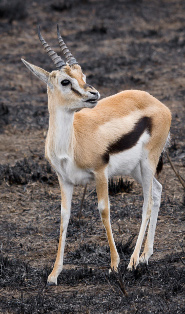
Thomson's gazelleThe Thomson's gazelle (gazella thomsonii) is the most common gazelle in East Africa. Although they are not as widespread as the Grant's gazelles, they can be found on ranches and farmland throughout East Africa, and persist long after other species have been killed off or migrated away.

Thomson's gazelles are commonly referred to as "tommies". Tommies stand at about half a meter (22-26 inches) tall and weigh in between 15 and 25 kilograms (35-55 pounds). Although very similar in appearance to the Grant's gazelle, they have some distinguishing features. Thomson's gazelles are slightly smaller in size compared to their cousins. In their coloring, tommies have a dark stripe that stretches from shoulder to flank, as well as a white patch on their rump. Females have either no horns, or very small, short, smooth horns. Males, which are larger, have a large ridged horns that curve back on their head.

The tommy has adapted to drier life on the open plains of East Africa, primarily in southern Kenya and northern Tazmania. Although tommies have many predators, including cheetahs, lions, leopards, and hyenas, they are frequently the last animals left on an abandoned ranch or farmland. They thrive by subsisting on the short, dry, remains of grasses left by the cattle, which make up 90% of their diet during dry seasons. Although they have many natural enemies, this disadvantage is balanced with fine senses of hearing, smell, and balance. Despite their persistence, many tommies fall victim to human gunshot.

Due to their vulnerability from predators, tommies form groups for protection. The strongest males set up territories by using exaggerated posing, marking their territory, and vigorously defending their territory with their horns. The groups consist of 5-50 females and their offspring, which wander through the male territories. These groups change in numbers, composition, and leadership as frequently as once an hour. Thomson's gazelles recognize others in their species or group by the largely visible black stripe and communicate disturbance through foot stamping. They breed twice a year, with a gestation period of six months. Due to the heavy threat of predation, approximately 50% of young tommies are lost as victims of prey.

While tommies are stubborn creatures that can subsist where other animals cannot, there has been a 60% decline in their population over the past 30 years. With a population estimate of 550,000, these animals are protected in many parks.

Picture of the Thomson's gazelle by Ikiwaner, licensed under GFDL You can help spreading the word about this animal by liking it on facebook

Permanent Link

Friday 17 September 2010 The Stonefish-Nature's Quick Change Artist

Stone fishThe Stonefish, (Leptosynanceia asteroblepa) can go from appearing to be a simple, harmless rock lying on the ocean’s floor to a stone-cold killer in a flash, making it one of nature’s most amazing quick-change artists.
Known for being the most venomous fish in the world, the stonefish makes its home in the shallow water among the coral reefs of the Indian and Pacific Oceans off Africa and the Red Sea to Northern Australia. There are an estimated twenty species of stonefish in the family of scorpion fishes, known for their razor-sharp dorsal fin spines which come factory-equipped with a venom so lethal it can kill any human being unfortunate enough to accidentally step on them. The fish has no scales, appears to be a rough stone with a rounded fish body and huge bug-like eyes. It weighs about 5 pounds, or 2400 grams, and can grow to about a foot long, or 30 to 35 cm. It feeds upon other fishes gliding above what they think is nothing but a harmless rock. Many a small fish or shrimp has become a meal for a fish so quick it snaps up its prey in less than a 15th of a second. It gets its name from the mottled grey, reddish-brown and white coloring that makes it look like a rock, another defense mechanism of the stonefish.

Human victims of the stonefish’s venom can’t do much to save themselves with the possible exception of applying heat. The application of heat to the stonefish’s venom renders the toxin somewhat ineffective. But in cases where a simple application of heat won’t save the day, anti-venom is available. Fishermen and others not careful about where they walk will feel the deadly sting of this remarkable animal, and some may not live to tell the tale.

The stonefish is prey to bottom-feeding scavengers like sharks. However, its defense, the row of 13 spines along its back, is quite effective against any fish that may attempt to put its jaws around the stonefish. The venom causes severe pain, paralysis and shock, and, once discharged, takes a few weeks to regenerate itself. During this time. the stonefish is not necessarily rendered helpless, the spines are still painfully sharp and surgically incisive.

The stonefish is not threatened or endangered in any way. Picture of the stonefish above licensed under GFDL

See this animal video how a stone fish catches its prey, did you see the stonefish?

You can help spreading the word about this animal by liking it on facebook

Permanent Link

Thursday 16 September 2010 The Pesty Striped Field Mouse
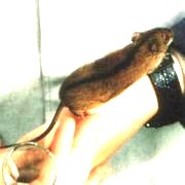
Striped field mouseThe Striped Field Mouse (Apodemus agrarius) is one species of mouse that owes its name to the black or dark stripe that goes down its spine. This rodent is natural to Europe and regions stretching all the way to Japan, including the regions of Siberia and Taiwan. This mouse is not considered a threatened species, rather of least concern according to conservation status classification. Its color is a light rich yellow-brown, which makes the dark striped along its back more prominent.

This little rodent can grow to be 70-140 mm long, but its tail can add 61-96 mm to those measurements. Its weight ranges from 12-49.5 grams approximate. This species can reproduce all year. Females usually have eight nipples and can give birth to six litters yearly; each litter may have up to six mice.

The striped field mouse likes to live in prairies, grasses, rice fields, the woods, gardens, marshes, cornfields, reedbeds, and forests. It is agile and capable of swimming and leaping. It lives in holes underground, which it inhabits during the nighttime, as this mouse is a diurnal animal. However, these patterns may change with the seasons becoming nocturnal during the summer, and diurnal during the cold months of winter. In autumn, it can be found during night and day. It prefers environments that have lots of foliage and a variety of grasses and vegetation and moist areas. It does not like arid areas or areas where the vegetation is not varied such as large forests. It is considered a species that is very widespread in Europe and beyond. Its diet consists mostly of insects and grains, seeds, berries, nuts, and plant roots. However, if found on wrong territory or environment it can damage food stores supplies or farm crops. It is considered to be a pest for agriculture. It has been known to be a carrier of hemorrhagic fever (HTNV).

In captivity, the diet should match what it eats in the wild as close as possible. This may include mouse mix of grains and seeds, green veggies, some servings of fruit, crickets, captive bred worms, wheat bread, and cheerios - the last two as a small quantity treat. However, junk food such as salty foods, chocolate, and other treats might harm these critters so it should never be fed to them. A vitamin supplement such as Nutrical - usually sold by veterinarians - is beneficial in very small quantities and reduced amounts and not to be overdone.

The reproduction of this species is high and natural occurrences such as rains, small predators, and freezing soils keeps it under control.

Picture of the striped field mouse by Silke Sohler, licensed under GFDL You can help spreading the word about this animal by liking it on facebook

Permanent Link

Wednesday 15 September 2010 The Spot-Billed Duck has it right on the nose!
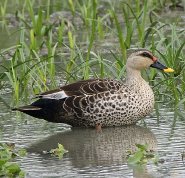
Spot-billed duckThe Spot-Billed Duck (Anas poecilorhyncha) is known by many names including the Yellow-Nib, Indian Spot-Billed, Spotbill and Chinese Spotbill, as well as being locally known as Garm Pai or Gugral. Its name comes from the red spots at the base of their yellow-tipped black bills, which the females of the species lack.
Spot-bills are native to Asia, being found largely in Haryana, India, but also in China, Japan and the USSR. They live in freshwater lakes, ponds, rivers and marshes and are normally found in waters with a depth of 0-1,867 meters or 0-6,125 feet.

They nest on dry ground on top of piles of thick moss, grass, feathers and/or down. Relationships in this species are monogamous and females will lay 7-10 white colored eggs that she incubates for 26-30 days. These ducks are known to hybridize (mate with other similar species of duck) naturally with mallards and in captivity, with the Pacific Black Duck and the Philippine Duck. Breeding season differs between north and south India and with water levels: i.e. from July to October in Northern India and November to December in Southern India.

Both genders are similar in appearance having scaled brown bodies, a blue speculum with white borders on their wings, a dark brown crown, nape and eye stripe and orange legs and feet. They are a rather large species with a length ranging from 53-58 centimeters or 21-23 inches and a height of 40-81 centimeters or 16-32 inches. They have a tapered wing shape with a wingspan range of 76-94 centimeters or 30-33 inches and a fan-shaped tail. Juveniles tend to be an overall gray color.

These ducks are "dabbling ducks" meaning that they do not dive for their meals but instead stick their heads underwater with their tails in the air to forage. Spot-Billed Ducks will also graze on dry land for their food. They eat seeds, snails, grasses and aquatic plants and normally weigh about 62 grams or 2.2 ounces. They are also considered to be very social ducks and can sometimes be found in groups as large as 50 or more.

The Spot-Billed Duck has a rating of "Least Concern" on the endangered species list due to its wide range and population. Some predators of this duck would be large fish, such as the European Pike, foxes and snakes, which mostly threaten the eggs while in the nests and newly hatched ducklings.

Picture of the Spot-billed duck by Lip Kee Yap, licensed under the Creative Commons Attribution-Share Alike 2.0 Generic license. You can help spreading the word about this animal by liking it on facebook

Permanent Link

Tuesday 14 September 2010 The Great Gerbil - A Natural Grocer

Great gerbilThe Great gerbil (Rhombomys opimus), is not a critter to be trifled with. Far and away unlike the gerbils found in pet stores, the great gerbil can grow to 16 inches (40.6 cm) and achieve a weight of .0627 pounds or .0285 kg. A world traveler, the great gerbil has been found in a variety of countries, climates and habitats. This animal is one hardy rodent who gets around. Populations of great gerbils exist in China, Russia, Turkmenistan, Kazakhstan, Iran, Southern Mongolia, and Afghanistan. It's a desert-dweller for the most part, but the great gerbil easily adapts anywhere.

Its scientific name, Rhombomys opimus, literally means "rich rhomboid mouse" because of the appearance of its teeth and the way it stores its food. Hoarders, the great gerbil stockpiles large quantities of groceries, foraging at dawn and dusk. If they can easily dig through the soil, they will bury their provisions to keep them safe. But in areas where the ground is rock-hard, they create little piles outside their nests. According to National Geographic, "Piles of food up to three meters across and a meter high have been recorded." (That's about 9 feet across and 3 feet high, quite a pantry).

The great gerbil is also a talented burrow-builder. Most likely they build strong burrows to protect their food stash, but also their families. They are gregarious animals, living in large extended families. A group of gerbils is called a "horde", a fitting name for animals who hoard their food.

These animals migrate often, always searching for more and better food. The burrows they leave behind become shelter for a variety of other animals that have been found living as squatters in an abandoned great gerbil burrow. Small mammals, birds, and insects have all been discovered living in gerbil burrows, which can be long and complicated in soft soil. Their traveling habits explain why they are found in so many countries. Their relentless search for sustenance has caused these gypsy gerbils to be listed as pests in many parts of the world. Especially for farmers and people who make their living in agriculture, the great gerbil is not so great for their livelihood. They destroy crops and damage irrigation systems, soil embankments and fields. Their enemies are any reptile, mammal or raptor fast enough to catch them, and humans who trap them for their fur and to eradicate them from managed vegetation.

Picture of the great gerbil at Baikonur-town, Kazakhstan by Yuriy75, licensed under GFDL You can help spreading the word about this animal by liking it on facebook

Permanent Link

Monday 13 September 2010 The Giant Trevally - The Muscle Car of the Ocean
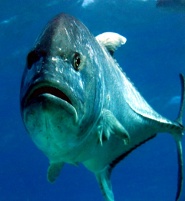
Giant trevallyThe Giant Trevally (Caranx ignobilis) is a powerful oceanic predator fish also known as the GT for short. It’s also called the Giant Kingfish, the Lowly Trevally, or the Barrier Trevally. Like the Mustang GT muscle car, this GT has its own muscle power: strong and thick midsection, and is distinguished by its steep and blunt head shape, and 26 to 38 scutes (sharp, bony plates) along its lateral line. Its color ranges from silver to black, and on those with darker color, it can have remarkable silvery-white patterns on its upper body.

The GT reaches its full size at 3-4 years. Typical size 60 cm long (1.969 feet, or .6 meters) but have been recorded with a length of 170 cm long (5.577 feet, or 1.7 meters) and a weight of 80 kg (176.4 pounds).

The distribution of the Giant Trevally occurs in the tropical or coastal areas of the Indian and Pacific Oceans. The range extends from the eastern coast of Africa, along the coasts of India and Pakistan, across the coast of northern Australia, to as far east as Hawaii. Its habitat is in the shallow coral reefs and lagoons and channels in these tropical areas.

With its canines in its upper jaw, and conical teeth in its lower jaw, the GT has been known to consume small turtles and dolphins. However, its main diet consists of most baitfish found in tropical waters, and it supplements its diet with lobsters, squid, and octopus. The Trevally’s method of operation is to use its muscled body to body slam its prey into stunned submission and then quickly eat before another competitor can take away the spoils. The GT also follows Monk Seals and reef sharks to their feeding grounds, and waits for when the shark or seal’s attention is diverted, and then grabs what it can of the other predator’s dinner.

The GT is prey to only two other predators: sharks, and man. Its biggest threat is population decline, which is largely suspected as due to erosion of coral reefs, which are the GT’s main habitat. While it remains a popular game fish in the Indo-Pacific region, its numbers have been decreasing around Hawaii. So far, fishing for the Giant Trevally has not been banned but anglers are being encouraged to follow a catch and release method instead. Recommendations are to have the fish out of water for no more than 30 seconds, to use a hose to pump saltwater through the gills, to use barbless hooks, to not hold the fish by just the mouth, gills, or tail, to hold it securely and not allow it to drop or hit against anything, and to gently swim it a bit before releasing it. You can help spreading the word about this animal by liking it on facebook

Permanent Link

Friday 10 September 2010 Guianan saki - Doing the Unexpected
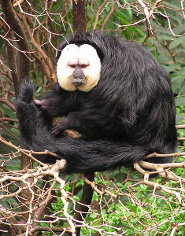
Guianan sakiThe Guianan saki (Pithecia pithecia) or White-faced saki is one among several species of saki monkey from the New World. It is a small, shy monkey that rarely touches the ground and prefers a quiet family life. However, it can roar with power to protect its territory and leap through the air from tree to tree for up to 10 meters.

It lives with its lifelong mate in the understory and lower canopy of the rainforests in northern and central South America. It lives in Brazil, French Guiana, Guyana, Suriname, Venezuela and Peru. In its family group it communicates with twitters and shrill cries which are unique for each family, however, it can roar to warn other animals and saki monkey families away from its territory. The Guianan saki monkey does not swing through the trees by its tail, because it does not have a prehensile tail. It mainly walks on all fours but does stand on two feet to jump between branches.

Parents and offspring move together (called a federation) and protect their territory. They groom each other, which creates a bond in the family and often older siblings will care for the young ones. Adults weigh approximately 1.48 kg (3.256 lbs) and are 30 to 50 cm long (11.81 to 19.69 in). Their long, bushy tail doubles their size. They live up to 36 years.

The females mature earlier at a little over 2 years while the males mature at approximately 4 years. They have one offspring at a time, once a year. There is no season for mating, it happened throughout the year. The gestation is from 150 to 180 days. It is easy to tell the difference between the males and females. The males have black fur with, a reddish-white face and females have shorter hair with brownish-gray fur and light brown stripes around the nose and mouth. Their fur fringes around their foreheads and looks like little hoods.

They eat fruits, flowers, insects, leaves and nuts and spend much of the day resting. In Guiana, White-faced saki have been seen looking into tree hollows and collecting bats which they tear apart and eat. Eating and playing during the day, at night they curl up like cats and sleep in the tree branches. The biggest cat of the rainforest, the jaguar, would prey on Guianan saki monkeys, but they are themselves endangered.

On the IUCN (International Union for the Conservation of Nature and Natural Resources) Red List of Threatened Species the Guianan saki monkey is classified as LC (Least Concern). Two recognized subspecies are Pithecia pithecia pithecia and Pithecia pithecia chrysocephala.

Picture of the guianan saki by Skyscraper, licensed under Creative Commons Attribution 3.0 Unported You can help spreading the word about this animal by liking it on facebook

Permanent Link

Thursday 09 September 2010 Scimitar-Horned Oryx - The Real Unicorn

Scimitar-horned oryxThe Scimitar-horned oryx (Oryx dammah) is a species of large antelope in the Oryx genus. Originally inhabiting the steppes and deserts of North Africa, it is currently extinct in the wild. Although there were reported sightings in Chad and Niger, attempts to independently verify these claims in a survey conducted from 2001 to 2004 turned up no trace of them in the wild. Currently, around 1250 live in captivity in fenced-off areas in conservation centers as distant from each other as Texas and Morocco.

The Scimitar-horned Oryx's most notable feature are its long, slender horns, which in both the male and female can reach between one and one and one quarter meters (3.28 - 4.1 ft) in length. The horns are truly distinctive in the way they arch backward like scimitars, the Middle-Eastern curved sword from which they take their name. The average Scimitar Oryx is about a meter (3.28 ft) tall and weighs roughly two hundred kilograms (440 lbs). Its coat is generally light in color with a dark red patch on its chest, and has markings along the its nose and forehead.

The Scimitar-horned oryx's diet consists of grass, leaves, and any other wild vegetation it can find. When hundreds of herds roamed the North African steppes, its main predators were lions, leopards, and hyenas. However, it was human hunters, who sought the oryx for its horns, who drove it to the brink of extinction.

One of the more fascinating things about the Scimitar-horned Oryx is its connection to the mythological unicorn. Because their horns are not like the antlers of other related species in that they do not grow back, many mythographers have hypothesized that members of the species who lost one their horns might have been mistaken for the legendary creatures by early European explorers and colonists in North Africa. What would have added to the impression is the fact that single-horned Scimitar Oryxes are quite often ostracized from their herds, forcing them to wander the steppes alone in order to survive. To Europeans, this perfectly matched the image of the unicorn, which was known for its pride and independent nature.

Even though they are extinct in the wild, there is still hope that it will be able to be reintroduced to the wild at some point. In Tunisia, there is a nature preserve which houses a small herd with precisely this end in mind. Also, as recently as this April, the first calf in 13 years was born at the National Zoo in Fort Royal, Virginia. With luck, within our lifetime, these pro-unicorns may roam the wild again.

Picture of the scimitar-horned oryx by Albinfo, licensed under GFDL You can help spreading the word about this animal by liking it on facebook

Permanent Link

Wednesday 08 September 2010 The Greater Hedgehog Tenrec - Spiny & Solitary
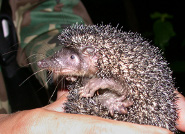
Greater hedgehog tenrecThe greater hedgehog tenrec (Setifer setosus), also called the Madagascan hedgehog or Madagascar tenrec, is native to northern and eastern Madagascar. Though they are similar to hedgehogs, the Madagascar tenrec has a larger body and a more rounded snout. Like a hedgehog, their backs and tails are covered in short, sharp spines; while their legs and undersides sport a softer fur. Madagascar tenrecs range in length from 6 inches to just shy of 9 inches (15-22cm) and range in weight from 6.3 to 9.5 ounces (180-270 grams). Their spines are black with white tips, though the fur may be light or dark in color.

The Madagascan hedgehog can be found primarily in dry forests or agricultural areas, though they may also be found in more humid or subtropical forests and highlands all over Madagascar. Their varied diet consists of fruits, insects, earthworms, reptiles and amphibians, and even carrion. During colder winter months, the Madagascar tenrec will often stick to a smaller foraging area or, if conditions are particularly tough, go into torpor. Torpor, something different than hibernation, is a state of inactivity or suspended activity in which an animal’s bodily functions slow down to conserve energy and let the animal survive bad weather.

The greater hedgehog tenrec is nocturnal and generally a solitary animal. Though its habitat is widespread, individual animals do not interact much outside of mating season. Their breeding season occurs during September and October, with females giving birth after 51 to 69 days. Litters can range in size from one to five, with three being the average. The young are weaned around 24 days, which seems relatively short as the greater hedgehog tenrec can live for up to 14 years.

The Madagascar tenrec is different from other tenrecs in that its defense mechanism is more docile. Rather than using its spines to attack potential enemies, it behaves more like a traditional hedgehog, rolling into a ball with its spines out. This spiny ball offers the tenrec protection from predators, which may include birds of prey, snakes, and carnivorous mammals called viverrids. Though it is unrelated to the hedgehog, the fact that Madagascar tenrec shares this particular trait is why it is called a hedgehog.

On the International Union of Conservation of Nature and Natural Resources (IUCN) list of threatened species, the threat to the greater hedgehog tenrec is low. No foreseeable threats loom that may harm the population of these solitary, spiny creatures, and they are therefore not considered endangered.

In the vast variety of creatures on the island of Madagascar, the greater hedgehog tenrec may seem small. But this little animal differs both from hedgehogs and other tenrecs, giving it a unique personality in the world of mammals.

Picture of the greater hedgehog tenrec by Tom Junek, licensed under the Creative Commons Attribution-Share Alike 3.0 Unported license. You can help spreading the word about this animal by liking it on facebook

Permanent Link

Tuesday 07 September 2010 Northern Elephant Seal - Macho Man of the Sea

Male northern elephant sealThe male Northern elephant seal (Mirounga angustirostris), is an incredibly strong animal that dives deep, migrates far and has bloody battles to win the harems. These harems can be from 30 to 100 females and the winning male may have over 500 pups in his lifetime.

Named elephant seals because of their long elephant-like noses, the snout is used during breeding season for territorial defense. It is nearly a foot (33 cm) long when it is relaxed, and when it is inflated it is used to make very loud roars to challenge other males. These true seals, Phocidae, breed, give birth and molt off the coast of California and northern Mexico mainly on offshore islands. Males travel as far north as the Gulf of Alaska and the Aleutian Islands to find food, but the females feed further south and have been seen in Hawaii. They migrate twice a year and are the only mammals that migrate such great distances.

Northern elephant seals molt annually. It is called a "radical molt", because the skin comes off with the fur in large sheets. They congregate onshore in summer and molt at different times, starting with the babies in March and ending with the males in July.

The males do not eat for three months while they are on land and may lose up to 36% of their weight. Females fast for five weeks during mating and when she is nursing her pup. She mates just days before her pup is weaned. Males can weigh 2,300 kg (5,000 lb) and grow to 4 m (14 ft) and females grow to 3 m (11 ft) and weigh 640 kg (1,400 lb).

They feed in deep water on squid, pelagic red crabs, Pacific whiting, skates and also small sharks and rays. They remain under water for long periods, averaging 21 minutes for males and 17 minutes for females. From wounds and scars found on their bodies it is clear they are attacked by orcas and large sharks, particularly the great white shark. This is a significant cause of mortality in baby elephant seals.

The Northern elephant seal is protected in the US and Mexico from human exploitation. It almost became extinct in the late 1800s because it was hunted for its blubber, but legal protection allowed them to repopulate and they made the fastest comeback ever seen in any mammal. Currently, the population is estimated at over 150,000, approximately 84,000 in California and 35,000 in Mexico. Today, it is classified as Least Concern (LC) on the International Union for the Conservation of Nature and Natural Resources (IUCN) Red List.

Picture of the male Northern elephant seal by Mila Zinkova, licensed under GFDL You can help spreading the word about this animal by liking it on facebook

Permanent Link

Monday 06 September 2010 The Tasmanian Pademelon - The Runway Makers

Tasmanian pademelonThe Tasmanian Pademelon (Thylogale billardierii) is one of Australia's completely unique animals. Their Latin name translates to Billardière's pouched-weasel. The Pademelon is a stocky mammal that has gray to dark brown fur. These kangaroo-like animals possess shorter legs and tails than their distant relatives the Wallaby and Kangaroo have. The males are twice as big as the females. Males typically weigh in at an impressive 8 kilograms, or 17.6 pounds, while the females only weigh around 4 kilograms, or 8.8 pounds. There have been cases of males found as heavy as 12 kilograms, or 26.4 pounds. Similarly, female Pademelons have grown to weigh as much as 10 kilograms, or 22 pounds. These larger sized Pademelons are not common.

The Pademelons only live in Tasmania today. It is widely believed that they used to dwell on the Australian mainland before Europeans arrived, bringing other predators with them. The animals' habitats are mostly rain forests, forest gullies, and coastal scrub areas. Nocturnal animals by nature, Pademelons require the presence of clearings nearby in order to graze by night. They also need denser undergrowth in order to sleep during the day. The best place to actually see the Tasmanian Pademelon is in the Mt. William National Park of Tasmania. Here, dry woodlands and coastal heath are both preserved in the north east of Tasmania. Tasmanian Pademelons' ranges can be extremely large, covering 170 hectares, or 420 acres. These amazing animals will frequently travel as much as 2 kilometers, or 1.25 miles, through the forest on any given night. Yet, when they reach the edge of a forest, the Pademelons do not often come out farther than 100 meters, or 109 yards, in order to graze for food in patches of grass.

The Tasmanian Pademelons are vegetarians. They only feed on plants that grow lower to the ground. Included in their diet are green shoots, grasses, seedlings, shrubs, and herbs. Clearings tend to be richer in these types of foods on which they thrive. As they eat forestry industry planted seedlings, the Pademelons have come into conflict with foresters.

In Tasmania, the Pademelons have few predators. They are hunted by Eagles, Tasmanian Devils, and spotted quolls though. There used to be an abundance of Pademelons on the Australian mainland. This all changed with the introduction of the foxes brought from Europe. As the foxes multiplied, there were simply too many predators after them on mainland Australia, and they became extinct on the mainland. Because no foxes live in Tasmania, the Tasmanian Pademelon proves to be quite common there.

A unique feature of these Pademelons is their one of a kind runways that they create. These cleared tracks that they make through low lying vegetation are easily spotted. These animals generally turn out to be territorial and loners by nature. Once in a while, they are seen feeding near one another, though this is uncommon. The animals prefer to be alone, except for of course the mothers and their babies who depend on them for care.

Picture of the tasmanian pademelon by PanBK, licensed under GFDL You can help spreading the word about this animal by liking it on facebook

Permanent Link

Friday 03 September 2010 The Indian Gray Mongoose - A Ruthless Cobra Killer
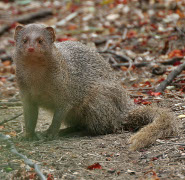
Indian gray mongooseThe Indian gray mongoose (Herpestes edwardsii), also known as the Common grey mongoose, is predominantly found in Sri Lanka and southern India although the species can also be found in other locations such as Iran, Saudi Arabia, other areas of India, and some areas of southeast China.

Unlike other forms of wildlife, the Indian gray mongoose is often found close to the dwellings of humans, particularly in areas of tall grass and trees. They are also found in areas of dense vegetation as well as in cultivated farmland. The animal creates its den in burrows and holes and occasionally under rocks and crags. It often lives alone or in the companionship of another of its species. Although very curious, it is rare to see the mongoose venture far away from its den and natural habitat.

The Indian gray mongoose is typically between 14 and 17 inches in length or 36 and 45 centimeters. The tail length of the mongoose is usually about the length of the body, about 17 inches or 45 centimeters. Its long tail length allows for the mongoose to be a very apt climber because of its added ability to balance. The species weighs between 2 and 4 pounds or 0.89 and 1.7 kilograms with the females being significantly smaller than the males. Their coloring is typically a tawny grayish brown color with their underside being lighter than their upper body. The Indian gray mongoose typically lives about 12 years in captivity.

The Indian gray mongoose has a varied diet consisting of rats, mice, other rodents, small birds, bird’s eggs, invertebrates and lizards. They are also known to kill snakes including cobras which requires a great deal of speed and agility. It is one of the only species that is known for its ability to kill these deadly snakes as well as other poisonous snake species. Their ability to kill these potentially fatal animals is due to their speed as well to their exceptionally thick, course coat.

The mongoose is an avid predator and is capable of defending itself against a variety of species. However, the primary predators of the Indian gray mongoose are the leopard as well as the snakes which the mongoose has been known to engage in fierce battle.

The species typically reaches sexual maturity between 6 to 9 months of age and soon after, begins to mate. Another characteristic which makes the Indian gray mongoose so unique is that they do not have a specific mating season. Instead, the mongoose breeds all year long with a gestation period of approximately 60 to 65 days. The litter of the mongoose ranges in size but usually consists of about 2 to 5 babies.

The Common gray mongoose, as its name suggests, is the most common species of mongoose and is not considered endangered. The species is listed as a Least Concern meaning that there is no immediate risk that the mongoose will become extinct. Although this species is not in immediate danger, there are other species of mongoose which are listed as endangered.

Picture of the Indian gray mongoose by J.M. Garg, licensed under Creative Commons Attribution-Share Alike 3.0 Unported license. You can help spreading the word about this animal by liking it on facebook

Permanent Link

Thursday 02 September 2010 Southern red-backed vole - Traveling on a Pogo Stick
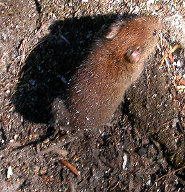
Southern red-backed voleThe Southern red-backed vole (Clethrionomys gapperi) hops through the forest, along old logs, across a bed of moss and up a tree stump. Always in a hurry, it sometimes runs but is most often seen hopping along the cool, damp forest floor.
It lives in bogs, swampy areas and coniferous or mixed forests from British Columbia to Newfoundland and in the northern U.S. in the forests of the Rocky Mountain system to Arizona and New Mexico. It lives in North and South Dakota, Minnesota, Wisconsin, northern Michigan and in New England south to Maryland. Also, in the Allegheny Mountain system to North Carolina and the Appalachian Mountains.

From the family of Muridae, mice and rats, it is small, only 120 – 158 mm (4 ¾ - 6 ¼ in) long and 30 – 50 mm (1 1/8 – 2 in) tall. It weighs 16 – 42 g (1/2 – 1 ½ oz). Its hind foot is 17 – 22 mm (5/8 – 7/8 in) and its tail is 35 – 50 mm (1 3/8 – 2 in) long. It has reddish fur on its back, grayish sides and white or silver on the belly. The tail is also two toned with brown on top and white below. The fur is a little longer and denser in the winter, but with a life span of 20 months maximum, not many live for two winters.

When they don’t feel like finding one of their own, the Southern red-backed vole borrows the nests of shrews and moles. Sometimes, they nest in the exposed roots of trees and crevices of rocks, but they do not construct elaborate nests. The male, female and young will stay together until the young get older when the male usually moves out.

Most Southern red-back voles live 10 to 20 months and start breeding at 2 to 4 months. Females typically have three litters of 2 to 8 young per year from late winter to late fall. Gestation is 17 – 19 days and the young are born hairless and pink with closed eyes and ears. By 17 days they are weaned.

The most common predators are Short-tailed Weasels and Broad-winged hawks, but Coyotes and Gray Wolves sometimes make a meal of the southern red-back vole. In the Great Smoky Mountains National Park one was found in the stomach of a timber rattlesnake.

The Southern red-backed vole is mainly vegetarian preferring plant parts in the spring, fruits and berries in the summer and nuts, seeds and possibly mushrooms in the fall. Occasionally, they eat some insects. They store food in the summer and fall that they will eat in the winter, and they also look for seeds, bark and roots. They are active day and night and all year round. They do not hibernate in the winter and hardly ever slow down as they hop through their short active life.

According to the International Union for Conservation of Nature Red List, the Southern red-backed vole is Least Concern (LC) on the endangered species list. This means the population is stable.

Picture of the southern red backed vole by D. Gordon E. Robertson, licensed under Creative Commons Attribution-Share Alike 3.0 Unported license. You can help spreading the word about this animal by liking it on facebook

Permanent Link

Wednesday 01 September 2010 The Tailless Tenrec: Surprise, I do have a tail!

Tailless tenrecThe Tailless Tenrec (Tenrec ecaudatus), also known as the Common Tenrec, is a species of mammal in the Tenrecidae family. The tenrec itself resembles a shrews or hedgehog. The tailless tenrec is most commonly found making its home in the islands near Madagascar, Mauritius, Réunion, and Seychelles. The natural habitat of the tailless tenrec is anywhere that is a little humid and warm. tailless tenrecs make there home in subtropical or tropical dry forests, lakesides, humid savanna, moist savanna, shrubland, high-altitude shrubland, subtropical or tropical lowlands and grassland, arable lands, domestic gardens, and urban areas. It is unique to the Madagascar and Indian Ocean area.

The Tailless Tenrec is also the largest of the land dwelling species that make up the many types of tenrec. At a typical length of 26 to 39 centimeters (10 to 15½ inches) in length and a weight of about 1.5 to 2.5 kg (3¼ to 5½ lb), the tailless tenrec is also one of the world's largest insectivores-- that is, an animal whose primary diet is insects. With its round, beady eyes and medium-length, soft gray to reddish-brown fur, it is also one of the most adorable insectivores. However, petting the tailless tenrec might not be a good idea, as it also has sharp spines along its body for protection. When it feels threatened, the tailless tenrec will shriek, make its spines puff up into a crest, jump out the way, and if it's cornered even buck and bite. While the tenrec mainly eats small insects hiding among leaves, it will occasionally eat any hiding frogs it its main food source is scarce enough.

The tailless tenrec will make a home out of nearby grass and leaves, sheltering its nest by building it underneath a rock, log or bush. It also has a large family-- the typical female tailless tenrec gives birth to a litter of about 15 to 20 babies at a time, though the highest recorded tenrec litter was 32 young. When the tailless tenrec is first born, they will usually have a fur coat that has black and white stripes, and may look almost mouse-like in appearance. The most curious fact of all is that despite being commonly known as the tailless tenrec, most tailless tenrec actually do have a tail! However, this tail is very small- only about 1 to 1.5 centimeters (⅜ to ½ inches) in length.

Picture of the tailless tencrec by Markus Fink, licensed under GFDL You can help spreading the word about this animal by liking it on facebook

Permanent Link