Subscribe to
"Animal of the day"

AddThis Feed Button
Or subscribe by e-mail

Enter your Email


Powered by FeedBlitz

We hope that reader will gain an increased appreciation of the need for more conservation measure in order to protect the beautiful creatures that inhabit the earth. Our philosophy is that the more we learn about animals, the more we respect them and take better care of them. That is why we update this blog with new animals, We encourage you to syndicate our content by adding "animal of the day" to your own blog! (read more)

About us

Our mission is to get people excited about animals and their welfare by writing articles on these animals. We encourage people to comment on posts and share with others. Don't forget to subscribe to our feed.

Contact us
Copyright notice

Cutest pet ever - cutest pet contest

Funny animal videos and pictures

Swimming with manatees - harmful or helpful

Last Comments

red (Disk Tetra - Hate…): How to breed the fish? Is…
alissa (Stump-Tailed Maca…): sooo cute
Anonymous (Shoebill - Swamp …): These are beautiul birds …
sugar glider info… (Greater Glider - …): They have large, protrudi…
Sabrina (Purple frog): wow, what a lovely frog. …
Organizari evenim… (Fattest cat in th…): :)) This is not funny! Re…
destiny (Ninja cat): hahah thats funny
sami (Bats - the only t…): is that true
Lexis.J (Ninja cat): So funny.He’s the top nin…
someone (Ninja cat): this is soooo cute!

Calendar

« February 2012
S M T W T F S
      1 2 3 4
5 6 7 8 9 10 11
12 13 14 15 16 17 18
19 20 21 22 23 24 25
26 27 28 29      

Archives

Next Archive

01 Jan - 31 Jan 2012
01 Dec - 31 Dec 2011
01 Nov - 30 Nov 2011
01 Oct - 31 Oct 2011
01 Sep - 30 Sep 2011
01 Aug - 31 Aug 2011
01 Jul - 31 Jul 2011
01 Jun - 30 Jun 2011
01 May - 31 May 2011
01 Apr - 30 Apr 2011
01 Mar - 31 Mar 2011
01 Feb - 28 Feb 2011
01 Jan - 31 Jan 2011
01 Dec - 31 Dec 2010
01 Nov - 30 Nov 2010
01 Oct - 31 Oct 2010
01 Sep - 30 Sep 2010
01 Aug - 31 Aug 2010
01 Jul - 31 Jul 2010
01 May - 31 May 2010
01 Apr - 30 Apr 2010
01 Mar - 31 Mar 2010
01 Feb - 28 Feb 2010
01 Jan - 31 Jan 2010
01 Dec - 31 Dec 2009
01 Nov - 30 Nov 2009
01 Oct - 31 Oct 2009
01 Sep - 30 Sep 2009
01 Aug - 31 Aug 2009
01 Jul - 31 Jul 2009
01 Jun - 30 Jun 2009
01 May - 31 May 2009
01 Apr - 30 Apr 2009
01 Mar - 31 Mar 2009
01 Feb - 28 Feb 2009
01 Jan - 31 Jan 2009
01 Dec - 31 Dec 2008
01 Nov - 30 Nov 2008
01 Oct - 31 Oct 2008
01 Sep - 30 Sep 2008
01 Aug - 31 Aug 2008
01 Jul - 31 Jul 2008
01 Jun - 30 Jun 2008
01 May - 31 May 2008
01 Apr - 30 Apr 2008
01 Mar - 31 Mar 2008
01 Feb - 28 Feb 2008
01 Jan - 31 Jan 2008
01 Dec - 31 Dec 2007
01 Nov - 30 Nov 2007
01 Oct - 31 Oct 2007
01 Sep - 30 Sep 2007
01 Aug - 31 Aug 2007
01 Jul - 31 Jul 2007
01 Jun - 30 Jun 2007
01 May - 31 May 2007
01 Apr - 30 Apr 2007
01 Mar - 31 Mar 2007
01 Feb - 28 Feb 2007
01 Jan - 31 Jan 2007
01 Dec - 31 Dec 2006
01 Nov - 30 Nov 2006
01 Oct - 31 Oct 2006
01 Sep - 30 Sep 2006
01 Aug - 31 Aug 2006
01 Jul - 31 Jul 2006
01 Jun - 30 Jun 2006
01 May - 31 May 2006
01 Apr - 30 Apr 2006
01 Mar - 31 Mar 2006
01 Feb - 28 Feb 2006
01 Jan - 31 Jan 2006
01 Dec - 31 Dec 2005
01 Nov - 30 Nov 2005
01 Oct - 31 Oct 2005
01 Sep - 30 Sep 2005
01 Aug - 31 Aug 2005
01 Jul - 31 Jul 2005

Animal pictures
Mammals.start4all.com
Animal diversity web
Recently extinct animals forum
Another chance to see

Miscellany

AddThis Feed Button

Tuesday 31 January 2012 Northern Viscacha - A Sun-Loving Andes Rodent
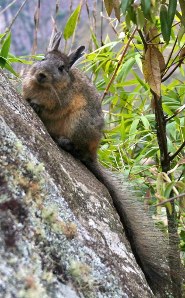
Northern viscachaThe Northern viscacha (Lagidium peruanum), which is also sometimes called the Northern mountain viscacha, is a rodent and a member of the chinchillidae family, which also includes chinchillas. These little guys can be found in Peru, northern Chile and possibly Bolivia and Ecuador. Although they are typically found between the timber and the snow lines in the Andes Mountains at elevations between 3,000 to 5,000 meters -- or 10,000 feet to 16,000 feet -- they can also be found in low coastal ranges at only 300 meters -- or 980 feet. In addition, the northern viscacha is one of only 70 mammal species that live in the unique Winter Rainfall-Valdivian Forests in Chile.

Northern viscachas make their burrows in the crevices of the rocky habitat they prefer and live in large colonies that can include up to 80 animals. The northern viscacha is not a territorial animal, but colonies tend to be separated from one another by some distance.

Northern viscachas look a little like a cross between a squirrel and a rabbit. They have large ears for their bodies, soft, thick fur, and a bushy curled tail. Northern viscachas that live at lower elevations are typically gray in color, while those living up higher tend to be brown. The fur on their lower body is lighter than their upper parts and can be white, pale gray or yellow. The ends of their long tails are darker than the rest of the northern viscacha's body, usually rust or black in color.

These rodents weigh about 1.25 kilograms on average, or 2.75 pounds, and are approximately 300 to 450 millimeters in length, or about 12 to 17 inches, excluding their tails. This animal's long tail is usually about 200 to 400 millimeters in length, or about 8 to 16 inches.

The rocky territory that the northern viscacha lives in has sparse vegetation, so the little herbivore feeds on the hardy grasses that can survive in this somewhat harsh environment. It also dines on lichens and mosses. Northern viscachas typically feed in the evenings and early nighttime hours. Their daytime hours are usually spent basking in the sun on rocks.

The northern viscacha is a mainstay of the Andean cat's diet. It is also hunted by humans for food.

The northern viscacha is currently listed on the IUCN Red List as a species of least concern. It is believed to be a widely distributed species with a healthy population.

Picture of the northern viscacha by Alex Lee, licensed under the Creative Commons Attribution 2.0 Generic license. You can help spreading the word about this animal by liking it on facebook

Permanent Link

Monday 30 January 2012 Murine Mouse Possum - Marsupials Without Pouches

Murine mouse possumThe murine mouse possum (Marmosa murina) is also known as the common mouse possum or Linneaus’s mouse opossum. But no matter what you call it, this is a small marsupial with huge eyes and no pouches. It also has the largest ears and part of the brain devoted to hearing, in comparison to its brain size, than any other mammal on the planet.

The murine mouse possum lives in the forests of South America near water sources, but has adapted to living near houses, orchards and cultivated fields. Countries it can commonly found in are Bolivia, Brazil, Columbia, Suriname, Guyana, Trinidad and Tobago, Venezulea, Peru and Ecuador. Unlike other marsupials, the common mouse possum is not endangered. There has been an effort in North America to breed the murine mouse possum for the pet trade.

Physical Appearance

As its name suggests, the murine mouse possum looks like a cross between a brown mouse and an opossum. Since the creature is nocturnal, the eyes and ears are huge in comparison with the head. The short, dense fur is shades of brown with a dark raccoon-like “mask” going over the eyes. The nose is pointed and pink-tipped. The belly, inside of the legs and chest are pale grey or white.

Adults reach a body weight of 8.8 ounces (250 grams) and a length of 4.3 to 5.7 inches (11 to 14.5 centimeters). But the body is far shorter than the spectacularly long tail, used as a fifth limb to help keep balance in tree branches, for storing body fat and for carrying nesting material such as leaves. The long, softly furred tail reaches lengths of 5.3 to 8.3 inches (13.5 to 21 centimeters).

Life Cycle and Behavior

Murine mouse possums eat a varied diet mainly of insects but also include birds’ eggs, newly hatched chicks, small lizards and fruit. They live solitary lives as adults. Their best defense from predators such as birds of prey or domestic dogs is to run and hide in such places as old bird’s nests and rotting tree logs.

Females take sole responsibility for raising the young. Mating is a ritual that can last hours. Because she is a marsupial, has an extremely short gestation – a mere 13 days. During this time, she constructs a nest made of soft materials like leaves. She has about 6 babies per litter. With luck, the babies will live for another three years. You can help spreading the word about this animal by liking it on facebook

Permanent Link

Thursday 26 January 2012 Pale-throated Three-toed Sloth - Sloth without Ears

Pale throated three-toed slothThe pale-throated three-toed sloth (Bradypus tridactylus) has a round but blunt head, small eyes, a slightly pointed nose but does not have visible ears, but it can hear. It lives a solitary life high up in the treetops of South American rainforests from Northern Argentina to Southern Honduras.

This sloth is not considered endangered, but needs Crecopia trees to survive. If the rainforest is destroyed, the chances are high that the pale-throated three-toed sloth will go extinct. Keeping it in captivity is difficult. Although slow and reliant on trees, the pale-throated three-toed sloth is far from helpless. Its three huge claws on each forepaw, which can grow up to 2.5 inches (6.35 centimeters) long, can defend itself against jaguars and ocelots. It is also an excellent swimmer.

Physical Appearance


Pale-throated three-toed sloths do have pale-colored throats. Their heads are shades of brown, the noses black, and their main body hair are in shades or grey, black and dark brown. However, many adults sport patches of dark green because algae grow in its shaggy fur and the sloth does not remove it. The green shades help it to blend in with the tree leaves in which it lives and feeds. Males have a bright yellow or orange splotch on their backs. Females have two prominent breasts in between their forelimbs.

Adults weigh anywhere from 4.95 to 12.1 pounds (2.25 to 5.5 kilograms). The bear-shaped long body grows to a length of 22 to 23.6 inches (56 to 60 centimeters) and sports a small, hard to see tail only 2.36 to 2.76 inches (6 to 7 centimeters) long.

Life Cycle

Pale-throated three-toed sloths breed year round. After a gestation of 141 days, the female gives birth to a single baby. The female does all of the work caring for the youngsters. She nurses the baby for one month, and then feeds the baby Crecopia leaves, twigs and buds from her own lips. She will care for the baby until it is about 9 months old, then it goes off on its own.

How slow are sloths?

It takes about one month for it to travel one mile. Sloth metabolisms are so slow that it only needs to urinate and defecate once a week. The sloth does this on the forest floor and then goes back up into the canopy. With luck, the sloth can live 12 years, although one pale-throated three-toed sloth in captivity lived to be 31.

Picture of the Pale-throated Three-toed Sloth in a rehabilitation center in Costa Rica by Connor Lee. A very young two toed sloth, in a cardboard box, is being hand fed in the righthand background. The cardboard boxes all have towels or blankets in them and are used as beds for the sloths being rehabilitated. Picture licensed under GFDL and under the Creative Commons Attribution ShareAlike 3.0 License You can help spreading the word about this animal by liking it on facebook

Permanent Link

Wednesday 25 January 2012 Gerp’s Mouse Lemur - Primate Discovered in 2012
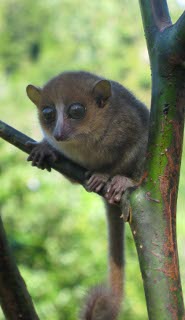
Gerp's mouse lemurThe Gerp’s mouse lemur (Microcebus gerbi) is a tiny, rare primate that lives only in the forests of the eastern part of the island of Madagascar. Because this species is so new to scientists and biologists, not much is known about them, except that they are nocturnal and they prefer to keep in the lowland section of the forests. Just why they prefer these areas is still unknown.

It is unknown how many are alive, what they eat or what predators eat them (besides humans). Their forests are being cut down for timber and agriculture. The particular area where this new lemur was discovered is not under national protection. We may never learn much about the Gerp’s mouse lemur if its habitat is destroyed.

The Discovery

This long-hidden species was discovered by a group of German researchers in 2012. The name “Gerp” is an acronym for the research organization’s station base, Groupe D’Etude et de Rechurche sur les Primates de Madagascar. The group first arrived in Madagascar in 2008 and first thought the creature now known as the Gerp’s mouse lemur was just a variation of another mouse lemur species.

Several lemurs captured in the Sahafina Forest, skin samples taken and released back into the forest. Its skin samples, along with samples of other lemurs in the area, went to a European lab to have the DNA sequenced. It took years to decode the DNA, but when the results were in, the team knew that they had discovered a new lemur species.

General Description

The adult Gerp’s mouse lemur is only as large as a pet hamster. Adults weigh a mere 2 to 2.5 ounces (60 to 70 grams). But it’s not the smallest mouse lemur in Madagascar. That honor goes to the mountain-dwelling Goodman’s mouse lemur, which weighs a mere 1.55 ounces (44 grams.) Like other lemurs, it has huge eyes in proportion to its head; a pointed pink nose and bat-shaped, mobile ears. The huge eyes and prominent ears help the tiny mammal maneuver in the dark.

The tail, at a whopping 5.77 inches (146.5 millimeters.) is longer than its body and hand-like paws containing six claw-like fingers. The Gerp’s mouse lemur is colored like a Syrian or golden hamster with a sandy brown body and white under parts. The fur is thick, short and dense, with longer hairs on the tail tip, which the lemur holds at rest in a hook shape.

Picture of the gerp's mouse lemur by Blanchard Randrianambinina, licensed under the Creative Commons Attribution-Share Alike 3.0 Unported license. You can help spreading the word about this animal by liking it on facebook

Permanent Link

Tuesday 24 January 2012 The Blue Poison Dart Frog - Pretty and Poisonous

Blue poison dart frogThe blue poison dart frog (Dendrobates azureus) flaunts its rich sapphire-blue coloring as a warning to predators that it will make a very unpleasant, possibly deadly meal. While poison dart frogs can be found in a number of different parts of Central and South America, this particular species occurs only in the southernmost area of Suriname, near its border with Brazil. This frog is also known as Okopipi, which is what the native Indians in Suriname call it.

The Dendrobates family of frogs produces a toxin known as pumiliotoxin. Although a person might infer from this frog’s common name its toxins were used in the manufacturing of poisonous darts by native tribes, only the secretions of three other species of poison dart frogs were actually ever used in that manner, and Dendrobates azureus was not one of them.

The blue poison dart frog is a striking-looking frog. Its upper body is a vivid sky blue that is liberally sprinkled with black and dark blue spots. Its four limbs and underside are a darker hue. Blue poison dart frogs typically weigh about 3 grams or approximately 0.11 ounces, and are typically 3 to 4.50 centimeters in length or 1.18 to 1.77 inches. It is believed that these amphibians can live up to between six to nine years in the wild.

The blue poison dart frog lives only in a few isolated rainforest islands that occur in Suriname’s otherwise dry Sipaliwini savannah area. This frog needs to live near a source of water, such as a stream. They are diurnal, meaning that they are active during the day, and are typically solitary, except during breeding season.

In the wild, these frogs feed on a variety of insects, including ants, spiders, termites and caterpillars; many of which contain toxic compounds. As the frog ingests its prey’s poisons, they are absorbed into its skin. Because of this reason, poison blue dart frogs raised in captivity and fed a diet of crickets and fruit flies do not produce toxins.

Unfortunately for the blue poison dart frog, being poisonous doesn’t mean that it can live a predator-free life. Some large spiders and snakes enjoy dining on these little amphibians. This frog is particularly vulnerable in its tadpole stage, where it may fall prey to snakes and dragonfly larvae.

Because this frog occurs in remote areas, its exact numbers are not known, but its IUCN status is vulnerable, and it is also currently listed as Appendix II of Cites, mainly due to its limited and unique habitat.

Picture of the blue poison dart frog by Wildfeuer, licensed under GFDL and Creative Commons Attribution-Share Alike 3.0 Unported. You can help spreading the word about this animal by liking it on facebook

Permanent Link

Monday 23 January 2012 Southern Two-Toed Sloth - Slowest Animal On Earth

Southern two-toed slothThe Southern two-toed sloth (Choloepus didactylus) is a member of the megalonychidae family which currently resides in the rain forests of South America. In appearance, the choloepus didactylus is between 20 to 30 inches long (5 to 8 dm) and weighs between 8 to 18 pounds. (4 to 8 kg). The body of the sloth is fairly short, with the longest part being four arms that end in, as the name implies, two hooked claws. Both the neck, head, and nose are short and stubby, but perhaps the most interesting feature of the southern two-toed slots is it's fur. A mixture of greyish brown hair covers the entire body, however the fur curves the opposite way of all other animals. The fur also contains several grooves which pick up algae and moss, giving the choloepus didactylus a greenish appearance even though the fur itself is brown.

The southern two-toed sloth is most well known for being the slowest animal on Earth. The creature spend nearly all of their life hanging upside down from branches, even when they sleep, mate, and give birth. This allows them to stay out of reach from most predators, despite being exceptionally slow. Because of this, the only predators they have to worry about are those that can fly or climb trees, such as large eagles, ocelots, or jaguars. It may also be hunted by humans as a source of meat, however their fur allows them to camouflage so well within the trees that they can be difficult to find.

The southern two-toed sloth feeds on mostly plant life, including leaves, twigs, berries and other fruits. They will occasionally eat small prey, such as insects, and less commonly sloths that are around human life have been seen consuming human feces from restrooms. With the exception of the latter, all these foods can be found within the trees they hang from. Because of this, the only time the choloepus didactylus ever descends from it's branches is switch trees.

While the two-toed sloth itself isn't endangered, the environment they live in is. Because of the creatures slow speed, they rely heavily on their ability to blend in with their surroundings. Unfortunately, their environment is being ripped apart on a daily basis due to rain forest logging. South America is currently the last remaining location this species can live in naturally, and many worry that with the rain forest being torn down, it will only be a matter of time before the southern two-toed sloth becomes endangered or extinct. You can help spreading the word about this animal by liking it on facebook

Permanent Link

Wednesday 18 January 2012 Baird’s Shrew - The Shrew That Can Only Be Found in Oregon

Bairds shrewThe Baird’s shrew (Sorex bairdii) was once thought to belong to other North American shrew species such as the vagrant shrew (Sorex vagrans) and the dusky shrew (Sorex monticolus). By 1990, biologists realized that the Baird’s shrew was a distinct species that did not breed with any other of the six shrew species it lives near. They are only found in the forests of one corner of the state of Oregon, from the Cascade Range to the Pacific coast. Despite living in a small area, their population is holding steady and they are not considered endangered.

Baird’s shrew is named after its discoverer, biologist Spencer Fullerton Baird (1823 to 1887). A friend of John James Audubon, Baird also discovered a tapir, a beaked whale, a dolphin and a pocket gopher, which are all named after him.

General Appearance

This is a small rodent with a pointed head, large human-like ears and a long, naked tail. Both makes and females appear alike. Adults weigh anywhere from 0.194 to 0.395 of an ounce (or 5.5 to 11.2 grams). Both males and females grow to a nose to tail length of 3.94 to 5.63 inches (or 100 to 143 millimeters).

The Baird’s shrew changes color during the seasons. In spring and summer, the coat is a light chestnut-brown but in the fall and winter are a much darker shade of brown. Their bellies and insides of the legs are a pale grey or yellow. Their tails are pink.

Life Habits

Not much is known about the Baird’s shrew because of its incredibly shy nature and secretive habits, but biologists know that it has a voracious appetite. It can eat a wide variety of insects and spiders. Biologists trying to study the secretive shrew have discovered it likes liver pate. It eats about its own body weight in insects or spiders every day because it has such a high metabolism.

Baird’s shrews have two breeding seasons in early spring and late summer, when insects are at their most plentiful. Although their gestation is unknown, it is thought to be only a few weeks because the species has two breeding seasons. Females give birth to a litter of 4 to 7 hairless, blind babies. These shrews prefer to live in damp areas of pine forests where rotting logs and the insects that inhabit rotting wood are abundant. It is unknown how long Baird’s shrews can live, but most species of shrews can only live about 18 to 24 months. You can help spreading the word about this animal by liking it on facebook

Permanent Link

Monday 16 January 2012 Red-Throated Diver - Smallest Diver Bird in the UK
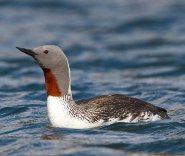
Red-throated diverThe red-throated diver (Gavia stellata) is also called the red-throated loon. The red-throated diver spends the summer in countries in the Arctic Circle, including Canada, Scotland, Northern Ireland and Russia. It spends the winters on the ocean waters in warmer climates like California, Japan and Morocco. It is the smallest ocean-diving bird that visits the UK.

They love each other’s company and live in large flocks containing 200 to 1200 birds. When in large numbers, they get some protection from their predators – large sea gulls and Arctic foxes. If red-throated divers cannot flock on ocean shorelines, they will flock on lakes or even large pools in tundra areas. This species is not endangered, although many die in fishing nets or oil spills.

General Description


The red-throated diver (Gavia stellata) does, indeed, have a red throat in its adult summer plumage. The rest of this water bird’s body consists of a white belly, dove-grey head, a black tail and a back of brown spots against a grey background. This plumage changes to far less spectacular winter plumage of white and grey, with the red throat changed to white. Chicks sport a fuzzy dark brown down before their first molt.

Males are slightly larger than females. Females weigh only 2.18 pounds (988 grams) while males tip the scales at 5.42 pounds (2460 grams). Females have a wingspan of 41.73 inches (106 centimeters) while male wingspans can reach 45.67 inches (116 centimeters). Both males and females have long wings in relation to their body lengths – 20.86 inches (53 centimeters) for females and 27.16 inches (69 centimeters) for males. These long wings help the red-throated diver to begin flying directly from standing still.

Life Cycle and Habits

Males and females form a pair bond when they are 2 to 3 years old and keep the same sexual partner for life. The female lays one or three eggs per year. Although courtship begins on the water, the nests must be on dry ground. The male selects the nest site. Arctic foxes are adept at hunting these eggs. Males and females take turns sitting on the eggs. After 27 days, they hatch. Chicks follow their parents into the water as soon as their down dries. Seven weeks later, they molt and can fly.

Red-throated divers eat a wide variety of fish, mollusks, fish fry, fish eggs, small frogs, tadpoles, insects, snails, prawns and, rarely, aquatic plants. In order to pursue its prey, the bird can dive down to 29.52 feet (9 meters) and snatch the prey with its long bill.

Picture of the red-throated diver by Ómar Runólfsson, licensed under the Creative Commons Attribution 2.0 Generic license. You can help spreading the word about this animal by liking it on facebook

Permanent Link

Thursday 12 January 2012 Black and Rufous Elephant Shrew - Monogamous Elephant Shrew from Africa

Black and rufous elephant shrewThe black and rufous elephant shrew (Rhynchocyon petersi) is also called the black and rufous giant elephant shrew and the black and rufous sengi. These guinea-pig sized mammals originate from Kenya and Tanzania but can also be found in zoos throughout North America. They are endangered due to habitat loss and poaching, since their meat is considered a delicacy. Unlike many other mammal species, males and females are monogamous.

General Description

The black and rufous elephant shrew is aptly named. Their hindquarters and tails are a glossy black while their head and forequarters are a rich red (rufous means “red” in Latin) They have very round guinea pig-like bodies with long, deer-like legs, triangular ears and a long, mobile nose. The mouth is located underneath the long nose close to the head. The “trunk” is used to push through leaves or dirt to uncover food like insects, small frogs, tiny mammals like baby rats, fruits and vegetables.

Both males and females look alike. Adults weigh only 1 pound (0.45 kilograms) and grow to a height of 10 inches (25.4 centimeters). Their bodies, excluding the tail are 12 inches (30.48 centimeters) long. The naked, mouse-like tail varies in length from 7 to 10 inches (17.78 to 25.4 centimeters. The elephant shrews slap their tails against their hindquarters to threaten predators such as large snakes, leopards and hawks.

Life Cycle and Habits

Black and rufous elephant shrews are born fully furred with eyes open. They are weaned after a mere 21 days, but their mother will care for her litter of 1 to 3 babies until they are one month old. Then, the babies leave their parents and find territories and mates for themselves. The females do all of the work of raising the babies, plus chasing any other female black and rufous elephant shrews out of the pair’s territory. Territories for each pair range in size from 2.47 to 4.2 acres (1 to 1.7 hectares).

The male stays with one female for life. He chases other males away and marks territory with a strong scent secreted from glands. Both makes and females use scent markings to leave trails to food. Because the elephant shrews live near the equator, they do not experience winter. The pair mates year-round and a female can have three or four litters per year. Her gestation is a brief 47 days. The pair is active during the day and sleeps at night in a make-shift nest of dead leaves.

Picture of the Black and Rufous Elephant Shrew by Joey Makalintal from Pennsylvania, USA, in Philadelphia Zoo, licensed under the Creative Commons Attribution 2.0 Generic license. You can help spreading the word about this animal by liking it on facebook

Permanent Link

Wednesday 11 January 2012 Eastern Diamondback - World’s Largest Rattlesnake

Eastern diamondbackThe Eastern diamondback (Crotalus adamanteus) is the largest rattlesnake species in the world. It lives in the southeast coast of the United States, especially in sand dunes, edges of swamplands, coastal areas and woodlands. Although they avoid water, these snakes are strong swimmers. Although not considered an endangered species, rattlesnake numbers have been declining due to habitat loss, over-hunting and getting run over by traffic. Humans, large hawks and eagles are their only known predators.

The Eastern diamondback is poisonous. This venom is used to paralyze and partially digest their prey – rodents and rabbits. It is strong enough to kill an adult human. Rattlesnakes are not aggressive but will strike if they feel threatened. The Eastern diamondback will always rattle its tail in warning before biting.

General Appearance

The eastern diamondback rattlesnake is a large, thick-set snake with a bulbous head and a small, blunt nose. Eastern diamondbacks come in several coloration shades, but all sport a pale belly and a series of diamond-shaped black markings from the head to the beginning of the dry rattle-like tail. Colors can be a combination of tan, brown, olive-brown, yellow, rust-red and black. Each scale appears like a bead. The eyes are striped with black and white bands. Their dark eyes have pupil’s that resemble cat’s pupils.

Males grow larger than females. An adult male can weigh 10 pounds (4.54 kilograms). The longest male eastern diamondback ever captured measured 96 inches (244 centimeters) in length, but most adult males do not grow longer than 72 inches (183 centimeters) long. Females average a length of 33 inches (84 cm).

Life Habits

Unlike many other species of snakes, Eastern diamondbacks give birth instead of laying eggs. A fertile female can give birth to a littler of 12 - 24 baby snakes in July and August. Females can only mate every 2 or 3 years. The Eastern diamondback has two mating seasons in the spring and autumn. Males fight to win females in a territory by wrestling with each other. The parents take no care of their offspring. With luck, rattlesnakes can live to be 25 years old.

In late autumn, snakes head below ground to hibernate. They sometimes hibernate together in large colonies in order to keep warm. When not hibernating, rattlesnakes use a series of burrows or tree stumps to hide in. Their patchy coloration makes them blend in with the forest or sandy flooring. They hide and wait for prey to appear and suddenly strike.

Picture of the eastern diamondback by Tad Arensmeier from St. Louis, MO, USA, licensed under the Creative Commons Attribution 2.0 Generic license. You can help spreading the word about this animal by liking it on facebook

Permanent Link

Monday 09 January 2012 Blackbuck Antelopes - (Literally) One of a Kind

Black buckThe blackbuck (Antilope cervicapra) is a species of antelope that is well known for their large horns, which typically curl about five times, giving them a very distinctive look. About the same size as other antelope, a female blackbuck weights about 55lb while a male weighs slightly more at 77lb. In height, the female stands at just above 3ft while the make is nearly 5ft due to the large horns that females lack.

One interesting note about these creatures is that the blackbuck is one of the only antelopes with distinctive coloration. Both genders start out as a light brown, but at around two years of age the males slowly darken to a rich chocolate or black color. Both genders also have white along their chest and underside, but only the males have the long twisted horn that the blackbuck's are so famously known for.

But perhaps the most amazing thing about the blackbuck is just how unique they are. In addition to their distinct coloration, the blackbuck is also the only surviving species of the Antilope population. Their ancestor, including the Antilope intermedius, Antilope subtorta, and Antilope planicornis, are all extinct, leaving only a few fossilized remains behind.

Sadly, the blackbuck may very well be on it's way to repeating history. The species is currently listed as "Near Threatened" on the conservation status scale and has been for nearly ten years. This means that while not currently threatened, without a close eye and constant repopulating, the blackbuck could become extinct. This is mostly due to being hunted by residents of India who view the antelope as crop-raiding pest. While now illegal, there have still been many reports of humans killing the species over the years.

Humans aren't the only thing hunting the blackbuck however. The Indian Cheetah was previously the blackbuck's biggest predators, partly because the cheetah was one of the few animals that could outrun the antelope, which are one of the fastest land animals. Now that that Indian Cheetah has become extinct, wolves and feral dogs have become the leading predators of this species.

The natural habitat of the Blackbuck has been dwindling overtime which is also adding to the threat of extinction. Blackbucks can usually be found in grassy plains, but as more plains are being torn apart and used as businesses, buildings and parking lots, the antelope is forced to go else where. They often end up near bovine who share the same diet of grass, flowers, pods and fruit. Unfortunately, this puts the blackbuck at disk for bovine diseases, resulting in them dying from diseases at an even faster rate.

While the blackbuck originally lived in India and Pakistan, in recently years the species has been brought to the US and Argentina. This is done in hopes that, by providing access to grassy plains, the antelope will be encouraged to breed more.

Today, there are over 50,000 blackbucks roaming their natural habitat with an additional 43,000 in the introduced locations. Because of their threatened nature, you can often see the species at the zoo.

Picture of the blackbuck by Pranav Yaddanapudi, licensed under the Creative Commons Attribution 2.0 Generic license. You can help spreading the word about this animal by liking it on facebook

Permanent Link

Wednesday 04 January 2012 Dusky Leaf Monkey - The Monkey with Eyeglasses

Dusky leaf monkeyThe Dusky leaf monkey (Trachypithecus obscurus), which is also known as the spectacled langur monkey and spectacled leaf monkey, is a very interesting looking creature. Large white circles ring each eye giving these adorable little primates the appearance of sporting eyeglasses, while a thatch of light fur also crowns its head.

In addition to the white circles around each eye, the dusky leaf monkey also has white skin surrounding its mouth region and creamy white coloring on its stomach region. Most of the rest of this monkey's fur is a dark gray, although some subspecies have brownish fur.

An adult male dusky leaf monkey weighs approximately 8.3 kilograms, which is about 18.3 pounds, and they grow to a length of approximately 675 mm or about 26.5 inches. The female dusky leaf monkeys weigh approximately 6.5 kilograms or 14.3 pounds and can grow up to 595 mm or 23.5 inches in length. For its size, the dusky leaf monkey has a very long tail. Its one name, langur, actually comes from a word in Hindu that means long tailed.

Although the adult dusky leaf monkey is typically gray or brown in color, the babies are born a very bright orange or yellow. After about six months, the baby's fur starts to turn gray, and by ten months, the young monkey has usually darkened to a gray or a brown, albeit a lighter shade than an adult.

There are seven subspecies of dusky leaf monkey, with the main distinction between each being the monkey's coloring and also the range in which it lives. For instance Trachypithecus obscurus halonifer lives only on Malaysia's Penang Island and is brownish in color, while Trachypithecus obscurus seimundi can be found on Thailand's Pennan Island and possibly a few parts of eastern Thailand. The latter is also brown in color.

Dusky leaf monkeys can be found primarily in Malaysia, Thailand, and Burma, which is also known as Myanmar. Some, but not all, resources claim that the dusky leaf monkey can be found in India, Laos, and Bangladesh, as well. The dusky leaf monkey is arboreal, meaning that it spends most of its time high up in trees, typically at heights of at least 35 meters -- approximately 114 feet -- or more. The dusky leaf monkey can live in a variety of habitats, from riverine and coastal forests to parks in urban areas.

Dusky leaf monkeys typically live in groups or troops that have an average of ten to seventeen animals. During the day, the troop will splinter into smaller groups to forage through the trees. Dusky leaf monkeys prefer to feed on young leaves, although it will also eat fruits, preferably unripe, and flowers. At night, the monkeys will regroup and then bed down for the evening in the trees.

Predators for this monkey include snakes and possibly large birds of prey. Humans also hunt these monkeys, and loss of habitat has become a problem for the dusky leaf monkey. Currently, these monkeys are listed as Near Threatened on the IUCN Red List.

Picture of the dusky leaf monkey by Robertpollai, licensed under the Creative Commons Attribution 2.0 Austria license. You can help spreading the word about this animal by liking it on facebook

Permanent Link
Tuesday 03 January 2012 Glass Headstander - Tiny Fish With Huge Appetites

Glass headstanderThe glass headstander (Charax stenopterus) is actually the common name for two species of small South American freshwater fish -- Charax stenopterus and Charax gibbosus. Both species are similar, except in color, that some taxonomists think they may be two subspecies instead of two separate species. But the C. stenopterus species is found in rivers and river basins of Argentina, Brazil, Uruguay and Paraguay while the C. gibbosus is found only in Guyana and Suriname.

Back in 1894 when the Europeans first discovered C. stenopterus, scientists and taxonomists christened it Asiphonichthys stenopterus. This classification has since been revised to Charnax stenopterus. But no matter what you call it, the glass headstander is a tiny fish with a huge appetite. Keeping the species in captivity can be difficult but they can be found in the pet trade.

Physical Description

The glass headstander gets its common name from its mostly transparent body, best visible when the fish is only a couple of months old. Adults loose this transparentcy as they get older, turning onto a shiny silver color with a blue spot behind the gills and a thin yellow dorsal spine. Individuals often have slight brown stripes running from the top to bottom of the fish and a visible yellowish-tan spine, clearly visible inside of the body. The internal organs vary in coloration depending on how hungry the fish is. A fish that has just eaten will have a brown or red stomach that appears like a brown spot behind the gills. It also seems to stand on its head when resting, which is a majority of the time while not eating.

These small predators grow to a mere 4.9 inches (12.5 cm) long, but fish in pet stores or aquarium supply stores are often much smaller because they are babies. Always ask how large an adult will grow before purchasing a fish. They have the silhouettes of thin piranha but lack the protruding jaws. They do have large teeth in relation to their size. Their eyes are often gold or yellow colored.

Life Cycle and Behavior


Unfortunately, not much is known about the wild behavior of glass headstanders. They prefer staying in small schools of their own species and will eat just about any other fish they can get a hold of. This makes them difficult to keep in captivity unless a person is willing to keep just glass headstanders in an aquarium. Males and females are almost identical, although the female’s ovipositor or egg-laying tube is sometimes just barely seen poking out from the belly close to the tail.

Breeding the glass headstander in captivity is difficult primarily because their spawning habits are unknown. Most glass headstanders in the pet trade are wild-caught. It is unknown what natural predators glass headstanders have in the wild beside man because the adults viciously defend themselves. They can be killed from parasites such as the small worm or flukes in the Genarchella genus.

Picture of the Glass Headstander by Cláudio Dias Timm, licensed under the Creative Commons Attribution 2.0 Generic license. You can help spreading the word about this animal by liking it on facebook

Permanent Link

Monday 02 January 2012 Cape Grysbok - A Rarely Seen but Common South African Antelope

Cape grysbokThe Cape grysbok (Raphicerus melanotis) is a small antelope that is endemic to South Africa. Though a relatively common species, it is rarely seen as it is very wary and avoids human contact when possible.

Cape grysboks have stout bodies perched on short, relatively delicate legs. This antelope's front legs are shorter than its back, giving the animal a sloping appearance. The coarse fur on the cape grysbok's back and sides is a mingling of red and white hair, while its underside is a lighter color. These antelopes have large ears and big, expressive eyes, and the males have short, thin horns.

Typically, cape grysboks stand about 540 mm at their shoulders, which is approximately 21.5 inches tall, and they weigh about 10 kg or about 22 pounds. The main feature that distinguishes cape grysbok from other grysbok and small antelope species is a set of false hooves that it has above the real hooves on its hind legs.

These tiny antelope are only found in the Western Cape and Eastern Cape provinces of South Africa. They prefer to browse on open plains that are near the shelter of thickets and dense shrubs that can provide them natural cover from predators. Though not as typical, some cape grysboks will live in areas where there is only tall grass to provide shelter.

Cape grysboks are, for the most part, browsers. They dine on grass and the leaves of bushes, trees and vines, as well as fruit. These small antelopes adapt pretty readily to habitat changes, which can sometimes lead it into trouble, especially when they decide to dine on the crops of farmers. Their penchant for nibbling on fruits in orchards and shoots of vines in vineyards has made them unpopular guests in some areas. The cape grysbok does not need a ready source of water and is reportedly able to survive for a period of time without drinking.

The cape grysbok is a nocturnal animal, sleeping during the day and coming out in the evenings to graze. They are also typically solitary in nature. Male cape grysboks are territorial and mark off their territory by means of scent markers to warn others males to stay away.

Because the cape grysboks are small, they are easy prey for many animals, including mammals such as jackals and leopards, as well as large birds of prey and snakes. Habitat destruction is another problem that cape grysboks face. Unfortunately for the cape grysbok, it's not just humans that wreak havoc on its habitat. Elephants in the Addo Elephant National Park, for instance, have managed to destroy much of the thickets in which the cape grysbok prefers to shelter.

Cape grysboks give birth to one baby at a time, usually in the spring. If conditions are ideal, a female may give birth to two babies in one year. Babies, which are known as lambs, are born with a darker coloring than their parents. Cape grysboks, being fairly common, are currently listed as Least Concern on the IUCN's Red List.

Picture of the cape grysbok by Jimfbleak, licensed under GFDL You can help spreading the word about this animal by liking it on facebook

Permanent Link