Wednesday 06 February 2008
Side-striped jackal
The
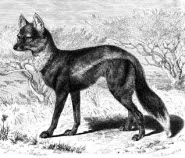
Side-striped jackal (
Canis adustus) inhabits the middle and southern parts of African territories. This jackal opts for the woodlands of the
savanna world. It is known that the biggest distribution in Africa belongs to the Side-striped jackals. It is very similar physically to the Silver-backed jackal. The name originates from the light marks running alongside the sides of their bodies. Coming from afar, the stripes are not exactly outstanding, but up close, the banding patterns can be discerned. Male Side-striped jackal is bigger than females, and significantly so.
Their diet mainly consists of rats, insects and fruits. Compared to their cousins, this jackal is more of a night creature, and more omnivorous.
Breeding period varies, all depending on the location where they reside. The gestation time frame goes from 57 to 70 days, and on the average, they produce three to four cubs. A Side-striped jackal's den is often situated on termite mounds, which have been abandoned by the Aardvark, for whatever reason. Weaning period goes from 8 to 10 weeks. In the wild, the longevity of an individual could go past a decade, 12 years in theory.
They live in pairs, and could even congregate up to 6 members. These jackals can produce a repertoire of sounds, such as hooting, growling, whining and yapping.
Interesting fact: One very common notion that enters our minds when we say "jackal" is howling, right? Well, this kind does not, despite the many sounds they can emit.
You can help spreading the word about this animal by liking it on facebook
Permanent Link
Monday 04 February 2008
Red Brocket
The
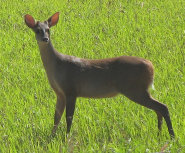
Red Brocket (Mazama americana) can be found in South America and Central America, particularly, they consider as their natural habitat bushes and the undergrowth. Its coat is yellow-red, darker at the back areas. Red Brockets have sharp antlers, not branched, and present in the males only. As in other kinds of deers, they could be shed every year, also...front legs are shorter than the back ones.
Its small physique allows it to hide within the thick plants/roots. A Red Brocket comes out at night to graze, and they have been found in melon plantations. When dawn comes, they would return to their sanctuary, resting in hollows under tree trunks, that or near roots. One could reside in small ranges with radius of 1,000m, and due to their extreme shyness, this breed is particularly hard to monitor. Upon sensing threats, one would freeze on its spot, and if alarmed, it would run away for a bit of ground, then look back to see the origin of the threat. Unlike other deers, a Red Brocket has low stamina and could be chased by ordinary dogs, not just chased, but caught. However, unless the dog is a good swimmer, they could escape if presented with a body of water. They are good swimmers, a river 300m wide is something they can negotiate.
Male Red Brockets hold territories, and they mark it via glands coming from the antlers, and what about the females? The female Red Brocket would just get into a male's territory to indulge in mating.
They do not hold a fixed breeding period. The gestation runs from 7 to 7 1/2 months, on average. A female would give birth to just one fawn, and this she would nurse for weeks until it could survive on its own.
Interesting fact: Some people think that deers can not produce any vocalization, but this is wrong... This kind of deer could let out a sharp cry (but just that, no other kind of sound).
Their main predators include
jaguars,
pumas,
tayra, feral dogs, eagles, snakes and
humans.
Picture of the Red Brocket by Whaldener, licensed under
GFDL
You can help spreading the word about this animal by liking it on facebook
Permanent Link
Monday 04 February 2008
Colombian weasel
As of the mid nineties, just 5 specimens of the
Colombian Weasel (
Mustela felipei) were recognized. They were found in West Colombia and also in parts of North Ecuador (Andes). The Colombian Weasel is labelled as riparian, and this means, living near water or a water-course, fact is, many individuals were acquired/sighted near bodies of water at elevations of 1700 to 2700 meters. There are of course exceptions, but truly exceptions at that, one recent discovery was from a place far from water. Speaking of the five specimens, they had been found at the high lands of Western Colombia, and these areas were heavily exploited, deforestation-wise. A specimen in the distant past was found in the upper Suaza (it's a river) where the body of water possesses stretches of currents mixed in with "peaceful" pools (and when I say mixed, interrupted is what it means here).
The eating inclinations of the Colombian Weasel: generally speaking, they eat up to forty percent of the body mass on a daily basis. The typical diet consists of : mammals, insects and birds. It is a hypothesis (or assumption) of some researchers/experts that Colombian Weasels are in fact aquatic, then it goes without saying that fish are part of their foods. The Colombian Weasel is basically a carnivore, lest you get confused, they have been known to attack chickens, and because of this, farmers attacked them in return.
At present, the Colombian Weasel is now labelled as 'endangered', with very few individuals been seen in the recent years. Specimens had been discovered in places at elevations of 5740' and 8900', and in case you do not know it, these are altitudes where typical cloud forests are present.
Interesting fact: THESE weasels have been killed in the past, because of local superstitious beliefs.
You can help spreading the word about this animal by liking it on facebook
Permanent Link
Sunday 03 February 2008
Black-tufted Marmoset
The
Black-tufted Marmoset (
Callithrix penicillata) is one of the New World monkeys in the order of the
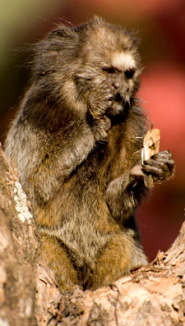
Primates. They mainly live in the forests of Brazilian Central Plateau, and more particularly, the rainforest. The Black-tufted Marmoset lives in the trees, and very seldom do they approach the ground level. As the name implies, they have black tufts around the ears, but usually, they would have some white hair at the facial area. The underside/rump are black, the tail mixed with white and black, but this tail is not for holding. (Black-tufted Marmosets use it for balancing.) They can reach a length of 22 centimeters and approximately 350 grams.
They are diurnal, and usually congregate in groups, anything from 2 to 14. These cliques are usually made up of a mating couple and the newborns. Males often help out in the raising of their young members. The Black-tufted Marmoset do migrate, they often relocate dependent on the season / weather.
Their foods consist of basically tree saps, but in difficult times (droughts), they would not let fruits or insects slide by. During the hardest times, bird eggs, mollusks and arthropods are all fair game. However, drought or not, their survival also hinges on whether they could escape from their predators, such as wild cats and snakes.
Interesting fact: A female often gives birth to twins.
Picture of the black tufted marmoset by Leonardo C. Fleck, licensed under
GFDL and
Attribution-ShareAlike 2.5, Attribution: leofleck
You can help spreading the word about this animal by liking it on facebook
Permanent Link
Saturday 02 February 2008
Bioko Allen's Bushbaby
The
Bioko Allen's Bushbaby (
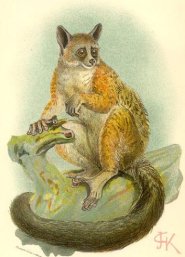
Galago alleni) has big eyes, pronounced ears and they appear to be communicative most of the time. They are also referred to as Night Apes due to their nocturnal nature. Living in the African rainforests, a Bioko Allen's Bushbaby could jump vertically. The Bioko Allen's Bushbabies live in sets with around fifteen individuals for each kilometer. They feed alone or with company, and they survive on fruits, flowers, tree saps, even eggs or birds. The females sleep together, while the male Bioko Allen's Bushbaby sleeps alone.
A male would mate with a large number of females and this results to a fierce competition. These primates have very expressive faces. Under danger, one would have eyes wide open, the lips apart, the teeth hidden by the lips, all in an attempt to scare a predator. A Bioko Allen's Bushbaby would talk to each other by what is called "urine washing", and what is this exactly? One would wash the hands/feet with urine, then rub it off to another thing. Lifespan-wise, the average would fall to a decade.
A long time back, they were exported to be pets in huge numbers as they are very cute, but at present, they are now shielded by Washington Convention. Right now, if you want to get a Bioko Allen's Bushbaby in the United States from outside of the US, you'll be faced with hardships.
Interesting fact: If one meets another, they would do this "greeting protocol": nose to nose sniffing, nose to nose touching, then one of the two would touch the face of the other.
You can help spreading the word about this animal by liking it on facebook
Permanent Link
Friday 01 February 2008
Pygmy right whale
Body Length: 4 - 6.5 meters (13.1 - 21.3 feet)
Mass: 3,000 - 3,500 kg (6,614 - 7716 lbs)
The
Pygmy Right Whale (
Caperea marginata) is a baleen whale and is the only member of the Neobalaenidae family. It is the smallest of the baleen whales, was first described in 1846, and has more in common with the
Gray Whale than a
Right Whale despite its name. The Right Whale is found in the Southern Ocean (Antarctic Ocean) in the Southern Hemisphere and is thought to be circumpolar. The circumpolar band in which it lives is 30°S to 50°S in waters ranging from 5 to 20 degrees Celsius at the surface. Pygmy Right Whales have been found in Tierra del Fuego (archipelago off the southernmost tip of South America), Namibia, South Africa, Australia, and New Zealand. It is also thought that one group of whales may be a year-round resident off Tasmania. The population of the Pygmy Right Whale is unknown.
The coloration of the Pygmy Right Whale is characterized by a dark grey dorsal side with a lighter grey ventral side, and having pectoral flippers of a darker tone than the whale’s sides. The head of the Pygmy Right Whale takes up a quarter of the animal’s total body length, and its throat has grooves that are caused by the mandibular ridges. A pair of light, chevron-shaped patches behind the eyes is a characteristic it shares similarly with the Dwarf and Antarctic Minke Whales. The arched jawline of the Pygmy Right Whale is not as pronounced as other Right Whales and is one reason they are often mistaken as
Minke Whales. The most effective way to distinguish a Pygmy Right Whale is the long, narrow cream-colored baleen plates and white gumline. Each side of the whale’s upper jaw contains 230 baleen plates that vary in length from a few centimeters to as long as 70 centimeters. The width of the baleen plates can be up to 10 centimeters with black/brown edges outlining the white of the baleen plate. It is thought that the baleen plates of the Pygmy Right Whale are tougher and more flexible than any other species. Pygmy Right Whales do not have callosities, which is a feature of true Right Whales. The whale’s dorsal-fin, located about three-quarters of the way along the back, is of a crescent shape, about 15cm tall, and will not be seen upon the whale surfacing, while the whale’s blow is small and indistinct. The swimming capabilities are of a slow, undulating nature but it is capable of burst of speed. Given the sparse encounters with the whale it is studied little and not much is known about the animal’s reproduction, but calves are born in the southern hemisphere’s spring months, September and October. Calves are thought to be 3 - 3.5 meters long when weaned, but lactation period and longevity is unknown.
Knowledge of the whale’s eating habits comes from analysis of the stomach contents of dead whales. The result of this analysis has shown a diet of copepods and euphausiids with copepods being small crustaceans, and euphausiids being krill.
Interesting Fact: The tongue of the Pygmy Right Whale is pure white and feathered at the tip.
You can help spreading the word about this animal by liking it on facebook
Permanent Link