Friday 17 February 2006
Kinkajou - nightwalkers known as honey bears
Kinkajous (
Potos flavus) are nocturnal animals native to the rainforests of Central and South America. They are part of the order of Carnivora and have razor sharp teeth, however, they are not carnivorous, eating primarily fruit and honey. Kinkajous resemble a hybrid between a bear in the face, an otter in the body, a monkey with its tail, and the curiosity of a raccoon. Kinkajous are related to the raccoon and can live as long as 23 years. Some people, like Paris Hilton, keep a kinkajou as a pet as they are very cute. However, there have been reports from owners about sudden vicious attacks after years of non-aggressiveness. Update:
Paris hilton's kinkajou, 'Baby Luv', has been confiscated.
Info on a kinkajou as a pet and a little movie
You can help spreading the word about this animal by stumbling it by pressing
this link
- Permanent Link
Tuesday 14 February 2006
Eastern grey kangaroo - hunted by a soccer boot?
Eastern grey kangaroos (
Macropus giganteus) can be found along the eastern coastlines of Australia, South Wales, and parts of Eastern Tasmania, and Queensland with the exception of western Cape York. Eastern grey kangaroos are often confused with the West grey kangaroos, but are distinguishable by their more even distribution of fur colors. The eastern grey also has a much lighter face complexion than the western. Did you know a baby kangaroo is called a 'joey'? And that a group is called a 'mob'? These 'mobs' have one dominant male and about 2-3 females with young, and about 2-3 young males. The only natural predator, besides man, is the dingo, but the effect is not significant. The kangaroo industry is huge, considering the kangaroo industry is worth AUD$200 million per year and directly employs 4000 people, many of these jobs are in remote areas with few other employment opportunities (
source, note: this is old, it probably is a lot more). The Viva ( Vegetarians International Voice for Animals) movement is calling it the largest wildlife massacre on the planet. The kangaroo industry produces kangaroo leather that is also used in soccer boots. Adidas produces one type of soccer boot that uses this leather: the predator (what an appropriate name). From
Viva's website:
"This (soccer boot) industry is vital to the kangaroo industry. Without it underpinning kangaroo skin prices the entire industry would be at risk. Adidas have received to date over 10,000 emails complaining about their use of kangaroo leather...and are obviously concerned about damage to their image."
The Viva sued adidas in 2003, read it here.
In response to critics, the Kangaroo industry association of Australia responds on their website with:
"Commercially utilising wildlife, especially iconic species like kangaroos, challenges the widely publicised view of conservation pushed by the modern NGO conservation movement. Many people living in New York, London, Paris or Sydney and brought up on an ‘entertainment diet’ of wildlife documentaries would believe ALL wildlife is endangered. The fact that some species, like the commercially harvested kangaroos, are super-abundant and can be sustainably harvested as a resource does not get much publicity from groups like Greenpeace who are dependent on a ‘concerned’ public for their annual revenue.
For other people the thought of killing an attractive wild animal such as a kangaroo goes against their deeply held love of animals." (source)
Please share your thoughts on this and take care.
You can help spreading the word about this animal by stumbling it by pressing
this link
- Permanent Link
Sunday 12 February 2006
The Koala - threatened by its popularity

The
Koala (
Phascolarctos cinereus) is found on the East coast of Australia. It's scientific name comes from
phaskolos meaning "pouch" and;
arktos meaning "bear". The Koala's original name was "New Holland Sloth" and also called it the "Koalo Bear", but also the "Ursine Sloth" because of the bear-like shape of the neck and the shoulders. They almost solely feed on eucalyptus leaves, a strange evolutionary twist since eucalyptus leaves are low in protein and hard to digest and toxic (!?!). Koalas have, just like wombats and sloths, a very low metabolic rate, they only are active 4 hours a day, the other sleeping and resting. Threatened by excessive hunting for its fur, the species almost became extinct in the 20th century. The increase in population of humans in the area threatens the koala population, since the koalas require large connected forests to ensure genetic diversity and humans bring along roads and cut forests. On Kangaroo Island in Australia the opposite problem exists, there are too many, mainly because of the absence of predators. There are already four times the number of koalas the island can support according to some biologists. The popularity of the Koala has made the possibility of a cull politically improbable (read more on
Koala cull: the Kangaroo Island controversy).
Image of the koala: A Koala climbing up a tree. Taken on the 28th of July, 2004 in Cape Otway National Park, Victoria, Australia, licensed under Creative Commons Attribution 2.5 License
You can help spreading the word about this animal by stumbling it by pressing
this link
- Permanent Link
Wednesday 08 February 2006
Dozens of New Species discovered in 'Lost World' in New Guinea
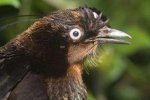
High in the mountain rainforests of New Guinea a "lost world" has been discovered, containing dozens of new species, by an international team of scientists. From the Independent: "In a jungle camp site, surrounded by giant flowers and unknown plants, the researchers watched rare bowerbirds perform elaborate courtship rituals. The surrounding forest was full of strange mammals, such as tree kangaroos and spiny anteaters, which appeared totally unafraid, suggesting no previous contact with humans."
Bruce Beehler, of the American group Conservation International, who led the month-long expedition last November and December, said:
"It is as close to the Garden of Eden as you're going to find on Earth. We found dozens, if not hundreds, of new species in what is probably the most pristine ecosystem in the whole Asian-Pacific region. There were so many new things it was almost overwhelming. And we have only scratched the surface of what is there."
Among the forty recorded mammal species are: six species of tree kangeroos, which are rare in New Guinea, were thriving there. Among those six species a new species to Indonesia has been recorded, the golden-mantled tree kangeroo. The spiny anteater, was also encountered.
"Like all the mammals found in the area, it was completely unafraid of humans and could be easily picked up, suggesting its previous contact with man was negligible."
Found:
- A new species of honeyeater, the first new bird species discovered on the island of New Guinea since 1939.
- The formerly unknown breeding grounds of a "lost" bird of paradise.
- First photographs of the golden-fronted bowerbird displaying at its bower.
- A new large mammal for Indonesia, the golden-mantled tree kangaroo.
- More than 20 new species of frogs, including a tiny microhylid frog less than 14mm long.
- A series of plant species- A remarkable white-flowered rhododendron with flower about 15cm across.
- Four new butterfly species.
Resources:
The Independent
Conservation International
8 pictures of the "lost world" species
You can help spreading the word about this animal by stumbling it by pressing
this link
- Permanent Link
Tuesday 07 February 2006
Stoat with its white winter coat
Stoats (Mustela erminea) are also called Short-tailed Weasels in North America and in winter, with its white winter coat, it is called an Ermine. The Stoat is a very opportunistic hunter, with its diet ranging from small rodents (mice and rats),
rabbits, birds, eggs, even fish, reptiles, amphibians, and invertebrates. It is also an extremely skilled treeclimber, descending from it with its head first, just like a
squirrel. Once introduced in New Zealand as a means to control the rabbit population, it now is considered a pest there, since that did more harm than good. The term 'ermine' is also used for its fur, for which they are hunted in some areas. In the wild they are found in the north temperate regions of Eurasia and North America.
Picture of the stoat by
BozMo, licensed under
GFDL
You can help spreading the word about this animal by stumbling it by pressing
this link
- Permanent Link
Monday 06 February 2006
Giant armadillo - eradicator of termite mounds

The
giant armadillo (
Priodontes maximus) or (
Priodontes giganteus) is the largest member of the armadillo family. It is an endangered species, living in tropical rainforests in South America, near termite mounds. They primarily feed on termites and certain ants and will consume a whole termite mound population once discovered. Giant armadillo's are easily distinguishable from other armadillo's by their huge size. They can weigh up to 26 kg and reach 90 cm in length. They are also known for their burrowing techniques. When a termite mound has been eradicated, they will bury themselves in the remains and rest there before moving on. It is believed that the giant armadillo is also a good swimmer.
"The giant armadillo was classified as Extremely Endangered (EN — A1cd) on the World Conservation Union's Red List in 2002, and is listed under Appendix I (threatened with extinction) of the Convention on the International Trade in Endangered Species of Wild Flora and Fauna. (source)"
Picture of the giant armadillo by Alessio Marrucci, licensed under GNU Free Documentation License.
You can help spreading the word about this animal by stumbling it by pressing
this link
- Permanent Link