Thursday 30 October 2008
Crabeater Seal
The
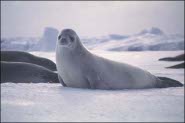
Crabeater Seal (
Lobodon carcinophagus) lives in the pack ice around Antarctica. It weighs about 20 kgs upon birth, and is around 1.5 to 1.6 meters long. Male adults range from 203 cm to 241 cm and have a weight of up to 225kgs. They have a long, pronounced snout, which, when agitated, has foam at their mouth. The majority of Crabeater Seals are scarred, and these parallel scars traverse the sides and the back.
There have been sightings of hundreds of seals congregating on a singular ice floe, but it could not be determined whether this multitude is in fact a social manifestation or it just happened by chance. They are first and foremost pack-ice creatures, but a Crabeater Seal can sometimes be found at the shore's territories.
The newborns come out mainly in September and October, and it is very common during these periods for them to be in trios. The male, female and the young. Male Crabeater Seals would be aggressive if a leopard seal thinks it could encroach on its territory. It is known that it could be threatening humans as well.
Their diet has been estimated to consist of 45 percent krill, 35 percent seals, 10 percent penguins, and 10 percent fish and cephalopods. One captured individual was observed closely, and it was discovered that it could suck preys to its mouth in a single gulp from lengths of up to 50 centimeters. This food was kept inside its mouth by the seal pressing its tongue to the palate, at the same time, it would bring up its lips to release the water.
It may not have a lot of predators it has to escape from, but it sure has a lot of competitors for krill. These are whales, other seals and even humans.
Interesting fact: Facial scars and at the flippers come from wounds acquired during their breeding days.
You can help spreading the word about this animal by liking it on facebook
Permanent Link
Thursday 16 October 2008
Southern common opossum
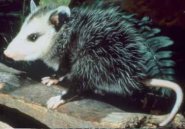
The
Southern Opossum (
Didelphis marsupialis) (also called the Common Opossum or in the Antilles the Manicou) is a wide ranging species of opossum that is located throughout southern Mexico all the way to Bolivia. The size of the common opossum is around the size of what we consider the common house cat. The fur of the opossum is actually yellow in the under-fur, but is hidden by the longer black guard-hairs that cover it, while the tail, fingers, and face are lighter – with the tail being without fur (somewhat similar to a giant rat tail – it can measure nearly 20 inches long). It has large ears that are usually black, and its face is usually a pale peach in color, with black whiskers and eyes that reflect reddish in light. With a body length of nearly a foot, and a tail that can reach almost two feet, the Common Opossum is one of the larger relatives in its family. They can weigh in at over three pounds, and they mostly live in the trees – however they can live without them.
Their habits and behavior are geared toward nocturnal activity, and terrestrial, and some arboreal exploration and habitation. They have a broad ability to adapt to environmental changes, and their teeth allow for them to eat many different foods which it forages for mostly on the ground. It can eat any number of small insects, small animals, fruits, vegetables, and also carrion. Their ability to digest almost anything edible gives them a broader range than a human (we do in fact have a broad range of things we can digest as omnivores ourselves) in what the Common Opossum can eat. They are usually a solitary animal, however will pair up on occasion for mating. They have a wide range of nesting in addition to their general-purpose status – usually they will create one in the hollow of a tree, however they will also dig a burrow and next in any dark location if nothing else is suitable (which often gets them in trouble with humans). They’re also considered pests due to their nature of being the all around marsupial version of the
Raccoon. Raided trashcans, habitation of locations that are not suitable, and causing mayhem if encountered within a living space of humans, they are often times trapped and killed.
Their scientific classification is Didelphis Marsupialis, which shows that they belong to the genus Didelphis in which all of the large American opossums are a part of. The Didelphis genus belongs to the subfamily Didelphinae which in turn belongs to the family Didelphidae. Didelphidae belongs to the order Didelphinmorphia, of which all of the common opossums belong to (those opossums being in the western hemisphere from North to South America). Their infraclass is Marsupialia, which means they are related to kangaroos, koalas and many other marsupials.
Interesting Facts about Common Opossums:
- The Common Opossum is sometimes used for food in poorer areas by humans.
- The Common Opossum lives for around 2.5 years and will have 5-9 babies between one and three times per year after maturity. The mother raises the young while the father takes no part in it.
You can help spreading the word about this animal by liking it on facebook
Permanent Link
Tuesday 14 October 2008
One in Four mammals is at risk of total extinction
Last week a summit in Spain along with a new study has shown that within the next average human lifetime one out of every four mammals may be extinct if the current trends in ecological and environmental destruction are not curbed. As of today there are 5,487 species of mammal alive and known (this is not counting the numerous endangered subspecies – which could alter the results to an even greater extinction rate). This is an astounding 1,141 species and subspecies of animals – considering most species have more than one subspecies altogether.
Unfortunately – and most alarmingly, marine based mammals may be at an even greater risk of extinction – 33%. That is one in three. Overall we are looking at an ecological and environmental crisis not seen since some of the great die-offs. The difference between those normal occurrences and this one is that we, human beings, are listed as the number one cause. This study was undertaken by the IUCN, in which more than 1,700 scientists, experts, and analysts took part, over the course of five years.
The animals most at risk for the long term are large cats, whales, and primates. The most threatened area of world on land is found in Asia, where the main human causes of environmental havoc are being experienced. Pollution, deforestation, and mass habitat loss to satiate the growing human populations through new housing and farming developments – not to mention poaching and the meat trade. Over 79% of Asia's primate population is staring down the barrel of the extinction gun through these direct human causes.
The largest contributor to the endangerment of species worldwide is the loss of habitat – in fact more than 40% of all the endangered species are at risk due to this cause alone. Most of the marine mammal deaths are preventable, however due to fast fishing methods on an industrial scale, there are all sorts of mammals being caught and killed without any benefit to man. They are usually discarded as it is most of the time illegal to catch an endangered species.
Currently laws and regulations in place to protect certain species, combined with conservation efforts, have been able to bring back populations from the brink of extinction. However, as our numbers continue to grow, passing seven billion soon enough, and possibly eight billion, our expansion will only continue to destroy and damage wildlife, threatening more and more species with their demise.
As this study outlines the impact that our species is having globally, it also shows that our current efforts have worked for some species. Unfortunately unless we review and look at our habits and ways of life, it may not be enough to start a cascade of ecological collapse, as many species are dependent on another – as one link in a massive food web is broken, others weaken or break off altogether. With the extinction of over 1,000 species in what could be just one human lifetime – it may threaten our very ways of life on this planet.
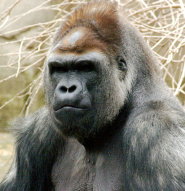
Picture of the western lowland gorilla by Kabir Bakie at the Cincinnati Zoo July, 2005. Licensed under Creative Commons Attribution
ShareAlike 2.5
You can help spreading the word about this animal by liking it on facebook
Permanent Link
Wednesday 08 October 2008
Kiang
The
Kiang (
Equus kiang), the largest wild ass, can go by many names: khyang, Tarpan or Gorkhar. They live on "the roof of the world", the Tibetan plateau, an elevated area of around 1000 (621 miles) by 2500 kilometers (1553 miles) (!) at altitudes ranging from 2700 to 5300 meters (8,800–17,400 ft), covering parts of Tibet, China and India. They are also known to live in Pakistan and Nepal. Because the terrain is so difficult and inaccessible, the Kiang is one of the least studied large animals in the world.
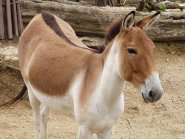
The Kiang has a large head, blunt muzzle and a curved nose and a average shoulder height is 140 centimeters. They have short manes which stand upright and a chestnut coat, which is darker in the winter and a little bit lighter (reddish) in the summer. The lower part of their body is white.
The
wolf is the only real predator besides
humans. Kiangs defend themselves by forming a circle and, with heads down kick out violently. This is an effective technique, so wolves usually attack single animals.
The Kiang has four subspecies, the Western, Eastern, Southern and Northern Kiang. The largest is the Eastern Kiang, the Southern is the smalles, the Western is a little bit smaller than the Northern and their coat has a darker shade of brown. They primarily feed on Stipa grass.
Picture of the Kiang by Bodlina, licensed under
GFDL
You can help spreading the word about this animal by liking it on facebook
Permanent Link