Subscribe to
"Animal of the day"

AddThis Feed Button
Or subscribe by e-mail

Enter your Email


Powered by FeedBlitz

We hope that reader will gain an increased appreciation of the need for more conservation measure in order to protect the beautiful creatures that inhabit the earth. Our philosophy is that the more we learn about animals, the more we respect them and take better care of them. That is why we update this blog with new animals, We encourage you to syndicate our content by adding "animal of the day" to your own blog! (read more)

About us

Our mission is to get people excited about animals and their welfare by writing articles on these animals. We encourage people to comment on posts and share with others. Don't forget to subscribe to our feed.

Contact us
Copyright notice

Cutest pet ever - cutest pet contest

Funny animal videos and pictures

Swimming with manatees - harmful or helpful

Last Comments

red (Disk Tetra - Hate…): How to breed the fish? Is…
alissa (Stump-Tailed Maca…): sooo cute
Anonymous (Shoebill - Swamp …): These are beautiul birds …
sugar glider info… (Greater Glider - …): They have large, protrudi…
Sabrina (Purple frog): wow, what a lovely frog. …
Organizari evenim… (Fattest cat in th…): :)) This is not funny! Re…
destiny (Ninja cat): hahah thats funny
sami (Bats - the only t…): is that true
Lexis.J (Ninja cat): So funny.He’s the top nin…
someone (Ninja cat): this is soooo cute!

Calendar

« May 2012
S M T W T F S
    1 2 3 4 5
6 7 8 9 10 11 12
13 14 15 16 17 18 19
20 21 22 23 24 25 26
27 28 29 30 31    

Archives

Next Archive Previous Archive

01 May - 31 May 2012
01 Apr - 30 Apr 2012
01 Mar - 31 Mar 2012
01 Feb - 28 Feb 2012
01 Jan - 31 Jan 2012
01 Dec - 31 Dec 2011
01 Nov - 30 Nov 2011
01 Oct - 31 Oct 2011
01 Sep - 30 Sep 2011
01 Aug - 31 Aug 2011
01 Jul - 31 Jul 2011
01 Jun - 30 Jun 2011
01 May - 31 May 2011
01 Apr - 30 Apr 2011
01 Mar - 31 Mar 2011
01 Feb - 28 Feb 2011
01 Jan - 31 Jan 2011
01 Dec - 31 Dec 2010
01 Nov - 30 Nov 2010
01 Oct - 31 Oct 2010
01 Sep - 30 Sep 2010
01 Aug - 31 Aug 2010
01 Jul - 31 Jul 2010
01 Jun - 30 Jun 2010
01 May - 31 May 2010
01 Apr - 30 Apr 2010
01 Mar - 31 Mar 2010
01 Feb - 28 Feb 2010
01 Jan - 31 Jan 2010
01 Dec - 31 Dec 2009
01 Nov - 30 Nov 2009
01 Oct - 31 Oct 2009
01 Sep - 30 Sep 2009
01 Aug - 31 Aug 2009
01 Jul - 31 Jul 2009
01 Jun - 30 Jun 2009
01 May - 31 May 2009
01 Apr - 30 Apr 2009
01 Mar - 31 Mar 2009
01 Feb - 28 Feb 2009
01 Jan - 31 Jan 2009
01 Dec - 31 Dec 2008
01 Nov - 30 Nov 2008
01 Oct - 31 Oct 2008
01 Sep - 30 Sep 2008
01 Aug - 31 Aug 2008
01 Jul - 31 Jul 2008
01 Jun - 30 Jun 2008
01 May - 31 May 2008
01 Apr - 30 Apr 2008
01 Mar - 31 Mar 2008
01 Feb - 28 Feb 2008
01 Jan - 31 Jan 2008
01 Dec - 31 Dec 2007
01 Nov - 30 Nov 2007
01 Oct - 31 Oct 2007
01 Sep - 30 Sep 2007
01 Aug - 31 Aug 2007
01 Jul - 31 Jul 2007
01 Jun - 30 Jun 2007
01 May - 31 May 2007
01 Apr - 30 Apr 2007
01 Mar - 31 Mar 2007
01 Feb - 28 Feb 2007
01 Jan - 31 Jan 2007
01 Dec - 31 Dec 2006
01 Nov - 30 Nov 2006
01 Oct - 31 Oct 2006
01 Sep - 30 Sep 2006
01 Aug - 31 Aug 2006
01 Jul - 31 Jul 2006
01 Jun - 30 Jun 2006
01 May - 31 May 2006
01 Apr - 30 Apr 2006
01 Mar - 31 Mar 2006
01 Feb - 28 Feb 2006
01 Jan - 31 Jan 2006
01 Dec - 31 Dec 2005
01 Nov - 30 Nov 2005
01 Oct - 31 Oct 2005
01 Sep - 30 Sep 2005
01 Aug - 31 Aug 2005
01 Jul - 31 Jul 2005

Animal pictures
Mammals.start4all.com
Animal diversity web
Recently extinct animals forum
Another chance to see

Miscellany

AddThis Feed Button

Monday 27 February 2012 Red-tailed Pascogale - Males Die After Mating

Red-tailed phascogaleThe red-tailed phascogale (Phascogale calura) is also called the red-tailed Wambenger. A "phascogale" (translated as "pouched weasel") is a small, meat-eating marsupial. Like kangaroos, red-tailed phascogale females grow their joeys (babies) in a pouch instead of a placenta. Unlike kangaroos, male red-tailed phascogales usually die after their first (and often only) mating. Females, however, can live to be three years old and have several litters.

This species was nearly wiped out due to the introduction of the domestic cat and the European fox, which were introduced to the continent with European settlers. Once found all over Australia, the red-tailed phascogale now only lives in a tiny part of southwest Australia. According to the Australian government, the red-tailed phascogale is endangered, although the International Union for the Conservation of Nature only classifies this species as "threatened." The red-tailed phascogale relies on trees for its survival, especially rock oaks. If the trees disappear, then so will the red-tailed phascogales.

Physical Appearance

The red-tailed phascogale resembles a smaller, longer-faced chinchilla. It's body is compact, with short legs ending in mostly hairless feet. The bottom of the feet contain pads that help the red-tailed phascogale climb trees. The body has a grey-brown coat with a white belly, chest and legs. Some individuals can appear silvery. The slim reddish tail ends in a black brush. The face has a rose pink nose and pale rings around the large, dark eyes.

Adults grow to a total body length of 9.45 inches (240 millimeters), where the tail is slightly longer than the rest of the body. Adults can weigh anywhere from 1.23 ounces to 2.47 ounces (35 to 70 grams.)

Life Cycle and Behavior

Although the red-tailed phascogale hunts and eats at night, it can be active during the day in order to search for food. When they sleep, they mostly do so in trees. But when they hunt, they do so on the ground, although sometimes they will hunt in the trees. Red-tailed phascogales can leap up to 6.5 feet (2 meters) in order to take down small birds. But mainly, red-tailed phascogales eat insects and small mammals like the European house mouse. The red-tailed phascogale does not need to drink water as it derives all of its fluids from its prey.

Red-tailed phascogales become sexually mature when they are about 12 months old. Mating season is in July. The immune system of males fail during this stressful time, so they usually do not survive to their second year. Females have up to 15 joeys.

Picture of the red-tailed phascogale by Interllectual, licensed under the Creative Commons Attribution-Share Alike 2.0 Generic license. You can help spreading the word about this animal by liking it on facebook

Permanent Link

Friday 24 February 2012 Saddlebacked Tamarin - A Tiny Twin-Bearing Monkey

Saddlebacked tamarinThe Saddlebacked tamarin (Saguinus fuscicollis) is a small primate that lives in South America. It is also sometimes known as the brown-mantled tamarin or saddleback tamarin. These little monkeys are related to, but are larger than marmosets.

There are many subspecies of Saguinus fuscicollis, so the Saddlebacked tamarin coloring can vary greatly but generally, this monkey’s shoulders, forelegs and tail are a darker color, while its back and hip area are a mixture of black, yellow and orange hair. The underside of this monkey is usually a dark red. However, the main coloring of different subspecies of the Saddleback tamarin can also be bright orange, black or white. Some of the lighter monkeys may actually appear to be all one color.

The saddleback tamarin is typically 17 to 27 centimeters long or 7 to 10 inches, not including its tail. Its tail is typically 43 centimeters or about 17 inches long. Saddlebacked Tamarins weigh approximately 338 to 436 grams or about 12 to 15 ounces. These monkeys have non-opposable thumbs and their digits – except for the big toe on each foot -- are claw-like.

These monkeys are diurnal, meaning they are most active during the day, and they live on a diet of fruits, insects, nectar, tree gums, and flowers. They will also dine on small animals and frogs.

The Saddlebacked tamarin lives in tropical areas, as well as dry forests and can be found in the countries of Ecuador, Bolivia, Peru, Columbia and Brazil. Their preferred habitat is the lower layers and the understory of primary, as well as secondary forests. Saddlebacked tamarins move on the ground by walking and running on all fours. In the trees, they swing from branch to branch, and they also use their strong claws to scramble up trees.

The saddlebacked tamarin is a social animal and lives in a group that ranges in size from between four and twenty animals. They are known to co-mingle with other species of primates, including moustached tamarins and Goeldi's marmosets. Only the dominant female in a group of saddlebacked tamarins will mate during a breeding season. She will then typically give birth to twins that are reared with the help of the entire group.

These primates are still quite common and, therefore, it is currently listed as a species of least concern on the IUCN Redlist. These little monkeys are, however, hunted for food by locals and are also captured as part of the pet trade. The saddlebacked tamarin is also preyed upon by eagles, hawks, snakes and members of the cat family, such as the ocelot.

Surprisingly enough, as recently as 2009, a new subspecies of saddleback tamarin, the Saguinus fuscicollis mura, was discovered by scientists in Brazil in a remote region of the Amazon.

Picture of the Saddlebacked tamarin by D. Gordon E. Robertson, licensed under GFDL 1.2. You can help spreading the word about this animal by liking it on facebook

Permanent Link

Thursday 23 February 2012 Banded Palm Civet - Rare Carnivore of the Tropical Forest

Banded palm civetThe banded palm civet (Hemigalus derbyanus) appears to be a strange-looking cat but is more closely related to the mongoose. There are over 20 species of civets, most in Asia and Africa. The banded palm civet lives in Borneo, Thailand, Malaysia, Indonesia and Burma. They are listed as a vulnerable species by the International Union for the Conservation of Nature because banded palm civets need to live in forests near water. Unfortunately, these forests are being cut down quickly to make lucrative palm oil plantations.

Banded palm civets also do not breed well in captivity. Despite the best efforts of biologists, hardly anything is known about the mating behavior of banded palm civets so zoos are at a loss as to help their banded palm civets breed. Scientists are not even sure when females come into season and will allow a male to get close without attacking him. Banded palm civets are also prey for leopards, tigers, crocodiles, large snakes and people.

Physical Description

Civets have long, slim bodies with short legs and a long tail. They have an elongated feline face with large dark eyes and small ears. The facial fur is a dark brown to black. The body fur is a yellowish-grey with thick dark stripes along the back, sides and around the tail. These thick stripes help the banded palm civet to blend in with the plants and shadows of the Asian tropical forests.

From nose to the base of the tail, adults grow 18.11 to 20.87 inches (46 to 53 centimeters.) Tails grow anywhere from 9.84 to 14.96 inches. (25 to 38 centimeters) long. Adults vary in weight from 3 to 10 pounds (1.4 to 4.5 kilograms.) Adults grow 40 triangular-shaped teeth, which are excellent for killing prey and slicing up meat into bite-sized chunks. Their semi-retractable claws are long to help dig burrows in the ground and to climb trees.

Life Cycle and Behavior

Not much is known about the life of wild banded palm civets due to their shyness and their nocturnal nature. It is known that they sleep during the day underground or in trees and hunt at night. They communicate with other banded palm civets with cries and through expelling a powerful musk from glands underneath the tail. Both males and females hold territories and only get together for breeding.

Females raise the young without any help from the males. Gestation lasts anywhere from 34 to 64 days. Females only have one or two babies with each litter. The mother nurses her babies for about 70 days and teaches them to hunt small rodents, frogs, lizards, worms and the occasional flower or fruit. Banded palm civets tend to seize prey in their teeth and shake it to death. With luck, a banded palm civet can live up to 13 years.

Picture by Mariomassone, licensed under GFDL 1.2 You can help spreading the word about this animal by liking it on facebook

Permanent Link

Tuesday 21 February 2012 Pallid Needle-clawed Galago - African Glider of the Forest

Pallid needle-clawed galagoThe pallid needle-clawed galago (Euoticus pallidus) is also known as the Northern needle-clawed bushbaby. This small primate lives in the forests of the African countries of Nigeria, Cameroon, Congo, Gabon and Equatorial Guinea. It relies on living in the treetops. If African forests continue to be decimated, then the pallid needle-clawed galago will become extinct in the wild. Currently, this species is not endangered.

This small primate has an interesting way to escape from predators like birds of prey – it leaps from a tree, spreads out a thin flap of skin which acts as a parachute and glides to another tree trunk or the ground. But this adaptation cannot help it against its primary predator, humans.

General Description

The pallid needle-clawed galago strongly resembles a lemur. It has a furry, monkey-like body with a long tail, a pointed head and prominent triangular ears. Fur color can vary from a cinnamon brown to a sandy tan. The belly, chest, inside of the legs and most of the tail are pearl grey to white. A dark colored stripe runs along middle of the back. The eyes are large and owlishly round. Eye color varies from yellow to a reddish orange.

The toes on all four paws have adapted to gripping tree limbs. It also helps the small primate to run down tree trunks like a squirrel. The second toe on the hind legs has a nail slightly different from the other toenails. The pallid needle-clawed galago uses this toe to help groom itself. The teeth on the lower jaw are used as a comb. Adults grow to a weight from 0.59 to 0.79 pounds (270 to 360 grams.)

Life Cycle and Behavior

Pallid needle-clawed galagos are not friendly and live solitary lives. The exception is for related females, which may get together for mutual grooming. Males and females hold individual territories which they guard vigorously. They mark territory with their urine and with loud calls. Males hold larger territories than females. Females give birth to a single baby that already can open their eyes and cling to fur. Females also carry babies around in their mouths.

These animals sleep during the day and search for food at night. They have a very specialized diet – tree sap, resin or gum. They cannot live in mountainous forests because those trees do not produce the type of resin or sap that they need to eat. It is unknown how long these primates live. You can help spreading the word about this animal by liking it on facebook

Permanent Link

Monday 20 February 2012 Thick-spined Porcupine - Adapted to Living Near People
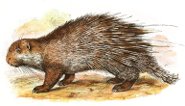
Thick spined porcupineThe thick-spined porcupine (Hystrix crassispinis) is also called the Bornean rattle porcupine. It is one of the few native mammals in Southeast Asia that is not endangered. This large rodent is often hunted by people for its meat. It lives in the forests, pastures and plantations of the Island of Borneo. It can survive in hilly regions up to 3937 feet (1200 meters) above sea level. It can even live in people’s back yards. Unlike many other native rodents, it seems unconcerned by the spread of man and his farmlands.

They also do well in captivity, provided that they are kept in heated environments with a humidity level kept to at least 35%. Food must be given on the ground or in bowls hard enough to withstand the strong, nearly beaver-like teeth, which grow throughout the porcupine’s life. When they are not eating or gnawing, thick-spined porcupines like to tunnel underground.

Physical Description

Thick-spined porcupines resemble large small-toothed beavers with long toes and pale spines behind the forelegs, up to the middle of the back and down to the tail. Spines, more properly called quills, are modified hairs and made of the same material as hair. Their short fur is brown or grey with a pale underbelly, neck and insides of the legs. Some have small white patches on the body or face. They have small heads in comparison to their body size, with small eyes and rose-petal shaped pale ears. Their narrow tail ends in a club-like clump of quills.

An adult thick-spined porcupine can grow to be 17 inches (43.18 centimeters) long. Quills can grow as long as 7 inches (17.78 centimeters.) Adults can weigh from 3.3 to 6.61 pounds (1.5 to 3 kilograms.) These quills can be raised or voluntarily rustled by the porcupine, making a hissing or rattling noise.

Life Cycle and Behavior

Much of thick-spined porcupine’s behavior is unknown because of their nocturnal lifestyle. Thick-spined porcupines tolerate being near each other, but tend to keep to just mated pairs and offspring. Males help protect babies, but the female does most of the work raising the young. The one to three babies produced stay with their parents from 6 months to one year before going off on their own.

Thick-spined porcupines sleep in underground burrows during the day and come up to feed at night. They eat fruits, vegetables, grains, roots, tubers, cereals and dry pet food. It is unknown what other predators feed on thick-spined porcupines other than people. You can help spreading the word about this animal by liking it on facebook

Permanent Link

Friday 17 February 2012 Julia Creek Dunnart - Mouse-like Marsupial
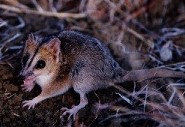
Julia creek dunnartThe Julia Creek dunnart (Sminthopsis douglasi) shares two features with the vastly different kangaroo – both are marsupials. Instead of developing in a womb, the babies develop in a pouch. Both creatures live in Australia. Unlike the kangaroo, the Julia Creek dunnart is considered endangered under Australian law. Its habitat has been restricted to a small Northeastern portion of Australia called the Mitchell Grass Downs, where a Julia Creek resides. This is an arid environment.

The Julia Creek dunnart was almost wiped out before it was discovered in the 1930. The species was thought to have been wiped out by invasive species such as the European fox and the domestic cat until it was rediscovered in 1992. Populations have risen slightly since then as Australia has begun exterminating stray cats. The Julia Creek dunnart is still prey for dingos.

General Description

This little marsupial strongly resembles a mouse, with tiny pink paws and a long, naked tail. Its coat is a light sandy brown with a dark stripe running from the tip of the nose down the spine. The dark eyes are large in comparison to the rest of the head. The belly, chest and inside of the legs are white.

Adults weigh in between 1.41 to 2.47 ounces (40 to 70 grams) and reach a nose to tail length of 6.3 to 9.45 inches (160 to 240 millimeters.) The tail is almost as long as the rest of the body. The Julia Creek dunnart is the largest of the 21 known species of dunnarts or mouse-like narrow-footed marsupials.

Life Cycle and Behavior

After a gestation of a mere 12 days, the females expel the pink embryos, which crawl from the vagina to the pouch. The embryos are so undeveloped that they do not have lungs and absorb oxygen through their skin. A female can have up to eight babies or joeys at a time. Julia Creek dunnarts begin hunting when they are only 10 weeks old. Julia Creek dunnarts live in family colonies and enjoy each other’s company.

Julia Creek dunnarts can take down lizards and mice nearly twice their size. They also hunt spiders and insects. They rarely need to drink because their prey contains the moisture they need. They make their homes deep in crevices in the ground during the day and come up at night to hunt. They can go into a hibernation-like state in order to survive times of famine.

Picture of the Julia Creek Dunnart by ZooPro, licensed under the Creative Commons Attribution-Share Alike 3.0 Unported license. You can help spreading the word about this animal by liking it on facebook

Permanent Link

Thursday 16 February 2012 Pignose Turtle - Last Member of Ancient Turtle Family

Pignose turtleThe pignosed or pignose turtle (Carettochelys insculpta) is the only remaining member of an ancient freshwater turtle family Carettochelys. They look more like a seagoing or marine turtle than a freshwater turtle, having flippers instead of feet. They live in Australia and New Guinea in bodies of freshwater like lagoons, rivers and ponds. Other local names for this unusual looking turtle include the pitted-shelled turtle, Fly River turtle, warradjan and the New Guinea plateless turtle.

But another name you can call it is “vulnerable.” This is the classification a species receives right before being declared endangered. The pignose turtle is hunted for its meat and eggs; can die from water pollution or from injuries from motorboats and are illegally removed from the wild for the exotic pet market. It is estimated that the total world population of pignose turtles are half of what they were in the early 1990s.

General Appearance

As its name suggests, this turtle has an oddly-shaped nose. It is long and ends in a snout. This helps the turtle remain completely hidden underwater while breathing through the long snout. The turtle has four flippers instead of feet with two pale claws on each flipper. The shell or carapace is not hard but leathery. The pignose turtle is a dull olive grey with a pale underbelly and bottom half of the shell.

Males are slightly smaller than females. They also possess a slimmer tail than females. The largest adult females can weigh 66.13 pounds (30 kilograms), but the average weight is 44 pounds (20 kilograms.) The shell of an adult pignose turtle grows to the length of 28 inches (70 centimeters.) A pignose turtle needs to be between 14 to 16 years old before it reaches its full size.

Life Cycle and Behavior

Females come out to sandy land to lay eggs during the dry season (which varies upon where the turtle lives.) A female lays two batches or clutches every other year. They need a year to rest in between breeding. The clutch contains anywhere from 4 to 39 eggs. The eggs hibernate throughout the colder rainy season. When the dry season comes around again, they hatch all at once and enter the water, where they fend for themselves.

Pignosed turtles eat a wide variety of foods, including flowers, fruits, seeds, plants, insects and shelled crustaceans and fish. With luck, a pignosed turtle can live for 50 years.

Picture of the pignose turtle by Faendalimas, licensed under the Creative Commons Attribution-Share Alike 3.0 Unported license. You can help spreading the word about this animal by liking it on facebook

Permanent Link

Wednesday 15 February 2012 Malagasy civet - Cat-like Predator Only Found on Madagascar

Malagasy civetThe Malagasy civet (Fossa fossana) is also called the striped civet. It used to be thought of as the banded palm civet (Hemigalus derbyanus), but recently biologists discovered that the Malagasy civet was a separate species. Although civets look like a cross between a domestic tabby cat and a fox, they are their own distinctive type of mammal. It’s not to be confused with the fossa (Cryptoprocta ferox), which is related to the mongoose. Taxonomists may soon rename the Malagasy civet in order to keep it from being confused with a fossa.

Malagasy civets are found only on the island of Madagascar, home to a wide variety of unique mammals found no where else on Earth. Although the Malagasy civet is currently not threatened with extinction, it depends on the evergreen forests in order to survive. If the forests of Madagascar disappear, so will countless animals, including the Malagasy civet. It is also hunted by humans and facing stiff competition for food and dwelling places from the small Indian civet, an invasive species.

General Appearance

The Malagasy civet walks and stalks its prey like a fox, but has a face that appears to be an elongated domestic cat’s face. It has shorter legs than a fox and carries its body close to the ground. Both male and female have a light tan and grey coat with tabby cat like black markings on its short but thick fur. There are no markings on the head. The nose is black. The tail is faintly ringed and appears bushy like an angry cat’s tail.

Males are slightly larger and heavier than females. Adult males weigh 5.51 pounds (2.5 kilograms) while females weigh a mere 4.91 pounds (1.5 kilograms.) From head to tail, males average 27.56 inches (700 millimeters) while females average 24.01 inches (610 millimeters.)

Life Cycle and Behavior


Little is known about the life of the Malagasy civet. It is known that males and females form strong pair bonds. Females give birth to only one baby at a time after a three-month gestation. This is a long gestation for such a small mammal, so the baby is furred and mobile within 72 hours after birth. Both males and females take care of the baby.

Malagasy civets sleep through the day in burrows made from hollow tree trunks or gaps in rocks. At night, they wander their territory searching for prey – frogs, insects, small birds and rodents. They store fat in their tails to help survive times when prey is hard to find.

Picture of the malagasy civet by Ettore Balocchi, licensed under the Creative Commons Attribution-Share Alike 3.0 Unported and GFDL You can help spreading the word about this animal by liking it on facebook

Permanent Link

Tuesday 14 February 2012 Brown Mouse Lemur - Lives Shortest Life of Any Primate

Brown mouse lemurThe brown mouse lemur (Microcebus rufus) is also called the rufous mouse lemur, the Eastern rufous mouse lemur or the russet mouse lemur. But no matter what it is named, this species is in danger of extinction due to habitat loss of their forests and marshes on the island of Madagascar. They are also hunted by people, domestic cats and dogs. This island, off the coat of Africa, is the only place brown mouse lemurs are found in the wild. It is difficult to keep in captivity.

Not much is known about the brown mouse lemur because of their tiny size, extreme shyness and nocturnal behavior. Until 1977, it was thought to be a color variation of another mouse lemur species, the grey mouse lemur (Microcebus murinus). Besides the color differences, brown mouse lemurs prefer to live in wetter conditions than grey mouse lemurs.

Physical Description

This is one of the smallest lemur species in the world. Adults grow to a mere 4.92 inches (12.40 centimeters) long from their nose tips to the base of their tails. Like other mouse lemurs, their tails are about as long as their bodies. Tails average 4.53 inches (11.5 centimeters) in length. They not only can use the tails to help keep their balance in the treetops, but also can store fat in it. They tip the scales anywhere from 1.37 to 3.45 ounces (39 to 98 grams.)

Their fur varies in color from a rich golden red chestnut (or russet) to a light brown. Their bellies, insides of the legs and underneath the tail are pale grey or white. They have a cream-colored stripe on their face between their large eyes. Their eyes need to be so large in order to survive in complete darkness. Their noses are slightly pointed, like a hamster’s, and they have triangular ears.

Life Cycle and Behavior

Brown mouse lemurs live solitary lives and only come together to mate. Males mate with several females. Males have larger territories than females in order to gain breeding rights to these females. Females have a litter of one to three babies after a 60 day gestation. She nurses them for another 60 days. When the babies are a year old, they are ready to hold their own territories and breed.

Brown mouse lemurs eat insects, flower nectar, pollen, buds, fruits and flowers. They prefer to stay in thick foliage to hide from natural predators like the fossa, the ringtailed mongoose, the Madagascar harrier hawk and owls. With luck, the brown mouse lemur will live up to 8 years in the wild and 15 in captivity.

Picture of the brown mouse lemur by Iraiidh, licensed under the Creative Commons Attribution-Share Alike 3.0 Unported and GFDL. You can help spreading the word about this animal by liking it on facebook

Permanent Link

Monday 13 February 2012 White-throated Rock-thrush - the Little Snail-Cracker

White-throated rock thrushThe White-throated Rock-thrush (Monticola gularis) is a small multi-colored bird found in Cambodia, China, Hong Kong, Japan, Korea, Malaysia, Singapore, Thailand, and Viet Nam. As with most species of birds, the male is more colorful than the female. The male has bright cobalt blue feathers on the top of wings, the crown and neck area, and black coloring around the eyes, ears, and outer edge of wings. The tail is colored chestnut to grey-brown, with a slight bluish tinge. They have an elongated white spot on the throat and neck area and a short, thick black bill. The under-side of the bird is a bright orange-chestnut color. The female has an olive-brown head and neck area with orange-reddish color on the tail getting darker brown around the edges. Around the eye area and the throat, the feathers are white. The eyes are big and black. The female also has several dark brown barred areas on her abdomen and tail.

The length is about 180 mm (7.08 inches), with a wing length of 95-99 mm (3.7-3.9 inches) and the tail is 74-79 mm (2.9-3.2 inches) long. The White-throated Rock-thrush is said to have a loud, sweet-sounding song. Unlike many other thrushes, they are most often found in dense forest areas with many mature trees. They prefer temperate forest and marshlands or subtropical lowland, moist forest areas. Like many other Rock Thrushes, they build their nest in a hole or rocky crag and they lovingly line them with mud. Typically, the female lays 4-5 blue eggs with small dark spots. Worms, insects, snails, and berries make up the diet of the rock thrush, and they often use a stone as a tool to crack the snail’s shell to extract the snail. The White-throated Rock-thrush is a migratory bird and breeds mainly in China, but also have been known to breed in the other countries, in smaller numbers. The main predators of the Rock Thrush are larger birds such as hawks and owls, and small mammals such as cats. In the last ten years of counts, they have been fairly numerous, so are listed as “Least Concern” on the Endangered Species List.

Picture of the white-throated rock thrush by JJ Harrison, licensed under the Creative Commons Attribution-Share Alike 3.0 Unported license. You can help spreading the word about this animal by liking it on facebook

Permanent Link

Friday 10 February 2012 Eld's Deer - Magazine Fights to Undo Human's Damage
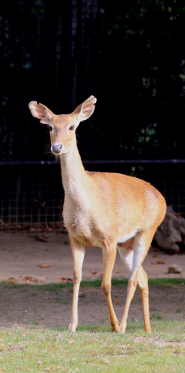
Eld's deerThe eld's deer (Panolia eldii) is a species of deer that live within Asia. The animal weighs between 270 to 380 pounds (125 - 175 kg) and are typically between 60 to 70 inches long (150 - 180 cm) with males being slightly larger than females. The fur on the eld's deer changes colors with the seasons, turning dark brown in the winter and a dark red in the summer months. The most unique physical feature about this creature, however, are the horns. Unlike other deer horns which grow upwards, the eld's horns grow outwards and inward, resulting in antlers that resemble a half-pipe.

Because the horns of the deer are so unique, the panolia eldii is often hunted by humans who consider the creature prized game. This has resulted in the species becoming extremely threated, ranking "Endangered" on the conservation status scale. Sadly, despite the fact that hunting these animals is illegal, hunters continue to do so, occasionally even sneaking into wildlife preserves to do so. Because there are so few panolia eldi left in existence, this makes humans their number one predictor.

A well-known Indian magazine for children, known as Chandamama, has taken to fighting for the rights of the eld's deer. In the magazine, stories told from the deer's point of view are featured in an effort to teach young children kindness and understanding towards the animal. The hope is that, if children are taught to respect the creature from a young age, there will be less poachers hunting the panolia eldii in the future.

In the wild, the eld's deer would typically live in dry forest areas and feed upon plants such as grasses, crops, and fruit. Because there are so few eld's deer left, the majority of them reside on wildlife preserves. The Keibul Lamjao National Park in India has played a key role in bring this species back from the brink of extinction. At the time the species was considered endangered, there were only 14 known living deer. Now, nearly 40 years later, the park has raised that number to nearly 200.

Not all deers are protected however. In Thailand, despite the species being endangered, there are no laws setup in order to protect the eld's deer. This is due to low funding and lack of politicians willing to protect the animal. Many fear that if this doesn't change soon, the eld's deer could become extinct in the very near future.

Picture of the eld's deer by Karelj, licensed under the Creative Commons Attribution-Share Alike 3.0 Unported license. You can help spreading the word about this animal by liking it on facebook

Permanent Link

Wednesday 08 February 2012 Lowland Streaked Tenrec - Uses Its Spines to Make Sounds

Lowland streaked tenrecThe lowland streaked tenrec (Hemicentetes semispinosus) is a small mammal with huge yellow and black stripes. A tenrec is a hedgehog-like mammal with a long snout. The lowland streaked tenrec lives only on the island of Madagascar’s eastern side. Unlike most mammals in Madagascar, this one is not endangered.

That can soon change if Madagascar’s rainforests and marshes continue to be destroyed. Lowland streaked tenrecs eat insects, especially earthworms, which thrive in wooded areas near water. Although there are tenrecs in protected areas of Madagascar, biologists fear that tourists or curious natives could disturb their life and communications to the point where they may die from stress.

Physical Description

The lowland streaked tenrec has a body similar to a pygmy hedgehog, but has a long snout like an anteater. The snout is tipped in pink skin. The undersides of this little mammal are a chestnut brown, but on top they are striped like a bumblebee in yellow and black. Adults grow to only 6.3 to 7.48 inches (16 to 19 centimeters) long and weigh 3.17 to 7.76 ounces (90 to 220 grams.)

But it’s this little mammal’s large spines that are truly remarkable. The spines along the flanks and back serve a dual purpose. They not only help protect the tenrec against predators such as domestic dogs, mongooses, Malagasy civets or the fossa, but are also used for communicating with other tenrecs. When a tenrec wants to communicate, it rubs specific pale spines together to generate an ultrasonic squeak. The sound carries a long way underground, where tenrecs spend most of their lives.

Life Cycle and Behavior

Lowland streaked tenrecs enjoy the company of tight-knit family groups. As many as 20 tenrecs can live in a single burrow. These very shy animals are opportunists, being active in both day and night to get food. Females become sexually active at the tender age of 5 weeks. Mating season is from September to December. After a gestation of 55 to 63 days, females give birth to a litter of one to eight babies that weigh a mere 0.28 ounces (8 grams) each. She will suckle them for only 25 days.

Tenrecs hunt for insects aboveground and below ground, using their long snouts to poke through dead leaves or other litter. They usually go out in pairs or small groups for safety. With luck, a lowland streaked tenrec can live two and a half years.

Picture of the lowland streaked tenrec by cliff1066, licensed under the Creative Commons Attribution-Share Alike 2.0 Generic license. You can help spreading the word about this animal by liking it on facebook

Permanent Link

Tuesday 07 February 2012 Tucuxi - Two Subspecies of South American Dolphin

TucuxiThe tucuxi (Sotalia fluviatilis) is also called the bufeo negro, the grey dolphin or the marine tucuxi dolphin. “Tucuxi” is pronounced “too koo she.” It is unknown how many of these rare dolphins are left. It is also unknown what natural predators feed on them except people. Many dolphins die due to water pollution and from getting caught in fisherman’s nets. Since dolphins need to breathe air, they soon drown in the nets. River dolphins can become stranded when rivers hit their lowest during the dry season.

There are two subspecies of the tucuxi and it is unknown whether they can interbreed. The riverine subspecies, Sotalia fluviatilis fluviatilis lives in freshwater rivers cutting through the tropical rain forest. The marine subspecies, Sotalia fluviatilis guianensis, lives in the coastal ocean waters off of Brazil, Ecuador, Columbia and Peru.

Physical Description


Both subspecies of tucuxi look like, except the marine subspecies is slightly larger than the freshwater. Adult marine tucuxi grow up to 86.61 inches long (220 centimeters) while freshwater tucuxi grow to a length of only 59 inches (150 centimeters.) Adults of the marine subspecies weigh an average of 99.2 pounds (45 kilograms) while the freshwater subspecies weighs only 77.16 pounds (35 kilograms.)

Both subspecies strongly resemble a small bottlenose dolphin, with a dolphin’s characteristic “grin.” The upper part of the body varies from a light grey to a blue-grey. The bottom part varies from a pinkish-white to a pearly white. White spots may appear on the tip of the triangular dorsal (top) fin and the tip of the nose. The dorsal fin is often hooked or curved at the top.

Life Cycle and Behavior

Tucuxi prefer to live in small pods or family groups from 15 to 50. The salt-water subspecies tend to live in larger pods. Males do fight for females, which then mate with more than one male if presented with the opportunity. Both subspecies eat fish and shellfish. Since the water is dark and hard to see through, they rely on echolocation in order to find prey and to navigate. Females of both subspecies have a gestation of 11 to 12 months and give birth to a single calf, often in November.

Tucuxi are most active at dawn and at dusk. They are less playful than other dolphin species, but sometimes leap out of the water. With luck, a tucuxi can live to be 35 years old. They do not do well in captivity.

Picture of the tucuxi by Archilider, licensed under the Creative Commons Attribution-Share Alike 3.0 Unported and GFDL. You can help spreading the word about this animal by liking it on facebook

Permanent Link

Thursday 02 February 2012 Boa constrictor - Nature's Adapter
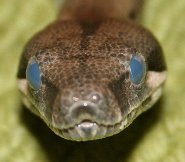
Boa constrictorThe Boa constrictor (Boa constrictor) is one of the most well known species of snake in the world. This is partly due to the fact that boa constrictors can be found in a wide variety of places, including Mexico, North America, South America, Caribbean islands, and more. They are also commonly seen at zoos and reptile houses across the world.

The boa constrictor is a large breed of snake, often reaching a weight of 60lb (27kg) in the wild. Female boas are larger than males, at around 10ft (3m) while males average around 8ft (2.5m). In captivity, these creatures have been known to grow even larger since they are well-fed on a regular basis.

The boa constrictor is highly versatile and adapts well to any living situation. Everything from the food they eat to the places they live are determined by their living environment. Ideally, the boa constrictor lives in the rain forest where it can camouflage itself within the trees and bushes, however this species has also been known to live in the desert or by oceans and lakes as well. When living in the desert, they often seek refuged deep within animal burrows, and while living by the water they tend to nest near the shore.

The boa constrictor's diet depends greatly on where it's living, but always consists of small animals. The snake will camouflage itself waiting for an animal to pass. Once one does, the boa strikes, biting it several times before constricting the creature until dead. Then the snake begins the process of digesting it, which can take up to a week. Mice, lizards and other small mammals are often consumed if the snake is living in the desert, while, and bats and birds are consumed if living in the rain forest. If the boa is living by water, they often use their outstanding swimming abilities to hunt amphibians found within the water. As the boa grows, the size of the prey goes up as well. It's not uncommon to see an adult bow constrictor hunting rabbits or wild chickens.

Young boa constrictors have many predators, including wild pigs, hawks, coatis, and caimans. The adult boa's main predator is the human, who hunt the snake for it's meat and skin. Because of this, the boa constrictor is listed as "Vulnerable" on the conservation status scale. This means that while the species isn't endangered currently, they are at a high risk of becoming so if special steps are not taken to protect this species.

Picture of the Boa Constrictor by XPS420, licensed under the Creative Commons Attribution-Share Alike 3.0 Unported license. You can help spreading the word about this animal by liking it on facebook

Permanent Link