Thursday 31 May 2007
Père David's Deer
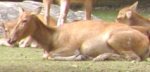 Pere David's deer
 (Elaphurus davidianus) only is known now in captivity, in the wild they were extinct in the 19th century. However, it has been reintroduced in Nan Haizi Milu Park, Beijing and Dafeng Reserve, Jiangsu Province in the 1980's. After the publication of his discovery, by father Armand David, working as a French missionary in China, the animals soon were extinct in the wild. The last remaining herd was in a preserve of the emperor and was eaten by Western and Japanese troops during the
Boxer Rebellion. Before that, a small number of Père David's Deer was exported to England, were they were bred further. All living Pere David's deer come from this single herd. It is now classified as 'critically endangered'. The Père David's Deer is very fond of water, unlike other deer species... The Chinese gave it the name "sze pu shiang" which means "none of the four", as it has a tail of a donkey, a neck like a camel, antlers of a deer, and hooves of a cow, but it doesn't look like any of them...
Image licensed under GFDL
You can help spreading the word about this animal by liking it on facebook
Permanent Link
Monday 28 May 2007
Swift fox
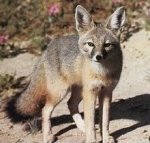
The
Swift Fox (Vulpes velox) lives in Saskatchewan and Alberta in Canada and the western grasslands of North America. It is indeed rather swift, reaching speeds of more than 50 kilometers per hour. The Swift Fox is severely endangered and scientists disagree whether the Swift fox and the Kit Fox are different species. The Kit fox (
Vulpes macrotis) is slightly larger than the Swift Fox, and the Swift Fox has a narrower snout. Molecular systematics (the study of both DNA) support that the two species are different. They are primary nocturnal and live in pairs. Swift foxes choose their partner for life. The pups are born in underground dens in which they remain for about one month. The first 15 days their eyes are closed, so they rely totally on their mother for food and protection.
You can help spreading the word about this animal by liking it on facebook
Permanent Link
Saturday 26 May 2007
Giant forest hog
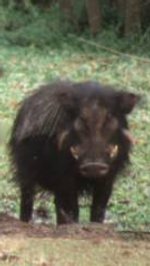
The
Giant forest hog (
Hylochoerus meinertzhageni) is the largest pig of the 16 pig species (family Suidae) in the world. The length of adults ranges from 130-210 cm, their height from 75-110 cm and they can weigh between 180-275 kg. They live in scattered populations in the rainforests of West and Central Africa. They are shy, nocturnal creatures, which feed on grass and do not dig with their snouts for food like other wild pigs. 'Wallowing', rolling through the mud, is a favourite activity of them. The male is responsible for defending the group and does so very aggressively. Giant forest hogs, like other pigs practice 'coprophagy', which means they consume feces of other animals, because they contain amounts of semi-digested food. Their main predators are the
leopard and the
hyena.
Interesting fact: In the Congo, eating a giant forest hog is believed to bring misfortune.
Picture of the Giant forest hog by S. Fimpel, licensed under GFDL
You can help spreading the word about this animal by liking it on facebook
Permanent Link
Sunday 20 May 2007
Moose - largest deer
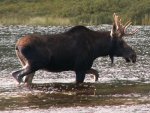
The
moose (Alces alces) lives on the Northern hemisphere in forested areas, from Alaska, Canada in North America and from Finland to Eastern Russia and China (see range map below). Moose are the largest species of deer and may stand as tall as 2.3 meters high. Male moose antlers can grow up to 2 meters from tip to tip. They drop their antlers after each mating season. The antlers will grow back on in spring, which takes 3 to 5 months. Moose can reach speeds of up to 53 kilometers per hour, have poor eyesight, but excellent hearing. Moose are not endangered, but in some areas there has been a decline due to habitat destruction and hunting. Predators of the moose are wolves, grizzly bears, black bears and humans.
Interesting fact: The name 'moose' means 'twig eater' in several languages spoken by indigenous peoples of the Americas.
Range map
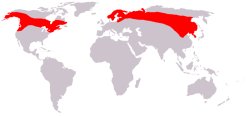
Range map by Jrockley, licensed under GFDL
Image by Greg Marton, licensed under Attribution ShareAlike License v. 2.5
You can help spreading the word about this animal by liking it on facebook
Permanent Link
Thursday 17 May 2007
Grey Seal
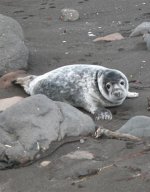
The
grey seal (Halichoerus grypus) is a big "true" seal, the largest British Isles native mammal, that is the one and only classified species of the Halichoerus genus of the Phocidae family. It is found in subarctic and temperate shores on both sides of the North Atlantic ocean. There are three specified populations of this seal: the western Atlantic population found in Canadian maritime provinces from Cape Chidley on Labrador coast and extends to Nova Scotia; the population on eastern Atlantic on the British Isles and Faeroe Islands up to Iceland southwestern coasts; and the Baltic Sea population.
The grey seal's habitat varies among individual groups. Some are found along the coasts of rocky continental areas, while some are seen on solitary islands. There are populations on ice shelves and icebergs, too.
A grey seal bull can be 2.5 to 3.3 meters in length and almost 300 kilograms in weight. A cow is much smaller, about 1.6 to 2 meters in length and weighing around 100 to 150 kilograms. Pups already weigh about 16 kilograms when born. They become even fatter thanks to their mothers' milk, and they will gain mass four times more by the time they reach moulting period. Sex differentiation by color will manifest at this stage. The female has a grey-silver colour with dark spots scattered all over its body. The bull has a darker shade of grey with lighter spots of grey silver. Both have darker backs and lighter bellies. The nose also tells the sex of this seal: the bull has a nose with a long arch and a roman profile while the cow has a narrower and shorter straight nose.
Grey seals eat usually by groups. They devour a lot of fish like sand eels cod, herring, flatfish, and skates. They also eat lobsters and octopus and other sea creatures. It is said that they need to eat about 5 kilograms of food everyday although they do not eat daily, and they actually go into fasting when breeding.
Picture of the grey seal by Porkeri, licensed under GFDL
You can help spreading the word about this animal by liking it on facebook
Permanent Link
Monday 14 May 2007
Striped skunk
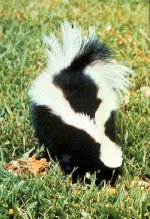
The
Striped Skunk (Mephitis mephitis) is a skunk of the family Mephitidae found only in the Neartic. It is a very popular animal in the US and also in Canada as it occurs from Northern Mexico to US mainland up to Central Canada. Its habitat is mostly open areas grasslands, woods, and even clearings and it prefers to be near water sources. This skunk can also be seen in suburban places because buildings can give shelter.
Striped skunks have black fur and a white-colored stripe that is basically a single line from the tail's base, which then divides into two lines at the back's sides, and then ends with a triangle at the head. There is also a white-colored stripe from the forehead and goes down between the skunk's eyes to its snout. The length and width of the stripe varies with each skunk. The length of this skunk is from 575 to 800 millimeters, and its tail is between 173 to 307 millimeters. Meanwhile, its head is small complimented by small ears. It has legs that are short and a black and white tail that is fluffy and long. Its plantigrade feet have five toes that are partially webbed. The longer front feet claws are for digging.
The striped skunk is a nocturnal mammal that sleeps at day in burrows that are either other animals' deserted den, or a hole under a building, tree, or boulder. It feeds at night and as an omnivorous animal, it eats mainly insects, mice, fish, eggs, crustaceans, carrion, grasses, fruits, berries, nuts, leaves, and grains.
Scent marking is the distinctive feature of a striped skunk. Its anal scent glands emit a very unpleasant offensive odor if the skunk wants to mark its presence, drive away threats, or mate. It arches its back and erects its tail and hair when threatened. Before releasing its signature scent, it first curls to the shape of a letter U with rump and head both fronting the enemy. It then shoots two streams of foul smelling fluid from its scent glands found in its anus that becomes a single stream after approximately 12 inches and a fine spray that can reach about 2 or 3 meters. The fluid can burn the eyes and also the nasal cavities and cause nausea.
You can help spreading the word about this animal by liking it on facebook
Permanent Link
Sunday 13 May 2007
Iberian lynx
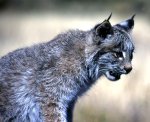
The
Iberian Lynx (Lynx pardinus) or Spanish Lynx (Felis pardina) is the most threatened species of cat in the world. They live in Spain and according to a study done in 2005, the population contains no more than 100 Iberian lynxes . The male is larger than the female. They can become 13 years of age in the wild. At twilight, the Iberian lynx hunts alone on primarily rabbits, rodents, birds,
reptiles and amphibians and continues during the night. They are threatened by feral dogs, poaching, habitat loss, collisions with vehicles and poisoning.
You can help spreading the word about this animal by liking it on facebook
Permanent Link
Thursday 10 May 2007
Hamadryas Baboon
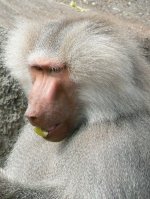
The
Hamadryas Baboon (Papio hamadryas) is an old world monkey, living in Africa in Eritrea, Egypt, Ethiopia, Somalia and the Arabian Peninsula (Saudi Arabia and Yemen). Like all other baboons, there is a big difference in size between male and females. Males tend to be twice as big as females. They live in 'harems' of which one male, the Alpha-male, is the leader and up to 15 females can follow him. Such a harem is called an 'OMU', or 'One Male Unit', and is a highly complex social structure. Its main threat is habitat loss, because of transformation into fields and pasture land. It faces almost no threat from leopards and lions because of the low numbers of these animals in the range of the Hamadryas Baboon.
Interesting fact: In old Egypt, the Hamadryas Baboon was a sacred animal, since it was the attendant to the deity Toth, hence it is also called the 'Sacred Baboon'.
You can help spreading the word about this animal by liking it on facebook
Permanent Link
Tuesday 08 May 2007
Puku
The
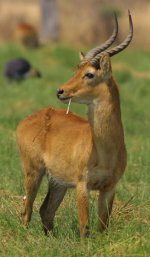
Puku (Kobus vardonii) is one of the smaller deerlike antelopes of the Bovidae family. Herds of these animals live in the drier areas of swampland and rivers or wet grasslands, and they are always near the water. They are scattered throughout eastern and central Africa, particularly in wet areas in Zambia and southern Democratic Repblic of Congo. These antelopes are also found in the area of Chobe River, near Kasane, in Botswana. However, 75% of the total population is assumed to be restricted now to the Kilombero Valley in Tanzania.
Puku are often mistaken for impala or lechwe because these three closely-related African antelopes often graze together. There is strength in numbers as they have common enemies. However, the puku's size is smaller although it is bulkier compared to the impala. They are around 80 centimeters tall on the shoulders, and their weights are between 70 and 80 kilos. These antelopes are brown like sand or nearly uniformly red in colour with the underbelly having a lighter shade while the impalas have ankles that are black and markings on their faces and the lechwe have black markings on the legs and high rear-quarters. The male puku has two horns that are shaped a little like a lyre and measure about 50 centimeters, smaller than the horns of the impala and lechwe.
Puku eat grass as they graze in water rich grassland. They live in herds that are segregated and a territorial male separates the female herd from the bachelors. This alpha male holds the female herds in its territory. A herd, meanwhile, can have about twenty females. Only submissive bachelors are allowed to mingle within the territory.
Puku are active during the earlier time of the morning and again in the late afternoon. When frightened or disturbed, they sound off a repeated whistle and they stot off with heads held up high compared to the lechwe that have their heads held down low. On rainy seasons, herds stay together to have added security and safety.
Picture of the Puku by Paul Maritz, licensed under GFDL
You can help spreading the word about this animal by liking it on facebook
Permanent Link
Tuesday 08 May 2007
Large Indian civet
The
Large Indian civet (
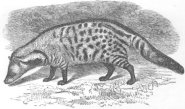
Viverra zibetha), known in the shorter form of Indian civet, can be found in places of Indochina all the way to South China, but for the record, they are also in Vietnam, Hainan, Malay peninsula, and Nepal. These civets frequent scrub lands, grasslands and the thick forests. It is also a fact that they like staying near human establishments.
An ordinary individual's weight is from 5 to 11 kilograms. Large Indian civets have dark spots at the body, and black/white stripes at the sides of its neck, and the tail possesses black rings surrounding it.
The female Large Indian civet is polyestrous, that is, they could breed at anytime within the year, and a typical litter has 2 to 4. These newborns are born at a hole (ground) or in vegetated areas. The newborn Large Indian civet would be able to open the eyes in a period of 10 days. Weaning is at 1 month, and in case you are wondering about the parents' role in rearing, the male does not. Only the female parents attend to the young.
Basically, they are nocturnal and solitary beings. In essence, they are terrestrial, yet they could climb as well. One marks his own place via the gland secretions, and this is not just for "territorial purposes", but as a simple means of identification of the place.
Interesting fact: The Indian civet produces a substance called 'civet', which is used commercially in perfumes.
You can help spreading the word about this animal by liking it on facebook
Permanent Link
Wednesday 02 May 2007
Giant pangolin
The
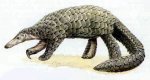
Giant Pangolin (Manis gigantea) is the largest of the scaly anteaters or 'pangolins'. It lives in Africa along the equator from west to east and its diet consists almost entirely on ants and termites. Because it eats only ants and termites, the giant pangolin has no teeth and cannot chew. Its main threats are habitat destruction, the bushmeat market, and the illegal medicine market. The giant pangolin, like other pangolins, is nocturnal. It is a good climber and a good digger with its strong claws, which they curl in their paws when walking around.
Picture by mt.wiki, licensed under GFDL
You can help spreading the word about this animal by liking it on facebook
Permanent Link