Subscribe to
"Animal of the day"

AddThis Feed Button
Or subscribe by e-mail

Enter your Email


Powered by FeedBlitz

We hope that reader will gain an increased appreciation of the need for more conservation measure in order to protect the beautiful creatures that inhabit the earth. Our philosophy is that the more we learn about animals, the more we respect them and take better care of them. That is why we update this blog with new animals, We encourage you to syndicate our content by adding "animal of the day" to your own blog! (read more)

About us

Our mission is to get people excited about animals and their welfare by writing articles on these animals. We encourage people to comment on posts and share with others. Don't forget to subscribe to our feed.

Contact us
Copyright notice

Cutest pet ever - cutest pet contest

Funny animal videos and pictures

Swimming with manatees - harmful or helpful

Last Comments

red (Disk Tetra - Hate…): How to breed the fish? Is…
alissa (Stump-Tailed Maca…): sooo cute
Anonymous (Shoebill - Swamp …): These are beautiul birds …
sugar glider info… (Greater Glider - …): They have large, protrudi…
Sabrina (Purple frog): wow, what a lovely frog. …
Organizari evenim… (Fattest cat in th…): :)) This is not funny! Re…
destiny (Ninja cat): hahah thats funny
sami (Bats - the only t…): is that true
Lexis.J (Ninja cat): So funny.He’s the top nin…
someone (Ninja cat): this is soooo cute!

Calendar

« February 2012
S M T W T F S
      1 2 3 4
5 6 7 8 9 10 11
12 13 14 15 16 17 18
19 20 21 22 23 24 25
26 27 28 29      

Archives

Next Archive Previous Archive

01 Jan - 31 Jan 2012
01 Dec - 31 Dec 2011
01 Nov - 30 Nov 2011
01 Oct - 31 Oct 2011
01 Sep - 30 Sep 2011
01 Aug - 31 Aug 2011
01 Jul - 31 Jul 2011
01 Jun - 30 Jun 2011
01 May - 31 May 2011
01 Apr - 30 Apr 2011
01 Mar - 31 Mar 2011
01 Feb - 28 Feb 2011
01 Jan - 31 Jan 2011
01 Dec - 31 Dec 2010
01 Nov - 30 Nov 2010
01 Oct - 31 Oct 2010
01 Sep - 30 Sep 2010
01 Aug - 31 Aug 2010
01 Jul - 31 Jul 2010
01 May - 31 May 2010
01 Apr - 30 Apr 2010
01 Mar - 31 Mar 2010
01 Feb - 28 Feb 2010
01 Jan - 31 Jan 2010
01 Dec - 31 Dec 2009
01 Nov - 30 Nov 2009
01 Oct - 31 Oct 2009
01 Sep - 30 Sep 2009
01 Aug - 31 Aug 2009
01 Jul - 31 Jul 2009
01 Jun - 30 Jun 2009
01 May - 31 May 2009
01 Apr - 30 Apr 2009
01 Mar - 31 Mar 2009
01 Feb - 28 Feb 2009
01 Jan - 31 Jan 2009
01 Dec - 31 Dec 2008
01 Nov - 30 Nov 2008
01 Oct - 31 Oct 2008
01 Sep - 30 Sep 2008
01 Aug - 31 Aug 2008
01 Jul - 31 Jul 2008
01 Jun - 30 Jun 2008
01 May - 31 May 2008
01 Apr - 30 Apr 2008
01 Mar - 31 Mar 2008
01 Feb - 28 Feb 2008
01 Jan - 31 Jan 2008
01 Dec - 31 Dec 2007
01 Nov - 30 Nov 2007
01 Oct - 31 Oct 2007
01 Sep - 30 Sep 2007
01 Aug - 31 Aug 2007
01 Jul - 31 Jul 2007
01 Jun - 30 Jun 2007
01 May - 31 May 2007
01 Apr - 30 Apr 2007
01 Mar - 31 Mar 2007
01 Feb - 28 Feb 2007
01 Jan - 31 Jan 2007
01 Dec - 31 Dec 2006
01 Nov - 30 Nov 2006
01 Oct - 31 Oct 2006
01 Sep - 30 Sep 2006
01 Aug - 31 Aug 2006
01 Jul - 31 Jul 2006
01 Jun - 30 Jun 2006
01 May - 31 May 2006
01 Apr - 30 Apr 2006
01 Mar - 31 Mar 2006
01 Feb - 28 Feb 2006
01 Jan - 31 Jan 2006
01 Dec - 31 Dec 2005
01 Nov - 30 Nov 2005
01 Oct - 31 Oct 2005
01 Sep - 30 Sep 2005
01 Aug - 31 Aug 2005
01 Jul - 31 Jul 2005

Animal pictures
Mammals.start4all.com
Animal diversity web
Recently extinct animals forum
Another chance to see

Miscellany

AddThis Feed Button

Sunday 28 August 2005 Domesticated rabbits
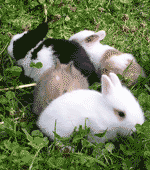
rabbits Domesticated rabbits (Oryctolagus cuniculus) are one of the most popular pets, apart from dogs and cats. They look attractive, lovely, gentle, friendly and cute. They are easy to take care and undemanding in terms of care and housing. They will settle well either indoor or outdoor, at home. There are 40 species of rabbits and hares worldwide. All domesticated rabbits are originated from European rabbits. The scientific name for domestic rabbit is Oryctolagus cuniculus. (more) You can help spreading the word about this animal by liking it on facebook

Permanent Link

Saturday 27 August 2005 Rescue Dogs

Rescue dog We have all grown up with at least one hero in our life, but how many people can call their hero Duke or Kiva? The answer - anyone who has had their life saved by a rescue dog. Whether it is a house fire, tornado rubble, leftovers from an earthquake, or flowing water behind a hurricane front, these specially trained rescue dogs rush in with no concerns for their own welfare, pulling out victims, some dead and some still alive. They do this time and time again. With a powerful snout and the ability to smell things a human may not, rescue dogs are hard-working and very loyal to doing what is expected of them. And what do they ask for in return? A hug, a treat or a little one-on-one play time. Not a huge reward, however for these special dogs, it is very satisfying. (more) You can help spreading the word about this animal by liking it on facebook

Permanent Link

Friday 19 August 2005 Shoebill - Swamp resident having a big mouth

shoebill "Abu Markub - father of the shoe" the Shoebill was called by arab explorers several centuries ago. No surprise looking at its bill, which doesn't only look like a shoe but has got its dimensions too. It is up to 20 cm long and almost of the same width. Therefore the Shoebill has got the largest bill among all bird species. Although it is known to science since a long time and surely is among the most impressing and curious birds, there is not much knowledge about the Shoebill. It is still disputed how it should be classified. Probably the "grey giant", which reaches a height of 1,5 metres, is related to storks, but this theory hasn't been confirmed finally yet. (more) You can help spreading the word about this animal by liking it on facebook

Permanent Link

Thursday 11 August 2005 Common seal - Made for living in the water

common seal The Common seal (Phoca vitulina) is probably the best-known seal species of the northern hemisphere. This might be due to its wide distribution and the fact, that Common seals live near the coasts and can be watched, resting on sandbanks, from the dry land. Common seals prefer regions, where rivers flow into the sea, because these waters are permanently ice-free even in the northern part of their distribution range. The Common seal's second name - Harbour seal - is due to its affinity to coastal regions. Common seals inhabit the European coasts of the Atlantic, the North sea and the Baltic sea as well as the Atlantic coast of the northern part of North America and North America's Pacific coast. Due to the Common seal's wide distribution there are several subspecies. (more) You can help spreading the word about this animal by liking it on facebook

Permanent Link

Wednesday 10 August 2005 Bali starling - One of the rarest birds

starling The Bali starling (Leucopsar rothschildi) is a quite "new" bird species. It is known to science since 1912 when it was described by the ornithologist Erwin Stresemann, who had found it one year before during an excursion. The natural distribution range of this starling is restricted to the island of Bali, a part of Indonesia nowadays. The birds inhabit monsoon forests and acacia savannas. They reach lengths up to 25 cm and weights up to 90 g. Bali starlings feed on all sorts of insects, most of all ants, termites and caterpillars. Fruits and seeds are part of their diet too. They prefer old woodpecker holes for their nests. Males tend to be very aggressive during the breeding season. Outside of the breeding season Bali starlings previously lived in flocks consisting of up to 40 individuals. But the emphasis is on "previously" since the entire population living in the wild is less than 40 birds at the moment. (more) You can help spreading the word about this animal by liking it on facebook

Permanent Link

Monday 08 August 2005 Alligator (Alligator mississippiensis) - Careful croc

american alligator What's the difference between an Alligator and a Crocodile? Well, one has to keep in mind, that Alligators are Crocodiles too. But they form a separate group within the order Crocodylia, which differs from the rest of the Crocodiles. Nowadays about 30 Crocodile species are known, just two of them are "real" Alligators - the members of the genus Alligator: the Mississippi alligator (Alligator mississippiensis) and the Chinese alligator (Alligator sinensis). The Caymans are seen as Alligators in the broader sense too. Together with the two "real" Alligators the Caymans form the family Alligatoridae. Alligators are an ancient group of Crocodiles. In the course of millions of years they changed less in many markings than the other Crocodiles. Their metabolism and their whole life is slower than in "modern" Crocodiles. They grow less rapidly and need less food. Alligators reach a maximum age of 75 years, which means that they can get about twice as old as "modern" Crocodiles. It is assumed that Alligators have been distributed worldwide in former times, but then have been replaced by "modern" Crocodiles. (more) You can help spreading the word about this animal by liking it on facebook

Permanent Link
Saturday 06 August 2005 African grey parrot (Psittacus erithacus) - More than an eloquent lodger

gray parrot There are not many parrot species living in Africa. This might be due to the aridness of many regions and the lack of fruit-bearing trees. The African grey parrot is one of the few African parrot species. Reaching a length up to 36 cm it is also the largest parrot inhabiting that continent. As the name implies, the African grey parrot is predominantly grey, with accents of white and a red or maroon tail depending on the subspecies. Greys, like all parrots, are zygodactyl, having 4 toes on each foot - two front and two back. They feed primarily on nuts and fruits, supplemented by leafy matter. (more) You can help spreading the word about this animal by liking it on facebook

Permanent Link

Friday 05 August 2005 Sirenians (dugongs, manatees, and sea cows)

manatee The order of sirenians contains five species in two families (Dugongidae and Trichechidae). The four living species of the Sirenia are the dugong, Amazonian manatee, West Indian manatee and African manatee. One species (Steller's sea cow) is extinct. The members of the order Sirenia are believed to be relatives of the elephants. Members of this order live their lives in the water and feed primarily on vegetation. They are seal-like animals with big streamlined bodies. To avoid danger a manatee or dugong can swim up to 16 miles per hour, but usually they swim much, much slower. The three species of manatees, and the closely related dugong, are unique in that they are the only plant-eating marine mammals in modern times. The most dangerous threat to them is hunting, fishing nets and boat accidents. (more) You can help spreading the word about this animal by liking it on facebook

Permanent Link

Thursday 04 August 2005 Zebras - Africa's striped wild horses

Zebra Zebras, Africa's striped wild horses, inhabit grasslands in the eastern and southern parts of the continent. Besides the Plains zebras (Equus quagga) there are two other species: The Mountain zebras (Equus zebra) and the Grevy's zebras (Equus grevyi). Although the species look very similar, they are not more closely related to each other than to the other horse species like Wild ass and Przewalski's horse. If one thinks of Zebras the first thing coming to mind is their stripy patterns. Their has been a lot of dispute about the reasons for the stripes. Probably there are several of them: Since there are individual differences in the patterns, it has been argued that they play a role in individual recognition. Moreover it is an efficient camouflage on the wide plains; predators have difficulties in seeing Zebras from a distance because of their patterns. But the stripes are not just useful against predators; also the disease-causing Tsetse flies can't make them out as easily as animals without patterns. (more) You can help spreading the word about this animal by liking it on facebook

Permanent Link
Tuesday 02 August 2005 Wolf - The unrecognized companion

canis lupus For millennia no other animal challenged man's fantasy as much as the Wolf. The Wolf (Canis lupus) served as the perfect example for evil in fairytales and fables. Nowadays Wolves are often transfigured as noble animals. What is the origin of this special attitude of man to Wolves? Since Wolves are at the top of the food chain, the paths of humans and Wolves crossed again and again. At times when humans were still leading their lives as hunters and collectors, Wolves were among their major competitors for food. When they settled down and started raising cattle, it was again the Wolf which threatened their herds; the cattle was easy to hunt since it lost its natural escape behaviour. From the Wolves' point of view it made sense to search for nearness to the herds and thus to humans. But Wolves have never been a direct danger to humans. There are hardly any serious reports of free living Wolves attacking humans. (more) You can help spreading the word about this animal by liking it on facebook

Permanent Link