Subscribe to
"Animal of the day"

AddThis Feed Button
Or subscribe by e-mail

Enter your Email


Powered by FeedBlitz

We hope that reader will gain an increased appreciation of the need for more conservation measure in order to protect the beautiful creatures that inhabit the earth. Our philosophy is that the more we learn about animals, the more we respect them and take better care of them. That is why we update this blog with new animals, We encourage you to syndicate our content by adding "animal of the day" to your own blog! (read more)

About us

Our mission is to get people excited about animals and their welfare by writing articles on these animals. We encourage people to comment on posts and share with others. Don't forget to subscribe to our feed.

Contact us
Copyright notice

Cutest pet ever - cutest pet contest

Funny animal videos and pictures

Swimming with manatees - harmful or helpful

Last Comments

Tima (Bottlenose dolphi…): J. David Smith, Ph.D., a …
Coda Plant (Pudu - smallest d…): Hey. I live in Northern C…
Michael Newton (Koala video): i love you mr. koala
Tohru (Asian Golden Cat): I hate them too! They are…
tiffany (Asian Golden Cat): i love this cat i’m doing…
BK (Nubian Ibex - The…): Magnificent animal, espec…
amanda (Long-nosed cusima…): thhisanimal is so so so s…
misscrient (Muskrats - Water-…): Third paragraph last sent…
rudy (Deer Mouse - The …): that is so cool ilove lea…
Nick (Fattest cat in th…): “The cat is not over fed.…

Calendar

« November 2009
S M T W T F S
1 2 3 4 5 6 7
8 9 10 11 12 13 14
15 16 17 18 19 20 21
22 23 24 25 26 27 28
29 30          

Archives

Next Archive Previous Archive

01 Nov - 30 Nov 2009
01 Oct - 31 Oct 2009
01 Sep - 30 Sep 2009
01 Aug - 31 Aug 2009
01 Jul - 31 Jul 2009
01 Jun - 30 Jun 2009
01 May - 31 May 2009
01 Apr - 30 Apr 2009
01 Mar - 31 Mar 2009
01 Feb - 28 Feb 2009
01 Jan - 31 Jan 2009
01 Dec - 31 Dec 2008
01 Nov - 30 Nov 2008
01 Oct - 31 Oct 2008
01 Sep - 30 Sep 2008
01 Jul - 31 Jul 2008
01 Jun - 30 Jun 2008
01 May - 31 May 2008
01 Apr - 30 Apr 2008
01 Mar - 31 Mar 2008
01 Feb - 28 Feb 2008
01 Jan - 31 Jan 2008
01 Dec - 31 Dec 2007
01 Nov - 30 Nov 2007
01 Oct - 31 Oct 2007
01 Sep - 30 Sep 2007
01 Aug - 31 Aug 2007
01 Jul - 31 Jul 2007
01 Jun - 30 Jun 2007
01 May - 31 May 2007
01 Apr - 30 Apr 2007
01 Mar - 31 Mar 2007
01 Feb - 28 Feb 2007
01 Jan - 31 Jan 2007
01 Dec - 31 Dec 2006
01 Nov - 30 Nov 2006
01 Oct - 31 Oct 2006
01 Sep - 30 Sep 2006
01 Aug - 31 Aug 2006
01 Jul - 31 Jul 2006
01 Jun - 30 Jun 2006
01 May - 31 May 2006
01 Apr - 30 Apr 2006
01 Mar - 31 Mar 2006
01 Feb - 28 Feb 2006
01 Jan - 31 Jan 2006
01 Dec - 31 Dec 2005
01 Sep - 30 Sep 2005
01 Aug - 31 Aug 2005
01 Jul - 31 Jul 2005

Animal posters
Animal pictures
Mammals.start4all.com
Animal diversity web
Recently extinct animals forum
PetLvr.com
Another chance to see
Happiness is a warm puppy

Miscellany

AddThis Feed Button

Thursday 25 May 2006 Aye aye - harbinger of death

aye ayeThe Aye aye (Daubentonia madagascariensis) is the world's largest nocturnal primate. It lives in the east coast forests of Madagascar, tapping the trees for grubs (beetle larvae), then gnawling a hole to stick its elongated (sometimes three times longer than the other fingers) middle finger in it to catch the grub. They grow up to 37 cms long, with a tail of 53 cms and can weigh about 2,5 kilograms. Not only is the Aye aye threatened by habitat destruction, it also is very much threatened by superstition of the local villagers. Native people believe it is a harbinger of death, and when it points its middle finger at you, you are doomed. Therefore it is killed on sight.

photo taken by Ancheta Wis, licensed under Creative Commons Attribution 2.0

You can help spreading the word about this animal by stumbling it by pressing this link StumbleUpon

one comment - Permanent Link

Friday 19 May 2006 Honey badger - most fearless animal in the world

Honey badgerThe honey badger (Mellivora capensis), or Ratel in Afrikaans, is the "most fearless animal in the world' according to the 2002 edition of the Guinness Book of Records. Watching National Geographic, I fell in love with these creatures. They do not fear anything! They plunder bee hives, kill snakes, etc. This video is an excerpt of the film "Snake killers: Honey badgers of the Kalahari" on National Geographic. A honey badger chases down a snake in a tree and eats it.

Click here to see the video

You can help spreading the word about this animal by stumbling it by pressing this link StumbleUpon

twelve comments - Permanent Link

Thursday 18 May 2006 Peacock - Beautiful and loud

PeacockThe Peacock (Pavo cristatus), which is also known as the Indian peafowl, has been part of the livestock of parks and gardens around the world for a long time. The large males are among the most beautiful gallinaceans, due to their shimmering blue plummage, their feather crowns and their about 150 long tail feathers with lots of eye marks, which they put up fanlike when performing their courtship display. The Peacock often is regarded as a domestic animal, whose feather fan is an artificial product of selective breeding. Surely there are a lot of Peacocks, which have been kept in parks and gardens for numerous generations, already showing signs of domestication, but most of them are not very different compared with their wild living relatives, which have got the same magnificent plummage. In the wild Peacocks inhabit lowlands and foothills in India and on Sri Lanka. They prefer park-like landscapes with a lot of bushes, which they use as refuges when in danger. Even a male Peacock with its magnificent plummage is able to fly up very quickly and hide in bushes or on a tree. (more)
You can help spreading the word about this animal by stumbling it by pressing this link StumbleUpon

one comment - Permanent Link

Wednesday 17 May 2006 Gray Whale - oldest species of mammals on earth

Gray WhaleThe Gray Whale (Eschrichtius robustus) can reach 15 meters in length, weighing about 36 tons and can become 60 years of age and has been estimated to being on earth for 30 million years, making it the oldest species of mammals! There are two populations of Gray Whales in the world, the third, the North Atlantic population was hunted to extinction in the 18th century. It is believed it was hunted In the remote past by Megalodon, a giant shark, which had jaws over 2 meter wide...
You can help spreading the word about this animal by stumbling it by pressing this link StumbleUpon

Add your thoughts about this animal - Permanent Link

Friday 12 May 2006 Okapi - can lick its own ears

OkapiThe Okapi (Okapia johnstoni), is a relative of the giraffe and because of the stripes on its leg bears some resemblance to a zebra. This was the reason for some people to believe it was a cross-breed, but it really isn't. It lives in the forest in the Democratic republic of Congo, where it is threatened by deforestation and and poaching. The "zebra markings" are believed to function as a beacon for the young to follow their mother in the dense forests. Did you know that the okapi is one of the few mammals that can lick its own ears?

Picture by Raul654 on January 16, 2005, licensed under GDFL

You can help spreading the word about this animal by stumbling it by pressing this link StumbleUpon

Add your thoughts about this animal - Permanent Link

Wednesday 10 May 2006 Marbled cat - seldom seen

Marbled catAbout the same size as the domestic cat, the Marbled cat (Pardofelis marmorata) has a longer and furrier tale than the domestic cat. Living in trees, this longer tail help for balancing. Its population is unknown as it is seldomly seen in the dense forests from north-east India to Indonesia. Another factor of their obscure status is that it is believed to be nocturnal. They are also known to hunt more on the ground than in trees in parts of Indonesia. They are very vulnerable to loss of their habitat as they benefit from large dense forest canopies.
You can help spreading the word about this animal by stumbling it by pressing this link StumbleUpon

one comment - Permanent Link

Tuesday 09 May 2006 Agoutis (Genus Dasyprocta) - Masters of the Brazil nut

agoutis With a little imagination you can guess the Agoutis' kinship: These rodents are relatives of the well-known Guinea pigs. But they are larger, more long-legged and more slender. Several species are known. They don't differ much in size and physique, but in fur colour. The best-known species are the Central American agouti (Dasyprocta punctata), the Black agouti (Dasyprocta fuliginosa) and the Golden agouti (Dasyprocta leporina). Agoutis are up to 50 cm long and weigh about 3,5 kg. There's something special about their physique; while the front part of their body is quite slender, the rear part is more bulky. This kind of physique is an adaptation to living among the undergrowth and reveals that Agoutis are inhabitants of forests. Many smaller mammals inhabiting forests are of such a physique, e.g. some small ungulates like Duikers (Cephalophinae) and Mouse deer (Tragulidae). (more)
You can help spreading the word about this animal by stumbling it by pressing this link StumbleUpon

one comment - Permanent Link

Monday 08 May 2006 Llama

LlamaThe Llama (Lama glama) is a large camelid, part of South American branch of the family Camelidae, which contains the vicuña, alpaca, and guanaco. The family Camelidae also contains the Dromedary and the Bactrian camel, which live in Africa and Asia. Through history they were kept as a beast of burden and also used for their flesh, hides, and wool. They are now only know in their domesticated state. The llama is famous for its spitting technique, which it uses as a defensive mechanism, although it often prefers to run away to avoid threats.

Picture by user Jcwf, licenced under GNU FDL

You can help spreading the word about this animal by stumbling it by pressing this link StumbleUpon

Add your thoughts about this animal - Permanent Link

Wednesday 03 May 2006 Pocket Gophers
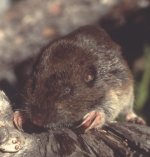
Pocket gophers Pocket gophers (family Geomyidae) live in North and Central America. They get their name from their large cheek pouches and they can be turned inside out. They are heavily built, small burrowing animals. A few can reach the weigh of one kilogram. They use their cheeks to bring food back to their burrows. Some squirrels are also refferred to as 'gophers', but Pocket gophers are the 'true gophers'.
You can help spreading the word about this animal by stumbling it by pressing this link StumbleUpon

Add your thoughts about this animal - Permanent Link

Monday 01 May 2006 Aardwolf

Aardwolf The Aardwolf (Proteles cristatus) looks like a small striped hyeana. It's name in Afrikaans means "earth wolf", because it lives in underground burrows. It feeds on larvae and termites and dead animals. It is called an insectivore, because carnivores that eat primarily (or only) insects are called insectivores. When compared to its much larger cousin, the hyena, the Aardwolf is shy and small. They are solitary compared to group behavior in hyenas. The Aardwolf has big ears to hear termites underground when it is hunting and also has a good sense of smell.
You can help spreading the word about this animal by stumbling it by pressing this link StumbleUpon

Add your thoughts about this animal - Permanent Link


Animal of the Day
Subscribe to the
animal of the day
Enter your Email


Powered by FeedBlitz