Subscribe to
"Animal of the day"

AddThis Feed Button
Or subscribe by e-mail

Enter your Email


Powered by FeedBlitz

We hope that reader will gain an increased appreciation of the need for more conservation measure in order to protect the beautiful creatures that inhabit the earth. Our philosophy is that the more we learn about animals, the more we respect them and take better care of them. That is why we update this blog with new animals, We encourage you to syndicate our content by adding "animal of the day" to your own blog! (read more)

About us

Our mission is to get people excited about animals and their welfare by writing articles on these animals. We encourage people to comment on posts and share with others. Don't forget to subscribe to our feed.

Contact us
Copyright notice

Cutest pet ever - cutest pet contest

Funny animal videos and pictures

Swimming with manatees - harmful or helpful

Last Comments

Tima (Bottlenose dolphi…): J. David Smith, Ph.D., a …
Coda Plant (Pudu - smallest d…): Hey. I live in Northern C…
Michael Newton (Koala video): i love you mr. koala
Tohru (Asian Golden Cat): I hate them too! They are…
tiffany (Asian Golden Cat): i love this cat i’m doing…
BK (Nubian Ibex - The…): Magnificent animal, espec…
amanda (Long-nosed cusima…): thhisanimal is so so so s…
misscrient (Muskrats - Water-…): Third paragraph last sent…
rudy (Deer Mouse - The …): that is so cool ilove lea…
Nick (Fattest cat in th…): “The cat is not over fed.…

Calendar

« November 2009
S M T W T F S
1 2 3 4 5 6 7
8 9 10 11 12 13 14
15 16 17 18 19 20 21
22 23 24 25 26 27 28
29 30          

Archives

Previous Archive

01 Nov - 30 Nov 2009
01 Oct - 31 Oct 2009
01 Sep - 30 Sep 2009
01 Aug - 31 Aug 2009
01 Jul - 31 Jul 2009
01 Jun - 30 Jun 2009
01 May - 31 May 2009
01 Apr - 30 Apr 2009
01 Mar - 31 Mar 2009
01 Feb - 28 Feb 2009
01 Jan - 31 Jan 2009
01 Dec - 31 Dec 2008
01 Nov - 30 Nov 2008
01 Oct - 31 Oct 2008
01 Sep - 30 Sep 2008
01 Jul - 31 Jul 2008
01 Jun - 30 Jun 2008
01 May - 31 May 2008
01 Apr - 30 Apr 2008
01 Mar - 31 Mar 2008
01 Feb - 28 Feb 2008
01 Jan - 31 Jan 2008
01 Dec - 31 Dec 2007
01 Nov - 30 Nov 2007
01 Oct - 31 Oct 2007
01 Sep - 30 Sep 2007
01 Aug - 31 Aug 2007
01 Jul - 31 Jul 2007
01 Jun - 30 Jun 2007
01 May - 31 May 2007
01 Apr - 30 Apr 2007
01 Mar - 31 Mar 2007
01 Feb - 28 Feb 2007
01 Jan - 31 Jan 2007
01 Dec - 31 Dec 2006
01 Nov - 30 Nov 2006
01 Oct - 31 Oct 2006
01 Sep - 30 Sep 2006
01 Aug - 31 Aug 2006
01 Jul - 31 Jul 2006
01 Jun - 30 Jun 2006
01 May - 31 May 2006
01 Apr - 30 Apr 2006
01 Mar - 31 Mar 2006
01 Feb - 28 Feb 2006
01 Jan - 31 Jan 2006
01 Dec - 31 Dec 2005
01 Sep - 30 Sep 2005
01 Aug - 31 Aug 2005
01 Jul - 31 Jul 2005

Animal posters
Animal pictures
Mammals.start4all.com
Animal diversity web
Recently extinct animals forum
PetLvr.com
Another chance to see
Happiness is a warm puppy

Miscellany

AddThis Feed Button

Sunday 31 July 2005 Cetaceans (Whales and dolphins)
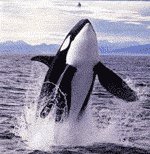
killer whale Thought to be once living on land, cetaceans have evolved to the aquatic life. Many cetaceans can dive for long periods and to great depths. Unlike humans, who can't dive too far down or stay under for too long or else too much nitrogen will be dissolved into our bodies, the cetaceans are not breathing pressurized air as is the scuba (self-contained underwater breathing apparatus) diver. The cetacean actually just holds its breath under water, so the air to be dissolved into its body, slowly decreases.The disease human divers can get from staying too long or too deep is called the caisson disease, altitude sickness, or the bends. A few cetaceans are believed to be the most intelligent non-primates and many have proportionately larger brains. (more)
You can help spreading the word about this animal by stumbling it by pressing this link StumbleUpon

one comment - Permanent Link

Tuesday 26 July 2005 Tamanduas (Genus Tamandua) - Tree-living Anteaters
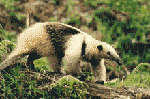
Tamanduas Anteaters (Myrmecophagidae) are members of a very special group of mammals - the Xenarthrans - quite unusual and conspicuous animals, such as Sloths (Pilosa) and Armadillos (Dasypodidae). There are just 29 Xenarthran species left nowadays, but this group has been one of the most dominating mammal orders in South America during the tertiary period.

(more)
You can help spreading the word about this animal by stumbling it by pressing this link StumbleUpon

two comments - Permanent Link

Monday 25 July 2005 Short-eared elephant-shrew - A "living fossil" from the Namib-desert

elephant shrew Somehow the small short-eared elephant-shrews (Macroscelides proboscideus) remind us of shrews, as indicated by their English name. So for a long time zoologists put them - together with the shrews - into the group of the insectivores. But nowadays it is known that elephant shrews form a very old order of mammals themselves. The Short-eared elephant shrew is one of 15 species of this order. Already 30 million years ago there have been mammals living in Africa, which were very similar to the elephant-shrews living nowadays. Species surviving such long periods without remarkable changes are known as "living fossils". (more)
You can help spreading the word about this animal by stumbling it by pressing this link StumbleUpon

two comments - Permanent Link

Monday 18 July 2005 Orang-utan - "Forest people" from Borneo and Sumatra

Orang utan The translation of the Malayan word "Orang-utan" is "forest man". And indeed do the large Great apes show a lot of human characteristics concerning their facial expression as well as their gestures. Adult male Orang-utans (Pongo pygmaeus) are imposing figures with their reddish shaggy fur, broad cheeks and long beards. In the wild they reach weights up to 80 kg. Male Orang-utans living in zoos and suffering from lack of exercise are often even heavier. Female Orang-utans are much smaller than the males. The face of young Orang-utans is fair-skinned but, like in Chimpanzees, gets darker the older they get. (more)
You can help spreading the word about this animal by stumbling it by pressing this link StumbleUpon

two comments - Permanent Link

Tuesday 12 July 2005 Giraffe - The long-necked gourmet of the savanna

Giraffa camelopardalis Giraffes (Giraffa camelopardalis) certainly are among the most conspiciuous animals of the African savannas. Their size and their long necks are extraordinary. The head of an adult Giraffe is about six metres above the ground; Giraffes are the highest animals living nowadays. But like all other mammals Giraffes have got only seven cervical vertebras. The long neck is a result of the fact that each cervical vertebra is extremely lengthened. Giraffes wear two to six short and blunt horns on their heads. These horns consist of bone tissue and are almost completely covered with skin and fur. The Giraffes's fore legs are longer than the hind legs. So the relatively short body slopes away. Like bovines and antilopes Giraffes are even-toed ungulates (artiodactyla). The common Giraffe, as we know it, is also called "Steppe-Giraffe" to seperate it from the closely related, short-necked Okapi (Okapia johnstoni), which is also known as "Forest-Giraffe". Although all (Steppe-) Giraffes are regarded as members of one single species nowadays, there are a lot of differences, especially concerning the markings of the fur. The species is divided into eight subspecies, but also the members of a certain subspecies differ individually in their fur markings; no Giraffe is alike another one. The markings of the fur are like fingerprints among Giraffes. (more)
You can help spreading the word about this animal by stumbling it by pressing this link StumbleUpon

one comment - Permanent Link

Monday 11 July 2005 Crested gibbon - At home in the top of the trees

White cheeked gibbon The Crested gibbon (Hylobates concolor) is one of five species of the Gibbon family. Gibbons are also called "lesser apes", indicating their close relationship to the "great apes", including Chimpanzees, Bonobos, Gorillas and Orang-utans. This means that Gibbons are also quite closely related to man. They inhabit rainforests of South-East Asia. Crested gibbons - like the other Gibbon species - live in family groups, consisting of an adult pair and their young. The female gives birth to a single young all two to three years. The young Gibbon stays with the group for several years. Thus different aged young, mostly two to four, belong to the family. The group migrates within its territory, in order to get enough of their prefered food - fruits, which are distributed in a dispersed way. Very special with Crested gibbons is the different colour of the genders. The male and the young are of black fur colour, whereas the female is bright brown. This sexual dimorphism is quite unusual concerning Gibbons. In the other Gibbon species males and females are quite similar, which is common with animals that are living monogamous. (more)
You can help spreading the word about this animal by stumbling it by pressing this link StumbleUpon

six comments - Permanent Link

Friday 08 July 2005 Even-toed ungulates (Artiodactyla)

Lesser malay mouse deer Smallest animal: lesser Malay mouse deer (see picture, 40 cm long)
Largest animal: Giraffe (5.8 meter)
Heaviest animal: hippopotamus (reports vary from 3,600 to 4,500 kg)

Most of the world's species of large land mammals are artiodactyls. The order of Artiodactyla, containing cattle, pigs, goats, and sheep, has helped humans through evolution. Humans domesticated them for their meat, milk, and leather, farmers to help them on the land.

(more)
You can help spreading the word about this animal by stumbling it by pressing this link StumbleUpon

two comments - Permanent Link

Tuesday 05 July 2005 Brown bear - The giants of tundra and mountains

Brown bear Who doesn't know the brown giants - probably the best-known of all bears? The Brown bear (Ursus arctos) can be found on coats of arms as well as on flags. And even in the naming of large cities like Berlin or Bern it played an important role. In former times the relationship between bears and humans was dominated by a kind of timorous admiration. This changed with the invention of firearms, which made it possible to hunt for bears at a relativly low risk. From that times on the large bear was just an unpleasant and dangerous competitor one had to get rid of. This attitude towards bears is very common even up until now. Of course there is a certain danger coming from a large Brown bear, but under normal conditions bear attacks on humans are quite rare. Normally bears try to get out of humans' ways. Just if a certain attack distance is reached - mostly by man - there might be a bear attack. Such accidents are normally due to lack of knowledge about bears or simply thoughtlessness. (more)
You can help spreading the word about this animal by stumbling it by pressing this link StumbleUpon

three comments - Permanent Link

Add "Animal of the day" to your blog

A new feature has been set up for your
site: "Animal of the Day", you can add this to your website by copying the code. An example of how
this would look like and the code to be added can be found here.

63 comments - Permanent Link


Animal of the Day
Subscribe to the
animal of the day
Enter your Email


Powered by FeedBlitz