Tuesday 31 August 2010
The Northern Night Monkey - Nature's Malaria Lab

The
Northern night monkey (
Aotus trivirgatus), also known as the northern owl monkey, is an arboreal primate native to Venezuela and north-central Brazil. Its color is mostly black or brown with vivid white markings on the face. Body size is 24 to 47 centimeters (9.4 inches to 18.5 inches) with a tail length of about 22 to 42 centimeters (8.7 inches to 16.5 inches). Adults of both sexes weigh about one kilogram (2.2 pounds).
The northern night monkey lives in woodlands including tropical rainforest. It is omnivorous, eating a variety of small invertebrates, fruits, nuts, leaves and bird's eggs.
An unusual trait of the northern night monkey is that it can carry the same malaria parasite that effects humans, making it valuable for medical research. While its use for this purpose has allowed great strides in the treatment of the disease, it has also led to the capture of large numbers of night monkeys to be used as lab animals. Since the 1970's, there have been efforts to regulate this trade. While regulation is certainly in order, it cannot be denied that many human lives have been saved because of the medical work using this animal.
The taxonomy of the night monkey is still in dispute. Before 1983, all species of owl monkey were regarded as subspecies of A. trivirgatus. In 1983 genetic evidence revealed enough divergence between the subspecies to justify classifying them as separate species. This classification is still not universally accepted. As further research is conducted, the taxonomy will undoubtedly become more definite.
The northern night monkey is atypical among nocturnal animals in that it has color vision.
Nocturnal animals tend to be primitive species which have not evolved color vision, but the night monkey is more advanced and has apparently re-evolved nocturnality from diurnal ancestors. The night monkey's transition to nocturnality has been incomplete, for it still requires strong moonlight to see and is largely inactive on moonless nights.
Some of the indigenous peoples also hunt the night monkey as a game animal.
Unfortunately, enforcement of hunting regulations has been spotty due to rugged terrain, the local culture and lack of funding. There is undoubtedly much illegal hunting and trafficking of the animal still going on. At the moment, humans are the most dangerous predators of the northern night monkey.
However, the greatest threat to this animal is another human activity, destruction of the rain forest, which is wiping out large segments of its habitat.
Picture of the northern night monkey by
Stavenn, licensed under
GFDL
You can help spreading the word about this animal by liking it on facebook
Permanent Link
Monday 30 August 2010
The Southern Elephant Seal-A Face Only a Mother Could Love!

The
Southern elephant seal (
Mirounga leonina) has the unfortunate distinction of being the fattest mammal in the carnivore family. But with an average size of 880 to 1,980 pounds (400 to 900 kg), nobody is making fun of this strange-looking animal, at least not to its odd face. And that’s the smaller of the species; the males typically weigh approximately 4,847-8,800 pounds (2,200 to 4,000 kg.) Stretched out, the Southern elephant seal averages 8 to 16.5 feet long (2.6 m to 5 m.) But its size is not the reason for his name. It’s that big elephant-like proboscis hanging off its face that earned it that moniker.
They are born cute and fuzzy, however, with a thick black fur to keep them warm and cozy. The pups, when fully weaned, spend their days hanging out in a type of “nursery” with other pups until their fur diminishes and they are on their way to adulthood. During that time, they enter the water and learn to swim, never venturing too far from the other seal pups until it’s ready to face life alone. Southern elephant seals live in groups while on land, but hunt individually. It takes the prize for its ability to dive deeper, longer and faster than other species of seals, surpassing even whales and dolphins with its ability to stay under water for long periods and dive to depths of 5,000 feet.
This strange and unusual animal makes its home in several geographical locations. It has been known to come ashore in Antarctica but their true home is in the Southern hemisphere where it hunts in the waters of the Falkland Islands, Argentina and the Indian Ocean. Colonies are also found in the islands of the Pacific Ocean south of New Zealand and Tasmania. But the largest concentration of Southern elephant seals, over half of the entire population, is found in South Georgia. Their habitat, when not in the ocean, is the rocky and sandy beaches where it mates and gives birth.
The Southern elephant seal has few predators. The
orca and the
great white shark, in addition to humans, are its only enemies. Hunted nearly to extinction in the early 1900s, the population is now relatively stable due to strict hunting regulations. It is somewhat threatened, however, as it competes with commercial fishing and other animals for the fish and squid on which they prey.
Picture of the southern elephant seal by B.navez, licensed under
GFDL
You can help spreading the word about this animal by liking it on facebook
Permanent Link
Friday 27 August 2010
Central American Spider Monkey - A Smart Primate That Barks Like a Dog

The
Central American Spider Monkey (
Ateles geoffroyi), also called Geoffroy's Spider Monkey or the Black-handed Spider Monkey, lives in the canopies of tropical forests throughout Central America, southern Mexico, and the northwest coast of South America. These monkeys are 12-25 inches (30-65cm) tall with a tail 24-33 inches (60-85cm) in length. Weight for a full grown monkey can range from 13-20 lbs. (6-9kg) with males weighing slightly more than females. There are several subspecies of this spider monkey with varying fur colors ranging from blond to dark red, but they all have some black fur.
These monkeys practice "fission-fusion" grouping: At night they gather in groups of twenty to one hundred monkeys which split into groups of two or three during the day to search for food. The only primates that share this trait are chimpanzees and humans.
Central American Spider Monkeys are believed to be the fourth smartest primate behind humans, chimpanzees, and orangutans. They have been seen using tools in two ways: They often rub a mixture of ground lime tree leaves and saliva into their fur which may act as an insect repellent. When frightened the monkeys will break off branches and drop them on the threat. Their primary predators are large cats including
pumas,
jaguars, and
ocelots. Large snakes and birds of prey have also been known to eat spider monkeys on occasion.
Often the monkeys don't have to resort to breaking branches. They warn potential predators by make a loud barking sound like a dog; locals know enough to stay out of a monkey’s way or risk blunt trauma. If a monkey is separated from its group it whinnies like a horse.
Central American Spider Monkeys are an endangered species. Logging has limited their habitat while they have been hunted for food or to be kept as pets. The majority of the monkey's diet is fruit and nuts, although they have been known to eat honey, bark, and insects when their preferred foods are in short supply. Scientists have noticed a decline in the number of spider monkeys in the year following an El Niño. The weather from this phenomenon reduces the amount of food available to the spider monkey and there is some concern that increases in El Niño strength from climate change could have a long term effect on monkey populations. These monkeys can contract malaria, making them a valuable tool for studying the disease but this also means they are susceptible to outbreaks.
Efforts to protect the monkeys have concentrated on restricting logging and mining in their habitat. Spider monkeys will breed in captivity which has prompted zoos to start breeding programs which will increase wild populations.
Picture of the Central American Spider Monkey by Lea Maimone in the Brookfield Zoo - Chicago, IL, licensed under the
Creative Commons Attribution-Share Alike 2.5 Generic license.
You can help spreading the word about this animal by liking it on facebook
Permanent Link
Thursday 26 August 2010
The Beautiful Fork-Marked Lemur of Madagascar

The
Fork-marked lemur (
Phaner furcifer) is a primate found in Madagascar. They tend to live in two main parts of the country, including the humid forests of the eastern portion of the country as well as the dry and temperate forests in the western part of Madagascar. They spend a majority of their time in gum-producing trees, where they live and eat. The fork-marked lemur is known for their harvesting skills of gum trees in this region. They also possess a dental comb, which is a row of teeth on the lower jaw that allows for gum to be extracted from the trees. The fork-marked lemurs also eat some insects, although to a lesser degree than they consume gum.
As a rule, the fork-marked lemur lives in a monogamous relationship with their mate. Once bonded, the lemurs live together in a hole in a tree and share their lives there. They reproduce only with one mate at a time. Both males and females participate in the raising of offspring, although the females tend to play a larger role in the lives of young ones than males do. This is a similar trait found in many primates, including other lemurs.
Many are dying because of deforestation in their homelands. Lemurs are tree-dwelling creatures, and forestry has become a popular industry that is taking the lives of these animals. For this reason, the fork-marked lemur is rapidly becoming more and more endangered each year. Among potential predators are carnivorous tenrecs,
fossas, and herpestids native to Madagascar. These lemurs are also likely to fall victim to snakes and birds of prey.
The average life expectancy for the fork-marked lemur is around twelve years. One infant is born to a lemur pair each season, and infants are expected to live with their parents until able to fend for themselves. Actual life span has decreased greatly since many lemurs have no trees to live in while in the wild, but lemurs who are under the care of humans tend to live around twelve years.
These lemurs are most commonly known for their distinct markings on the face. The fork-marked lemur is named for its two black stripes that run from the eyes to the tip of the snout, making the animal stand out among its other lemur counterparts. These lemurs also possess large, bushy tails that can be between 29 and 37 centimeters long.
You can help spreading the word about this animal by liking it on facebook
Permanent Link
Wednesday 25 August 2010
The Loggerhead Sea Turtle; Male or Female?

The
Loggerhead Sea Turtle (
Caretta caretta) has an enormous range. They live in all of the oceans of the world, Atlantic, Pacific, Indian and Mediterranean, except for the most frigid. Loggerheads favor coastal habitats but can have been known to travel far out to sea as well. They spend all of their lives in saltwater or estuarine habitats, except for a short time when the females come to land to lay their eggs. One of the features that distinguish the Loggerhead turtle as unique is the fact that there are no gender differences until the Loggerhead reaches adulthood. Another interesting feature of the Loggerhead turtle is that the female Loggerheads will often travel thousands of miles in order to lay their eggs at the same beach at which they were hatched. They do this with the help of a substance they have in their brains, magnetite (an iron compound), which allows the Loggerhead turtles to feel the magnetic field of the earth.
The Loggerhead turtle is an omnivorous reptile with a life span of 47-67 years. They range in size from around 31 to 49 inches (around 78 centimeters to 124.5 centimeters) and weigh around 170 to 315 pounds (around 77 kilograms to 142 kilograms). They feed on sea cucumbers, barnacles, crabs, shrimps, horseshoe crabs, sea urchins, conchs, fishes, octopuses, sponges, whelks, star fish, sea anemones, floating egg clusters, insects, flying fish, squids and jellyfish. Although the young have many predators, as do the eggs, once a Loggerhead becomes an adult their size limits their chance of becoming prey except to larger marine life such as sharks, parrotfish,
monk seals, moray eels and
killer whales.
The population of Loggerheads has declined by over 50% which makes the Loggerhead turtle an endangered species. Declining populations are due to the development of coastlines and beach disturbances by people such as cleaning, artificial lighting (discourages nesting and makes it hard for hatchlings to find their way to the water), fishing, driving and pollution. They are also hunted for food by some cultures as well as for their shells. High speed boat propellers are another killer as is the swallowing of trash such as fishing lines and plastic bags. Another cause of death is when Loggerheads get caught in fishing nets and drown for which the leading killer are shrimp and fish nets.
Conservation groups are trying to implement laws that will save Loggerhead turtles and get them off the endangered list.
You can help spreading the word about this animal by liking it on facebook
Permanent Link
Tuesday 24 August 2010
The Horn Shark - The Seafaring Unicorn

The
horn shark (
Heterodontus francisci) is one of nine living Heterodontiformes or
bullhead sharks. Fossil records dating back more than 100 million years have established bullheads as the first type of sharks to inhabit the oceans. The small-bodied horn shark is easy to identify by its blunt bull snout, piggish nostrils, and pronounced ridges directly over the eye sockets. To blend in with the rocky sea caves and sandy flats it inhabits, the horn shark has developed grayish-tan colored skin with a speckling of small dark brown dots for camouflage. The feature that gives horn sharks their name and makes them so unique is the set of two deeply-rooted venomous spines or recurved horns in front of the shark’s dorsal fins. When attacked by angel sharks and elephant seals, the horn shark’s spines act as a deadly defense mechanism that makes their body too difficult or too painful for predators to swallow.
In nature, horn sharks are typically two feet or 58cm long when they reach maturity although many will continue to grow until they are one meter long or a little more than one yard. Mature horn sharks generally weigh around 10 kilograms or 22 pounds. According to scientific records, the largest horn shark measured 122cm or 48” although measurements of 97cm or 38” are more common.
The natural range of the horn shark extends from Northern California through the Baja Peninsula and the Gulf of California. Adults prefer deep waters and rocky reefs on the continental shelf while juveniles begin life in the sandy shallows closer to the coast. Unfortunately, horn sharks are targets for aerial attacks by bald eagles and other birds of prey while enjoying their shallow water feeding grounds.
The horn shark’s diet is made of up hard-shells mollusks and crustaceans, such as gastropods, sea urchins, crabs, and shrimp, which are crushed between the shark’s large molar-like teeth. The horn shark’s Latin name Heterodontus literally translates to mixed teeth from the root words hetero and odonto. Although the horn shark is not endangered, they are caught unintentionally in the indiscriminate trawler nets of commercial fishing vessels. Horn sharks are also caught and killed for their horns, which are used to make jewelry.
This naturally nocturnal hunter is a docile shark that only strikes humans if provoked. The horn shark’s calm nature makes it a good candidate for aquariums. However, immature juvenile are preferred for home fish tanks while mature horn sharks are only seen in public aquariums.
You can help spreading the word about this animal by liking it on facebook
Permanent Link
Monday 23 August 2010
Large Hairy Armadillo - The Delicious Omnivore

The
Large Hairy Armadillo (
Chaetophractus villosus) is the perfect name for this South American native, heavily armored around the body and head with thick bony plates. The difference from most other armadillos is a dense covering of long whitish or light brown hairs. These hairs cover his underparts and project from around the edges of his armor plating. It's Latin name, Chaetophractus Villosus, translates to "Hairy shell Hairy".
An adult weighs approximately two kilograms, or 4.4 pounds, with a snout to tail length varying from 31 cm (12.12 inches) to 57 cm (22.4 inches).
The Large Hairy Armadillo makes its home in Bolivia, Argentina,Chile, Paraguay, and Tierra del Fuego. They can be found from sea level to 1300 meters, in grasslands, savanna, forests, and farmland. Their species is widely distributed and highly adaptive. Some live close to human habitation, and indulge in "dumpster diving" meals, with maggots being a favorite treat.
Humans consider them pests, but also delicious. They are eaten and enjoyed quite extensively. Due to their heavy armor, the Large Hairy Armadillo's only serious predators is man. They are hunted for sport, food, or making musical instruments. They are often victims of road kill as well, due to their poor eyesight.
With their wide distribution and large population, these armadillos are considered to be of Least Concern on the Red List of the IUCN, the International Union of Conservation of Nature and Natural Resources. They are prolific breeders, reaching sexual maturity at an age of about nine months. Females commonly have three litters a year with two offspring. The Large Hairy Armadillo baby looks like a little piglet wearing soft leathery armor and it makes noises not unlike kitten mews.
Large Hairy Armadillos are powerful and fast diggers, due to the long sharp claws on their forefeet. They dig burrows, simple ones for temporary shelter, or complex burrows with branches that are used for living space and raising their young. They are usually nocturnal, but during the wintertime, some daylight activity is not unusual.
Except for
humans and their appetites, dogs, and cars, the Large Hairy Armadillo doesn't have such a bad life. They can be quite long-lived, reaching over twenty three years in captivity. Due to their adaptability and omnivorous diet, they have made a presence in large parts of South America.
Picture of the large hairy armadillo by Guérin Nicolas, licensed under
GFDL
You can help spreading the word about this animal by liking it on facebook
Permanent Link
Wednesday 18 August 2010
The Ruddy Mongoose - the Feisty Recluse

The
ruddy mongoose (
Herpestes smithii) lives in India and Sri Lanka, being the only type of mongoose found in these regions. It very close related to the
Indian grey mongoose. Other species of mongoose can be found throughout South Asia and Africa, with a total of 33 different mongoose species in all. The ruddy mongoose are usually found in hills and forests, generally preferring to hide. The life expectancy of the ruddy mongoose isn't known, but generally, the mongoose has been known to live anywhere between 7 and 13 years of age. It would be safe to assume the ruddy mongoose would rank in the lower to mid part of that range, being it's among the smaller species.
At its full size, its body can reach between 39 and 47 centimeters, or 15.3 and 18.6 inches, with its tail being between 33 and 36 centimeters, or 13 and 14.2 inches. The mongoose is a light animal, weighing only around 0.95 and 1.85 kgs, or 2 and 4 pounds. Their coat is usually brown, with white and black specks peppering throughout its body. The mongoose head blends into a reddish color, with the tip of its tail being painted black.
The ruddy mongoose is not endangered in the least, and often mongoose are kept as pets. However, though they are not endangered, it is illegal to bring them into most other countries from their natural habitat. There is not much known about its breeding habits. Other mongoose species that live in India can breed all year round, with a litter of 1 to 3 and a gestation period of 40 to 60 days, so it is safe to assume that the ruddy mongoose's breeding habits are similar. All mongoose species make a high pitched noise during mating season known as giggling, used to call to their potential mates and secure them during the actual breeding process.
Not much is known about the ruddy mongoose's behavior, except that it is a feisty little animal. This mongoose can attack and kill a cobra, one of the most deadly snake there are, without being harmed at all. By bristling its fur, it can appear to be much larger than it really is, making its predators afraid and put off guard. Snakes, small lizards,
rodents, and dead carcasses are among the ruddy mongoose's diet.
Picture of the Ruddy mongoose from Daroji wildlife sanctuary in Karnataka, India, by
Kalyanvarma, licensed under the
Creative Commons Attribution-Share Alike 3.0 Unported license.
You can help spreading the word about this animal by liking it on facebook
Permanent Link
Thursday 12 August 2010
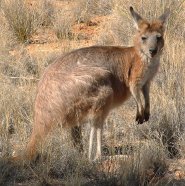
The Hill wallaroo - Dwarf Kangaroo of the Australian Hills
The
Hill wallaroo (Macropus robustus), also known as the Common wallaroo or Hill kangaroo, also is a small, stocky marsupial found throughout mainland Australia. Indeed it could be considered rather much the "hobbit" of the kangaroo family in physical terms. Sexual dimorphism is pronounced in this species, the male being almost twice the size of the female. A male Hill wallaroo typically weighs about 30 kilos or 65 lbs, and may be up to 140 centimeters or over 4 feet in length. His female counterpart will average about 16 kilos or 35 lbs in weight, and can grow up to about 3 feet in length. Unlike better known cousins, such as the
Eastern Grey Kangaroo, the Hill wallaroo is primarily solitary and nocturnal. The color of the pelt varies from ruddy brown to a very dark shade of grey, approaching black. Unlike other kangaroos which favor open plains country, the Hill wallaroo's favored abodes are rocky hills and cairns, over which it can skip with great agility, utilizing abundant ledges and caves for both shade and protection from predation.
Macropus robustus is well adapted to the desert continent it inhabits, being able to derive much of its water from vegetable sources and able to go as long as 90 days without imbibing a drop. The Hill wallaroo is an opportunistic breeder with no set mating seasons, although females will often cease being receptive during prolonged and intense periods of drought. A single offspring is born to the female after a gestation of approximately a month, whereupon, as with other kangaroos, it crawls unaided to its mother's pouch and begins to suckle a teat. As with other marsupials, most development occurs outside the womb. The offspring is weaned after approximately 14 months. Male Hill wallaroos are ready to breed when a year and a half old, whereas females of the species reach sexual maturity after about two years. There are four subspecies of Macropus robustus, these being the Eastern, Euro, Northern Woodland, and Barrow Island varieties. The Barrow Island type is the most differentiated of the four subspecies, growing to be about as half as large as its mainland counterparts. The Hill wallaroo is not currently considered endangered or threatened, although the Barrow Island subspecies is considered vulnerable, owing to its small population of only about 1,800 individuals.
Picture of the hill wallaroo by Michael Barritt & Karen May, licensed under
Creative Commons Attribution-Share Alike 2.0 Generic license.
You can help spreading the word about this animal by liking it on facebook
Permanent Link
Tuesday 10 August 2010
Longhorn cowfish - A Poisonous Pet

The
Longhorn cowfish is one of the strangest-looking fish ever to swim in an aquarium. It's actually not well-suited to life in captivity, thanks to its ability to release ostracitoxin when stressed. This can have bad effects on a tank's other inhabitants. However, the Longhorn cowfish's odd appearance has made it quite popular with saltwater fish keepers. It is a type of boxfish, a group of fish that is related to the more widely recognized Pufferfish family. Most fish stick to the standard, streamlined shape, but all cowfish have a blocky, boxy shape that makes this group unique and easily recognized. The Longhorn cowfish's standard color is yellow ranging to olive with white or blue-white spots, but other morphs exist with orange or green coloration. The fish's defining feature is the set of horns that protrude from the head; they're much longer than the horns of any other cowfish.
Maximum adult size - about 50 cm, or 20 inches.
Weight - Most captive specimens are young and don't weigh more than a few ounces. A large one might weigh in at a pound or two, or .5 to 1 kilogram.
Obviously, longhorn cowfish are not particularly large fish. A 6 inch fish would be considered large at a pet shop. In the wild, the longhorn cowfish is most often found on and near reefs of the Indo-Pacific region, but it also lives in still bays, harbors and estuaries with sand or mud bottoms. Young fish are often associated with Acropora corals.
The longhorn cowfish generally sticks to shallow water from 1 to 50 meters. They may be found in water up to 100 meters deep, but this is not common. Longhorn cowfish range from the Red Sea all the way to Australia and southern Japan, and they also live along Africa's southern Atlantic coast. They are not endangered, and they're common enough to be found in pet stores. Like many popular aquarium fish, longhorn cowfish are not found in the Americas.
Most boxfish are slow swimmers; they can actually be caught by hand. The longhorn cowfish is certainly not an agile hunter, so its diet consists mainly of invertebrates and benthic algae. They have even been observed blowing jets of water into the sand to uncover delectable worms. Larger fish also eat other fish when they can. Between their poisonous flesh and their scaly armor, cowfish are unattractive to many predators. The horns on the head and under the tail are thought to make the fish hard to swallow. Even so, longhorn cowfish are sometimes eaten by larger predators like albacore and bigeye tuna.
Picture of the Longhorn cowfish by Drow male, licensed under
GFDL
You can help spreading the word about this animal by liking it on facebook
Permanent Link
Wednesday 04 August 2010
The Black Skimmer - Skimming in Flocks

The
Black Skimmer (
Rynchops niger) feeds by skimming the surface of the water with its long lower mandible.
Native to the Americas, the Black Skimmer measures about 40 to 50 cm (15.75 in - 19.70 in) as an adult with a wingspan of 107 to 127 cm (42 in - 50 in). The adult male weighs about 325 grams (11.5 oz) as compared to the smaller female of about 235 g (8.3 oz).
In North America, the Black Skimmer breeds in the warmer waters of the Atlantic and Pacific coasts. In South America, the breed migrates mainly in reaction to seasonal flooding. A seabird, this species inhabits sand or gravel beaches and bars, estuaries, and salt marshes.
In appearance the Black Skimmer resembles a tern and is black on top with white underside. The bill is bright red with black tip, and the long, narrow wings are dark on top and grayish below. The legs and feet are red, while the tail is white with a black center. The bird’s call is a “kak kak kak” or “kur kur kur.”
The Black Skimmer is the only bird species in the United States in which the lower mandible is longer than the upper mandible. Upon hatching, the two mandibles have the same length but henceforth the lower mandible grows until it is much longer than its counterpart. The birds generally feed during the day, flying just over the water’s surface in order to dip their lower mandible and “skim” for prey including
fish, insects and shellfish.
Predators can include dogs, foxes, cats and raccoons, and humans looking for eggs. The eggs are also vulnerable to flooding and ecological disturbance by humans. Human development and traffic along beaches can threaten the bird's nesting grounds, as the species is sensitive to even minor disturbances during breeding.
The species can be divided into three subspecies: Rynchops niger niger, located from southern California to Ecuador on the Pacific coast, and along the North American Atlantic coast; Rynchops niger cinerscens, a larger subspecies located on the Atlantic coast of South America; and Rynchops niger intercedens, also located on the South American Atlantic coast down to Argentina.
The species is listed under the category of Least Concern after a prior rating of Lower Risk. The current population of Black Skimmers is estimated at about 200,000 individual birds, and the population has remained stable for the last decade.
Picture of the black skimmer by Googie man, licensed under
GFDL
You can help spreading the word about this animal by liking it on facebook
Permanent Link