Subscribe to
"Animal of the day"

AddThis Feed Button
Or subscribe by e-mail

Enter your Email


Powered by FeedBlitz

We hope that reader will gain an increased appreciation of the need for more conservation measure in order to protect the beautiful creatures that inhabit the earth. Our philosophy is that the more we learn about animals, the more we respect them and take better care of them. That is why we update this blog with new animals, We encourage you to syndicate our content by adding "animal of the day" to your own blog! (read more)

About us

Our mission is to get people excited about animals and their welfare by writing articles on these animals. We encourage people to comment on posts and share with others. Don't forget to subscribe to our feed.

Contact us
Copyright notice

Cutest pet ever - cutest pet contest

Funny animal videos and pictures

Swimming with manatees - harmful or helpful

Last Comments

Tima (Bottlenose dolphi…): J. David Smith, Ph.D., a …
Coda Plant (Pudu - smallest d…): Hey. I live in Northern C…
Michael Newton (Koala video): i love you mr. koala
Tohru (Asian Golden Cat): I hate them too! They are…
tiffany (Asian Golden Cat): i love this cat i’m doing…
BK (Nubian Ibex - The…): Magnificent animal, espec…
amanda (Long-nosed cusima…): thhisanimal is so so so s…
misscrient (Muskrats - Water-…): Third paragraph last sent…
rudy (Deer Mouse - The …): that is so cool ilove lea…
Nick (Fattest cat in th…): “The cat is not over fed.…

Calendar

« November 2009
S M T W T F S
1 2 3 4 5 6 7
8 9 10 11 12 13 14
15 16 17 18 19 20 21
22 23 24 25 26 27 28
29 30          

Archives

Next Archive Previous Archive

01 Nov - 30 Nov 2009
01 Oct - 31 Oct 2009
01 Sep - 30 Sep 2009
01 Aug - 31 Aug 2009
01 Jul - 31 Jul 2009
01 Jun - 30 Jun 2009
01 May - 31 May 2009
01 Apr - 30 Apr 2009
01 Mar - 31 Mar 2009
01 Feb - 28 Feb 2009
01 Jan - 31 Jan 2009
01 Dec - 31 Dec 2008
01 Nov - 30 Nov 2008
01 Oct - 31 Oct 2008
01 Sep - 30 Sep 2008
01 Jul - 31 Jul 2008
01 Jun - 30 Jun 2008
01 May - 31 May 2008
01 Apr - 30 Apr 2008
01 Mar - 31 Mar 2008
01 Feb - 28 Feb 2008
01 Jan - 31 Jan 2008
01 Dec - 31 Dec 2007
01 Nov - 30 Nov 2007
01 Oct - 31 Oct 2007
01 Sep - 30 Sep 2007
01 Aug - 31 Aug 2007
01 Jul - 31 Jul 2007
01 Jun - 30 Jun 2007
01 May - 31 May 2007
01 Apr - 30 Apr 2007
01 Mar - 31 Mar 2007
01 Feb - 28 Feb 2007
01 Jan - 31 Jan 2007
01 Dec - 31 Dec 2006
01 Nov - 30 Nov 2006
01 Oct - 31 Oct 2006
01 Sep - 30 Sep 2006
01 Aug - 31 Aug 2006
01 Jul - 31 Jul 2006
01 Jun - 30 Jun 2006
01 May - 31 May 2006
01 Apr - 30 Apr 2006
01 Mar - 31 Mar 2006
01 Feb - 28 Feb 2006
01 Jan - 31 Jan 2006
01 Dec - 31 Dec 2005
01 Sep - 30 Sep 2005
01 Aug - 31 Aug 2005
01 Jul - 31 Jul 2005

Animal posters
Animal pictures
Mammals.start4all.com
Animal diversity web
Recently extinct animals forum
PetLvr.com
Another chance to see
Happiness is a warm puppy

Miscellany

AddThis Feed Button

Monday 30 March 2009 Gaur - the tiger killer

Indian GaurThe Gaur (Bos frontalis) is a big relative of the cow, being a bovine itself, and is the largest known wild cattle on the planet – in fact they are bigger than bison, water buffalo, and the Cape buffalo. They are found in south Asia, and are particularly vulnerable. In fact, they are listed as a threatened species, and if more is not done to prevent their population loss, they will become endangered soon. They have a high ridge on their forehead between their horns and back has a ridge that is marked and raised with their body length being around 250 to 360cm (8-12 feet), and they typically stand as high as 220cm (7.2 feet) although the males typically are taller than females. They have big ears, smallish tails which average 70 to 100cm (28-40 inches), and a noted pattern of hair loss on their backs in males as they age. As adults they are very dark in color, being a dark brown to black – and darkening with age. Their heads from the eyes to the neck is an ashen gray and sometimes lighter, while their muzzle is a pale color. Their legs, from the knees down, are white. Adolescent and young Gaurs are usually lighter and paler in tone, and gradually darken with aging. Males typically weigh close to 1500kg, with a range of 1000-1500 being considered normal (2200 – 3300 lbs), while females being smaller and lighter weigh 700 to 1000 kg (1500-2200 lbs).

As they are the heaviest, and most powerful of all wild cattle, they hold a special place as the apex bovine, and their ecological role provides an important food source for only one large apex predator which is known to have killed a healthy adult – that being a tiger. Even then, there are more cases of tigers being killed by Gaurs, than Gaurs being killed by tigers. The males of the species are extremely muscular, and powerful – able to generate enough power to be deadly to predators, humans, and other domestic cattle that are unfortunate enough to provoke them. They live in herds of around 30-50 members, and they gestate for around 280 days. Herds are typically led by the oldest female, while males are mostly nomads that wander in search of females. In the herd the young are typically protected fiercely, as the large adult females will form a circle with heads and horns facing outward to protect the young from possible attack by tigers. An unusual behavior observed when a tiger was sensed by a herd, and they formed in an ancient human military tactic called a phalanx, and drove it off in a steady march toward the unfortunate tiger while lined up.

The Gaur’s Binomial Name is Bos gaurus, and there are four subspecies: Bos gaurus laosiensis which is found in Myanmar to China, Bos gaurus gaurus (seen in the picture) which is the type species that is found in India, Bos gaurus hubbacki which is found in Thailand and Malaysia and is the smallest, and finally Bos gaurus frontalis which is the domestic Gaur, and is likely a hybrid between cattle and Gaur. Gaur belong to the Genus Bos, of which all wild and domestic cattle belong. Bos belongs to the Subfamily Bovinae, which include the antelope, water buffalos, Voar, Saola, Bushback, and many more. Bovinae belongs to the Family Bovidae, of which all Bovines belong, including goats, impalas, chirus, gazelles, and many more. Bovidae belongs to the Infraorder Pecora which is most of the ruminants, such as giraffes, deer, musk deer, and more. Pecora belongs to the Suborder of Ruminantia, of which all ruminants belong, which includes the mouse deer. Ruminantia belongs to the Order Artiodactyla, of which all the even toed ungulates belong. Artiodactyla belongs to Laurasiatheria, of which many mammals are members including carnivores and bats. This of course belongs to the Infraclass Eutheria, or all the placental mammals, and this belongs to the Subclass Theria, which is all the mammals with the exception of the Monotremes.

Interesting Fact: The Gaur was cloned in 2001, and became the first cloned endangered species, unfortunately the healthy calf died due to unrelated causes (dysentery) two days later.

Picture is of the Indian Gaur, by LRBurdak licensed under GFDL
You can help spreading the word about this animal by stumbling it by pressing this link StumbleUpon

one comment - Permanent Link

Tuesday 24 March 2009 Mariana fruit bat
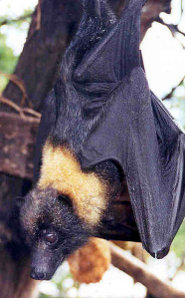
Mariana fruit batThe Mariana Fruit bat (Pteropus mariannus) is an endangered species of bat only found habituating the Mariana Islands, including Guam, and it is directly threatened by human behavior. Poaching has played a role in the decreasing numbers of the Mariana Fruit Bat, along with deforestation resulting in habitat loss and stress. Additionally this bat is found to be a popular local meal; however it is also linked to diseases and is a natural concentrator of pesticides much like other larger animals that accumulate DDT or similar chemicals from their food. Their diet consists of local fruit and nuts found in the trees, which they feast upon with their small but sharp teeth, they only eat plant matter and are of no threat to humans.

The Mariana fruit bat is a mid-sized bat, neither unusually large nor small for flying foxes (a flying fox is the nickname to megabats) and it can weigh up to a full pound (577 grams). Its forearm length ranges from 5 to 6 inches, (13-15.6cm); however the males are usually slightly larger. Their abdomens are usually a dark brown to black, while it has gray hairs throughout that appear to be scattered, their shoulders are usually a light brown or golden color, as are their necks while the head is particularly darker in tone. Individuals have much minor variation, with some having unusually light coloration, and others having much darker – but all within the ranges expected of this bat. They have very large eyes that make it easy for them to see, and rounded ears with a pointed muzzle, giving them the appearance of a canine. This is another reason they are called flying foxes.

The Binomial name of the Marianas Fruit bat is Pteropus mariannus mariannus. They belong to the genus Pteropus, which has some of the largest bat species in the world (P. vampyrus is the largest with a seven foot wingspan), and some of the most endangered species of bat in the world; it contains 64 known species (one was found as recently as a year ago – more are likely to be found). Pteropus belongs to the Subfamily Pteropodinae which contains 36 known Genera – many of which are endangered as entire Genera. Pteropodinae belongs to the Family Pteropodidae, of which there is only one other Subfamily with five Genera of bats. Pteropodidae belongs to the Suborder Megachiroptera of which they are the only member (however this is disputed – some suggest they belong to a new Suborder that also has a few microbat families based on recent genetic studies – if so it would be called Yinpterochiroptera). This in turn, belongs to the Order Chiroptera, which contains all of the bats. Chiroptera belongs to the Superorder Laurasiatheria, of which the ungulates, carnivores, and many other mammals are a member, and that in turn belongs to the Infraclass Eutheria – which is all the placental mammals.

Interesting Fact

The Mariana Fruit Bat, like other bats, might be a reservoir for diseases like Ebola, Marburg, and other hemorrhagic fevers, along with rabies and quite a few other diseases. They are naturally unaffected by the diseases, however humans are not. Although only a fraction of a percent carries the diseases, there is always the possibility of infection as with any wild animal.
You can help spreading the word about this animal by stumbling it by pressing this link StumbleUpon

Add your thoughts about this animal - Permanent Link

Friday 20 March 2009 Indiana bat
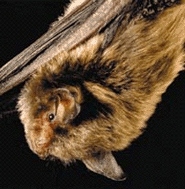
Indiana batThe Indiana bat (Myotis sodalis) is a brown to grayish bat which is listed as an endangered species due to population loss and habitat destruction. Its known range extends from the northern panhandle of Florida through Alabama and Georgia, north to cover all of Tennessee, parts of Western Virginia, and Northern Arkansas, along with all of Missouri, Indiana, Illinois, West Virginia, Ohio, southern Michigan, Pennsylvania, and upstate New York. It also has been found in some of the smaller states such as New Jersey, New Hampshire, and Vermont. The Indiana Bat is hard to distinguish from other related bats due to its similarities, especially a close relative of the Indiana Bat called the ‘little brown bat’. However the way they are told apart most often is the size of their feet, the length of the hairs on their toes, and also that instead of having black lips, theirs are pink. The Indiana Bat usually grows up to 2 inches and can weigh as much as a fourth of an ounce, additionally they live up to nine years in the wild, however some can live nearly double that amount of time – the record being 14 years. Its variations in color are often more brownish, however they can range from a lighter grayish color to a dark black.

They only eat insects that can also fly, and are a valuable asset to the environment in which man inhabits because they can consume thousands upon thousands of mosquitoes and other flying insects in just one night. The Indiana Bat is known to migrate, as throughout the summer it will spread far and wide – however in the winter it will hibernate in very few caves. It is estimated that since the mid 70’s the population of the bat has been decimated, and is only at 50% of pre 1970’s levels today. The current estimated population is under but close to 250,000, and nearly 23% of that population hibernates in Indiana in just a few caves. When hibernating they will cluster into very tight groupings, and will live in caves that provide only the most optimal of conditions for their winter sleep.
Although it has a large range and overlaps with its close relative the Gray Bat, it has a significantly smaller population caused by destruction of colonies, pesticides, and the loss of habitat in the clearing of woodland for housing subdivisions and other habitat losses. The Indiana Bat is threatened by the WNS (white nose syndrome) a mysterious illness which has killed tens of thousands of bats. Although it may not be a direct cause, it is usually seen as a small white ring of fungus around the muzzle of an afflicted bat, and also on the wings. A recent disease, it was only first noted widely in 2006, and has so far been seen in thousands of bat deaths, and is spreading rapidly. Between 2006 and 2009 it spread to 9 states. Of the caves afflicted, mortality rates can be as high as 90%.

Their binomial name is Myotis sodalist, and they are in the genus Myotis – otherwise known as the Mouse Eared Bats. Myotis contains within it around 90 species of bat, and belongs to the Subfamily Myotinae. Myotinae has three genera and is a Subfamily of the Family Vespertilionidae, or vesper bats. Vespertilionidae is the largest Family of bats as far as species count goes, and within it has five Subfamilies; Vespertilionidae belongs to the Suborder Microchiroptera, which has seven known super-families, and is also known as the microbat; Microchiroptera belongs to the order Chiroptera, which contains all bats, and has only one other Suborder called Megabats or Megachiroptera. Chiroptera belongs to the Superorder Laurasiatheria of which many orders of mammal belong, such as the carnivores and ungulates. Laurasiatheria in turn belongs to Infraclass Eutheria, of which all placental mammals are members; this belongs to Subclass Theira of which all mammals, with the exception of the Monotremes, are members.

Interesting Fact

The Indiana Bat is not the only bat afflicted by the white nose syndrome; in fact many relatives are also being infected as they also suffer the same stresses of habitat loss and pollution from pesticides, although the actual cause of the illness remains a mystery.
You can help spreading the word about this animal by stumbling it by pressing this link StumbleUpon

Add your thoughts about this animal - Permanent Link

Wednesday 18 March 2009 Cape Hare

Cape hareThe Cape Hare (Lepus capensis) is a common hare found on the continent of Africa, and has spread to other locations as well, such as the Middle East, Asia, and Europe – and also was unfortunately spread to Australia where it is an alien species. Although the species is a least concern species – it does have twelve known subspecies, and any one of those could be at risk of extinction due to lack of empirical data on their numbers. Additionally, although the numbers are not known, it is likely and predicted that there will be a decline each year, and that their numbers are slowly dwindling down although currently there are a large number.

The hare is usually brown, with large acute eyes and good vision, topped off by almost propeller shaped ears. They breed all year and have between one to two offspring in each litter, and a female can give birth to nearly eight litters per year. Their preference for using shrubs and small plants rather than grass is known, and this behavior usually occurs in the summer time. They prefer open areas; however have been known to be in other settings and altitudes. The species is generally adaptable to many conditions and terrain within limits of temperature. Diet is likely dependant on where they are, however data is lacking on specifics.

The Cape Hare’s binomial name is Lepus capensis, and within this species there are twelve subspecies. The Type species, or the one which is commonly used as the name for the species, is Lepus capensis capensis (much like Homo sapiens sapiens), while the rest are L.s. aquilo, L.s. carpi, L.s. granti, L.s. aegyptius, L.s. hawkeri, L.s. isabellinus, L.s. sinaiticus, L.s. arabicus, L.s. atlanticus, L.s. whitakeri, L.s. schlumbergi, and possibly more yet unknown. The Genus is Lepus of which the Hares and Jackrabbits are members, and there are ten known Subgenus in Lepus. Lepus belongs to the Family Leporidae, of which include the rabbits and has eleven Genera in all. Leporidae belongs to the Order Lagomorpha, of which Pikas are the only other Family. Lagomorpha belongs to the Superorder Euarchontoglires within the Clade Glires. Within this Clade they are related to Rodents, and in the Superorder they are related to Euarchonta, of which Primates (us too) are members. Euarchontoglires belong to the Infraclass Eutheria (placental mammals), which belongs to the Subclass Theria which are all mammals except the monotremes.

The decline of the Cape Hare is dependent on several factors, and the future decline will be influenced by actions or inactions of local governments and people. Because of its range in resource rich areas they are being displaced by urban developments and habitat loss, along with fragmentation (where pockets of wildlife are separated by human development), poisoning, pesticides, hunting, competition with livestock, road kill from vehicles, climate change, and predation by human kept animals in addition to their natural predators. The Cape Hare is protected by law in several places such as the United Arab Emirates, Jordan, Oman, and Bahrain.

Interesting Fact

Like all Lagomorpha the Cape Hare practices coprophagia, or the consumption of their own droppings. Because their digestive tracks are not as complex, they have feces which are half digested and are re-consumed – however they also have normal feces which they do not re-consume.

Picture of the cape hare by Benjamint444, licensed under GFDL
You can help spreading the word about this animal by stumbling it by pressing this link StumbleUpon

one comment - Permanent Link

Monday 16 March 2009 Gray bat

Gray batThe Gray Bat (Myotis grisescens) is an endangered species of bat which prefers to live in caves, and can be found in the southern United States, and it prefers to live close to water. The bat is usually 8-13g in weight and has a wingspan of nearly a foot (30 cm), additionally it is known for its long distance travel of 8 miles (14 kilometers) from where it sleeps to where it finds food. They are a gray color, which is indicated in their name, and they like to hunt over bodies of water; additionally they have mouse-like ears. They are most commonly found inside of caves that are close to areas of water. Their range extends throughout northern Arkansas, Missouri, southern Illinois, southern Indiana, most of Kentucky, the midland of Tennessee and then down through Alabama into parts of Georgia and Florida at the boarders. Although their population is over a million, it was found through an extensive survey that they likely only live in eight major caves, with one in Arkansas, one in Alabama, one in Kentucky, three in Missouri, and two in Tennessee.

Although they number a million and a half, they are endangered due to massive population losses, mostly caused by human action and interference in their habitats. Most of the destruction to their habitat has occurred due to vandalism and disturbances by tourists. Because of their limited caves and their specific food needs they are also endangered as the loss of a single cave could wipe out a significantly large population (an eighth). The Gray Bat was listed as an endangered species by the U.S. Fish and Wildlife Service agency in 1976.

Their binomial name is Myotis grisescens, and they belong to the Genus Myotis, or the Mouse-eared bats. Within this genus there are 90 known species, with 10 living in Europe alone and come in many different sizes. It is thought that some species have yet to be discovered. The Genus Myotis belongs to the Subfamily Myotinae, which has three Genera within it; they are Myotis (the aforementioned Mouse-ear bats), Lasionycteris (a single species in its own Genus) also called the Silver haired bat, and Cistugo which are called the wing-gland bats. Myotinae belongs to the Family Vespertilionidae, or the Vesper Bats; there are five Subfamilies in the Family Vespertilionidae. Vespertilionidae belongs to the Suborder Microchiroptera, of which all the Microbats belong. Microchiroptera belongs to Chiroptera of which the Micro and Megabats (flying foxes, which are large fruit eating bats) belong. Chiroptera belongs to the Superorder Laurasiatheria of which the carnivores, ungulates, moles, and many other orders of mammal belong. Laurasiatheria in turn belongs to Infraclass Eutheria, of which all placental (including humans) are members. This in turn belongs to the Subclass Theira of which all mammals, with the exception of the Monotremes, are members.

Interesting Fact

The Gray Bat is a close relative to the Indiana Bat, which is in the same Genus, and is also endangered. Their territories overlap, and they share many of the same traits – however the Indiana Bat is brown, and there are less than 300,000 left.
You can help spreading the word about this animal by stumbling it by pressing this link StumbleUpon

Add your thoughts about this animal - Permanent Link

Wednesday 04 March 2009 Sumatran rhinoceros

Sumatran rhinocerosWarning: The Sumatran Rhinoceros (Dicerorhinus sumatrensis) is Critically Endangered, and is at the brink of extinction from human hunting, poaching for their horns, and habitat loss. There are an estimated 300 left in the wild, and a recent rescue effort that ran for 20 years was an abysmal failure. In that program 40 Sumatran Rhinoceroses were captured, tagged, and taken into captivity in hopes of establishing a breeding program. At the end of the 20 year attempt no calves had been born, and nearly all the rhinos were dead – a worse decline than the wild’s current rate. This species is at the very brink of annihilation, but it still is varied enough to be saved with a concerted effort, habitat protection, and poaching prohibition. Of the three subspecies one is already completely extinct – and the other two are very rare.

The Sumatran Rhinoceros is one of the five species left of rhino in the world, it is of those five the smallest and one of the most endangered. Their height at the shoulder is usually around 4-5 feet (1.2-1.5 meters) and they are usually 8 feet in length (2.5 meters). On average they weigh between 1100-1800 lbs (500-800 kg) and have two horns – a large nasal horn with a smaller horn behind it which is usually no more than a stub. Their horns can grow to 10 inches (25cm) in length, and they are hunted for them. One unique feature of the Sumatran Rhinoceros is that it is covered in a reddish-brown coat, and it is sometimes called the Hairy Rhinoceros. The species (not so many years ago) once ranged throughout India, Bangladesh, Bhutan, Malaysia, Indonesia, Laos, Myanmar, and China. However, today they are so few in number that their range is but a speck in a handful of locations. The six locations left are the Tabin Wildlife Refuge in eastern Malaysia on the island of Bonero, the Taman Negra National Park in Malaysia, the Gunung Leuser National Park in Sumatra Indonesia, the Kerinci Seblat National Park in Sumatra Indonesia, the Bukit Barisan Selatan National Park in Sumatra Indonesia, and finally the Way Kambas National Park in Lampung Province of South Sumatra Indonesia.

The Sumatran Rhino is a solitary animal for most of its adult life, with the exception of during mating season and calf care. They communicate vocally, and they stamp their feet, or leave feces as a means of letting others know where they are. One of the difficulties in maintaining a rhino population in captivity is the size requirements – each bull requires up to 20 square miles of territory, while the females require 5 square miles. They spend their days in mud wallows to keep cool, and are active at dawn and dusk for feeding. The wallows serve to also maintain their skin, and health – as captive rhinos deprived of this needed daily mud-bath soon die from diseases, or become very sick with inflamed skin, eye infections, hair loss, and broken skin.

Conservation efforts, as stated, have universally failed with one recent exception. In the United States 7 rhinos were sent as a part of the initial 40, and of them 4 had died. However, the three remaining were monitored, and eventually it was discovered that by supplementing a hormone it was possible for the breeding program to succeed. To date three baby rhinos have been born, the first in 2001, and are healthy. It is hoped that with this recent progress in the United States that the population could be saved. The male was later sent to Sumatra in hopes of helping with the females there, however no success has been reported as of yet.

The binomial name of the Sumatran Rhinoceros is Dicerorhinus sumatrensis, and its two remaining subspecies are Dicerorhinus sumatrensis sumatrensis and Dicerorhinus sumatrensis harrissoni. The Sumatran Rhino belongs to the Genus Dicerorhinus, of which it is the only surviving species out of seven other extinct species. Dicerorhinus belongs to the Subfamily Dicerorhininae which contains other extinct species, and that belongs to the Family Rhinocerotidae of which all other rhinos are a member, and there are currently four genera, and out of this only one species is not endangered in some way (but it is close). Rhinocerotidae belongs to the Suborder Ceratomorpha, which contains the Rhinos, and the Tapirs. Ceratomorpha belongs to the Order Perissodactyla, otherwise called the odd-tied ungulates; members include the horse, the donkey, the Onager, the Zebra and many extinct relatives. Ceratomorpha belongs to the Superorder Laurasiatheria which holds the bats, anteaters, whales, moles, and many others, and belongs to the Infraclass Eutheria of which we are members, and are the placental mammals. This in turn belongs to the Subclass Theria of which all placental mammals and marsupial mammals belong – and only the monotremes do not – and Theria belongs to Mammalia.

Fact: The Sumatran Rhino’s closest relative is the extinct Wooly Rhinoceros, which went extinct not more than 8,000 years ago and could be brought back with recent advancements in DNA.

Picture of the Sumatran rhino by nicolaitan, licensed under Attribution ShareAlike 2.0
You can help spreading the word about this animal by stumbling it by pressing this link StumbleUpon

one comment - Permanent Link


Animal of the Day
Subscribe to the
animal of the day
Enter your Email


Powered by FeedBlitz