Subscribe to
"Animal of the day"

AddThis Feed Button
Or subscribe by e-mail

Enter your Email


Powered by FeedBlitz

We hope that reader will gain an increased appreciation of the need for more conservation measure in order to protect the beautiful creatures that inhabit the earth. Our philosophy is that the more we learn about animals, the more we respect them and take better care of them. That is why we update this blog with new animals, We encourage you to syndicate our content by adding "animal of the day" to your own blog! (read more)

About us

Our mission is to get people excited about animals and their welfare by writing articles on these animals. We encourage people to comment on posts and share with others. Don't forget to subscribe to our feed.

Contact us
Copyright notice

Cutest pet ever - cutest pet contest

Funny animal videos and pictures

Swimming with manatees - harmful or helpful

Last Comments

red (Disk Tetra - Hate…): How to breed the fish? Is…
alissa (Stump-Tailed Maca…): sooo cute
Anonymous (Shoebill - Swamp …): These are beautiul birds …
sugar glider info… (Greater Glider - …): They have large, protrudi…
Sabrina (Purple frog): wow, what a lovely frog. …
Organizari evenim… (Fattest cat in th…): :)) This is not funny! Re…
destiny (Ninja cat): hahah thats funny
sami (Bats - the only t…): is that true
Lexis.J (Ninja cat): So funny.He’s the top nin…
someone (Ninja cat): this is soooo cute!

Calendar

« February 2012
S M T W T F S
      1 2 3 4
5 6 7 8 9 10 11
12 13 14 15 16 17 18
19 20 21 22 23 24 25
26 27 28 29      

Archives

Next Archive Previous Archive

01 Jan - 31 Jan 2012
01 Dec - 31 Dec 2011
01 Nov - 30 Nov 2011
01 Oct - 31 Oct 2011
01 Sep - 30 Sep 2011
01 Aug - 31 Aug 2011
01 Jul - 31 Jul 2011
01 Jun - 30 Jun 2011
01 May - 31 May 2011
01 Apr - 30 Apr 2011
01 Mar - 31 Mar 2011
01 Feb - 28 Feb 2011
01 Jan - 31 Jan 2011
01 Dec - 31 Dec 2010
01 Nov - 30 Nov 2010
01 Oct - 31 Oct 2010
01 Sep - 30 Sep 2010
01 Aug - 31 Aug 2010
01 Jul - 31 Jul 2010
01 May - 31 May 2010
01 Apr - 30 Apr 2010
01 Mar - 31 Mar 2010
01 Feb - 28 Feb 2010
01 Jan - 31 Jan 2010
01 Dec - 31 Dec 2009
01 Nov - 30 Nov 2009
01 Oct - 31 Oct 2009
01 Sep - 30 Sep 2009
01 Aug - 31 Aug 2009
01 Jul - 31 Jul 2009
01 Jun - 30 Jun 2009
01 May - 31 May 2009
01 Apr - 30 Apr 2009
01 Mar - 31 Mar 2009
01 Feb - 28 Feb 2009
01 Jan - 31 Jan 2009
01 Dec - 31 Dec 2008
01 Nov - 30 Nov 2008
01 Oct - 31 Oct 2008
01 Sep - 30 Sep 2008
01 Aug - 31 Aug 2008
01 Jul - 31 Jul 2008
01 Jun - 30 Jun 2008
01 May - 31 May 2008
01 Apr - 30 Apr 2008
01 Mar - 31 Mar 2008
01 Feb - 28 Feb 2008
01 Jan - 31 Jan 2008
01 Dec - 31 Dec 2007
01 Nov - 30 Nov 2007
01 Oct - 31 Oct 2007
01 Sep - 30 Sep 2007
01 Aug - 31 Aug 2007
01 Jul - 31 Jul 2007
01 Jun - 30 Jun 2007
01 May - 31 May 2007
01 Apr - 30 Apr 2007
01 Mar - 31 Mar 2007
01 Feb - 28 Feb 2007
01 Jan - 31 Jan 2007
01 Dec - 31 Dec 2006
01 Nov - 30 Nov 2006
01 Oct - 31 Oct 2006
01 Sep - 30 Sep 2006
01 Aug - 31 Aug 2006
01 Jul - 31 Jul 2006
01 Jun - 30 Jun 2006
01 May - 31 May 2006
01 Apr - 30 Apr 2006
01 Mar - 31 Mar 2006
01 Feb - 28 Feb 2006
01 Jan - 31 Jan 2006
01 Dec - 31 Dec 2005
01 Nov - 30 Nov 2005
01 Oct - 31 Oct 2005
01 Sep - 30 Sep 2005
01 Aug - 31 Aug 2005
01 Jul - 31 Jul 2005

Animal pictures
Mammals.start4all.com
Animal diversity web
Recently extinct animals forum
Another chance to see

Miscellany

AddThis Feed Button

Monday 30 May 2011 Indo-Pacific Humpbacked Dolphin - The Lazy Dolphin
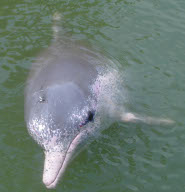
Indo-Pacific Humpbacked DolphinThe Indo-Pacific humpbacked dolphin (Sousa chinensis) is a marine mammal that generally inhabits the tropical and temperate reefs and estuaries of the Pacific ocean and the Indian ocean. Their easternmost range extends to between northern Australia and southern China, while their westernmost range extends to the edges of the Indian ocean and southern Africa. They are most common in the coastal waters surrounding Indonesia.

Indo-Pacific humpbacked dolphins travel in groups of less than ten individuals, with some groups containing up to 30 individuals. These small, close-knit groups are referred to as pods. They do not have a specific breeding season, and breed all throughout the year. However, they do generally tend to give birth in the summer months between December and February. A generally slow and non-acrobatic marine mammal, males have been known to put on acrobatic displays in order to win mates for breeding.

These dolphins are characterized by their "humped" dorsal fins. Though this hump can be very distinctive in most males, it is not uncommon for males to completely lack this humped dorsal fin. It is also not uncommon for males to have well-defined ridges on their dorsal tail stock. Their bodies are very stocky, making them formidably strong. Indo-Pacific humpbacked dolphins have bee known to drive off and kill sharks, mostly due to this size and strength. Their beaks are highly defined, and look very distinctive. Indo-Pacific humpbacked dolphins are distinctly long and large, topping out at around 10.5 feet (about 3 meters) in large males. Females generally are no larger than 8 (about 2.5 meters) feet long. Adult Indo-Pacific humpbacked dolphins are not known to grow larger than 626 lbs (284 kg).

Being a large fan of reefs, the diet of the Indo-Pacific humpbacked dolphin involves mostly reef fish, crustaceans, and mollusks. Using echolocation, they hunt in smaller groups to pick out their prey from amongst the reef. While they are known to hunt mostly in small groups, it is not unheard of for them to hunt alone. In almost all cases, they are known to eat alone. They are aggressive when feeding, and do not abide intrusion well.

The Indo-Pacific hump backed dolphin is not in any major danger. They are hunted for meat and oil, but not on a significant enough scale to warrant concern. The major impact to their population numbers is found in commercial fishing by-catch. Every year, many dolphins are netted and killed accidentally by commercial fishermen. Their only known predators are sharks.

Picture of the Indo-Pacific Humpbacked Dolphin by takoradee, licensed under GFDL You can help spreading the word about this animal by liking it on facebook
Permanent Link

Monday 23 May 2011 Long-tailed field mouse - Comic of the Forest

Long-tailed field mouseThe long-tailed field mouse (Apodemus sylvaticus) is commonly found in the woods, hedgerows and scrub throughout the countryside in Britain and Ireland. It also ranges to Scandinavia to the north, to Ukraine to the east and to the south in north western Africa and on many Mediterranean islands.

It is the cousin to the yellow-necked mouse, but the long-tailed field mouse is smaller and darker. Cats, weasels, stoats, foxes, owls and moles will make a meal of the mouse if they can, but the long-tailed field mouse is a great jumper and climber and not easy to catch. If it is caught by the tip of its tail, it will immediately shed the end of its tail and make its escape. The shed tip may never grow back. On the IUCN Red List of threatened Species it is classified LC (least concern).

Also called the wood mouse, it is mainly nocturnal and will eat a varied omnivorous diet including seeds and nuts when they are plentiful and small insects, snails, spiders and larvae mainly in the spring along with roots, berries and other fruit. It lives underground in burrow systems and has chambers for nesting and storing food. Its nests consist of balls of dry grass, leaves and moss. Sometimes it uses vacated bird’s nests to store food. It lives mainly outdoors in grassland and cultivated fields, but it will live inside a building during an especially harsh winter.

It has a breeding season from February to October which consists of a free-for-all competition between males and females. This results in multiple paternity litters. After 25 or 26 days the litters are born and usually contain five young. They are independent at three weeks and sexually active at two months.

The long-tailed field mouse is larger than a common house mouse measuring 8.1 cm (3.9 inches) to 10.3 cm (4 inches) nose to tail. The tail is 7.1 cm (2.8 inches) to 9. 3 cm (3.6 inches) long. They weigh between 13 grams (.46 ounces) and 27 grams (.95 ounces).

The long tailed field mouse does not hibernate, but it does greatly reduce its physiological activity during sever winter seasons. At night when they are most active they sometimes mark their food hiding places with conspicuous objects such as a bright leaf or large twig. They use these signs as landmarks while they are foraging for food. Basically, they are organized food gatherers, but have scramble competition for copulation.

Picture of the long-tailed field mouse by Rasbak, licensed under GNU Free Documentation License. You can help spreading the word about this animal by liking it on facebook

Permanent Link

Wednesday 18 May 2011 Long-tailed pangolin - Claws Tougher than Concrete

Long-tailed pangolinThe Long-tailed pangolin (Manis tetradactyla) is a fascinating creature, looking a bit like a walking pinecone. These species are usually found in the trees of dense rainforests, from Uganda to Senegal and Angola. Their scales are dark brown or pale olive green and are distinct. They range in size from 30 to 40cm (11.8 - 15.7 inches) in length and two to three kgs (4.4 to 6.6 lbs) in weight. Their very long tails are 60 to 70cm (23.6 - 27.6 inches) in length. This species of pangolin has a life expectancy of 13 years in captivity. It is unknown how long they can live in the wild.

The diet of the Long-tailed pangolin consists mostly of ants and termites. They make use of their long and sticky tongues to capture their prey, and they have no teeth. These animals find their food using their amazing sense of smell, which can sense termites and ants from hundreds of feet away. If the Long-tailed pangolin is attacked by a predator, it will curl into a small, tight ball, make a hissing sound, shake its scales and emit a distinct, foul-smelling liquid. They can even roll away from a dangerous situation if they need to.

They are generally solitary animals, spending daylight hours sleeping or climbing in trees, searching for food. In fact, they rarely come in contact with the ground at all, although they are good swimmers. They spend their nights in the hollows of trees.

In general, Long-tailed pangolins are born between November and March. Gestation takes about 120 to 150 days. The birth weight of baby pangolins ranges from 3-18 ounces (85.4-512.5 grams) and usually only one baby is born at a time. Young pangolins mature in two years.

Some of the natural enemies of the Long-tailed pangolin include leopards, hyenas and pythons. Human beings are also thought of as a predator. While not much is known about the exact number of Long-tailed pangolins in existence, the number of pangolins is declining in general. They are hunted for meat by many African tribes, their skin is used for boots and their scales are thought to have medicinal and ceremonial value. The destruction of the rainforest is another reason that their numbers declining, but their status is not of a large concern to conservationists at this time. You can help spreading the word about this animal by liking it on facebook

Permanent Link

Monday 09 May 2011 Northern Luzon Giant Cloud Rat - Bashful and Bewhiskered

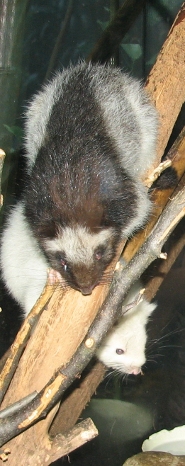
Northern Luzon Giant Cloud RatThe Northern Luzon giant cloud rat (Phloeomys pallidus) gets its name from its habit of dwelling in rainforest treetops, which seem to reach the clouds. Though it mainly lives in the trees, the giant cloud rat is occasionally seen foraging on the forest floor. Its native range is the northern and central provinces of the island of Luzon, in the Philippines.

This rodent reaches an average length of 700 mm, a weight of 2.6 kg and lives for about 10 to 12 years.

A coat of long, coarse fur is usually whitish or pale gray, with dark brown or black markings around the snout, eyes and ears. The tail is also covered with dense fur. A short, blunt snout is framed by long whiskers, and it has bright, black eyes and small ears. Strong hindquarters, large feet and specialized, sharp claws give the Northern Luzon giant cloud rat its tree-climbing talents and digging ability.

Nocturnal and slow-moving, the Northern Luzon giant cloud rat is a vegetarian, eating new, fresh leaves and fruit. It has also been known to raid crops and gardens near the forest edge.

Unlike its cousin, the brown rat, which can produce several litters of pups in a year, giant cloud rats reproduce only once per year, bearing only one pup. Nests may be found in hollow trees or underground burrows. The female carries her progeny until it is able to forage on its own.

The Northern Luzon giant cloud rat has few known predators other than large birds. Because it is so slow-moving, the rodent can only protect itself with claws and a strong odor from its musk glands.

The main threat to their existence is deforestation. Destruction of rain forests by agriculture and logging companies has greatly reduced its range and habitat. Because this animal is only found in the Philippines and reproduces very slowly, the odds are becoming stacked against its survival.

Giant cloud rats are hunted by humans for their meat, and human predation has been a significant factor in their reduced population. Attempts to raise them in captivity, however, are showing some success. The Northern Luzon giant cloud rat is currently a protected species and is listed as 'near threatened', but local people of the Philippines are still allowed to hunt them.

Picture of the Northern Luzon Giant Cloud Rat at Cincinnati Zoo by Ltshears, licensed under Creative Commons Attribution 3.0 Unported license. You can help spreading the word about this animal by liking it on facebook

Permanent Link

Wednesday 04 May 2011 The Pyrenean Chamois - Nature's Acrobat

Pyrenean chamoisThe Pyrenean chamois (Rupicapra pyrenaica), sometimes known simply as chamois, pronounced "shammy", is a goat-like creature native to the mountain ranges of the Pyrenees, northwestern Spain and the Apennines in central Italy. It's natural habitat is the high alpine meadows during the warmer part of the year, venturing down onto the slopes when the weather gets colder. They only very rarely will enter the forest.

The animal usually weighs between 24 and 50 kg, or 53 to 110 lbs. The average weight is about 37 kg, or 81 lbs. It has a length of 90 to 120 cm, or 35 to 51 inches, with an average length of 110 cm, or 43 inches. In the summer, its coat is reddish-brown and in winter it grows a much thicker brownish-black coat, with white markings. Both males and female have black horns that are close together and slender, rise vertically and then bend sharply to form hooks. They have padded and rather elastic hoofs, allowing them to keep their footing on otherwise treacherous terrain.

The Pyrenean chamois is nimble and known for its grace. It can jump nearly two meters, or approximately six feet, straight up into the air. It can also reach speeds of about 50 km per hour, or about 31 miles per hour, over rough and uneven ground. The chamois is also prized for its skin, which is made into a very soft and pliable leather which is popular for shining products. It is also hunted for meat and its dense winter fur.

For a time, the Pyrenean chamois population was in decline because of over-hunting and the animal was placed on the endangered list, but thanks to protective measures it is not currently at risk. The population and range of the chamois continue to increase. However, the subspecies R. p. ornata is still vulnerable and considered endangered at this time.

Other than humans, the Pyrenean chamois' natural predators include wolves, lynxes and fox. The chamois themselves feed on herbs and flowers during the summer. In the winter, they turn to moss, lichen and young pine shoots. When conditions become extremely difficult, chamois can fast for up to two weeks until food becomes available. You can help spreading the word about this animal by liking it on facebook

Permanent Link