Subscribe to
"Animal of the day"

AddThis Feed Button
Or subscribe by e-mail

Enter your Email


Powered by FeedBlitz

We hope that reader will gain an increased appreciation of the need for more conservation measure in order to protect the beautiful creatures that inhabit the earth. Our philosophy is that the more we learn about animals, the more we respect them and take better care of them. That is why we update this blog with new animals, We encourage you to syndicate our content by adding "animal of the day" to your own blog! (read more)

About us

Our mission is to get people excited about animals and their welfare by writing articles on these animals. We encourage people to comment on posts and share with others. Don't forget to subscribe to our feed.

Contact us
Copyright notice

Cutest pet ever - cutest pet contest

Funny animal videos and pictures

Swimming with manatees - harmful or helpful

Last Comments

Tima (Bottlenose dolphi…): J. David Smith, Ph.D., a …
Coda Plant (Pudu - smallest d…): Hey. I live in Northern C…
Michael Newton (Koala video): i love you mr. koala
Tohru (Asian Golden Cat): I hate them too! They are…
tiffany (Asian Golden Cat): i love this cat i’m doing…
BK (Nubian Ibex - The…): Magnificent animal, espec…
amanda (Long-nosed cusima…): thhisanimal is so so so s…
misscrient (Muskrats - Water-…): Third paragraph last sent…
rudy (Deer Mouse - The …): that is so cool ilove lea…
Nick (Fattest cat in th…): “The cat is not over fed.…

Calendar

« November 2009
S M T W T F S
1 2 3 4 5 6 7
8 9 10 11 12 13 14
15 16 17 18 19 20 21
22 23 24 25 26 27 28
29 30          

Archives

Next Archive Previous Archive

01 Nov - 30 Nov 2009
01 Oct - 31 Oct 2009
01 Sep - 30 Sep 2009
01 Aug - 31 Aug 2009
01 Jul - 31 Jul 2009
01 Jun - 30 Jun 2009
01 May - 31 May 2009
01 Apr - 30 Apr 2009
01 Mar - 31 Mar 2009
01 Feb - 28 Feb 2009
01 Jan - 31 Jan 2009
01 Dec - 31 Dec 2008
01 Nov - 30 Nov 2008
01 Oct - 31 Oct 2008
01 Sep - 30 Sep 2008
01 Jul - 31 Jul 2008
01 Jun - 30 Jun 2008
01 May - 31 May 2008
01 Apr - 30 Apr 2008
01 Mar - 31 Mar 2008
01 Feb - 28 Feb 2008
01 Jan - 31 Jan 2008
01 Dec - 31 Dec 2007
01 Nov - 30 Nov 2007
01 Oct - 31 Oct 2007
01 Sep - 30 Sep 2007
01 Aug - 31 Aug 2007
01 Jul - 31 Jul 2007
01 Jun - 30 Jun 2007
01 May - 31 May 2007
01 Apr - 30 Apr 2007
01 Mar - 31 Mar 2007
01 Feb - 28 Feb 2007
01 Jan - 31 Jan 2007
01 Dec - 31 Dec 2006
01 Nov - 30 Nov 2006
01 Oct - 31 Oct 2006
01 Sep - 30 Sep 2006
01 Aug - 31 Aug 2006
01 Jul - 31 Jul 2006
01 Jun - 30 Jun 2006
01 May - 31 May 2006
01 Apr - 30 Apr 2006
01 Mar - 31 Mar 2006
01 Feb - 28 Feb 2006
01 Jan - 31 Jan 2006
01 Dec - 31 Dec 2005
01 Sep - 30 Sep 2005
01 Aug - 31 Aug 2005
01 Jul - 31 Jul 2005

Animal posters
Animal pictures
Mammals.start4all.com
Animal diversity web
Recently extinct animals forum
PetLvr.com
Another chance to see
Happiness is a warm puppy

Miscellany

AddThis Feed Button

Thursday 29 September 2005 Giant squid - Japanese scientists take the first images of a living specimen
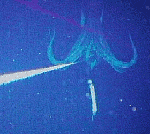
Giant squid Japanese scientists discovered the giant squid by following Sperm whales, which hunt for the giant squids. It is believed to reach lengths of 60 ft (18 meters) long and has two tentacles that can stretch up to two thirds of its length. Tracking the Sperm whales and dangling bait and their camera at 450 fathoms (800 meters) they managed to catch the attention of a 25 ft (7.62 m) long giant squid and some pictures.

A researcher from New Zealand has captured the first live images from a "giant" squid earlier, although you can leave "giant" out, they were only half an inch long larvae.

In 2003, a giant squid attacked a french boat, which was taking part in the round-the-world (talk about coincedence!) Jules Verne Trophy. (Jules Verne is the author of 20,000 Leagues Under the Sea, in which is described how giant squid attacked Capt Nemo's submarine Nautilus).

Links
news.telegraph
news.yahoo
20,000 Leagues Under the Sea (public domain version)

You can help spreading the word about this animal by stumbling it by pressing this link StumbleUpon

one comment - Permanent Link

Saturday 17 September 2005 Day geckos (genus Phelsuma) - Beauties from Madagascar
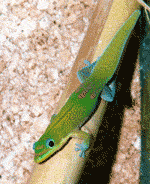
day geckos Most members of the family Geckonidae are nocturnal animals. But there are some exceptions too. Among these are the members of the genus Phelsuma, the so called Day geckos. They inhabit the island of Madagascar, which lies off South-East Africa. But Day geckos are also distributed on some "nearby" islands like the Comores, the Seychelles, Nossi B�, Aldabra, Assumption and Sainte Marie. Some species also can be found in some coastal regions of South-East Africa. (more)
You can help spreading the word about this animal by stumbling it by pressing this link StumbleUpon

two comments - Permanent Link

Friday 09 September 2005 Tiger - Largest cat killed by Chinese medicine?
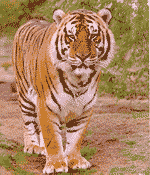
Tiger The largest of all cats killed by traditional Chinese medicine? There are different opinions among scientists, whether to call the Tiger Panthera tigris (Panthera tigris) and leave it in the genus Panthera together with the Lion and the other so-called Great cats or to call it Neofelis tigris and have it in the genus Neofelis together with the much smaller Clouded leopard (Neofelis nebulosa). But the following is not disputed: Tigers are the largest living cats. They reach a length up to 280 cm and a weight of almost 300 kg. Remarkable are the dark stripes on orange- or ochre- coloured ground. There are various subspecies, which partly differ widely in size. The largest subspecies is the Siberian tiger. (more)
You can help spreading the word about this animal by stumbling it by pressing this link StumbleUpon

one comment - Permanent Link

Sunday 04 September 2005 Puma - America's allrounder

puma Many animal species are adapted to quite narrow habitats providing certain living conditions. This is not different concerning cats: cheetahs, eg., are animals which are able to survive only in savannas and semi-deserts, while tigers are "forest creatures", which prefer habitats with a lot of trees and much water. But on the other hand there are also species, which are real allrounders, inhabiting all kinds of habitats in many subspecies. The most prominent examples are the Leopard in Africa and Asia and its American counterpart - the Puma (Puma concolor) . (more)
You can help spreading the word about this animal by stumbling it by pressing this link StumbleUpon

two comments - Permanent Link

Saturday 03 September 2005 Proboscis monkey - The swimming star with the giant nose

proboscis Everyone who has the opportunity to see a Proboscis monkey (Nasalis larvatus) is struck by its giant nose. But there is a second feature which is very typical for Proboscis monkeys and their relatives, the so called Leaf-monkeys - it's their large belly. Indicated by the name of that group of apes, they almost exclusively feed on leaves - and leaves are not easy to digest. Moreover leaves are not very rich in energy-content. So Proboscis monkeys have to eat a lot of leaves and spend most of their time on feeding. In order to obtain enough energy from their meagre nourishment, Proboscis monkeys have got a complicated stomach divided into several parts. Their stomach is quite similar to that of ruminants, which have to face the same problems. Adult Proboscis monkeys are large animals. Males reach a length of about 70 cm and a weight up to 24 kg. Females are significantly smaller, reaching lengths of 60 cm and weights of just 12 kg. The tails of Proboscis monkeys are about as long as their bodies. Their fur is brick-red, the front and the cheeks are of brighter colour and the arms and legs are more greyish. The most obvious feature of Proboscis monkeys is the male's extremely long nose, shaped like a cucumber. Noses of females and young are not small either but don't reach the sizes of the noses of males by far. (more)
You can help spreading the word about this animal by stumbling it by pressing this link StumbleUpon

three comments - Permanent Link


Animal of the Day
Subscribe to the
animal of the day
Enter your Email


Powered by FeedBlitz