Subscribe to
"Animal of the day"

AddThis Feed Button
Or subscribe by e-mail

Enter your Email


Powered by FeedBlitz

We hope that reader will gain an increased appreciation of the need for more conservation measure in order to protect the beautiful creatures that inhabit the earth. Our philosophy is that the more we learn about animals, the more we respect them and take better care of them. That is why we update this blog with new animals, We encourage you to syndicate our content by adding "animal of the day" to your own blog! (read more)

About us

Our mission is to get people excited about animals and their welfare by writing articles on these animals. We encourage people to comment on posts and share with others. Don't forget to subscribe to our feed.

Contact us
Copyright notice

Cutest pet ever - cutest pet contest

Funny animal videos and pictures

Swimming with manatees - harmful or helpful

Last Comments

red (Disk Tetra - Hate…): How to breed the fish? Is…
alissa (Stump-Tailed Maca…): sooo cute
Anonymous (Shoebill - Swamp …): These are beautiul birds …
sugar glider info… (Greater Glider - …): They have large, protrudi…
Sabrina (Purple frog): wow, what a lovely frog. …
Organizari evenim… (Fattest cat in th…): :)) This is not funny! Re…
destiny (Ninja cat): hahah thats funny
sami (Bats - the only t…): is that true
Lexis.J (Ninja cat): So funny.He’s the top nin…
someone (Ninja cat): this is soooo cute!

Calendar

« February 2012
S M T W T F S
      1 2 3 4
5 6 7 8 9 10 11
12 13 14 15 16 17 18
19 20 21 22 23 24 25
26 27 28 29      

Archives

Next Archive Previous Archive

01 Jan - 31 Jan 2012
01 Dec - 31 Dec 2011
01 Nov - 30 Nov 2011
01 Oct - 31 Oct 2011
01 Sep - 30 Sep 2011
01 Aug - 31 Aug 2011
01 Jul - 31 Jul 2011
01 Jun - 30 Jun 2011
01 May - 31 May 2011
01 Apr - 30 Apr 2011
01 Mar - 31 Mar 2011
01 Feb - 28 Feb 2011
01 Jan - 31 Jan 2011
01 Dec - 31 Dec 2010
01 Nov - 30 Nov 2010
01 Oct - 31 Oct 2010
01 Sep - 30 Sep 2010
01 Aug - 31 Aug 2010
01 Jul - 31 Jul 2010
01 May - 31 May 2010
01 Apr - 30 Apr 2010
01 Mar - 31 Mar 2010
01 Feb - 28 Feb 2010
01 Jan - 31 Jan 2010
01 Dec - 31 Dec 2009
01 Nov - 30 Nov 2009
01 Oct - 31 Oct 2009
01 Sep - 30 Sep 2009
01 Aug - 31 Aug 2009
01 Jul - 31 Jul 2009
01 Jun - 30 Jun 2009
01 May - 31 May 2009
01 Apr - 30 Apr 2009
01 Mar - 31 Mar 2009
01 Feb - 28 Feb 2009
01 Jan - 31 Jan 2009
01 Dec - 31 Dec 2008
01 Nov - 30 Nov 2008
01 Oct - 31 Oct 2008
01 Sep - 30 Sep 2008
01 Aug - 31 Aug 2008
01 Jul - 31 Jul 2008
01 Jun - 30 Jun 2008
01 May - 31 May 2008
01 Apr - 30 Apr 2008
01 Mar - 31 Mar 2008
01 Feb - 28 Feb 2008
01 Jan - 31 Jan 2008
01 Dec - 31 Dec 2007
01 Nov - 30 Nov 2007
01 Oct - 31 Oct 2007
01 Sep - 30 Sep 2007
01 Aug - 31 Aug 2007
01 Jul - 31 Jul 2007
01 Jun - 30 Jun 2007
01 May - 31 May 2007
01 Apr - 30 Apr 2007
01 Mar - 31 Mar 2007
01 Feb - 28 Feb 2007
01 Jan - 31 Jan 2007
01 Dec - 31 Dec 2006
01 Nov - 30 Nov 2006
01 Oct - 31 Oct 2006
01 Sep - 30 Sep 2006
01 Aug - 31 Aug 2006
01 Jul - 31 Jul 2006
01 Jun - 30 Jun 2006
01 May - 31 May 2006
01 Apr - 30 Apr 2006
01 Mar - 31 Mar 2006
01 Feb - 28 Feb 2006
01 Jan - 31 Jan 2006
01 Dec - 31 Dec 2005
01 Nov - 30 Nov 2005
01 Oct - 31 Oct 2005
01 Sep - 30 Sep 2005
01 Aug - 31 Aug 2005
01 Jul - 31 Jul 2005

Animal pictures
Mammals.start4all.com
Animal diversity web
Recently extinct animals forum
Another chance to see

Miscellany

AddThis Feed Button

Thursday 25 February 2010 Chinkara - a Gazelle that lives with Little Water
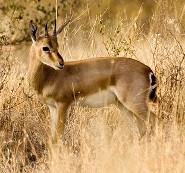
ChinkaraThe Chinkara (Gazella bennettii) is type of gazelle native to various regions of southern Asia including Pakistan, Bangladesh, Iran and, predominantly, India (hence the common name "Indian Gazelle"). An adult Chinkara stands about 65 centimeters (26 inches) tall at the shoulder and weighs in at about 23 kilograms (50 pounds).

The Chinkara has a smooth, reddish coat in the summer, and in the colder months the otherwise only slightly paler detail in the gazelle's stomach and neck becomes several shades lighter, almost white. As with most animals under the threat of attack from more powerful predators, their coat has the primary function of aiding them to blend in with their grassland environment. The Chinkara sports distinctive hazelnut stripes running from the inner corner of their eyes to their mandible bordered by sharply-defined white fur. It has a black stripe beginning a few inches above the coccyx which widens as it reaches the tail, where it is bordered by a thinner patch of white fur. Characteristically of gazelles, they have relatively modest horns which, though rarely larger, are generally measured at around 40 centimeters (16 inches) at their maximum length.

Much like its African cousins, the Chinkara rarely wanders into territory occupied by humans and will actively distance itself from any mammalian species it perceives as a potential threat. What makes the Chinkara unique, however, is its remarkable ability to sustain itself on very little water. Indeed, researchers following Chinkara on the move have observed certain individuals go for days at a time without ever drinking from a real water source. Instead, they can survive merely on dew and other water condensed on leaves and shaded foliage. It is this same vegetation that provides the Chinkara's primary diet, which primarily consists of grass in addition to occasional fruits.

Though not yet in significant danger of extinction, Chinkara numbers are dwindling. A large part of this is due to game hunters, who in recent years have increasingly taken to pursuing these gazelles. Estimates place the remaining Chinkara at 75-85K, with their protected status doing little to deter hunters from reducing those numbers. Still, with such a number of individuals still living in the wild over such a large area, the population is not expected to dwindle significantly in the near future. Local conservation efforts have proved relatively successful, and indeed a number of cases to prosecute those caught hunting the Chinkara have resulted in prosecutions. A secondary effect of the decreased Chinkara population has been a corresponding decrease in cheetah numbers, (cheetahs are now presumed to be extinct in India), with the big cat being the Chinkara's primary predator.

Picture of the Chinkara by S. Shankar, licensed under Creative Commons Attribution 2.5 Generic You can help spreading the word about this animal by liking it on facebook
Permanent Link

Wednesday 24 February 2010 The Lesser Egyptian Jerboa - an extreme jumper

Lesser Egyptian JerboaThe Lesser Egyptian Jerboa (Jaculus jaculus) is mouse-like in appearance with large eyes and ears with brown and gray fur with a lighter color belly. The animal is very small at only 95 to 110 millimeters long (3.74 to 4.33 inches) and 43 to 73 grams (1.51 to 2.57 ounces) in weight. Despite the Lesser Egyptian Jerboa's small stature, the creature can jump an impressive one meter (3.28 feet) from a standing position and 1.5 meters (4.95 feet) at top speed. It has even been known to travel up to ten kilometers (6.21 miles) in one evening in search of food. This is due to the animal's long bald tail except for a clump of fur at the end for balance and huge feet. Its posture and stride mimics that of a kangaroo. However, unlike a kangaroo, the Lesser Egyptian Jerboa is native to areas in central Asia, Iran, Israel, Sudan and north Africa. It is an especially common animal in Egypt, hence its name.

Since the Lesser Egyptian Jerboa lives in dry desert areas, it lives in burrows in the sand. The animal sleeps during the day and feeds on seeds, grass, grains and even some insects at night. Although the creature's main defense is its swift jumping abilities, it must remain vigilant against faster fox, weasel, and snake predators. Safety may not even be found in its own burrow as these can also become home to scorpions and spiders.

Being a solitary creature, little is known about how it communicates with other Lesser Egyptian Jerboas. In captivity, these animals seem to recognize each other by smell by closing their eyes and touching noses together. They breed twice a year and have liters of three pups at a time. Although the mother will have close contact with her babies in the wild and stay with them in the burrow for eight weeks, breeding in captivity is never successful. For whatever reason, the mother simply refuses to touch her pups after their birth. Yet, Lesser Egyptian Jerboas brought into captivity can live up to six years and tamed as pets. Wild Jerboas can live up to four years. You can help spreading the word about this animal by liking it on facebook

Permanent Link

Tuesday 23 February 2010 The Hoary Bat - International Speedster

Hoary batThe Hoary Bat (Lasiurus cinereus), is an international speedster whose habits have not been completely documented.

For example, have you ever found the head and wings of a moth on the ground, and the rest of the body missing? It might look like an alien autopsy, but it is more likely the work of the hoary bat. It is thought that the hoary bat hunts by flying up behind its quarry and biting off the body in one swift motion, leaving the less tasty head and wings to fall to the ground. The hoary bat is thought to fly at speeds approaching 60 miles per hour, which explains its stealth and success as an insect predator.

A nocturnal hunter, the Hoary bat eats a variety of insects including moths, flies, dragonflies, wasps, mosquitoes, grasshoppers, termites, and beetles. Their chosen diet makes them a valuable ally to humans as they naturally reduce pest insect populations.

The hoary bat has heavy, brown fur which is tipped with white, giving it a frosted appearance, and accounting for its name.

Something of a loner, the hoary bat prefers to find shelter either alone or in small family groups. These bats typically opt for densely wooded areas, often choosing stands of evergreens. The hoary bat is found throughout the United States and Southern Canada and as far south as Chile and Argentina in South America. A subspecies (L. c. semotus) is also found in Hawaii. These bats migrate during colder months to warmer coastal areas of the United States, to Mexico, and possibility farther south. Although normally solitary, they may migrate in groups.

The hoary bat does not have many natural predators, but occasionally they fall victim to birds of prey and snakes. The Hoary Bat is not considered to be a threatened or endangered species.

The hoary bat’s body is no bigger than a common mouse, typically weighing between 20 and 34 grams (or .7 and 1.2 ounces) and measuring between 7.5 and 15 centimeters in length (between 3 to 6 inches). The bat has a wingspan of up to 40 centimeters (16 inches). These bats usually have offspring annually, normally bearing two per litter, although litters of as many as four pups have been observed. You can help spreading the word about this animal by liking it on facebook

Permanent Link

Monday 22 February 2010 Banteng - Crossing the Line

BantengThe banteng (Bos javanicus) is an ox similar in size and proportion to domestic cattle, but with a smaller head and more slender neck. Mature banteng stand 61" to 65" (1.55 to 1.65 meters) at the shoulder, and weigh 1,300 to 1,800 pounds (600 to 800 kilograms). Both male and female banteng have white rumps, stockings, ear tufts, muzzles, and spots above their eyes. The color of their horns ranges from bright white to brown with very dark tips.

Bulls are black or dark brown at maturity, although they are born a lighter shade of reddish brown. Their horns, measuring 24 to 30 inches (60 to 75 centimeters) in length at maturity, are horizontal at the skull and curve upward to vertical as they grow. What makes the bull appear so extraordinary is the horn-like patch on the forehead which seems to join the two horns, creating the look of a stereotypical Viking headdress.

BantengThe cow is lighter brown with a dark brown stripe along her ridge. Her much smaller horns emerge from the skull at a higher angle without the horn-like patch between, curve outward only slightly, and then turn inward at the tips as she matures, as though to create a halo.

Banteng, like all oxen, are herbivorous and feed on grasses, fruit, bamboo, and leaves found in the grassy forests or prairies. In the wild, banteng live in small herds of two to forty cows and one bull. Reproductive herds are usually dominated by an experienced cow. Rejected bulls often live together in all-male herds.

The life cycle of the banteng proceeds at a leisurely pace befitting such a docile creature. The gestation period is 265 days.. Calves are weaned at about six to nine months, and sexual maturity occurs at two to three years of age with domestic animals maturing faster than wild ones. Wild banteng have an average life span of about eleven years while domesticated banteng can live well past twenty years.

Native to Southeast Asia, specifically Java, Borneo, Bali, Myanmar, Thailand, Laos, Vietnam, and Cambodia (it is the national animal of Cambodia), almost all remaining banteng, about a million and a half, are domesticated work animals or livestock in their native regions. Only a few thousand live in wild herds in their native habitat. Of these, the Burma Banteng (B. j. birmanicus) subspecies is classified as Critically Endangered. Several hundred bulls and cows representing all three subspecies are protected within wildlife sanctuaries around the world. Other than mankind, their primary predators are the dhole, and to a lesser extent, tigers.

And then there is the Australian banteng. Twenty head of banteng livestock were brought to Australia in 1849 to provide meat for a newly established British military outpost in the Northern Territory. Just a year later the outpost was abandoned, and the banteng were released into the wild. Over the next hundred and seventy years, this feral population increased to perhaps as many as fifteen thousand on the Cobourg Peninsula, becoming a favored trophy of hunters from around the world as well as a food source for the local population.

Today much debate centers around the Australian banteng. Should they be eradicated to allow the environment to regress to its natural state? Should they be reintroduced to the Southeast Asian herds to augment the endangered native herds? Should they be left in place and accepted as a beneficial element of the current regional ecosystem? More study and monitoring are needed to determine the biological, ecological, and economic risks and benefits of the various proposals being considered.

It is believed that the banteng originally descended from domestic cattle. For centuries they have been crossing and recrossing the line between domestic and wild. Both the domestic and wild populations have important economic and ecological roles within their regions.

Picture of the Banteng cow by Aaron Logan, licensed under Attribution share-a-like
Picture of the Banteng by Πβ, licensed under Attribution share-a-like You can help spreading the word about this animal by liking it on facebook

Permanent Link

Saturday 20 February 2010 The White-Lipped Peccary - Nature's Aggressive Conservationist

White-lipped peccaryThe white-lipped peccary (tayassu pecari), has gained a reputation in Central and South America as the most dangerous of the peccary species. The question should be asked, "Who is dangerous to whom?", because peccaries do not seek to be in contact with humans. People native to Central and South America still hunt peccaries for food, and people have already cleared away acres of rainforest in order to build competitive new industries or to feed cattle. White-lipped peccaries will stand their ground against anyone who gets too close to their territory. The White-lipped peccaries' preferred territory is within a rainforest, and since this territory has been rapidly shrinking, why shouldn't they defend it as aggressively as they can?

A white-lipped peccary is rather small to be such an aggressive animal. An adult peccary will stand from 40 to 60 centimeters at the shoulder (1.3 to 1.96 feet), with a body length between 90 and 130 centimeters (3 to 4.5 feet), and a weight from 25 to 40 kilograms (55 to 88 pounds). (Mayer,J.J., and R.M. Wetzel.1987. Tayassu pecari.mammalian species;293:1-7)) This animal does not have claws like a bear or a puma. It uses its sharp tusks as a defense. Even with sharp tusks, a lone peccary would not have gained a reputation for aggression. White-lipped peccaries like to travel in large herds, and some of these herds can exceed 300 in number. If one individual within a herd is attacked, the entire herd will run to defend the injured individual.

The white-lipped peccary has a large range, from southeastern Mexico to northern Argentina, mostly in undisturbed rainforest. Its numbers have sharply declined in Central America and Mexico, and it is already considered extinct in El Salvador. Mike Boston and others in Costa Rica consider it to be a threatened species because of continued hunting.(Mike Boston-Osa Safari:The White-Lipped Peccary-in Osa Aventura)

The white-lipped peccary forms larger herds than any of the other peccary species that share some of its territory. These large herds, rarely smaller than 50 individuals, make it difficult to gain a consensus that the white-lipped species is endangered. These large herds can often be smelled before they are seen, since they have a skunk-like odor. A large herd of white-lipped peccaries can also be very noisy when threatened. They "bark" and they make chattering noises with their teeth. With their smell and noise and numbers, these peccaries can appear to be more of a threat to humans than humans are to them.

Much of the white-lipped peccary's former rainforest habitat has already disappeared, being replaced by industrialization and the preparation of grazing land for cattle. These relatively new land uses have threatened peccary populations far more than any group of hunters ever did. Hopefully, more people will learn to respect the warning barks of the white-lipped peccary, and let this guardian of the rainforest keep what is left of its territory.

Picture of the white-lipped peccary by Chrumps, licensed under GFDL You can help spreading the word about this animal by liking it on facebook

Permanent Link

Friday 19 February 2010 Mountain hare

Mountain hareThe Mountain Hare (Lepus Timidus) is found from Scandinavia to Eastern Siberia. In addition it also occurs in the Alps, Poland, Ireland and the United Kingdom. It is also known as the white hare or blue hare in winter and is different from the brown hare or other rabbits for several reasons. As compared to brown hare, it is lighter in built-up and its tail remains white throughout the year. Its ears are black at the tips and during winters, it turns white while in summers remains brown. Although females look similar to males in appearance, they are actually heavier than the males. The size of an adult hare from head to tail is approximately 46.65 cm (18.56 inches) and the tail is about 4.38 cm (1. 72 inches). The weight of an adult hare can be up to 2. 6 kg (5.732 pounds) and if well-fed in captivity, it can grow a little more and attain more size and weight.

In Britain, the mountain hare previously was found only in the Scottish highlands in Great Britain but later, it was translocated to Wales, England, some Scottish islands, and the Isle of Man for shooting purposes. Now, it can be also found in south-west Scotland, in the borders areas, and in the Peak District. Today, the mountain hare is thought to become extinct in Welsh region. Only six species are now found in England and moreover, the position of these species here seems precarious. Outside England, there is broad distribution of this species, especially in the Palaearctic region.

Generally, the mountain hare, as its name predicts, is found in hilly regions and its main habitats include boreal forests and the heather moorlands of Great Britain. It is also found in dry-rocky-hills, new forest plantations, and mountain grasslands. The mountain hare is also found in the arable lowlands and green pastures where there are no brown hares.

The mountain hare is generally active at night but it becomes more active during the day time in the breeding season. During the daytime, the mountain hare prefers resting in burrows or scrapes, and forms in soil or snow. Normally, it is seen that they like solidarity, sometimes, they roam in groups and the number can go up to 70 individuals in one group. The mountain hare feeds itself on grasses, sedges, herbs, rushes, bilberry, and other such vegetation.

The breeding season of mountain hare extends from February to August. During the breeding period, many males may try to pursue one female but if the female does not want to mate, then it may not attend to them. The female may give birth to one or four litters in one year consisting of 1-5 young, called leverets. Gestation time is about 50 days. The young ones have fur at birth and they are quite independent from birth. The mother comes from time to time to suckle them. Adult mortality among mountain hare is quite high and its major predators are stoats, cats, birds of prey, and foxes. If spared, their lifespan may reach up to 9 years of age. You can help spreading the word about this animal by liking it on facebook

Permanent Link

Tuesday 16 February 2010 Cuvier's gazelle

Cuviers gazelleCuvier's gazelle (Gazella cuvieri) is also known as the Atlas Gazelle, edmi, and Mountain Gazelle. The head, back and legs of the Cuvier's gazelle are dark brown in color while its rump patch and lower part (belly) are white. Its tail is almost black and there is a black spot at the tip of the nose. There are black strips on its face running from the nose to ears. There are spiraled, vertical horns present in both male and female gazelles and their length is about 35 cm (14 inches).

In the starting of the 20th Century, this species was found in great numbers in the Moroccan Mountains, western Tunisia, and Algeria. After that, there was a significant drop in its population by the year 1932 and only small herds of Cuvier's gazelle were seen by 1972 in the Atlas Mountains. At present, this species has very little population scattered at the higher altitudes of Tunisia, Morocco, and Algeria. The range where Cuvier's gazelle is found is quite large. It includes pine forests, oak forests, vineyards, open country, desert plateaus, and grasslands. Atlas Mountains are the main habitat of this species, since it is found only at higher altitudes.

Cuvier's gazelle is particularly seen in early morning or in the night roaming in the valleys and during the day it moves to the hills. In order to drink water, it visits waterholes regularly. The gazelles patrol their territory leaving their signs with dung and urine. There is only one male present in each territory but females can be seen in one or more numbers with their babies. Males sometimes indulge in quarrels with their horns lying down the back, head raised, and the horns interlocked and pushing to attain dominance.

Early winter is the mating season for Cuvier's gazelle and the young ones are born in spring. It takes about 170 days and this is also the time for fresh vegetation after rains. There is only one calf in most of the cases but twins can also be found sometimes. In good conditions, a female may conceive twice a year but this is very uncommon. For the first few weeks, the young ones stay hidden in tall grasses so there is no risk from predators. After seeing the predators, this nervous species signals alarm with the flick of their tails.

This species has been hunted for its skin, sport, and meat wantonly, resulting in the reduction of its number to a great extent. At present, since the habitat is being used for agricultural activities and the land is also being turned into grazing grounds, this species is facing the danger of becoming extinct.

Although, in Tunisia, Cuvier's gazelle is found only in protected areas, it is not the same case in Algeria and Morocco. Availability of suitable habitat for these captive animals is sufficient in Tunisia but arrangements for accessible waterholes and safe corridors are needed to re-establish this species successfully. In Almeria, North America, and Spain, Cuvier's gazelle is found in large numbers as captive animals. You can help spreading the word about this animal by liking it on facebook

Permanent Link

Thursday 11 February 2010 The Black Howler Monkey - Howling Its Name Out Loud!

Black howler monkeyThe black howler monkey (Alouatta Caraya) belongs to the southernmost species of the howler monkey. Found mainly in the forests of Bolivia, Argentina, Paraguay, and Brazil, the black howler monkey is also known as the New World Monkey. The males of this species are black but the females are surprisingly overall pale.

The black howler monkey is found in groups of 3-19, but most commonly in groups of 7-9 individuals. In a group of 7-9 females, there are only 1-3 males and they always mate in single pairs. As the name suggests, they are named after their vocalization and usually can be heard around sunrise. Their "dawn chorus" seems more roaring than howling, and it clears the howler group's position to the other groups so that there is no conflict between groups. Their howling sound can be heard up to 5 km away.

These New World monkeys are thought to be the laziest monkeys because 80% of their day goes in sleeping or resting. They are mainly habitants of forests and leaves are on the top of their diet, but occasionally they also indulge in eating fruits like figs. They usually prefer climbing and walking rather than leaping and running. Since their prehensile tail is very strong, it provides support as their fifth limb. With the help of their tail, they can climb trees easily and it also provides them safety from an occasional fall. The structure of their limbs makes their terrestrial movement quite awkward; they remain on the trees for most of the time. Dry spell forces them to come down in search of water. Their thirst is satisfied by simply licking their wet hands due to the wet tree leaves. Their lifespan can be up to 20 years but generally in the wild, they are able to live only up to 15 years.

The black howler monkey weighs about 4 to 10 kg. There is a big difference in the weight of a male and a female. The average weight of a male can be 6.7 kg while a female may weigh only 4.4 kg. The length of a male can be 1.7-2.2 ft and the size of the tail is the same as that of the body. The average length of a female can be 1.6 ft and its tail is slightly longer than its body. This species is sexually dichromatic. Since the male's hair is generally black, it is called the Black Howler Monkey. Females usually have olive or yellow-brown colored hair. At birth, the infants have golden coat which changes as they mature. The strong and prehensile tail of the monkey is hairless from underneath which makes it sensitive enough to identify the things it touches. The face of the monkey is also hairless except for its bushy eyebrows.

Habitats of the Black Howler Monkey range from the tropical deciduous forests marked with wet and warm, and dry and cool seasons to tropical semi-deciduous forests that have rains all year round.

Picture of the black howler monkey by Lea Maimone, licensed under Creative Commons Attribution-Share Alike 2.5 Generic You can help spreading the word about this animal by liking it on facebook

Permanent Link

Monday 08 February 2010 South African Ground Squirrel

South African ground squirrelThe South African Ground Squirrel (Xerus Inauris) is also known as the Cape Ground Squirrel in England. In French, it is called Écureuil foisseur de cap and in German, it is known as Kap-erdhornchen. The length of this squirrel is 28 to 38 cm (11 to 15 inches) and it weighs about 500 to 1100 gm (1.1 to 2.4 lb). The color of its coat is tawny yellow and there is a white strip on both sides of the body. There are two dark bands on its tail.

The South African Ground Squirrel is mainly found in Botswana, Namibia, South Africa, and Zimbabwe. Its usual habitats are open, arid country sides with sandy areas where it digs communal burrows. The South African Ground squirrels feed on grasses, roots, shrubs, fruits, seeds, and sometimes, they feed on insects as well.

The South African Ground Squirrel does not hibernate. These squirrels are very social and live in groups with about 1 to 3 females and 2 to 3 males. Sometimes, the number of males can exceed up to 9 with some sub-adult females. An interesting thing about this breed is that mature males like to form their own groups and there can be 19 to 20 individuals in one group. These groups are called bands. Their home range is shared with other groups which is actually quite a surprising thing, since in case of most of the mammals there is generally an extremely tough competition to get the female. The group-living instinct of this species gives it a survival opportunity from predators overweighing the disadvantage of breeding opportunities which come from competition.

Breeding in South African Ground Squirrels is asynchronous and there is no specific period of breeding although very few litters are seen above the ground in the months of July to October. Gestation period lasts for 48 days and the young ones are weaned after 52 days. There are one to three babies per litter. A female becomes sexually mature when she is 10 months old and a male matures at the age of 8 months. Although a female has the capability to breed throughout the year, less than 10% reproduce more than one litter in a year.

As the name suggests, this species is mainly a native of South Africa, Zambezi Rivers, and southern Cunene. In Botswana, it is found in Semi-desert regions of Kalahari and also in the central parts of South Africa, the Northern Cape, and Free State. The main habitats of South African Ground Squirrels are arid parts of South Africa, Succulent Karoo, and Nama-Karoo biomes where annual rainfall is about 100 to 500 mm. These animals prefer to roam in open terrains which are covered with bushes. They are also found in floodplain areas, dry watercourses, open grasslands, or on grounds that are overgrazed. The South African Ground squirrel is a colonial, gregarious, and diurnal animal.

Picture of the South African ground squirrel by de:Benutzer:BS Thurner Hof, licensed under GNU Free Documentation License You can help spreading the word about this animal by liking it on facebook

Permanent Link

Thursday 04 February 2010 Black caiman

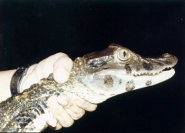
Black caimanDark colored, largest species of the family Crocodylidae, Black Caimans (Melanosuchus niger) have their own historical presence in and around the areas of French Guiana and Brazil. Extensively hunted for its skin, the species now is under the category of conserved reptiles and is under surveillance to prevent the species to become extinct. They were formerly located at Amazonian range, but due to constant hunt by the Brazilians for the animal’s tough skin, their population started getting thinner, to the extent of being extinct in that area. Still black caimans are present in large numbers in and around Kaw Swamps in French Guiana and on the Rupununi River in Guyana. The irony is that people living in these areas do not consider the importance of reptile on the verge of being extinct. For them the crocodile is a dangerous species living alongside them, which is surely a natural alarm. The black caiman is found to hunt the dogs, children and even adults, which create a menace and a lot of hue and cry in the surrounding areas.

Black caimans are very dark colored. Their color is subject to age and maturity where young caimans have grey colored lower jaws, which gradually turn out to be brown on aging. The yellow or white bands present across the body are more prominent in new born to six months old caimans, which fade gradually on maturity. Thus Caiman’s skin biological composition changes over a period of time. The shape of skull is a bit different from other caiman species. Black caimans have distinct protruding eyes with relatively a narrow snout.

The black caiman is an aquatic reptile. It shows it presence in not very deep but shallow fresh water bodies, particularly slow moving rivers and streams. They are also noticed in and around flooded savannah and other marshy and wetlands. They usually hunt during night. They are blessed with extra ordinary sensory organs, be it auditory or visual. They locate and hunt for their prey which usually comprises of fish, turtles, deer, domestic animals dogs and pigs.

The female black caiman starts breeding during the dry season when water levels fall and fish are easily available in shallow pools, providing an easy and plentiful meal. caimans build a huge mound nest using dead and fresh vegetable matter, into which eggs are laid. The mother caiman always be near the nest and provide protection to the eggs till the hatching process begins and is safe for the young black caimans to come out in the water.

Picture of the black caiman by Mokele, licensed under GFDL You can help spreading the word about this animal by liking it on facebook

Permanent Link