Subscribe to
"Animal of the day"

AddThis Feed Button
Or subscribe by e-mail

Enter your Email


Powered by FeedBlitz

We hope that reader will gain an increased appreciation of the need for more conservation measure in order to protect the beautiful creatures that inhabit the earth. Our philosophy is that the more we learn about animals, the more we respect them and take better care of them. That is why we update this blog with new animals, We encourage you to syndicate our content by adding "animal of the day" to your own blog! (read more)

About us

Our mission is to get people excited about animals and their welfare by writing articles on these animals. We encourage people to comment on posts and share with others. Don't forget to subscribe to our feed.

Contact us
Copyright notice

Cutest pet ever - cutest pet contest

Funny animal videos and pictures

Swimming with manatees - harmful or helpful

Last Comments

Tima (Bottlenose dolphi…): J. David Smith, Ph.D., a …
Coda Plant (Pudu - smallest d…): Hey. I live in Northern C…
Michael Newton (Koala video): i love you mr. koala
Tohru (Asian Golden Cat): I hate them too! They are…
tiffany (Asian Golden Cat): i love this cat i’m doing…
BK (Nubian Ibex - The…): Magnificent animal, espec…
amanda (Long-nosed cusima…): thhisanimal is so so so s…
misscrient (Muskrats - Water-…): Third paragraph last sent…
rudy (Deer Mouse - The …): that is so cool ilove lea…
Nick (Fattest cat in th…): “The cat is not over fed.…

Calendar

« November 2009
S M T W T F S
1 2 3 4 5 6 7
8 9 10 11 12 13 14
15 16 17 18 19 20 21
22 23 24 25 26 27 28
29 30          

Archives

Next Archive Previous Archive

01 Nov - 30 Nov 2009
01 Oct - 31 Oct 2009
01 Sep - 30 Sep 2009
01 Aug - 31 Aug 2009
01 Jul - 31 Jul 2009
01 Jun - 30 Jun 2009
01 May - 31 May 2009
01 Apr - 30 Apr 2009
01 Mar - 31 Mar 2009
01 Feb - 28 Feb 2009
01 Jan - 31 Jan 2009
01 Dec - 31 Dec 2008
01 Nov - 30 Nov 2008
01 Oct - 31 Oct 2008
01 Sep - 30 Sep 2008
01 Jul - 31 Jul 2008
01 Jun - 30 Jun 2008
01 May - 31 May 2008
01 Apr - 30 Apr 2008
01 Mar - 31 Mar 2008
01 Feb - 28 Feb 2008
01 Jan - 31 Jan 2008
01 Dec - 31 Dec 2007
01 Nov - 30 Nov 2007
01 Oct - 31 Oct 2007
01 Sep - 30 Sep 2007
01 Aug - 31 Aug 2007
01 Jul - 31 Jul 2007
01 Jun - 30 Jun 2007
01 May - 31 May 2007
01 Apr - 30 Apr 2007
01 Mar - 31 Mar 2007
01 Feb - 28 Feb 2007
01 Jan - 31 Jan 2007
01 Dec - 31 Dec 2006
01 Nov - 30 Nov 2006
01 Oct - 31 Oct 2006
01 Sep - 30 Sep 2006
01 Aug - 31 Aug 2006
01 Jul - 31 Jul 2006
01 Jun - 30 Jun 2006
01 May - 31 May 2006
01 Apr - 30 Apr 2006
01 Mar - 31 Mar 2006
01 Feb - 28 Feb 2006
01 Jan - 31 Jan 2006
01 Dec - 31 Dec 2005
01 Sep - 30 Sep 2005
01 Aug - 31 Aug 2005
01 Jul - 31 Jul 2005

Animal posters
Animal pictures
Mammals.start4all.com
Animal diversity web
Recently extinct animals forum
PetLvr.com
Another chance to see
Happiness is a warm puppy

Miscellany

AddThis Feed Button

Thursday 26 January 2006 Chimpanzee - Jane Goodall gets UNESCO honor

Chimpanzee Through habitat reduction, the chimpanzee (Pan troglodytes) populations in rainforests and savannas have declined dramatically in West- and Central Africa. There are only a handful of animals that uses tools and the chimp is one of them. Examples are using twigs to poke into termite nests or using rocks to break things. It is our closest relative, sharing about 98 percent of our genes. Jane Goodall, who is 71 years of age, is internationally recognised for her work in the Gombe reserve in Tanzania, and the discoveries she made observing them and their social behavior. Recently, she has been given a UNESCO honor for her struggle to protect our close relatives...

Link: Jane Goodall honored
Image by Aaron Logan, from http://www.lightmatter.net/gallery/albums.php, licensed under Creative Commons Attribution 1.0

You can help spreading the word about this animal by stumbling it by pressing this link StumbleUpon

one comment - Permanent Link

Wednesday 25 January 2006 Parents of Toga (the stolen penguin) have produced an egg
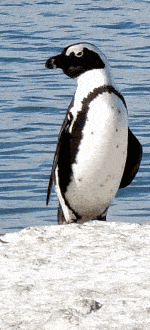
Toga the penguin The parents Kyala and Oscar of the baby jackass penguin Toga, which was stolen in December from the Amazon World Zoo Park on the Isle of Wight have gained worldwide attention by producing an egg that in approximately 40 days is expected to hatch.

Read more on the CNN website.

Or read the previous entries:

Zoo does not give up hope for stolen penguin Toga

In the news: Snatched penquin may be christmas gift

You can help spreading the word about this animal by stumbling it by pressing this link StumbleUpon

Add your thoughts about this animal - Permanent Link

Friday 20 January 2006 In the news: Bottlenosed whale spotted in the Thames

Whale in the thames A Northern bottlenosed whale (Hyperoodon ampullatus) is swimming in the Thames. See the video here. Usually, whales don't swim up rivers except when they are sick. However, vet experts have said it doesn't seem to be ill. Rescuers in boats are trying to keep it away from the Thames's banks, on which it would likely strand when coming to close. Northern bottlenosed whales weigh around seven tonnes usually, so this will complicate things even more when trying to rescue the whale. There is just no way to gently guide it in a certain direction. If it wants to swim in another direction, it will. Other strange animals spotted in the Thames over the years include dolphins, porpoises and seals.

Update: Unfortunately, despite rescue attempts the whale has died...

Range map


Range map of the Northern bottlenosed whale under GNU Free Documentation License

Resources:
Article on the bbc, including video
Wikipedia on the Northern bottlenosed whale

You can help spreading the word about this animal by stumbling it by pressing this link StumbleUpon

one comment - Permanent Link

Thursday 19 January 2006 Order Xenarthra - strange joints

anteater Including anteaters, armadillos and sloths. They were formerly classified as the order Edentata (meaning toothless) and put in the same order as the aardvark and pangolins, until they discovered that the order was polyphyletic, meaning that unrelated species were seen as a group and was invalid. Now, anteaters, armadillos and sloths are in the order called Xenarthra which means "strange joints". It was named this way because they all have unique vertebral joint structure unlike any other mammal.

Image: photographer Malene Thyssen, Licensed under Attribution ShareAlike 2.5

You can help spreading the word about this animal by stumbling it by pressing this link StumbleUpon

one comment - Permanent Link

Monday 16 January 2006 New species discovered resembling Sun bears

sun bear A Sun bear (Helarctos malayanus) stands approximately 1.2 m in length. It is the smallest member of the bear family, and therefore often called dog bear and probably the most aggresive of the bear family, and will attack without provocation. Relatively, they have the largest canines of all the bear species. They suffer from habitat loss and poaching. According to this article in a Bangkok newspaper, a new carnivorous species resembling the Malayan Sun bear has been discovered. The discovered fossil has been named Mae-mohcyon potisati Pigne and "strangely, the species can be compared with the Malayan sun bear which still exists. But unlike the Malayan sun bear, the extinct species could not stand on two feet." The discovered species had a dog-like head but bear-like body.

The Sun bear is also called "honey bear", they are the smallest and least known of all species of bears. Sun Bears could be discerned from the rest via its yellow or white mark on the chest (half-moon by shape). They are good climbers and they stay long periods in trees, and one good reason for this is they procure honey from the hives.

A Sun Bear's natural habitat is lowland tropical forest. One could weigh from 27 kilograms to 46 kilograms. The male Sun Bear is bigger than the female but just by a bit. The head is flat and short, tiny ears, coarse fur and going back to the chest patch, there are those without it.

On the average, the number of newborns are from 1 to 3, and gestating could run from 95 to more than 200 days. One Sun Bear in Berlin (zoo) reportedly gave birth twice in a single year, but that is quite unusual. The cubs remain with the mothers until they have totally grown. Behaviorally, they are active during nighttime. One could sleep and just laze in trees whose heights go from 2-7 meters. These bears do not hibernate, maybe because of the tropical habitat and the fact that their foods are available at all times.

Their main diet consists of termites, worms and bees. They also take in fruit if they chance upon it. In a way, they are like lizards, for they possess long tongues which are used for catching insects from the trees, the termites from the nests. It is known that they could eat rodents and birds too.

Their exact number at present is unknown, but it is surely on the decline due to hunting and deforestation. The latter means the lands are cleared to give way to rubber (and other kinds) plantation territories.
You can help spreading the word about this animal by stumbling it by pressing this link StumbleUpon

one comment - Permanent Link

Thursday 12 January 2006 Moon Bears - pressure on China to ban farming of bears for bile

asiatic black bear The Asiatic black bear (Ursus thibetanus) (or Moon bear, Tibetan black bear or the Himalayan black bear) can be found in moist forests and brushland in countries ranging from Russia, Korea, Taiwan, Afghanistan, India, China and Japan. It is omnivorous and its diet consists of fruits, berries, etc., honey and meat (fish, birds, and small mammals). It is a little bit more carnivorous than its American cousin, the American black bear, and it is less strong than the brown bear. It is threatened by deforestation and habitat loss. Until the 1980's the Asiatic black bears were also hunted in the wild for their gall bladders which are used in Chinese medicine. Since China outlawed the poaching of the bears, the gall bladders are supplied by special farms in China which provide bile by caging and restraining the bears while catheters are inserted in their gall bladders allow bile to drip into a container. Recently, European parlement passed a resolution to put pressure on China to ban these farms, because of the inhumane and cruel handling of these animals. It can be argued that without these farms the supply for bear bile would not meet demand, causing more illegal poaching of the already endangered bears. Synthetic bile may be the solution?
You can help spreading the word about this animal by stumbling it by pressing this link StumbleUpon

six comments - Permanent Link

Tuesday 10 January 2006 The excellent Primates

Primates The word Primate comes from the latin "primas" which stands for "one of the first" or "excellent, noble". This table from Wikipedia shows the high difference in weight between sexes for Old world monkeys and a low difference for New world monkeys. The difference between old world monkey and new world monkeys is, besides their range, the structure of the nose and their dental structure. Old world monkey exist in Africa and Asia and New world monkeys are found in Central and South America. Also in the order of primates are the Apes, including gibbons and the great Apes (humans, gorillas, chimpanzees, orangutans).

Species Female Male
Gorilla
105 kg (231 lb) 205 kg (452 lb)
Human
62.5 kg (137.5 lb) 78.4 kg (172 lb)
Patas monkey
5.5 kg (12 lb) 10 kg (22 lb)
Proboscis Monkey
9 kg (20 lb) 19 kg (42 lb)
Pygmy Marmoset
120 g (4.2 oz) 140 g (5 oz)

You can help spreading the word about this animal by stumbling it by pressing this link StumbleUpon

Add your thoughts about this animal - Permanent Link

Saturday 07 January 2006 Secrets of the deap sea near extinction because of bottom trawling nets
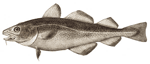
Fish Canadian researchers have studied five deep sea species in the North Atlantic Ocean. Recently, their study revealed that some species suffered 98% decrease of population size in a generation, meeting the definition of 'critically endangered'. Among those are the roundnose grenadier, onion-eye grenadier, blue hake, spiny eel and spinytail skate. Deep sea fish are extremely vulnerable, because of their late maturation. Any disturbance, and people largely blame the bottom trawling boats for this, can be the cause of dramatic effects. The bottom trawling nets scrape over the bottom of the ocean, plowing it to 15 cm deep. In this article on wikipedia it is explained how bottom trawling works and a picture can be seen below. In their study, the scientists conclude that "Conservation measures are necessary and lack of knowledge must not delay appropriate initiatives".
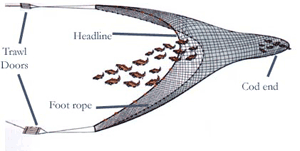
Benthic Trawl

You can help spreading the word about this animal by stumbling it by pressing this link StumbleUpon

Add your thoughts about this animal - Permanent Link

Thursday 05 January 2006 Tail hair of elephant reveals diet
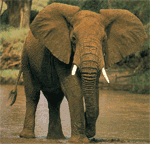
african elephant A tail hair of an elephant can reveal clues about their diet. Researchers look at the chemical analysis of an elephant hair to determine diet and behavior. In Kenya's Samburu National Reserve, scientists studied the elephants using GPS. Through the chemical analysis of the tail hairs, the researchers found out one of the seven elephants observed, had been raiding crop fields, which can upset farmers. "How can we secure a future for elephants when we know that the areas set aside for their protection are too small?" said study co-author and zoologist Iain Douglas-Hamilton, founder of the Save the Elephants Foundation in Nairobi, Kenya according to this article in BBC NEWS.
You can help spreading the word about this animal by stumbling it by pressing this link StumbleUpon

three comments - Permanent Link

Monday 02 January 2006 Pikas, early warning systems for detecting global warming, are extinct

pika The pika (Ochotona princeps), a cousin of the rabbit may look like a hamster, but it isn't. It sometimes is known as "whistling hare" because when it dives into its burrow, it emits a high-pitched warning cry. Donald Grayson reports in the current issue of the Journal of Biogeograph that 7 out of 25 historically described American Pika populations in the Great Basin -- the area between the Sierra Nevada and Rocky Mountains, have become extinct at the end of the 20th century. Reasons described are the grazing of livestock and the increase of roads. According to Grayson, the pika populations are totally isolated from each other so they cannot reach other populations. Pikas are also considered to be one of the best early warning systems for detecting global warming.

CNN article on the extinction of the American Pika
NatureWorks on the American Pika

You can help spreading the word about this animal by stumbling it by pressing this link StumbleUpon

three comments - Permanent Link


Animal of the Day
Subscribe to the
animal of the day
Enter your Email


Powered by FeedBlitz