Wednesday 21 December 2011
Reindeer - Santa's reindeer all female
The
caribou (
rangifer tarandus) is the name of the species when found in the wild, 'reindeer' when domesticated. They can be found in North America, Norway, Iceland and Greenland (caribou, green in the range map below) and in Scandinavia and Russia (reindeer, red in the range map below.
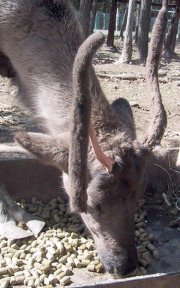
The different species of caribou display a wide range of size. Sexual dimorphism exists, in some subspecies the male is twice as large as the female. The female can become as old as 15 years of age, while the male's average lifespan is up to 10 years in the wild. The caribou in North America can run at speeds of up to 80 km/h (50 mph) and may travel as much as 5,000 km (3,000 miles) in a year. Both sexes grow antlers and these grow again each year (see picture, the velvet is shedding, and you can see the new antler). Their diet consists of leaves of birches and willows, cotton grass, sedges, lichens, but also mushrooms and various other vegetation found on the ground. They use their keen sense of smell to find food covered underneath the snow.

The reindeer has a long history of being hunted/herded, dating back to the Middle Stone Age and have played a very important role in Siberian, Scandinavian, and American native cultures. The caribou young are very vulnerable to attacks by bears, wolves, and other predators during their first week of life.
Interesting fact: The caribou (
rangifer tarandus) is the only species of deer in which both sexes have antlers. It is argued that Santa's reindeer must be female, because male reindeer will lose their antlers during winter.
Picture of the caribou loosing velvet on one of its antlers by Chris73, licensed under
Creative Commons Attribution ShareAlike 2.5
You can help spreading the word about this animal by liking it on facebook
Permanent Link
Monday 19 December 2011
Red Goral - Red Furred Bovidae Verging On Extinction
The red goral (
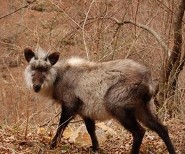
Naemorhedus baileyi) is a species of mountain goat most known for its bright red fur. This is unusual for the goral because all other members of the Naemorhedus family have grey or brown fur, making the red goral stands out significantly due to its oddly bright fur. While the coloring is unusual, this animal has many of the same traits as its distantly related family, including long shaggy hair and a long black tuff of fur that makes up the tail. The red goral also has a single black stripe that runs from its skull down to its tail.
The red goral itself is the smallest member of the bovidae family, weighing only 20 to 30 kg (44 to 66 lbs) and with a length of 100 cm (39 in). About 16 cm (6 in) of this is made up of the horns that both male and female have. These horns are used for fighting when necessarily, though it is in the red goral typical nature to flee rather than fight. When predators, most commonly including
leopards and jackals, challenge them, the goral can use its quick speed and strong climbing and jumping skills to bolt up ledges where they are unreachable to other animals. They use this technique to their advantage, feeding on grass, stems, and leaves during the day, then retreating to inaccessible cliff ledges at night to avoid the threat of predators.
The red goral is most commonly found in grasslands and forests in
China, though there have been reports of the species living in
India and
Myanmar as well. The species is currently on the endangered list, rating "Vulnerable" on the conservation scale. This means the animal is likely to become endangered unless drastic measures are taken to improve environmental conditions. The red goral is currently falling victim to habitat loss as well as hunting, and as little as 810 are feared to be alive today. The hunting, while illegal, is partly due to the bright red fur that the goral's have in comparison to their relative, which are a much duller shade. This also prevents the goral's from blending into their surroundings, which can make avoiding predators more difficult.
Despite the low number of red goral's alive today, those who are surviving tend to roam alone, or in a small pack of three. This is most commonly with a male, female, and young. If a male goral isn't present, the female will often travel with two of her young instead of just one.
Due to its "Vulnerable" status on the conservation scale, the red goral can often be seen in zoos where they are encouraged to mate with one another to help improve the number alive today. Unfortunately, their keen skill of jumping can make this difficult, as the animal has been known to jump as high as nearly 2 meters (6 ft) from a stand still. Zoo owners must be careful to watch the species to insure that none of them escape.
Picture of the red goral by Beaukarpo, licensed under
GFDL
You can help spreading the word about this animal by liking it on facebook
Permanent Link
Friday 16 December 2011
Columbia Sturgeon - Huge Fish That Can Live Up to 104 Years
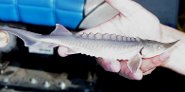
The Columbia sturgeon (
Acipenser transmontanus) is known by many other common names, including the white sturgeon, the Oregon sturgeon and the Pacific sturgeon. But no matter what you call it, this is the largest freshwater fish in America, although it can also survive in brackish (slightly salty) and salt water, depending on its age. It is also very long-lived. The oldest known specimen lived to be 104 years old. But most Columbia sturgeons are harvested long before they reach that age.
The Columbia sturgeon’s native habitats are fresh and brackish water bodies in the
United States along the Pacific states of Alaska down to mid-California. The fish has been released into other lakes, streams and rivers in Idaho, Georgia and the Colorado River. Efforts have been made by game wardens and sport fisherman to remove all Columbia sturgeon from Georgia as they were accidentally introduced there and could have greatly upset the natural ecosystem. The species is not endangered.
General Description
The white sturgeon has a silhouette resembling a narrow submarine torpedo. Juveniles are miniature versions of adults. The adults grow up to 1700 pounds (816 kg) and a nose-to tail length of 20 feet (6.1 meters). Unlike many other species of fish, Columbia sturgeon has skin instead of scales. Down their back and sides from head to tail is a lone of firm pyramid-shaped pale growths. The tail is long and forked, with the top fork longer than the bottom. Their long heads include a horn-like snout and four catfish-like “whiskers” called barbels. When the fish swims head-on towards a viewer, they resemble thin alligators.
Both adult and juvenile Columbia Sturgeons over one month old are colored an alligator green with grey fins and a pale belly. The barbells tend to be white. Although called a “bony fish” by biologists and taxonomists, they do not possess skeletons of bones but of a tough cartilage. This makes them flexible and strong in the water.
Life Cycle and Behavior
Adults spawn in freshwater. Females can release about 100,000 eggs. Newly hatched fry look like tadpoles. They are born with a yolk sac which depletes in 20 to 30 days. The fry is then large enough to eat small mollusks, shellfish and insects. Once they reach 19.01 inches (48.3 cm) long, they begin hunting fish. Normally, juveniles travel upriver out to sea and stay near the coastlines. They stay in salt water until they mature. However, some populations have adjusted to being landlocked after dams were built on their waterways out to the see. They stop feeding just before spawning and go as far inland as possible. The parents take no part in raising the fry.
Juvenile sturgeons (as shown in the picture) are prey to carnivorous fish larger than themselves, including the prickly sculpin fish (
Cottus asper) and the
common carp (
Cyprinus carpio). Adult Columbia sturgeon are fished for sport, for their meat and for their eggs, sold as caviar. Columbia sturgeons are related to the endangered Beluga and the keluga, which provide the world’s finest caviar.
You can help spreading the word about this animal by liking it on facebook
Permanent Link
Tuesday 13 December 2011
Daurian Hedgehog - Rare Russian Hedgehog Almost Wiped Out By Pesticides
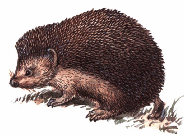
Not much is known about the Daurian hedgehog (
Mesechinus dauuricus) or (
Erinaceus dauuricus) but scientists know more about this solitary and elusive little mammal since the 1960s, when use of broad-spectrum insecticides and rodenticides almost wiped out the species. Daurian hedgehogs primarily eat insects and mice. Coming across a load of dead prey is too tempting for any hedgehog to pass up. Unfortunately, the poison that killed the insects can also kill hedgehogs.
The Daurian hedgehog has adapted to a wide territory of northern
China,
Russia (especially in the Dauria region) and
Mongolia. It prefers to live alone near water sources in steppes, grasslands, farmed fields and forests. Although this species is so rare in Russia that it is protected by law, the International Union for the Conservation of Nature lists the species as thriving based on its population worldwide. But the ICUN notes that if the natural habitat was destroyed, the species population would plummet.
Physical Description
The adult Daurian hedgehog is primarily shades of brown, with their backs and tops of the heads covered in soft, spine-like material. The spines are grooved to help burrow underground and possibly to discourage predator bites. A white variation exists, with white bodies but grey spines. Unlike an albino, these hedgehogs have dark eyes and noses. Their bodies primarily look like spiny balls with little feet. Both males and females grow to the same head to tail body length of 5.9 to 7.87 inches (15 to 20 cm) and weights of 2.2 pounds (1 kilogram.)
Another less common name for the Daurian hedgehog is the long-eared hedgehog. Unfortunately, there is another species of hedgehog that spreads from China to Africa called the long-eared hedgehog (
Hemiechinus auritus) which can confuse laypeople and biologists. But both species do sport prominent tan triangular ears that are much larger than the European hedgehog. These ears help the hedgehogs detect movements of their prey, which not only includes insects but small rodents, small reptiles, baby bird and eggs. They also eat carrion, including dead insects.
Life Cycle and Behavior
Adult Daurian hedgehogs break their solitary lives to search for mates in June and July. It is unknown exactly how long a female Daurian hedgehog’s gestation is. She gives birth to a litter of 3 to 7. Two months later, they are weaned and finding food for themselves. During this brief childhood, the mother hedgehog teaches her babies how to hide from their main predators of badgers, foxes, wolves, eagle owls and eagles. If the babies can’t get underground, they are to roll up in a tight ball so that the predators can only bite spines.
In order to survive the brutal Russian, Chinese or Mongolian winters, hedgehogs hibernate and do not wake up until April. They can have several small burrows in a territory so that they can always be near a hiding spot should a predator appear. Each hedgehog, male and female, keeps a territory of 12.4 to 24.7 acres (5 to 10 hectares.) Although equipped with tough claws, Daurian hedgehogs prefer to use burrows made and abandoned by other creatures rather than dig their own. They prefer old ground squirrel and marmot burrows. With luck, a Daurian hedgehog can live to the ripe old age of six.
You can help spreading the word about this animal by liking it on facebook
Permanent Link
Monday 12 December 2011
Stump-Tailed Macaque - Nearly Extinct Species Used for Human Medical Research
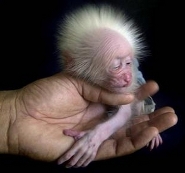
The bear macaque or stump-tailed macaque (
Macaca arctoides) is a large Asian monkey with a short tail and a short survival expectancy. The International Union for the Conservation of Nature (ICUN) lists this species as “vulnerable”, meaning it can go extinct during this century. Stump-tailed macaque populations have plummeted 20% since 1992 and are almost extinct in Thailand and thought to be extinct in Bangladesh. They can be found in many medical research laboratories. Experiments on stump-tailed macaques resulted in at least two drugs for hair loss due to male pattern baldness.
Baby stump-tailed macaques are especially prone to meat-eating raptors. Both babies and adults are on the menu for clouded leopards, common leopards and feral dogs. But their worst predators are
humans. Not only do humans hunt the macaques for meat and body parts for Traditional Chinese Medicine, but humans will wipe out the adults in a troop in order to sell the babies for the exotic pet trade. Humans are steadily destroying the macaque’s environment through overdevelopment. Once it ranged all throughout Asia from China down to India and across to Vietnam. Now it can be rarely found in the wild.
General Description
Stump-tailed macaques are covered in thick brown fur over grey to black skin. The shade of brown varies from macaque to macaque, from a dark chocolate to a golden tan. Babies are born white with pink skin, but become darker as they age. Adult macaques are hairless on their hands, feet, faces and stumpy hamster-like tails. Older stump-tailed macaques, like older humans, suffer from baldness on their heads.
Males are larger and heavier than females. Males grow up to 22.44 pounds (10.2 kg) while females are a mere 16.5 pounds (7.5 kg). Males grow to 25.59 inches long (58.5 cm) while females are 19.09 inches (48.5 cm). Tail length varies considerably, no matter what the sex. Tails have been recorded with lengths from 1.26 to 2.72 inches (32 to 69 mm) Males also sport prominent canine teeth, which they bare at intruders and rival males.
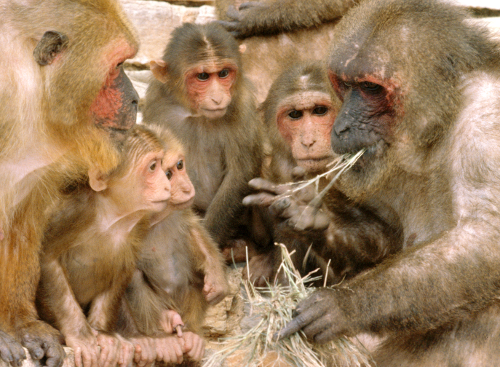 Picture from Peace Lessons from an Unlikely Source by Frans de Waal, licensed under the Creative Commons Attribution 2.5 Generic license.
Life Cycle and Behavior
Stump-tailed macaques live in small groups called troops. Although troops of 60 macaques have been recorded, most troops contain less than 30 individuals. Troops are of mixed sexes and sometimes overlap with other troops when food is plentiful. Males and females mate with whomever they choose, although the highest-ranking male gets preference. But if low-ranking males are patient, they can steal away into the bushes with a female. Females often choose their males instead of the other way around. They remember which males found them food and gave good grooming. Females only come into season every two years so they need to be choosy.
Females do all of the work of caring for the young after a 177 day gestation. She nurses the baby for nine months and then teaches the baby where to find food such as frogs, shellfish, bird eggs, small birds, seeds, roots, leaves, flowers and insects. Bear macaques will also strip farmer’s fields, which make local humans unsympathetic to the idea of conservation.
You can help spreading the word about this animal by liking it on facebook
Permanent Link
Friday 09 December 2011
Bonnet macaque - Never Ending Fight for Survival
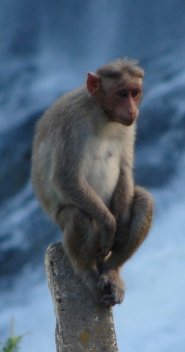
The Bonnet macaque (
Macaca radiata) is a species of old world monkey that is commonly found in
India at elevations of 2000 meters (about 6000 ft). Much like other macaques breeds, the pack maintains a dominance hierarchy of both male and females. Females are typically born into the role as 'alpha' leader, while males compete for it. While males are usually dominant over the females, this isn't always the case and there have been some reports of female bonnet macaque's being the pack leader.
Male bonnet macaque's typically weight more than females at around 9 kg (20lb), while females are about half that. The monkeys are typically covered in white, grey and brown fur while remaining bald on their face and ears. The color of their skin can range from a deep black to dark red to tan. Each monkey has a tail between 30 cm (11 in) to 60 cm (22 in) long.
The most interesting note about the bonnet macaque is the constant struggle for dominance. Breeding takes place only a few months of the year, with one female only giving birth to one child per birth, and the alpha male gets first pick of the females. Because of this, there are often power struggles amongst the males in the group. It's not uncommon for fights to break out, some proving deadly, just so another male can move up.
While it's not impossible to gain dominance within your troop, many males choose to leave and join other groups of bonnet macaque instead. Other groups of the
Macaca radiata will alert the members of their troop of this new monkey by emitting a loud scream call. In most cases a coalition will be formed and the new monkey will be accepted, usually at a higher rank than they were previously.
Females, on the other hand, have a much more laid back approach to the situation. They do not battle for dominance but are instead born into it. There have been a few rare cases when females were forced to battle due to a low number of female spawn, but this is not the natural order of things.
The
Macaca radiata feeds on several types of food, but the most common is fruit, nuts and seeds. The species stores this food in their cheeks while searching for more. In situations where fruit, nuts and seeds cannot be found, the breed may also resort to eating bugs or raiding the houses of humans for cereal, fruit, and nuts.
The species typically lives in wet forests, though they've also been spotted in urban areas. When kept in captivity, the breed can live around 30 years, however they rarely survive that long in the wild. Those who live in an urban environment are often killed by humans, cars and dogs while those in the wild are hunted by tigers,
leopards, eagles, crocodiles, and pythons.
The bonnet macaque is currently listed as "Least Concerned" on the conservation status scale, meaning that there is currently no long term threat risk to the species.
Picture of the bonnet macaque by M.arunprasad, licensed under
GFDL
You can help spreading the word about this animal by liking it on facebook
Permanent Link
Thursday 08 December 2011
Chocolate Wattled Bat - Surprisingly Cute Bat from Australia
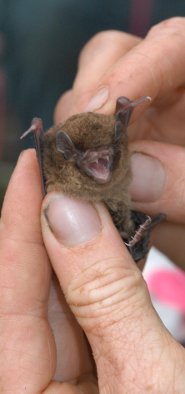
If you think bats can’t be cute, then you’ve never seen the southern Australia’s chocolate wattled bat (
Chalinolobus morio). These aerial acrobats sport round fuzzy brown bodies, pink noses and a pug-like face. They are only found in southern
Australia, especially in the suburbs of Melbourne and Manna Park. Their only predator is
man. Currently, this cute and helpful bat is considered a common species but they rely on roosting areas like trees and attics for hibernation. Should these roosting spots disappear, so will the bats.
Although southern Australia is not noted for its cold winters, temperatures can plummet to 50 degrees Fahrenheit (10 degrees C). Chocolate wattled bats cannot possibly eat enough insects in order to keep warm, so they slip into a hibernation phase. But during the winter, the insects are not available. They roost together in colonies of 10 to 100 individual bats in order to conserve body heat. If they get disturbed during their hibernation and need to fly, they may starve to death before spring.
Physical Description
Chocolate wattled bats are so small that they are officially listed as “microbats.” Adults, both male and female, only tip the scales at 0.3 ounces (9 grams). Their fuzzy brown bodies, nose to tail, are a mere 2.36 inches (60 mm). Their black eyes are tiny in comparison to the rest of the head. Their teeth are tiny but, although they can bite if frightened, they do not feed on human blood. Their wings are black and naked.
Although their eyes are tiny, their ears are large and their heads are crowned with a huge, fur-covered dome. Chocolate wattled bats do not rely on vision during their nocturnal adventures. They instead rely on sound. They emit a high-pitched shriek that bounces of objects. The bat’s brain translates these sounds much like modern sonar. Chocolate wattled bats are also listening for the sounds emitted from their prey – flying insects such as moths. They can hear frequencies as soft as 50 kilohertz (kHz), while human hears can only detect frequencies up to 15 kHz.
Life Cycle and Behavior
Unlike many others of Australia’s native mammals, chocolate wattled bats give birth to their young rather than use a pouch. Babies are born naked. In comparison to their mothers, these babies are huge – up to 30 percent the mother’s own weight. Mothers take tender care of their young and nurse them up to two months. Since the mothers cannot stay in the cave all of this time, only a couple of adult females are left with the babies each night in a crèche while the other mothers go out to feed. Mother bats take turns at who guards the crèche.
Microbats have very high metabolisms due to their tiny bodies. They need to eat at lest half of their body weight every night in order to stay alive. One colony of chocolate wattled bats can help keep the population of annoying night-flying insects to a manageable level.
Picture of the chocolate wattled bat by
Doug Beckers, licensed under the
Creative Commons Attribution-Share Alike 2.0 Generic license.
You can help spreading the word about this animal by liking it on facebook
Permanent Link
Wednesday 07 December 2011
Kaluga - The World's Largest Freshwater Fish
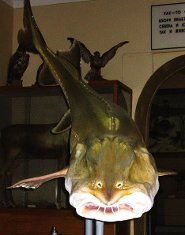
The river beluga or kaluga (
Huso dauricus) is thought to be the largest freshwater fish in the world, although one female beluga caught in 1824 was larger and heavier. But on average, kaluga grow larger than beluga. However, the point may soon be moot as both the kaluga and the beluga are critically endangered. Adult kaluga are only found in the freshwater Amur River basin as they have been fished to extinction in the Argun River. Juveniles live in salt water from the Sea of Okhotsk in
Russia down to the Japanese island of Hokkaido.
Kaluga are heavily poached for their roe or caviar, which is considered a delicacy. Just one ounce of kaluga caviar fetches prices of $150 (US). kaluga caviar tastes very similar to beluga caviar. Adult females can produce up to 44 pounds (20 kilograms) of caviar. The fish must be killed in order to extract the caviar. Increasing pollution in the Amur River is also killing kaluga of all ages and sizes.
Physical Description
Adult kaluga fish resemble sharks, with elongated bodies and wide mouths with needle-like teeth. They lack a prominent dorsal fin. Instead, they have a row of small, pyramid-shaped bony fins going down the back of their spines. This row can break the surface of the water similar to a shark’s dorsal fin. They have pale bellies and greenish-tan upper bodies with a yellow tinted tail. Adults can grow as long as 18.6 feet (5.6 meters) and weigh up to 2205 pounds (1,000 kilograms), although many are killed before they reach this monster size.
Adults possess very unusual heads. Their eyes are tiny in comparison to the rest of the body and places in the center of the massive, ridged head. Due to the location on the front of the head instead of the sides, kaluga may have bifocal vision. Their heads end in a pointed snout.
Life Cycle and Behavior
Kaluga hatch in shallow gravel beds in freshwater estuaries of the Amur River. Their parents play no part in raising their young. After growing in their eggs from 83 to 295 hours, fry hatch with a yolk sac that keeps them fed for 8 or 9 days. Then they must hunt. Juveniles fend for themselves, eating tiny zooplankton, insects and shrimp. The current carries the young fish out to sea, where they mature until they are ready to breed around 10 to 14 years of age. Females can only breed every four years.
Adult kaluga possess prodigious appetites. They eat pike, carp, herring,
chum salmon, keta and just about any other fish or shellfish that can fit in their mouths. kaluga spawning season begins in May and ends in July. Adults travel in small groups of 3 to 20 individuals to the shallow gravel beds to spawn. If a fish is too large, they can die from getting stuck in such shallow water. kaluga can spawn with another species of fish, the Amur sturgeon. With luck, a kaluga can live up to 55 years.
Picture of the kaluga by Eliezg, licensed under
GFDL
You can help spreading the word about this animal by liking it on facebook
Permanent Link