Wednesday 30 August 2006
Long-tailed weasel
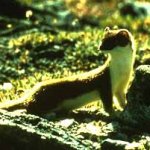
The
Long-tailed Weasel (
Mustela frenata) is the most widespread Mustelid of the Americas, it ranges from north of South America to the south of Canada. Once thought to be nocturnal, it also hunts by day, primarily on voles. They are known for their zig-zag pattern hunting from burrow to burrow. The reason why weasels in a chicken yard, may kill all the chickens (more than it needs), is because its instinct dictates it should procure food when available and store it afterwards. When weasels drag their rump on the ground, they are thought to leave a scent to let other weasels know its sex and maybe even its identity. The Long-tailed Weasel is hunted by hawks, owls, cats, foxes, and snakes...
You can help spreading the word about this animal by liking it on facebook
Permanent Link
Tuesday 29 August 2006
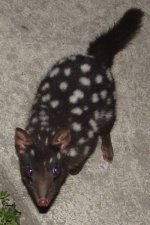
Eastern Quoll
The
Eastern Quoll (
Dasyurus viverrinus) is a carnivorous marsupial of Australia, where it is extinct on the mainland of Australia, and only extant on Tasmania. With the size of a small cat, the Eastern Quoll hunts at night on insects and small rodents and fruit. The dens of the eastern quoll are usually in caves and hollow logs or trees. They are threatened by illegal poisoning by humans and feral cats and dogs and the destruction of their habitat. They are under tight legislation in Tasmania as a threatened species.
Picture of the Eastern Quoll licensed under GFDL
You can help spreading the word about this animal by liking it on facebook
Permanent Link
Saturday 26 August 2006
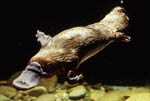
Platypus - unlike we have ever seen before, until now...
The
platypus (Ornithorhynchus anatinus) is a member of the order of monotremata, the egg laying mammals. It is very strange: a venomous, duck-billed, egg-laying mammal (?!). It is unlike we have ever seen, until now! Recent
fossil discovery of an extinct species named
Akidolestes, a half shrew - half platypus species, challenges conventional wisdom about how placental mammals split from earlier egg-layers. The platypus has a low body temparature compared to other mammals, it is only 32°C compared to 38°C. The platypus is one of the closest relatives of ancestral mammals, although it is not itself a link in the chain of mammalian evolution. Its branch is quite separate from any other one known to man. The recent fossil discovery of
Akidolestes gives hope to get more insight in the separation of this branch.
Image:
Author striatic http://www.flickr.com/photos/striatic/17367/
Licensed under Creative Commons Attribution ShareAlike 2.0
Resources:
National geographic news
Wikipedia on the platypus
You can help spreading the word about this animal by liking it on facebook
Permanent Link
Sunday 20 August 2006
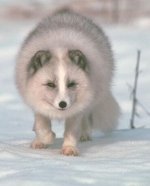
Arctic fox
The
arctic fox (Alopex lagopus), also called 'polar fox', lives in the cold Arctic regions of the Northern Hemisphere. It differs from the
Red Fox with its smaller, more rounded ears, a more rounded braincase, and a slightly shorter and broader muzzle. Its diet consists mostly of lemmings. Other prey are arctic hares, birds and their eggs, and carrion. The population of Arctic foxes is declining, because the Red Fox shares the same habitat.
Gray wolves used to control the number of Red Foxes, but since humans almost hunted gray wolves to extinction, the Arctic Fox is losing ground.
You can help spreading the word about this animal by liking it on facebook
Permanent Link
Friday 11 August 2006
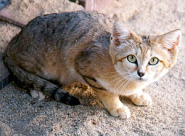
Sand Cat
The
Sand Cat (Felis margarita) lives in very hot deserts like the Sahara, the Arabian Desert, and the deserts of Iran and Pakistan. Their paws are covered with long fur to protect them from the hot sands. During the night, the sand cat goes out to hunt insects, rodents and lizards. During the day, the sand cat hides in the shadow of rocks. It lives under extreme conditions as the temperatures may rise to about 126ºF (52ºC) during the day and as low as 23ºF (-5ºC) during the night. Most distinctive characteristic is their large pinnae. They use their highly developed ears at locating the underground movements at night of prey. Sand cats are known for their excellent digging capabilities, which they use to dig burrows to escape the heat of the sun. They may also lie on their back outside their burrow to loose internal heat. Sand cats have been known to close their eyes at night when humans approach, making them difficult to see them because their eyes do not lit up.
You can help spreading the word about this animal by liking it on facebook
Permanent Link
Tuesday 08 August 2006
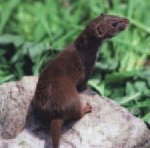
Least Weasel
The
Least Weasel (Mustela nivalis) is the smallest living carnivore on the planet! Its length rarely exceeds 23 centimeters. It has reddish-ginger fur, which is brighter than that of most other weasels, with white belly fur. In the northern parts of its range it has pure white fur in winter, as
camouflage for snow and therefore is called the Snow Weasel in some northern regions, and is called Snow Mouse in Norway and Sweden. They live highly solitair and even mating does not go without a fight!
You can help spreading the word about this animal by liking it on facebook
Permanent Link
Sunday 06 August 2006
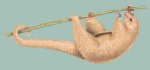
Silky anteater
The
Silky Anteater or Pygmy Anteater (Cyclopes didactylus) is the smallest of the anteaters. Its total length is between 36 and 45 centimeters. Its other distinguishing features are its short snout, soft golden brown fur, prehensile tail and two very enlarged claws in each forepaw. It is nocturnal and arboreal, and feeds on large amounts of ant in the trees, between 100 and 8000 ants a day. If the Silky Anteater feels threatened, it stands in a defensive posture, standing on their hind legs, holding its forefeet close to its face so they can strike, with its sharp claws, any animal that tries to get closer to it.
Nice pictures of the silky anteater can be seen here, here and here.
You can help spreading the word about this animal by liking it on facebook
Permanent Link
Thursday 03 August 2006
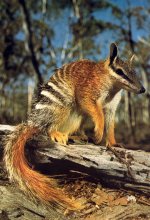
Numbat
The
Numbat (Myrmecobius fasciatus) lives in the Southern and Western parts of Australia. Before the English name of the
Myrmecobius fasciatus was changed to 'Numbat', its common name was the "Banded Anteater". This was a misnomer, because the Numbat primarily feeds on termites.. It synchronizes its day with termite activity which is temperature dependent. The Numbat hunts on the termites by waiting until they become active and when they do it uses its excellent smell to determine specialized galleries just below the surface on the way to the feeding sites of the termites. It then uses its claws to get to the termites. The Numbat cannot do any harm to the termite mound, because it only has little claws, unlike for example pangolins. In the 1970's, the population of numbats on Australia declined to about a 1000 animals, by the deliberate release of the Red fox on Australia. Its conservation status is still 'vulnerable'.
You can help spreading the word about this animal by liking it on facebook
Permanent Link
Tuesday 01 August 2006
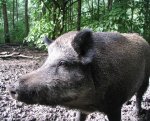
Wild boar - toothbrushes made from boar hair
The
Wild Boar (Sus scrofa) is the ancestor of the domestic pig. Its weight can reach up to 300 kilograms! Although 'boar' usually means male pig, the Wild boar is the name of the species. The males have both upper and lower tusks, while females have none. When in a group of pig, the pigs are called 'sounders'. Before the invention of synthetic fibers, toothbrushes were made from the hair on the back of a boar, although they contained lots of bacteria...
Picture of the wild boar by GerardM, 2004
You can help spreading the word about this animal by liking it on facebook
Permanent Link