Sunday 30 August 2009
White-headed Capuchin - The Movie Star and Service Primate

The
White-headed Capuchin (
Cebus capucinus), also known as the White-faced Capuchin and sometimes as the White-throated Capuchin, is a New World Monkey from South America and Central America, with a range that includes Panama, Ecuador, Costa Rica, Honduras, and parts of Columbia. They are a very versatile and adaptable species, which is considered a least-concern in the IUCN red list. They are able to adapt to their changing environment and have an omnivorous diet. They are usually around 8-9 pounds (3.9-4.2kg) and are usually 12 to 19.6 in (33-50) cm in length, with a prehensile tail that is an additional 15-21 in. (40-55cm) in length. The White-headed Capuchin's diet consists of an omnivorous mix of fruits and insects, and sometimes small birds, seeds, and small mammals. They are arboreal, but it will go to the ground more often than other relative New World Monkeys.
They usually live in groups of 5-30 individuals which have multiple males; however there is a hierarchy which starts with the Alpha Male, followed by the Alpha Female, and so on. As a social species they practice grooming, where the lower ranked members groom the higher ranked members and so on. Females of the species will form coalitions and stay with each other closely, when a new male or group of males attempts to take control and oust the other males they usually stay to themselves and cut off interacting with the males to keep themselves and the infants safe, however sometimes they will join with the males against intruding males. Interactions between troops seem to normally be aggressive and antagonistic in nature, however violence is usually a last resort. They will interact with other species of New World Monkey that are closely related, such as the various subspecies and even Geoffroy's Spider Monkey - and in rare instances going so far as travelling with and grooming them. On the flip side, there are violent fights between the two species as well as this sympatric behavior. They may also interact with howlers, however it is limited and mostly when young of both species play.
There are three subspecies of White-headed Capuchin, which are all closely related and will willingly interact socially (whether this is with aggression or not is dependent on the situation).
- Cebus capucinus capucinus lives in Columbia and Ecuador, and is restricted to the western bank of the Rio Cauca River.
- Cebus capucinus limitaneus lives in Honduras and possibly in the Mayan Mountains in Belize, although this remains unconfirmed.
- Cebus capucinus imitator lives in Panama and covers areas of Costa Rica and also in the islands of Coiba.
- Cebus capucinus curtus lives on Gorgona Island.
The White-headed Capuchin and its subspecies are all in the genus Cebus and Subfamily Cebinae, of which all Capuchin monkeys are members and many are endangered. Cebinae belongs to the Family Cebidae, which includes the squirrel monkeys. Cebidae belongs to the Parvorder Platyrrhini, which are all New World Monkeys, and this belongs to the Infraorder Simiiformes, of which we are members. This belongs to the Suborder Haplorrhini, which belongs to the order Primates. Primates belong to the Superorder Euarchontoglires which is comprised of Glires, being rodents and lagomorphs, and Euarchonta, being shrews, flying lemurs, and primates. Euarchontoglires belong to the Infraclass Eutheria, placental mammals, which belong to the Subclass Theria, which is all mammals except the monotremes. Finally this belongs to the Class of Mammals, of which all mammals are of course members.
They are able to use tools to help with food gathering, and are very skilled at adaptation and problem solving. They are, because of this, considered one of the highest in intelligence among other species in the new world and they have been studied for many years, and their intelligence is only ranked below the spider monkey in New World monkeys. If threatened by snakes they will pick up sticks and use them to beat the snake, and drive it away, or even to rescue an infant. In one example of tool use while captive (they usually use tools for food or for or in defense) a White-headed Capuchin actually picked up and threw a Squirrel Monkey at a human. In addition to tools they also rib certain plants on themselves and their fur in order to prevent parasites and deter insects, additionally they also use ants and millipedes, which release an irritating chemical normally, to further enhance this characteristic. It is because of their high intelligence and ability to learn and be trained that they have become service animals for humans that are disabled, such as paraplegics who cannot use their legs and quadriplegics who cannot use their arms or legs. They have a long history of being in the media as well, such Katie who played Marcel in the television series Friends.
Interesting Facts:
In addition to Friends, a White-headed Capuchin was featured in the film Outbreak.
Picture of the white-headed capuchin by Michelle Reback, licensed under
GFDL
You can help spreading the word about this animal by liking it on facebook
Permanent Link
Wednesday 26 August 2009
Spinner dolphin

The
Spinner Dolphin (
Stenella longirostris) is a relatively common dolphin found across the globe; however the conservation status of this species is data deficient currently, so whether it is a threatened or non-threatened species is as of yet unknown. They live in tropical waters that are deep, and they occur in all oceans which have a tropical temperature, additionally they may congregate near shorelines as occurs in Hawaii. The largest population of Spinner Dolphin is between the Tropic of Capricorn and the Tropic of Cancer, as those waters are best suited for them. It is thought that the Hawaiian or Gray Spinner Dolphin is endangered due to many of the old fishing practices which would regularly entrap dolphins and end up killing them. Their main locations are divided up into several subspecies, and it is due to this along with the difficulties of actually counting and cataloguing this species that their current world population is unknown, however it is obvious that their numbers across the world were culled dramatically during the period of unsafe mass fishing. They are usually a dark gray with darker and differing patches of gray at the tail, on their backs, and on their throats. They will also usually have a lighter belly and their beaks, or nose, is very long and thin, and has a unique dark top that varies from each individual. In fact they are the most varied in colorations, as even though what has been said is common, from one dolphin to the next they are recognizably different. They weigh from 50 to 171 pounds (23 to 78kg), and measure from 4 to 7.5 feet (1.2 to 2.3 meters) in length, and it is known that they mature from seven to ten years, however how long they can live is unknown (but likely past 40 as is common in many other species of dolphin and cetacean).
A very active species, it is thought that when males are seeking mates they will perform their famous spin, which is when they leap into the air and spin on the way down. However it is unconfirmed if this behavior really is about mating, as it may also be a form of play or of communication as the noise made by slamming down will travel much further in water than in air. Their communication also consists of slapping the water with their fins, heads, backs, and possibly the aforementioned spin. They also are vocal, with clicks and whistles along with pulses which allow them to not only communicate, but through echolocation find possible food. They mostly feed on fish, jellyfish, krill, squid, and other creatures with soft shells - what is interesting is that before they dive down to feed they will form a grouping, and then descend and spread out while staying in constant communication at all times through their clicks and whistles, even if they are a mile apart. They are pretty much forming hunting parties that keep in constant touch in the case of danger from predators such as sharks.
There are four identified subspecies of Spinner Dolphin:
Stenella longirostris longirostris - Gray's Spinner Dolphin, or otherwise called the Hawaiian Spinner Dolphin is found in the waters in the central Pacific Ocean around Hawaii, but is a highly variant subspecies found worldwide - even in the Atlantic. Numbers were decimated by fishing practices that did not stop them from being trapped and killed.
Stenella longirostris orientalis - The Eastern Spinner Dolphin is found in the tropical waters of the eastern Pacific Ocean.
Stenella longirostris centroamericana - The Costa Rican Spinner, or otherwise known as the Central American Spinner Dolphin is found in the eastern Pacific, close to Latin America and northern South America, although will be mixed in with others.
Stenella longirostris roseiventris - The Dwarf Spinner Dolphin, the smallest of the Spinner Dolphins, is found only in the Gulf of Thailand.
The Genus Stenella has four other species of dolphin within it, being the Striped Dolphin, The Clymene Dolphin, the Atlantic Spotted Dolphin, and the Pantropical Spotted Dolphin. It belongs to the family Delphinidae, which are the Oceanic dolphins. Within the family Delphinidae there are 17 known living genera, ranging from Orcas to the Bottlenose. Delphinidae belongs to the Superfamily Delphinoidea, which has seven known living and extinct families within it and contain such species as the Narwhal, Beluga, porpoises, and others. Delphinoidea belongs to the Suborder Odontoceti, which are the toothed whales and the largest being the sperm whale. Odontoceti belongs to the Order Cetacea, of which all whales are members. There are two unranked groups above Order and below Superorder to which all Cetaceans are members; they are Whippomorpha, which includes the hippopotamus and Cetartiodactyla of which whales and even toed ungulates. Currently because of the confusions, and changes needed, cetaceans may also be in a group called Cetruminantia which contains the Whippomorpha and also the Ruminants like cows. In any event, this all belongs to the Superorder Laurasiatheria (Bats to Carnivores to Horses) which belongs to the Infraclass Eutheria (placental mammals), which belongs to the Subclass Theria (All but monotremes) which belongs to the class Mammalia (every mammal alive).
Interesting Facts about Spinner Dolphins:
They dive down to 3,000 feet to find prey, where they cannot see, and use their clicks as a form of echolocation to see their food without being seen.
Spinner dolphins are found in many aquariums around the world because they can be kept relatively easily in conditions that are favorable.
Over two million spinner dolphins were killed after what is called purse seine fishing for tuna fish was introduced, decimating numbers in the pacific and word wide. Although data is currently still not amassed to reach any conclusion, it is possible they are threatened or vulnerable to possible extinction in the future, and may be endangered, and also certain that at least one subspecies is indeed in need of conservation efforts. Populations have been reduced by an entire 80% since the 1950s, and if there are no steps taken more than one subspecies could go extinct sooner rather than later. Purse seine fishing is not only dangerous to the Spinner Dolphin, but will indiscriminately trap all sea life that is large enough, and kill it with no chance of escape. This has decimated countless species of dolphin and porpoise, and is one of the major threats to cetaceans left in the world since the ban on whaling.
Picture of the Spinner dolphin by Magnus Kjaergaard, licensed under
Creative Commons Attribution 3.0 Unported
You can help spreading the word about this animal by liking it on facebook
Permanent Link
Sunday 23 August 2009
Mantled Howler - The Noisemaker

The
Mantled Howler (
Alouatta palliata), also called the Golden-mantled Howling Monkey, is a species of new world monkey in the howler monkey genus Alouatta. Their binomial name is Alouatta palliata, and they are a species that is of least concern on the IUCN redlist, meaning their populations are stable or growing (in the Alouatta palliata palliata subspecies and most common), unlike some of their relatives (the endangered Maranhão Red-handed Howler, and the endangered Guatemalan Black Howler being the two most at risk) however two of the subspecies of the Mantled Howler are endangered, and one of them is critically endangered. They have a black fur that covers their entire body; however they have a golden coloration upon each side which gives them their name. The Mantled Howler is one of the largest monkeys in the New World (specifically Central America and South America) with females reaching close to, or at two feet in length (63 cm), and males being over two feet (~65 cm) - added to that is a prehensile (usable) tail that measures an additional two feet (~64 cm) on average. Adult females can range in weight from seven to seventeen pounds (3-7kg) while adult males will usually come in heavier at ten to twenty two pounds (4.5-10kg). The weight of each monkey can vary depending on nutrition, location, and other factors related to where they are.
Their environment has pushed them to adapt to a mostly folivorous diet, which consists of leaves mostly (between half to three quarters of their daily food intake). The other portion of their diet consists of opportunistic feeding, such as when fruit or flowers are available. If enough fruit is available it can make up half or more of their diet at that given time, however otherwise they stick to leaves. These adaptations include both physical and behavioral. The molars of the Mantled Howler have shearing crests that are higher to help with the consumption of leaves. Their eyesight, unlike other New-world Monkeys, is tri-color (called trichromacy) which means they can see as well as we do, in order to distinguish between young and old leaves. Due to leaves being an extremely low energy food source, the males will make a howl to locate each other, rather than actually look; their distinctive call from the adaptation to a low energy diet: a modified hyoid bone allows for greater amplification of the calls made by males, which expends less energy - being comparable to if you were to talk normally. Some of the behaviors include resting for much of the time, and also being very selective about the leaves they eat, going for young leaves which are less likely to have toxins, and are easier to digest than mature leaves.
There are three known subspecies of the Mantled Howler.
The Ecuadorian Mantled Howler, binomial name
Alouatta palliata aequatorialis, is located in Columbia, Panama, Peru, Ecuador, and Costa Rica. They are listed as vulnerable and considered endangered due to habitat loss and poaching.
The Golden-mantled Howler, binomial name
Alouatta palliata palliata, is the most common and located in Costa Rica, Honduras, Nicaragua, and Guatemala. They are listed as a least-concern due to their healthy population.
The Mexican Howler, binomial name
Alouatta palliata mexicana, is only found in Guatemala and Mexico, they are critically endangered and close to extinction due to massive amounts of habitat loss, it is expected to lose more than 80% of its population within the next 3 generations and possibly be extinct after this. This subspecies is in extreme danger.
The species name is palliata, and there are three subspecies (as shown above). The Mantled Howler belongs to the Genus Alouatta of which all the other howlers belong, and Alouatta belongs to the Family Atelidae which is one of the four in the New World Monkeys. Within Atelidae are the howlers, the spider monkeys, the woolly monkeys, and some extinct relatives. Atelidae belongs to the Parvorder Platyrrhini, which includes all of the New World Monkeys, such as the world’s smallest monkey, the Pygmy Marmoset to the sakis, and the squirrel monkeys. Platyrrhini belongs to the Infraorder Simiiformes of which we are members, and all in this Infraorder are called simians. From here on out it is a journey to all of our mammal relatives, as Simiiformes belongs to Suborder Haplorrhini which includes tarsiers and other relatives. Haplorrhini belongs to the Order Primates which includes our relatives like the lemur. Primates are all Euarchontoglires, which is the Superorder we belong to, and that includes our extinct relatives the Plesiadapiformes, the colugos, the treeshrews, and more distantly (being the Glires) rabbits, hares, pikas, and rodents. Euarchontoglires evolved in the late Cretaceous, before the Dinosaurs went extinct, starting way back some 80-90 million years ago - of course 65 million years ago that changed as the Dinosaurs went extinct. Euarchontoglires belong to the Infraclass Eutheria (placental mammals) which belongs to the Subclass Theria (all but monotremes) and that belongs to the Class Mammalia (All mammals).
They are very athletic when the need arises, and their locomotion is determined by their environment. Aided by their prehensile tail they can navigate the trees they live in and will leap from one limb to another if it must. They are an arboreal, meaning they are a tree-dweller, in addition to being diurnal, active in the day, and they mostly climb, walk, or run with all four hands and feet. They usually don’t do anything if they don’t have to however, as they are an exceptionally lazy and inactive monkey due to their very low energy diet - they are nearly comparable to the sloth, as they spend most of their active period eating and their social time is less than five percent. They do live in groups, and they number around 20 to 40 members, and when a young monkey reaches maturity they are usually evicted.
Interesting facts about the Mantled Howler:
They may use tools, as relatives have been recorded shooing away sloths that decided to walk into their trees, such as sticks.
Picture of the mantled howler © by Leonardo C. Fleck, licensed under
GFDL
You can help spreading the word about this animal by liking it on facebook
Permanent Link
Thursday 20 August 2009
Cacomistle

The
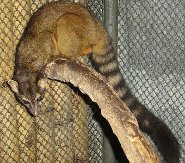
Cacomistle (
Bassariscus sumichrasti) is a species within the Order Carnivora, which means it is related to both Cats, and Dogs, along with many other animals. Their binomial name is Bassariscus sumichrasti, and they are found in Mexico, Panama, and Costa Rica, and they are dependent upon the forests for their livelihood, and are at a greater risk that other adaptable species in the face of deforestation. Their name in the Nahuatl language actually means half-cat, and can be confused with its relative the
Ringtailed Cat (Bassariscus astutus) which is found in Mexico and the Southwestern United States. They are usually around 15 to 18 inches in length (38-47cm) and have a tail that is 15 to 20 inches in length (39-53cm). The Cacomistle does look very similar to the Ringtailed Cat; however they can be differentiated by their more pointed ears, their non-retractable claws, along with their naked soles, a significantly longer tail, and the lower ridges on their molars. The coloration of their pelage is a grayish to somewhat brownish gray, and their tail – similar to the Ringtailed Cat – has rings of black.
There are five known subspecies of Cacomistle: Bassariscus sumichrasti sumichrasti, Bassariscus sumichrasti latrans, Bassariscus sumichrasti notinus, Bassariscus sumichrasti variabilis, Bassariscus sumichrasti oaxacensis. They belong to the genus Bassariscus which has only one other species, the Ringtailed Cat. They are the only living members of their Subfamily Procyoninae, which belongs to the Family Procyonidae. Procyonidae contains many extinct species, but also has the raccoons, coatis, Kinkajous, and Olingos, and belongs to the Superfamily Musteloidea which has weasels, skunks, and red pandas as its members. Musteloidea belongs to the Suborder Caniformia, which has dogs, bears, the Giant Panda, otters, seals, sea lions, and the walrus. Caniformia belongs to the Order Carnivora which has one other Suborder, Feliformia – which are the cat-like carnivorans. They belong to the Superorder Laurasiatheria which is one of the four Superorders in the Infraclass Eutheria. Eutheria, the placentals, belongs to the Subclass Theria which is all the marsupials and placentals along with extinct relatives, except the monotremes. Theria belongs to the class Mammalia, of which all mammals are members.
The current population trend of the Cacomistle is unknown, however it is heavily dependent upon its environment and, with ever increasing rates of habitat loss its future fate is uncertain. They are a solitary mammal, and they usually have a nest or den built into a tree to facilitate the birth of their young. A single solitary offspring is the usual for the Cacomistle, and it takes around 60 days for gestation, followed by being able to eat solid food after seven weeks. By three months it will be weaned and nearly ready to go off on its own. The Cacomistle is a nocturnal species, which means it is active at night and sleeps during the day, additionally it is arboreal, which means it lives in the trees for most of its life. They are omnivorous and will eat a variety of food that they can readily grab, such as fruits, small mammals, insects, eggs, lizards, and frogs. They inhabit the wet tropical evergreen forests and mountain woodlands, and live in the mid and upper altitude of the tropical canopy in those forests. However during some seasons they will wander into drier forests for food and shelter.
Interesting Facts:
Cacomistles are sometimes kept as pets, and similar to the Ringtail it is possible to tame, but not exactly domesticate the Cacomistle. Their cousin the Ringtail was kept by miners and would rid their cabins of vermin like mice.
You can help spreading the word about this animal by liking it on facebook
Permanent Link
Sunday 16 August 2009
Southern Bog Lemming - A Cycle of Boom and Bust

Lemmings are animals of legendary cultural status, inspiring a wide range of myths, music, films, a chess move and, of course, an extremely popular series of computer games. This article aims to reveal the animal behind the myth, focusing on one species in particular: the
southern bog lemming (
Synaptomys cooperi).
The southern bog lemming, like all lemmings, is a type of rodent. It has a large round body with a relatively small head and a very short tail measuring just two centimeters (slightly less than an inch). They have brown fur, which provides superb
camouflage in the undergrowth in which they live. Interestingly, their undersides are a light silver colour. They weigh in at about 35 grams (1.2 ounces) when adult and grow to about 13 centimeters (just over 5 inches) in length.
Southern bog lemmings are found in North America and in the northern part of their range they are sympatric with the northern bog lemming (the only other species in the genus
Synaptomys). The habitat of the southern bog lemming includes grasslands, wetlands and forests. They are herbivorous with a diet consisting of mosses, grass and fungi. With all the green vegetation in their diet it is perhaps not hugely surprising that the droppings of the southern bog lemming are green. Birds of prey, weasels and snakes all see the southern lemming as a particularly appetising meal.
Southern bog lemmings breed year round with females having up to three litters per year with an average of two young per litter. This means a single female can raise six young in a single year, which explains how lemming populations can go through short periods of rapid expansion known as population explosions. Females give birth in under ground burrows, which the lemmings are capable of digging themselves. The life expectancy of a southern bog lemming in the wide is less than a year.
Contrary to common belief lemmings are not suicidal. There are in fact other cases in the animal kingdom where suicide has proven to be evolutionary adaptive, however, this does not seem to be the case with lemmings. The myth of lemming suicide arose from a Disney film, which showed lemmings marching off a cliff to their deaths. Further investigation revealed that the lemmings filmed (not in this case southern bog lemmings) were actually actively launched off the cliff using a turntable. In the wild, lemming populations go through boom and bust cycles spanning a period of about four years (including the southern bog lemming and in common with many other species of rodent). At the point in this cycle when overpopulation occurs, large numbers of lemmings will migrate in search of new territories. Occasionally large groups of migrating lemmings may reach a cliff and some may be forced over the edge by the marching hoard of lemmings behind them. However, even this scenario is uncommon.
You can help spreading the word about this animal by liking it on facebook
Permanent Link
Thursday 13 August 2009
The Assam Macaque - A distant relative of ours

The
Assam Macaque (
Macaca assamensis) is a species of primate that lives in Southeast Asia, and can be found in India, Vietnam, Nepal, Thailand, and southern China. It is an omnivorous animal that feeds on both vegetation, and on meat - being the meat of insects and other invertebrates. They are like most macaques in appearance; however coloration is that of medium amber with a lighter belly and underside, while their skin is a reddish dark tan. They have been recently seen in some areas as a declining population, however numbers are still high. Unfortunately the Assam Macaque is listed as near-threatened due to hunting and poaching and they are estimated to have just 300 left in Nepal.
Their behavior consists of foraging and social interaction along with grooming and sleeping. As a diurnal animal, they are much like us in that during the day they are active, doing what they do, and at night they sleep. They will live either in trees (which is called arboreal) or on the ground (which is called terrestrial), however it obviously has a preference for the denser areas and is subsequently most frequent in dense forests.
There are two subspecies of the Assam Macaque:
The Eastern Assamese Macaque (Macca assamensis assamensis) is located around Bhutan, southern China, northeastern India, Lao, Myanmar, Thailand, and Vietnam. This subspecies, although widely distributed, is threatened by habitat destruction and some populations, such as in Nepal, are nearly at the end of their survivable habitat limits, and in Nepal it is listed as Endangered. In Thailand the habitat loss is also a threat, and so is a secondary albeit minor threat of hunting - however they are not allowed to be hunted, trapped, or harmed in the temples. In Myanmar they are hunted to make shoes and footwear, while their skins are taken to Tibet for sale; combined with habitat loss this population is facing an imminent threat. In Lao and Vietnam the threat is hunting for bones to make balm and glue, and although it is not used in Lao, it is exported to Vietnam at a profit due to demand.
The Western Assamese Macaque (Macca assamensis pelops) is only found in a few populations that are next to each other in India, Bhutan, and also China. There are less than 1,000 left alive in the wild and they are at a high risk of becoming extinct.
Both subspecies belong to the species Macca assamensis, and the Assam Macaque belongs to the Genus Macca. Macca contains many different species of macaques including some extinct fossil species. This genus belongs to the Subfamily Cercopithecinae, which has twelve genera of living species such as
Allen's Swamp Monkey,
Patas Monkey, guenons, mangabeys, and possibly more. This Subfamily belongs to the Family Cercopithecidae which belongs to the Superfamily Cercopithecoidea, which are called Old World Monkeys, members include Colobus, Langurs, Surilis, and Doucs (along with too many more to list) are members. This Superfamily belongs to the Parvorder Catarrhini, and there’s something very special about this Parvorder. We’re a member of Catarrhini, as the three families in it are Cercopithecidae, Hylobatidae, and Hominidae (that’s ours). In addition to having all of the Old World Monkeys, and the gibbons, it also includes the Great Apes, such as
Gorillas,
Orangutans,
Chimps, and Humans (
Homo sapiens sapiens). Catarrhini belongs to the Infraorder Simiiformes. Simiiformes belongs to the Suborder Haplorrhini which includes all that has been listed along with the extinct omomyids. Haplorrhini belongs to the Order Primates which has one other Suborder, Strepsirrhini, so in addition to what has been listed, this includes the non-tarsier prosimians such as lemurs. This leads to the Class Mammalia in the following way: Order
Primates -> Superorder Euarchontoglires (includes rabbits and rats) -> Infraclass Eutheria (placentals) -> Subclass Theria (all but monotremes) -> Mammalia (all mammals).
The Western Assamese Macaque may be extinct within the next 50 years without proper management and habitat restoration.
You can help spreading the word about this animal by liking it on facebook
Permanent Link
Tuesday 11 August 2009
Vampire bats - Nature's little bloodsuckers

Vampire bats are in the subfamily Desmondontinae, as there are three different species alive today; they are the
Common Vampire bat (Desmodus rotundus), the Hairy-legged Vampire Bat (Diphylla ecaudata), and finally the White-winged Vampire Bat (Diaemus youngi). Each species has their own unique differences but are closely related, as they all are able to metabolize and break down blood (the eating of blood is called hematophagy), and they also have adaptations like thermoreceptors on their noses so that they can find mammals to feed on. Contrary to popular belief, they do not have venom nor are they specifically man hunters, but instead prefer the blood of large mammals like livestock. That is not to say that they do not occasionally use human blood, but they do not have fangs to suck blood out with. Instead they create a wound, and their saliva has an anti-coagulation property which allows the blood to flow freely, enabling them to lap it up into their stomachs or suck it up with specialized groves in their mouths on their tongues. They also do not make high pitch screams, but rather low pitch vocalizations which they use to communicate, and this is similar to the distantly related Fruit Bat (megabats) which also uses low pitch sound rather than high pitches.
The Hairy-legged vampire bat is a small bat that is around the same size as the Common Vampire Bat. It is adapted to mainly feed upon avian blood, rather than mammalian blood, and it is found in South America, and can be found resting with fellow bats. Usually found in small numbers, there have been larger colonies reported, but none bigger than 35 and can also be found co-habitating caves with the Common Vampire Bat. Within this species there are two regionally separated subspecies, one being the Diphylla ecaudata centralis which is in Mexico down to Panama, and Diphylla ecaudata ecaudata, which is found from Peru to Brazil and also eastern Panama.
The Common Vampire Bat (Desmodus rotundus) has a burnt amber fur on their backs while also a lighter brown on their bellies and measure around three and a half inches long (9 centimeters) and posses a wingspan of roughly a half foot or more - upward of seven inches (18 centimeters). They're very light (a whopping 2 ounces [57 grams]). This species has an advantage of a groove in their mouth which allows for sucking like a straw down the middle of the tongue, which is not present in the Hairy-legged vampire bat.
The White-winged Vampire Bat (Diaemus youngi) can sometimes be found in the same places as the Common Vampire Bat, and are known to feed on birds, rather than large mammals. They get their name from the white tips of their wings, while their color is close to that of the Common Vampire Bat if not a tad lighter and in the blond range. This species of bat does not jump on takeoff like the Common Vampire, nor does it hop around or run like the Vampire. However it possesses a unique advantage in that within its mouth is a pair of specialized glands that will emit a hissing, or putrid liquid and create a strongly offensive smell, possibly for defensive means. It is likely because of this defensive mechanism that they are more docile than the Common Vampire bat and easier to handle – they are also more vocal.
All three species of bat are located in the Desmodontinae Subfamily of the Family Phyllostomidae, which are all of the New World bats with leaf-nosed appearances. This Family is a part of the Suborder Microchiroptera, which are the microbats. However recent genetic studies may change the way bats are ordered, and furthermore change the order of the orders and suborders – however the currently recognized standard will be used for this. Microchiroptera belongs to the order Chiroptera, of which all bats are members. This order belongs to the Superorder Laurasiatheria, of which the hedgehogs, shrews, whales, anteaters, carnivores, and ungulates are a part of. Laurasiatheria in turn belongs to Eutheria, or all the placental mammals and their extinct ancestors – of which we are of course a member. In turn Eutheria belongs to the Subclass Theria of which all mammals except for the monotremes are members, and all mammals belong to the class Mammalia.
The behavior of Vampire Bats is to be communal and supportive, where if one bat fails to feed, another bat will share its food with it and increase the overall survival chances of the small colonies. They can often be found cohabitating but there is no interbreeding. They are all capable of remembering past meals and often revisit livestock that they have marked, as most of the time the livestock travels very little distance. Their numbers have been increasing, as before mankind began having larger land mammals they mostly fed on what could be found, from opossums to snakes and new world monkeys, and especially birds.
Interesting Facts about the Vampire Bats
- Vampire bats can double their weight in one feeding.
- Vampire bats will share blood if a member comes back without feeding, but that member is expected to do the same if it happens to another bat.
- Vampire bats, like all bats, have the possibility of spreading rabies, however only .5% of bats carry rabies. Those that do are likely unable to fly, and may act aggressive.
- Saliva (spit) from Vampire bats may be useful in treating stroke patients.
Picture of the Desmodus rotundus, Picture taken at Sangayan Island, Paracas National Reserve, Departamento Ica, Peru, in March 2005. Licensed under
GFDL
You can help spreading the word about this animal by liking it on facebook
Permanent Link
Sunday 09 August 2009
Field vole - Bite-size Snack for Owls

The
field vole (
Microtus agrestis), like all voles, is a type of rodent, belonging to the family Rodentia. Field voles have a coat of gray-brown fur covering the top of their 13 cm (just over 5.1 inch) long bodies, which provides them with
camouflage in the grassland that they inhabit. This adaptation helps them to avoid predators, such as owls. Interestingly, their underbellies are, however, gray in color. Field voles can weigh anything from 14 to 50 grams (about 0.5 to just under 1.8 ounces).
Field voles are also known as short-tailed voles because, as this alternative name implies, their tails only extend a very short distance from their bodies. Indeed, everything about this species seems to be diminutive, with small eyes and little ears.
The field vole is one of the most common animal species in the whole of Europe. Thus conservationists do not consider the species to be under any threat of extinction. The range of the field vole is vast, running from the Atlantic coast to the banks of Lake Baikal. That is to say, they are found in Asia and across Europe, including mainland Britain but notably excluding Ireland.
The field vole is an important prey item for owls and other birds of prey, many of which are endangered. The population of field voles fluctuates according to a well described predator-prey pattern, with the population going through predictable peaks and troughs in cycles of approximately four years.
As nocturnal herbivorous animals, field voles predominantly feed on grass and green leaves during the night. In the summer such food is often abundant in the habitats they occupy, which include; grasslands, marshlands, riverbanks and meadows. However, during the winter food becomes scarcer and field voles may be forced to forage during daylight, which brings an increased risk of predation.
Field voles tend to construct their nests above ground; however, they do spend some of their time burrowing in order to create bolt holes into which they can run if they detect a predator. However, birds of prey are thought to be able to track the recent movements of these bite-size snacks by detecting UV light radiating from the trails that they run along.
While male field voles can be fiercely territorial, the home ranges of females commonly overlap. They have a long breeding season, which runs from March to October each year. The gestation period is really quite short, lasting only 18 to 20 days, after which the mother gives birth to a litter of up to 6 young. By human standards field voles are relatively short lived, living just two years at best but commonly falling prey to owls or kestrels well before this time. However, with a short gestation period and large litters, the population can increase rapidly in response to an improved food supply or reduced threat of predation.
Picture of a field vole by
Bruce McAdam, licensed under
Attribution ShareAlike 2.0
You can help spreading the word about this animal by liking it on facebook
Permanent Link
Tuesday 04 August 2009
Big Brown Bat - A Noise in the Night Time
Big brown bats (
Eptesicus fuscus) - While many mammals are capable of gliding, bats are the only mammals capable of true powered flight (excluding humans with their ingenious mechanical aids). The only other groups of animal to achieve this are insects, pterosaurs (now extinct) and birds. Remarkable, all four groups evolved this amazing ability independently.
The ability to fly is perhaps even more impressive in the case of the big brown bat because they are, as the name suggests, bigger than most bat species. Big brown bats typical weigh in at about 18 grams (5/8 ounce) and are about 12.5 centimetres (5 inches) in length.
Big brown bats are nocturnal, that is to say they are mostly active during the night. This presents them with a problem; with no light to see by how do they navigate in the dark? Those nocturnal animals with their feet firmly on the ground frequently solve this problem with an improved sense of touch, hearing and/or smell. However, many species of bat, including big brown bats, have evolved an alternative solution: echolocation. This mechanism is very similar to sonar used by humans but, as with flight, bats got there first. The bats release ultrasound waves from their mouths or noses and then receive and analyse the echo, which will have bounced off the surfaces of surrounding objects, including prey items such as insects. Interestingly, big brown bats are one of only two bat species to produce an audible noise during flight.
Detection of prey by echolocation, and of course the evasive manoeuvres of the unwilling prey, largely accounts for the frequent and rapid changes in direction observed during a big brown bat's flight.
During the day big brown bats will roost in trees, caves or old buildings. This provides them with some protection against the elements and against being eaten by predators while they sleep.
Big brown bats are known to hibernate during the winter months. Hibernation involves a period of reduced metabolism, which means the bats have a reduced energy requirement during the harsh winter months when little food is available. However, during hibernation they require a steady temperature and thus require somewhere with a relatively constant temperature. Typically this takes the form of an underground area, such as a mine or a cave. However, the details of where big brown bats spend the winter have yet to be fully elucidated, requiring further scientific research.
The big brown bat mating season start in November and may continue all the way to March. Females that have been successfully impregnated will subsequently leave the main colony and form separate maternal colonies.
Big brown bats are fairly common with a low risk, ‘least concern' conservation classification. There are, in fact, two subspecies of big brown bat; Eptesicus fuscus fuscus and Eptesicus fuscus pallidus. You can expect to find E. fuscus fuscus all over the eastern coast of the United States except Florida. While, E. fuscus pallidus is found in Utah.
The big brown bat mating season start in November and may continue all the way to March. Females that have been successfully impregnated will subsequently leave the main colony and form separate maternal colonies.
Big brown bats are fairly common with a low risk, ‘least concern’ conservation classification. There are, in fact, two subspecies of big brown bat; Eptesicus fuscus fuscus and Eptesicus fuscus pallidus. You can expect to find E. fuscus fuscus all over the eastern coast of the United States except Florida. While, E. fuscus pallidus is found in Utah.
You can help spreading the word about this animal by liking it on facebook
Permanent Link
Monday 03 August 2009
Collared Mangabey - Troop Traders

The
Collared Mangabey otherwise known as the Red-capped Mangabey and sometimes as the Cherry-crowned Mangabey (Cercocebus torquatus) is a primate in the family Cercopithecidae. It is what is called a monotypic species, as there are no other species within the genus Cercocebus. Their natural habitat is located around Cameroon and spreads into Equatorial Guinea and also Nigeria. It may also be located in Benin; however it has not been confirmed as a naturally occurring resident. The Collared Mangabey can be defined as having a reddish brown hair atop its head, with white tufts of fur on its cheeks, followed by a uniform grey coloration on its body and back, with a lighter front. Additionally towards its hands and feet, along with the tail, there is a darker coloration, however with the tail it may end lighter than the uniform grey.
They usually live in what is deemed as the high forest but can also be found in mangroves, and swamp forests; and has also been shown adaptable to younger forests and even areas that have been cultivated. Their usual groupings consist of around 14-23 other Mangabeys and they feed mostly on fruit and seeds; however they may feed on small animals like invertebrates, and if they are lucky perhaps even an egg or two from a nesting bird. They are an arboreal species, which means they live in the trees and avoid the ground usually; however they will spend a good portion of their time on the ground in dry seasons. They are a daylight active creature, which is called diurnal. Just like humans usually do, they are active and awake during the day, and they sleep at night. In their social structure they are usually led by a single adult male, however when groups meet they may be friendly to each other and some members may even trade between them, rather than fighting.
The Binomial Name of the Collared Mangabey is Cercocebus torquatus, with the Genus being Cercocebus, which has 5 other species of mangabey, of which all but two are endangered, and one of those two is data deficient, meaning it could be endangered once more is known. Cercocebus belongs to the family Cercopithecidae and Superfamily Cercopithecoidea, or Old World Monkeys, which contains two subfamilies. Cercopithecoidea belongs to the Parvorder Catarrhini, which is one of the three main divisions, and is the one you and I belong to as well. From this point on the order is: -> Infraorder Simiiformes -> Suborder Haplorrhini -> Order -> Primates -> Superorder Euarchontoglires -> Infraclass Eutheria -> Class Mammalia.
The Collared Mangabey is currently listed as Vulnerable according to the IUCN, as pressures from hunting and habitat loss have drastically cut down on their numbers. Additionally a disconcerting trend has emerged where even in areas with low hunting pressure it has become uncommon or even missing completely. This means the population trend, meaning their overall population, is decreasing. They are considered a pest by many locals, and are hunted for their meat or to prevent perceived damage to crops. It is likely that they will be listed as endangered in the next decade; however they are not near the dire straits that the Tana River Mangabey is, as this species is critically endangered and is likely to be extinct soon, with only 1,000 or less left alive.
Interesting Facts about the Collared Mangabey: They are related to human beings by being in the same Order, Suborder, Infraorder, and Parvorder.
Picture of the by
BS Thurner Hof, licensed under
GFDL
You can help spreading the word about this animal by liking it on facebook
Permanent Link