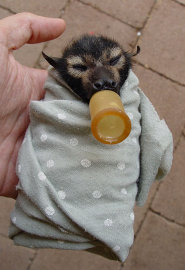
 The Spectacled Flying-fox (Pteropus conspicillatus) is a large fruit bat which is also called the Spectacled Fruit Bat, or Spectacled Bat. It lives on the islands of Woodlark, Alcester, Kiriwina, and Halmahera in New Guinea, and is also found in Queensland Australia. This species of bat is listed as a threatened species in the CEPBCA act of 1999 in Australia, and are considered vulnerable because of a decline in numbers from habitat loss, however as a worldwide species the IUCN lists them as being of least concern due to population distribution and stability. This means that although the populations in Queensland are in danger, the species as a whole is not going to go extinct in the near or median future.
 Their length from head to toe is 8-9 inches (20-25cm) and they weigh 2.2lbs on average (1kg). They are a large and black bat, and have a grayish yellow striped fur around their eyes, while their mantle is also this same color and follows along their back, their neck, and their shoulders. Coloration varies from individual, and some seem paler, while others more yellowish in color. They have a very sensitive sense of smell, and very good eyesight. Because they are a fruit bat they do not rely on echolocation to track insects - they don’t eat them. Instead they prefer to eat fruit, blossoms, and nectar.
The Binomial Name of the Spectacled Flying-fox is Pteropus conspicillatus, and it belongs to the Genus Pteropus. Within Pteropus there are roughly 64 known species of bat, and are the largest bats alive in wingspan; almost all of the species of bats in this genus are threatened. Pteropus belongs to the Subfamily Pteropodinae, which has around 36 known genera. Pteropodinae belongs to the Family Pteropodidae, which belongs to the Suborder Megachiroptera or fruit bats also known as megabats. Megachiroptera belongs to the Order Chiroptera - this is all bats. Under the revised model of mammals, yet to be adopted, Chiroptera belongs to the Superorder Laurasiatheria, which then includes the carnivores, cows, camels and many more. Laurasiatheria belongs to Eutheria - the placental mammals, which include the primates and their relatives (us). Eutheria belongs to Theria, which are all the mammals with the exception of the monotremes.
Interesting Facts about the Spectacled Flying Fox
Like many other megabats, the Spectacled Flying Fox may drink ocean water on the way to the forests to feed, sustaining flight and keeping thirst down. However, for humans to drink seawater without first filtering it - it would cause more thirst, and possibly dehydration.
Photo of the baby Spectacled flying-fox taken at the Tolga Bat Hospital, Australia by Mnolf, licensed under GFDL & CC ShareAlike 2.0
The Spectacled flying-fox is listed as Least Concern (LR/lc), lowest risk. Does not qualify for a more at risk category. Widespread and abundant taxa are included in this category, on the IUCN Red List of Threatened Species
Namings for the spectacled flying fox
A spectacled flying fox group is called a 'flock'.Some facts about the
Spectacled flying fox
Adult weight : 0.776 kg (1.7072 lbs)
Gestation : 180 days
Litter size : 1

Custom Search