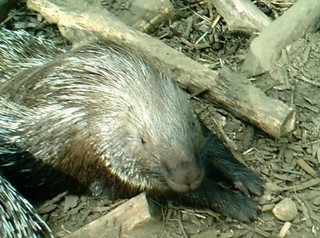
Cape porcupine
Order : Rodentia
Suborder : Hystricognathi
Family : Hystricidae
Species : Hystrix africaeaustralis
Keywords: nocturnal , quill , tail
Which zoos have them?
Artis (Netherlands)The Cape porcupine is listed as Least Concern. Does not qualify for a more at risk category. Widespread and abundant taxa are included in this category, on the IUCN Red List of Threatened Species
Namings for the Cape porcupine
A young / baby of a Cape porcupine is called a 'pup'. The females are called 'sow' and males 'boar'. A Cape porcupine group is called a 'prickle or family'.Countries
Botswana, Burundi, Congo, Democratic Republic of the, Congo, Republic of the, Kenya, Lesotho, Malawi, Mozambique, Namibia, Rwanda, South Africa, Swaziland, Tanzania, Uganda, Zambia and ZimbabweCape porcupine habitats
Arable Land, Artificial / Terrestrial, Grassland, Moist savanna, Plantations, Rural Gardens, Savanna, Shrubland, Subtropical / Tropical Dry Grassland and Subtropical / Tropical Dry ShrublandSome facts about the
Cape porcupine
Adult weight : 24 kg (52.8 lbs)
Maximum longevity : 23 years
Female maturity :375 days
Male maturity : 390 days
Gestation : 94 days
Weaning : 77 days
Litter size : 2
Litters per year : 2
Interval between litters : 379 days
Weight at birth : 0.351 kg (0.7722 lbs)
Basal metabolic rate : 13 W
Body mass : 11.3 kg (24.86 lbs)
Temperature : 37.85 °C (100.13 °F)
Facts about the Cape porcupine
Cape porcupines are monogamous. (Full text)
The general pattern of steroid secretion during the 30-day oestrous cycle of the Cape porcupine is that of a surge (25-176 pg/ml) in oestradiol-17 beta secretion at the time of perforation of the vaginal closure membrane, followed by an increase in progesterone concentrations, the latter attaining peak values (mean 5. (Full text)
The reproductive tract of the male Cape porcupine is morphologically and histologically similar to that of New World hystricomorph rodents. (Full text)
More animals beginning with C