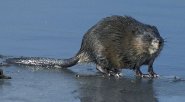
 The Muskrat (Ondatra zibethicus), is a semi-aquatic, medium-sized rodent. It is found in North America and has also been recently introduced in Asia, South America, and Europe. The main habitat of muskrat is wetlands but this animal can successfully adapt to different habitats and climates. It is very beneficial to nature and important to humans for its fur and as food.
 Muskrats are not the true rats which belong to the genus Rattus. There are two scent glands near its tail which give off a strong musky smell that is used by muskrat to declare its territory. It is this attribute of the muskrat that has given it its name.
The size of an average muskrat is around 16 - 24 inches (40 - 60 cm). The size of its tail is almost double its body size and it weighs about 1.5 - 4 lb (0.7 - 1.8 kg). An adult muskrat is just a little longer than the brown rat but it weighs four times the weight of brown rat. It has a medium or dark brown coat with small but thick hair and the color of its belly is lighter than the body. The two-layer fur protects it from cold water. Instead of hair, they have scales on their long tail which flattens vertically to help them in swimming.
Muskrats spend a lot of time in water.
They are found in marshy lands close to salt water or fresh water wetlands, ponds, rivers, or lakes. Since the construction of canals and other irrigation channels is being created on large scales, muskrats are especially becoming common in these areas. Muskrats can survive in areas where sulfurous water from coal mines is released. Muskrats may occupy that area of water where other animals such as frogs or fish perish.
Like other rodents, muskrats are also prolific breeders. Females can give birth to 2-3 litters per year and there can be 6-8 young ones in each litter. The babies are very small and weigh only 0.8 oz (22 gm) at birth. In warm environment, it matures just in six months while in a cold climate it may take one year to mature.
Muskrats are active when it is cool at night, dawn, or dusk. Aquatic vegetation or cattails are their main food. Although plant materials fulfill 95% of their food needs, sometimes, they may also eat small animals such as frogs, fish, and mussels etc.
The Muskrat is listed as Least Concern (LR/lc), lowest risk. Does not qualify for a more at risk category. Widespread and abundant taxa are included in this category, on the IUCN Red List of Threatened Species
Namings for the muskrat
A young / baby of a muskrat is called a 'kitten, nestling, pinkie or pup'. The females are called 'doe' and males 'buck'. A muskrat group is called a 'colony, horde, pack, plague or swarm'.Some facts about the
Muskrat
Adult weight : 1.362 kg (2.9964 lbs)
Female maturity :285 days
Male maturity : 285 days
Gestation : 26 days
Weaning : 25 days
Litter size : 7
Litters per year : 3
Interval between litters : 30 days
Weight at birth : 0.023 kg (0.0506 lbs)
Weight at weaning : 0.152 kg (0.3344 lbs)
Basal metabolic rate : 4 W
Body mass : 0.976 kg (2.1472 lbs)
Temperature : 37.85 °C (100.13 °F)

Custom Search