Subscribe to
"Animal of the day"

AddThis Feed Button
Or subscribe by e-mail

Enter your Email


Powered by FeedBlitz

We hope that reader will gain an increased appreciation of the need for more conservation measure in order to protect the beautiful creatures that inhabit the earth. Our philosophy is that the more we learn about animals, the more we respect them and take better care of them. That is why we update this blog with new animals, We encourage you to syndicate our content by adding "animal of the day" to your own blog! (read more)

About us

Our mission is to get people excited about animals and their welfare by writing articles on these animals. We encourage people to comment on posts and share with others. Don't forget to subscribe to our feed.

Contact us
Copyright notice

Funny animal videos and pictures

Swimming with manatees - harmful or helpful

Last Comments

Erik (Narwhal - The Wha…): Awesome! I had not heard …
Matty (Pudu - smallest d…): Look, I know they are cut…
Doro (Fattest cat in th…): check out fat-animals.com…
dylan barker (Pink fairy armadi…): i acctually think that th…
Lindsay (Fattest cat in th…): this cat is not to fat my…
Tima (Bottlenose dolphi…): J. David Smith, Ph.D., a …
Coda Plant (Pudu - smallest d…): Hey. I live in Northern C…
Michael Newton (Koala video): i love you mr. koala
Tohru (Asian Golden Cat): I hate them too! They are…
tiffany (Asian Golden Cat): i love this cat i’m doing…

Calendar

« November 2009
S M T W T F S
1 2 3 4 5 6 7
8 9 10 11 12 13 14
15 16 17 18 19 20 21
22 23 24 25 26 27 28
29 30          

Archives

Next Archive Previous Archive

01 Nov - 30 Nov 2009
01 Oct - 31 Oct 2009
01 Sep - 30 Sep 2009
01 Aug - 31 Aug 2009
01 Jul - 31 Jul 2009
01 Jun - 30 Jun 2009
01 May - 31 May 2009
01 Apr - 30 Apr 2009
01 Mar - 31 Mar 2009
01 Feb - 28 Feb 2009
01 Jan - 31 Jan 2009
01 Dec - 31 Dec 2008
01 Nov - 30 Nov 2008
01 Oct - 31 Oct 2008
01 Sep - 30 Sep 2008
01 Jul - 31 Jul 2008
01 Jun - 30 Jun 2008
01 May - 31 May 2008
01 Apr - 30 Apr 2008
01 Mar - 31 Mar 2008
01 Feb - 28 Feb 2008
01 Jan - 31 Jan 2008
01 Dec - 31 Dec 2007
01 Nov - 30 Nov 2007
01 Oct - 31 Oct 2007
01 Sep - 30 Sep 2007
01 Aug - 31 Aug 2007
01 Jul - 31 Jul 2007
01 Jun - 30 Jun 2007
01 May - 31 May 2007
01 Apr - 30 Apr 2007
01 Mar - 31 Mar 2007
01 Feb - 28 Feb 2007
01 Jan - 31 Jan 2007
01 Dec - 31 Dec 2006
01 Nov - 30 Nov 2006
01 Oct - 31 Oct 2006
01 Sep - 30 Sep 2006
01 Aug - 31 Aug 2006
01 Jul - 31 Jul 2006
01 Jun - 30 Jun 2006
01 May - 31 May 2006
01 Apr - 30 Apr 2006
01 Mar - 31 Mar 2006
01 Feb - 28 Feb 2006
01 Jan - 31 Jan 2006
01 Dec - 31 Dec 2005
01 Sep - 30 Sep 2005
01 Aug - 31 Aug 2005
01 Jul - 31 Jul 2005

Animal posters
Animal pictures
Mammals.start4all.com
Animal diversity web
Recently extinct animals forum
PetLvr.com
Another chance to see
Happiness is a warm puppy

Miscellany

AddThis Feed Button

« Domesticated rabbits | Home | Puma - America's allr… »

Proboscis monkey - The swimming star with the giant nose

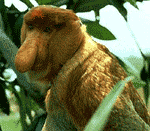
proboscis Everyone who has the opportunity to see a Proboscis monkey (Nasalis larvatus) is struck by its giant nose. But there is a second feature which is very typical for Proboscis monkeys and their relatives, the so called Leaf-monkeys - it's their large belly. Indicated by the name of that group of apes, they almost exclusively feed on leaves - and leaves are not easy to digest. Moreover leaves are not very rich in energy-content. So Proboscis monkeys have to eat a lot of leaves and spend most of their time on feeding. In order to obtain enough energy from their meagre nourishment, Proboscis monkeys have got a complicated stomach divided into several parts. Their stomach is quite similar to that of ruminants, which have to face the same problems. Adult Proboscis monkeys are large animals. Males reach a length of about 70 cm and a weight up to 24 kg. Females are significantly smaller, reaching lengths of 60 cm and weights of just 12 kg. The tails of Proboscis monkeys are about as long as their bodies. Their fur is brick-red, the front and the cheeks are of brighter colour and the arms and legs are more greyish. The most obvious feature of Proboscis monkeys is the male's extremely long nose, shaped like a cucumber. Noses of females and young are not small either but don't reach the sizes of the noses of males by far.

Proboscis monkeys inhabit Borneo. They are endemic on that South-Asian island. The prefered habitat of Proboscis monkeys are rainforests of the lowlands and most of all mangrove-forests at the river mouths. They live on trees and wander about in groups of sizes from 10 to 30 animals. Mostly several adult males can be found in one group, but groups with just one single adult male are known too. Proboscis monkeys move quite rapidly on the trees. They are able to swing from branch to branch using their hands but are also very skilled in running on all fours. If Proboscis monkeys are in a hurry, they jump from tree to tree. They prefer this way to move when they have to cross rivers or escape from predators like the Clouded leopard, a cat which is closely related to the Tiger. If there's no other opportunity to escape left, Proboscis monkeys drop themselves into the water even from high branches. They are very skilled swimmers and divers. This is not very common among primates, since most ape species are said to be more or less scared of water. But it's a necessity of life to be able to swim in a habitat that is dominated by rivers and river mouths. But accidents are very common; sometimes Proboscis monkeys are driven out to the open sea by river currents.

Adult male Proboscis monkeys are imposing figures. They are quite aggressive towards members of other groups. But before initiating a fight they try to clarify their positions by showing threatening behaviour. Doing a lot of fuss they break branches and give loud calls. But there are not much further details known about Proboscis monkey behaviour and their social life in the wild. Long-term studies of Proboscis monkey groups are extremely difficult, because they can be observed only by boat in the mangrove-forests. In spite of the unapproachability of its habitat the Proboscis monkey is regarded to be endangered, since habitat destruction doesn't stop even at such places.

This article was originally published at magazine.naturspot.de. Link to the original article


three comments:

These monkeys are the most coolest thing I’ve seen!!!!!!!!!!!!!!!!!!
Jamie - 31 01 06 - 16:35

those monkeys r cool, i did a five paragraph report on them, so thanx for your information u gave me.
Chrisitna (Email) - 04 03 06 - 01:52

thankss for your information.Me and my friend were doing a project about mammals and the information was useful to our project.
tingting (Email) - 04 06 08 - 05:22

You can help spreading the word about this animal by stumbling it by pressing this link StumbleUpon or
  
Remember personal info?

Emoticons / Textile

To be able to comment you are asked to answer this silly question. This question baffles automated spam bots, but fortunately for you it is a simple question, i hope.
 

  ( Register your username / Log in )

Notify:
Hide email:

Small print: All html tags except <b> and <i> will be removed from your comment. You can make links by just typing the url or mail-address.
Animal of the Day
Subscribe to the
animal of the day
Enter your Email


Powered by FeedBlitz

Add "Animal of the day" to your blog

A new feature has been set up for your
site: "Animal of the Day", you can add this to your website by copying the code. An example of how
this would look like and the code to be added can be found here.

63 comments - Permanent Link