Subscribe to
"Animal of the day"

AddThis Feed Button
Or subscribe by e-mail

Enter your Email


Powered by FeedBlitz

We hope that reader will gain an increased appreciation of the need for more conservation measure in order to protect the beautiful creatures that inhabit the earth. Our philosophy is that the more we learn about animals, the more we respect them and take better care of them. That is why we update this blog with new animals, We encourage you to syndicate our content by adding "animal of the day" to your own blog! (read more)

About us

Our mission is to get people excited about animals and their welfare by writing articles on these animals. We encourage people to comment on posts and share with others. Don't forget to subscribe to our feed.

Contact us
Copyright notice

Funny animal videos and pictures

Swimming with manatees - harmful or helpful

Last Comments

Erik (Narwhal - The Wha…): Awesome! I had not heard …
Matty (Pudu - smallest d…): Look, I know they are cut…
Doro (Fattest cat in th…): check out fat-animals.com…
dylan barker (Pink fairy armadi…): i acctually think that th…
Lindsay (Fattest cat in th…): this cat is not to fat my…
Tima (Bottlenose dolphi…): J. David Smith, Ph.D., a …
Coda Plant (Pudu - smallest d…): Hey. I live in Northern C…
Michael Newton (Koala video): i love you mr. koala
Tohru (Asian Golden Cat): I hate them too! They are…
tiffany (Asian Golden Cat): i love this cat i’m doing…

Calendar

« November 2009
S M T W T F S
1 2 3 4 5 6 7
8 9 10 11 12 13 14
15 16 17 18 19 20 21
22 23 24 25 26 27 28
29 30          

Archives

Previous Archive

01 Nov - 30 Nov 2009
01 Oct - 31 Oct 2009
01 Sep - 30 Sep 2009
01 Aug - 31 Aug 2009
01 Jul - 31 Jul 2009
01 Jun - 30 Jun 2009
01 May - 31 May 2009
01 Apr - 30 Apr 2009
01 Mar - 31 Mar 2009
01 Feb - 28 Feb 2009
01 Jan - 31 Jan 2009
01 Dec - 31 Dec 2008
01 Nov - 30 Nov 2008
01 Oct - 31 Oct 2008
01 Sep - 30 Sep 2008
01 Jul - 31 Jul 2008
01 Jun - 30 Jun 2008
01 May - 31 May 2008
01 Apr - 30 Apr 2008
01 Mar - 31 Mar 2008
01 Feb - 28 Feb 2008
01 Jan - 31 Jan 2008
01 Dec - 31 Dec 2007
01 Nov - 30 Nov 2007
01 Oct - 31 Oct 2007
01 Sep - 30 Sep 2007
01 Aug - 31 Aug 2007
01 Jul - 31 Jul 2007
01 Jun - 30 Jun 2007
01 May - 31 May 2007
01 Apr - 30 Apr 2007
01 Mar - 31 Mar 2007
01 Feb - 28 Feb 2007
01 Jan - 31 Jan 2007
01 Dec - 31 Dec 2006
01 Nov - 30 Nov 2006
01 Oct - 31 Oct 2006
01 Sep - 30 Sep 2006
01 Aug - 31 Aug 2006
01 Jul - 31 Jul 2006
01 Jun - 30 Jun 2006
01 May - 31 May 2006
01 Apr - 30 Apr 2006
01 Mar - 31 Mar 2006
01 Feb - 28 Feb 2006
01 Jan - 31 Jan 2006
01 Dec - 31 Dec 2005
01 Sep - 30 Sep 2005
01 Aug - 31 Aug 2005
01 Jul - 31 Jul 2005

Animal posters
Animal pictures
Mammals.start4all.com
Animal diversity web
Recently extinct animals forum
PetLvr.com
Another chance to see
Happiness is a warm puppy

Miscellany

AddThis Feed Button

« Indian rhinoceros - R… | Home | Short-eared elephant-… »

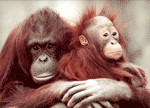
Orang-utan - "Forest people" from Borneo and Sumatra

Orang utan The translation of the Malayan word "Orang-utan" is "forest man". And indeed do the large Great apes show a lot of human characteristics concerning their facial expression as well as their gestures. Adult male Orang-utans (Pongo pygmaeus) are imposing figures with their reddish shaggy fur, broad cheeks and long beards. In the wild they reach weights up to 80 kg. Male Orang-utans living in zoos and suffering from lack of exercise are often even heavier. Female Orang-utans are much smaller than the males. The face of young Orang-utans is fair-skinned but, like in Chimpanzees, gets darker the older they get.

Orang-utans inhabit rainforests in the lowlands of Borneo and Sumatra in the national territories of Malaysia and Indonesia. Two subspecies are known, the Borneo-orang-utan and the Sumatra-orang-utan, which differ in facial characteristics and colour of their fur. Orang-utans also inhabited Java but have been exterminated on that island because they were hunted by early humans. Orang-utans are the largest animals living on trees more or less all the time. Only adult males need to climb down sometimes when they are not able to change from one tree to another, because the branches are not strong enough to carry their weight. Living on trees protects Orang-utans from getting killed by their natural enemies, first of all the Tiger.

Orang-utans spend also the nights on trees. They construct sleep nests - mostly a new one each evening -, which they roof over with branches to protect themselves against heavy rain. Orang-utans find their food on trees too. It's consisting of fruits and leaves for the larger part. But the Great apes don't refuse small animals either. So they also take ants and termites or eggs and young birds as well as squirrel nestlings. But their major food - fruits - have a dispersed distribution in the forest habitat, which forces Orang-utans to wander about in order to find enough to eat. Although the territories of adult males might reach an extension of about 10 sqarekilometres, the apes do only short distances each day. Wandering about is very energy consuming and exhausting for apes of that size. The much smaller Gibbons, inhabiting the same area, do much longer distances each day to find their food. How do the Orang-utans, in spite of investing not so much effort in searching for food, manage to find enough to eat? The most important reason is their great deal of intelligence. The few present sources of food are exploited very efficiently by Orang-utans. So they wander to the trees, where they expect food, using the most direct way. Intelligence tests revealed that young Orang-utans are partly more intelligent than other primates like the Chimpanzees and Gorillas of the same age.

Orang-utans lead a solitary life. Adult males have a large territory, which normally includes smaller territories of several females. To mark their territory and show their position adult high ranking male Orang-utans give loud calls and sometimes emphasize them by breaking branches. Other males that entered the territory of a calling male mostly retire very quietly when confronted with such a spectacle. But the intrusion of a male Orang-utan into another male's territory may also lead to serious conflicts; many Orang-utan males have scars from bites or suffer from broken fingers. The calls of an adult male have another function too: They are attracting females that are willing to mate. They join the males and stay with them for several months sometimes. When they get pregnant, they leave the male Orang-utans and go on their ways. Like in humans, pregnancy lasts for about nine months. The baby stays close to its mother for about one year. During this time it is most of the time carried by the female. After that time the young Orang-utan becomes more and more independent and starts exploring its surroundings. But the child never goes far away from its mother. It is weaned at the age of three years or even later, in case no new young is born. The average interval between two births is six years in free living Orang-utans. Whenever young Orang-utans meet each other, they take the opportunity to play. Even the mothers join on such an occasion, but seldomly get into direct contact to each other. Such communities may stay together for some weeks before they split up and each small family goes on going its way again.

The Orang-utan is probably the most endangered Great ape at the moment. It's estimated that there are only 30,000 to 50,000 free living Orang-utans left. Nowadays the major reason for their disappearance is the destruction of their habitat. Large areas of rainforest are systematically converted to fields and plantations. The ways this is accomplished are not at all soft. An often used means is burning down parts of the forest. The devastating forest fires raging in 1997 and 1998 in Indonesia were caused by man. They had a fatal influence on the stocks of Orang-utans living in that area. A lot of Orang-utans were killed during the fires. Apes, which managed to escape the fires, had to migrate to areas, that were inhabited by other Orang-utans. This increased the population density and the social stress for the single Orang-utans. Although Orang-utans have been protected for decades their survival seems to be possible just in reserves and zoos. According to the current 25-years-plan the Indonesian government plans the conversion of 20 million hectares of rainforest to plantations and fields. Facing such a scenario, efforts to reintroduce Orang-utans, which were raised in zoos, seem to be hopeless. But these efforts, first of all forced by the biologist Birut� Galdikas, at least have the effect, that the Indonesian government establishes new reserves, in which the survival of the remaining Orang-utans seems to be secure.

This article was originally published at magazine.naturspot.de. Link to the original article


two comments:

Your ANIMAL KINGDOM blog is essential.

But there are some missing ones such as Osama bin Laden and his likes.
ekenyerengozi michael chima (Email) (URL) - 18 07 05 - 15:44

This picture reminds me of two people I know very well in Africa.

Actually,my mother believed that the Yetty still exists in our jungle in Nigeria.
ORIKINLA OSINACHI (Email) (URL) - 20 07 05 - 21:16

You can help spreading the word about this animal by stumbling it by pressing this link StumbleUpon or
  
Remember personal info?

Emoticons / Textile

To be able to comment you are asked to answer this silly question. This question baffles automated spam bots, but fortunately for you it is a simple question, i hope.
 

  ( Register your username / Log in )

Notify:
Hide email:

Small print: All html tags except <b> and <i> will be removed from your comment. You can make links by just typing the url or mail-address.
Animal of the Day
Subscribe to the
animal of the day
Enter your Email


Powered by FeedBlitz

Add "Animal of the day" to your blog

A new feature has been set up for your
site: "Animal of the Day", you can add this to your website by copying the code. An example of how
this would look like and the code to be added can be found here.

63 comments - Permanent Link