Subscribe to
"Animal of the day"

AddThis Feed Button
Or subscribe by e-mail

Enter your Email


Powered by FeedBlitz

We hope that reader will gain an increased appreciation of the need for more conservation measure in order to protect the beautiful creatures that inhabit the earth. Our philosophy is that the more we learn about animals, the more we respect them and take better care of them. That is why we update this blog with new animals, We encourage you to syndicate our content by adding "animal of the day" to your own blog! (read more)

About us

Our mission is to get people excited about animals and their welfare by writing articles on these animals. We encourage people to comment on posts and share with others. Don't forget to subscribe to our feed.

Contact us
Copyright notice

Funny animal videos and pictures

Swimming with manatees - harmful or helpful

Last Comments

Erik (Narwhal - The Wha…): Awesome! I had not heard …
Matty (Pudu - smallest d…): Look, I know they are cut…
Doro (Fattest cat in th…): check out fat-animals.com…
dylan barker (Pink fairy armadi…): i acctually think that th…
Lindsay (Fattest cat in th…): this cat is not to fat my…
Tima (Bottlenose dolphi…): J. David Smith, Ph.D., a …
Coda Plant (Pudu - smallest d…): Hey. I live in Northern C…
Michael Newton (Koala video): i love you mr. koala
Tohru (Asian Golden Cat): I hate them too! They are…
tiffany (Asian Golden Cat): i love this cat i’m doing…

Calendar

« November 2009
S M T W T F S
1 2 3 4 5 6 7
8 9 10 11 12 13 14
15 16 17 18 19 20 21
22 23 24 25 26 27 28
29 30          

Archives

Next Archive Previous Archive

01 Nov - 30 Nov 2009
01 Oct - 31 Oct 2009
01 Sep - 30 Sep 2009
01 Aug - 31 Aug 2009
01 Jul - 31 Jul 2009
01 Jun - 30 Jun 2009
01 May - 31 May 2009
01 Apr - 30 Apr 2009
01 Mar - 31 Mar 2009
01 Feb - 28 Feb 2009
01 Jan - 31 Jan 2009
01 Dec - 31 Dec 2008
01 Nov - 30 Nov 2008
01 Oct - 31 Oct 2008
01 Sep - 30 Sep 2008
01 Jul - 31 Jul 2008
01 Jun - 30 Jun 2008
01 May - 31 May 2008
01 Apr - 30 Apr 2008
01 Mar - 31 Mar 2008
01 Feb - 28 Feb 2008
01 Jan - 31 Jan 2008
01 Dec - 31 Dec 2007
01 Nov - 30 Nov 2007
01 Oct - 31 Oct 2007
01 Sep - 30 Sep 2007
01 Aug - 31 Aug 2007
01 Jul - 31 Jul 2007
01 Jun - 30 Jun 2007
01 May - 31 May 2007
01 Apr - 30 Apr 2007
01 Mar - 31 Mar 2007
01 Feb - 28 Feb 2007
01 Jan - 31 Jan 2007
01 Dec - 31 Dec 2006
01 Nov - 30 Nov 2006
01 Oct - 31 Oct 2006
01 Sep - 30 Sep 2006
01 Aug - 31 Aug 2006
01 Jul - 31 Jul 2006
01 Jun - 30 Jun 2006
01 May - 31 May 2006
01 Apr - 30 Apr 2006
01 Mar - 31 Mar 2006
01 Feb - 28 Feb 2006
01 Jan - 31 Jan 2006
01 Dec - 31 Dec 2005
01 Sep - 30 Sep 2005
01 Aug - 31 Aug 2005
01 Jul - 31 Jul 2005

Animal posters
Animal pictures
Mammals.start4all.com
Animal diversity web
Recently extinct animals forum
PetLvr.com
Another chance to see
Happiness is a warm puppy

Miscellany

AddThis Feed Button

« Vicuna - The stormpro… | Home | Griffon vulture - A v… »

Lynx

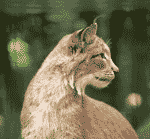
lynx lynx There are just a few wild cat species living in Europe. Besides the European wild cat there are two species of the genus lynx that have to be mentioned: The Lynx or Eurasian lynx (Lynx lynx) and the Spanish lynx (Lynx pardinus). Reaching a length up to 110 cm and a weight up to 38 kg, the Eurasian lynx is larger than its Iberian relative and moreover the largest wild cat inhabiting Europe. In America two further lynx species are distributed: the Canadian lynx (Lynx canadensis) and the Bobcat (Lynx rufus). The distribution scheme in America is similar to the one in Europe. The larger Canadian lynx inhabits the northern parts of North america, whereas the smaller Bobcat can be found in the more southernly parts down to Mexico.

In the Eurasian lynx four subspecies are known, which differ widely in size and colour and markings of the fur. The colour of the fur stretches from reddish brown to light grey. The markings of the fur are dominated by spots and short lines. Typical for Lynxes and extraordinary concerning the cat family are their "brush ears" and sideboards. They are not kind of fashionable extravagances but serve as means of intraspecific communication. Most cat species communicate partly by moving their tails to a certain position. But Lynxes just have very short tails. So they use their ears and sideboards to communicate. The sideboards can be extended or doned - each movement or form has got a certain meaning.

The typical habitats of the Lynx are forests and moorlands. Lynxes lead a solitary life in territories reaching an extension of up to 100 square kilometres. Their favourite prey are mammals of different sizes from mice to roedeers but also ground living birds. Larger prey isn't eaten at once; the Lynx returns to its kill several times. After a pregnancy of about 70 days the female Lynx gives birth to up to six young, but mostly there are just two young which will survive. How long the young Lynxes stay with their mother depends on the environmental circumstances. Lynx families living in northern regions with mild winters and enough food split up in autumn, whereas young lynxes living in the north and being confronted with harder winters and less food are supplied by their mother during winter. Those families split up in next year's spring.

Eurasian lynxes are distributed in Europe and Northern Asia. In Europe their distribution range has been reduced more and more during the last 200 years. The Lynx got extinct in Western and Central Europe. The large cat was seen as a competitor for huntable game and was killed by hunters whenever they found one. After a lot of convincing done by species and nature conservation societies it seems that now there is a chance to reintroduce the Lynx in parts of its former distribution range. There have been successful efforts in Austria, Switzerland and France and just these days it's tried to reestablish a Lynx population in Germany.

This article was originally published at magazine.naturspot.de, Link to the original article


five comments:

:-D, I wonder if a Lynx can be kept as a pet. They look sort of like sabertooths without the huge teeth and smaller. They look cool … I want one. Now where to get one is the question mhmmm…
sulimonster (Email) (URL) - 15 07 05 - 02:19

I’d love to have one as a pet too LOL but I imagine the upkeep, space needed, food issues, etc would be a lot… I’ll stick with my house cat! ;)
PureMood (URL) - 18 07 05 - 08:58

Having a lynx as a pet is like having a aligator for a pet thar natural instenct will make them turn on thair owner eventualy, they are beutifule creaturs and are extreamly soft but very dangerous.
nick o 17 (Email) - 10 03 06 - 15:18

No, lynx are safe to have as pets. they’re almost exactly like an actual house cat. you have to give them a reason to attack. And I did know someone who had kept an aligator as a pet. ^^
Kat (Email) - 02 11 06 - 16:18

it luks scary man.
rock dude - 02 09 08 - 18:27

You can help spreading the word about this animal by stumbling it by pressing this link StumbleUpon or
  
Remember personal info?

Emoticons / Textile

To be able to comment you are asked to answer this silly question. This question baffles automated spam bots, but fortunately for you it is a simple question, i hope.
 

  ( Register your username / Log in )

Notify:
Hide email:

Small print: All html tags except <b> and <i> will be removed from your comment. You can make links by just typing the url or mail-address.
Animal of the Day
Subscribe to the
animal of the day
Enter your Email


Powered by FeedBlitz

Add "Animal of the day" to your blog

A new feature has been set up for your
site: "Animal of the Day", you can add this to your website by copying the code. An example of how
this would look like and the code to be added can be found here.

63 comments - Permanent Link