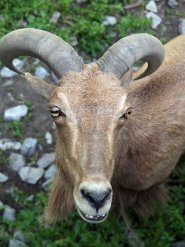
 An Aoudad (Ammotragus lervia) can range from 1.3 to 1.65 meters in length, with a tail length of 15 centimeter, and its weight ranges from 30 to 145kgs. The Aoudads' outer coverings are red or sandy brown. Bother sexes have a heavy covering of hair at the throat's area, but for the male, this covers its front feet and chest. The Aoudad has very thick, triangular-based horns. Their horns have rings, and as the Aoudad gets older, worn down, which gives a smooth facade. They live in the rocky mountains of North Africa.
The Aoudad has a gestation period of 160 days, and the average number in a litter is just one. Although it has been recorded that in rare occasions, they could go to three. The longevity of an Aoudad is 20 years, give or take a year or two. Breeding can occur at any time within the year, but the peak goes from September to November.
Principally, this is a desert dweller, and they are most busy at the cooler hours of the dusk/dawn, and they seek refuge during the day's heat. Talking of sure-footed animals, this animal is surely one, they can jump 2 meters without difficulties. They usually get water from the foods they get, but if water is within reach, they also drink. Their diet consists of lichens, acacia and grass. The leopard is their natural predator.
Oh...this you should know, the word is pronounced as "Ow-dad", and this is the name used by the North African tribe of Berbers.
Interesting fact: The newborns are capable of traversing rocky hills just (almost immediately) after being born.
Picture of the Aoudad by Andrzej Barabasz (Chepry), licensed under GFDL
The Aoudad, barbary sheep, uaddan is listed as Vulnerable (VU), considered to be facing a high risk of extinction in the wild, on the IUCN Red List of Threatened Species
Countries
Algeria, Chad, Egypt, Israel, Libya, Mali, Mauritania, Morocco, Niger, Sudan, Tunisia and Western SaharaAoudad habitats
Grassland, Shrubland, Subtropical / Tropical Dry Grassland and Subtropical / Tropical Dry ShrublandSome facts about the
Aoudad
Adult weight : 92.5 kg (203.5 lbs)
Maximum longevity : 22 years
Female maturity :335 days
Gestation : 149 days
Weaning : 122 days
Litter size : 1
Litters per year : 2
Interval between litters : 229 days
Weight at birth : 4.5 kg (9.9 lbs)

Custom Search