Subscribe to
"Animal of the day"

AddThis Feed Button
Or subscribe by e-mail

Enter your Email


Powered by FeedBlitz

We hope that reader will gain an increased appreciation of the need for more conservation measure in order to protect the beautiful creatures that inhabit the earth. Our philosophy is that the more we learn about animals, the more we respect them and take better care of them. That is why we update this blog with new animals, We encourage you to syndicate our content by adding "animal of the day" to your own blog! (read more)

About us

Our mission is to get people excited about animals and their welfare by writing articles on these animals. We encourage people to comment on posts and share with others. Don't forget to subscribe to our feed.

Contact us
Copyright notice

Funny animal videos and pictures

Swimming with manatees - harmful or helpful

Last Comments

jikka (Fattest cat in th…): the cat looks cute :)
Jakki (Fattest cat in th…): oh geese leave them alone…
hippie chick (Asian Golden Cat): what has been lost becaus…
we6yu8 (Golden lion tamar…): how can we protect them
Jillian (Pudu - smallest d…): I’m looking for someone w…
Landon (Swamp Rabbits - T…): Yes you are clearly crazy…
jim (Fossa - hunting l…): i believe the fossa to be…
sharkbytes (Eastern Chipmunk …): And they are very precoci…
Stephanie (Swamp Rabbits - T…): Okay, I know I’m a ‘lil o…
Roger (Sika deer): In today’s white snow we …

Calendar

« February 2010
S M T W T F S
  1 2 3 4 5 6
7 8 9 10 11 12 13
14 15 16 17 18 19 20
21 22 23 24 25 26 27
28            

Archives

Previous Archive

01 Feb - 28 Feb 2010
01 Jan - 31 Jan 2010
01 Nov - 30 Nov 2009
01 Oct - 31 Oct 2009
01 Sep - 30 Sep 2009
01 Aug - 31 Aug 2009
01 Jul - 31 Jul 2009
01 Jun - 30 Jun 2009
01 May - 31 May 2009
01 Apr - 30 Apr 2009
01 Mar - 31 Mar 2009
01 Feb - 28 Feb 2009
01 Jan - 31 Jan 2009
01 Dec - 31 Dec 2008
01 Nov - 30 Nov 2008
01 Oct - 31 Oct 2008
01 Sep - 30 Sep 2008
01 Jul - 31 Jul 2008
01 Jun - 30 Jun 2008
01 May - 31 May 2008
01 Apr - 30 Apr 2008
01 Mar - 31 Mar 2008
01 Feb - 28 Feb 2008
01 Jan - 31 Jan 2008
01 Dec - 31 Dec 2007
01 Nov - 30 Nov 2007
01 Oct - 31 Oct 2007
01 Sep - 30 Sep 2007
01 Aug - 31 Aug 2007
01 Jul - 31 Jul 2007
01 Jun - 30 Jun 2007
01 May - 31 May 2007
01 Apr - 30 Apr 2007
01 Mar - 31 Mar 2007
01 Feb - 28 Feb 2007
01 Jan - 31 Jan 2007
01 Dec - 31 Dec 2006
01 Nov - 30 Nov 2006
01 Oct - 31 Oct 2006
01 Sep - 30 Sep 2006
01 Aug - 31 Aug 2006
01 Jul - 31 Jul 2006
01 Jun - 30 Jun 2006
01 May - 31 May 2006
01 Apr - 30 Apr 2006
01 Mar - 31 Mar 2006
01 Feb - 28 Feb 2006
01 Jan - 31 Jan 2006
01 Dec - 31 Dec 2005
01 Sep - 30 Sep 2005
01 Aug - 31 Aug 2005
01 Jul - 31 Jul 2005

Animal posters
Animal pictures
Mammals.start4all.com
Animal diversity web
Recently extinct animals forum
PetLvr.com
Another chance to see
Happiness is a warm puppy

Miscellany

AddThis Feed Button

« Even-toed ungulates (… | Home | Giraffe - The long-n… »

Crested gibbon - At home in the top of the trees

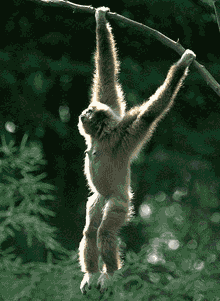
White cheeked gibbon The Crested gibbon (Hylobates concolor) is one of five species of the Gibbon family. Gibbons are also called "lesser apes", indicating their close relationship to the "great apes", including Chimpanzees, Bonobos, Gorillas and Orang-utans. This means that Gibbons are also quite closely related to man. They inhabit rainforests of South-East Asia. Crested gibbons - like the other Gibbon species - live in family groups, consisting of an adult pair and their young. The female gives birth to a single young all two to three years. The young Gibbon stays with the group for several years. Thus different aged young, mostly two to four, belong to the family. The group migrates within its territory, in order to get enough of their prefered food - fruits, which are distributed in a dispersed way. Very special with Crested gibbons is the different colour of the genders. The male and the young are of black fur colour, whereas the female is bright brown. This sexual dimorphism is quite unusual concerning Gibbons. In the other Gibbon species males and females are quite similar, which is common with animals that are living monogamous.

The arms of Gibbons are the longest among all primates. They reach 2,6 times their bodylength (man: 1,48 times). The length of their arms enables Gibbons to move in a way, which is optimal in the top of the trees and can be described as "swinging hand over hand". They move hand over hand from one branch to another while their body is swinging passivly like a pendulum. This way to move is not only energy saving, but also enables them to reach high speeds and to "fly" between branches which are up to ten meters apart. To be able to do such leaps, it's important to preserve much of the motion deriving from the swinging, which is easier to achieve with long arms. In spite of their skilfulness Gibbons don't escape accidents. It's estimated that about one third of all Gibbons suffer from fractures, which were caused by falls. The "hand over hand" way of moving is also of importance concerning the way Gibbons feed. It enables them to take fruits growing on thin branches far away from the centers of the trees.

Gibbons are very extraordinary primates in any respect. Famous is one of their ways to communicate. Gibbons do far-reaching singing, which lasts from 20 to 30 minutes. Some Gibbon species, including the Crested gibbon, have throats that are inflated while singing, serving as a soundbox. Two things are obvious: Gibbons scarcely sing alone. In most cases both partners or the entire family sings. In addition the singing of the pair is well coordinated and alternating. There are fluid transitions between the singing of the partners of an old, harmonic pair. It's presumed that this choir- and duet-singing has several functions: Like the singing of songbirds it serves as a means of fencing off the territory and indicating the location of the group. In addition it strengthens the bounds between the partners, which is essential to successfully raising young.

This article was originally published at magazine.naturspot.de. Link to the original article


six comments:

nice informative blog you have..
Ankur (Email) (URL) - 11 07 05 - 12:46

Good job with your site. Thank you for helping us learn about the many different animals in the world!
Tim (Email) (URL) - 11 07 05 - 17:32

I think you could have found a better slogan then (find out before they die out!)
Ray nicholas (Email) - 05 09 06 - 22:40

i love crestid gibbons!
jade - 14 09 07 - 11:51

I love crested gibbons!!!!!!!!!!! by the way im only 8 and im doing a school asinment go to school on the computer
Grant (Email) - 14 11 07 - 21:56

to cute!
shara - 30 04 08 - 10:49

You can help spreading the word about this animal by stumbling it by pressing this link StumbleUpon or
  
Remember personal info?

Emoticons / Textile

To be able to comment you are asked to answer this silly question. This question baffles automated spam bots, but fortunately for you it is a simple question, i hope.
 

  ( Register your username / Log in )

Notify:
Hide email:

Small print: All html tags except <b> and <i> will be removed from your comment. You can make links by just typing the url or mail-address.
Animal of the Day
Subscribe to the
animal of the day
Enter your Email


Powered by FeedBlitz

Add "Animal of the day" to your blog

A new feature has been set up for your
site: "Animal of the Day", you can add this to your website by copying the code. An example of how
this would look like and the code to be added can be found here.

63 comments - Permanent Link