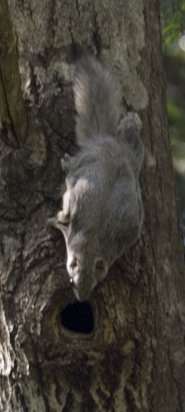
 The Russian or Siberian flying squirrel (Pteromys volans) only glides rather than flies in the way birds fly. Natural predators such as owls, hawks, domestic cats and weasel-like martens patrol tree trunks in search of a tasty squirrel. The Siberian flying squirrel can quickly escape by leaping from one tree trunk, spreading out its thin flap of skin by stretching out all of its limbs, and gently gliding to another tree trunk well out of the predator’s reach.
But they cannot glide away from humans. Siberian flying squirrels need to live in tree trunks, preferably of pine, cedar or spruce. They need to live in tall, older trees that are large enough to support their diet and nesting sites. They need to live with woodpeckers because Siberian flying squirrels prefer to use an abandoned woodpecker nest hole rather than try to make one themselves. Humans have been cutting down trees at an alarming rate and reducing the food and living space of the little rodent.
Physical Description
Siberian flying squirrels strongly resemble the more familiar North American grey squirrel. It has far larger eyes and has white patagiums or gliding membranes from its forelegs to the end of its hind legs. When the squirrel is not gliding, the membrane becomes bunched up and gives the squirrel its common name of "flying mitten.
This is a small rodent only weighing an average of 4.58 ounces (130 grams.) Its body length, including the tail, ranges from 4.72 inches (120mm) to almost 9 inches (228 mm.) They produce very distinctive droppings found ringing tree trunks. The droppings appear like golden-brown grains of rice. Looking for the droppings helps clue scientists, conservationists and forestry managers as to which trees the flying squirrels inhabit.
Life Cycle and Behavior
There still is a lot unknown about the Siberian forest squirrel, primarily since it’s shy and nocturnal. It lives it’s four or five year life span entirely in the tree tops and can theoretically never need to come down to the ground. Siberian flying squirrel females can produce one or two litters per year. The average litter size is three, but litters of six have been reported. After one month, the mother weans the babies.
Siberian tree squirrels are omnivorous, but are primarily vegetarians. Everything they eat is provided by the trees they live in – nuts, seeds, bark, buds, twigs, pinecones, berries, sprouts, bird eggs and hatchlings. Siberian tree squirrels take over abandoned red squirrel nests (dreys) as well as woodpecker holes. They live in mated pairs and any nursing babies. Some will also nest in attics or commercially made bird houses. Siberian flying squirrels used to be found in upper Europe, Asia and down to Japan. They are now found in countries committed to preserving forests, such as Finland and Estonia.
Picture of the Siberian flying squirrel by Marko Schrader, licensed under GFDL.
Keywords: tail , black , gray , stripe , nocturnal , hibernate , orange , yellow
The Russian flying squirrel, siberian flying squirrel is listed as Near Threatened (LR/nt), is close to qualifying for or is likely to qualify for a threatened category in the near future, on the IUCN Red List of Threatened Species
Namings for the Siberian flying squirrel
A young / baby of a Siberian flying squirrel is called a 'pup, kit or kitten'. The females are called 'doe' and males 'buck'. A Siberian flying squirrel group is called a 'dray or scurry'.Countries
Belarus, China, Estonia, Finland, Japan, Korea, North, Korea, South, Latvia, Mongolia and RussiaSome facts about the
Siberian flying squirrel
Adult weight : 0.13 kg (0.286 lbs)
Maximum longevity : 11 years
Gestation : 30 days
Weaning : 46 days
Litter size : 3
Litters per year : 2

Custom Search