
Pangolins


Friends

 Submit your pet
for the cutest pet ever competition


StumbleUpon Toolbar Stumble this page!

Animal of the Day
Subscribe to the
animal of the day
Enter your Email


Powered by FeedBlitz

Top articles


Mammals and their maximum age

Mammals sorted by birth weight

The white rhino

Animals living in the water

Swim with manatees - harmful or helpful?

Pangolins

Order : Pholidota
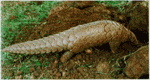
  pangolin Digging for ants and termites with their strong claws and large tongue, the pangolins have little to fear, except humans. They can curl up into a ball and their razor sharp provide extra defense. "There is a story of a villager that knocked a pangolin out and brought it back to the village with it around his neck. But the pangolin regained conscience and quickly tried to curl up into a ball. Unfortunately the villager's neck was caught in the middle and he was found strangled to death with the pangolin still wrapped around him." (source) Another defense mechanism is their ability to spray acid like a skunk when threatened. They can be found in parts of africa and asia. Once placed with the Xenarthra, the edentates, because of their ability to curl, like the armadillo and the use of their tongue, like the anteater, but now the seven species of pangolin have an order of their own, the Pholidota.

Animals in the order Pholidota

Indian pangolin
Giant pangolin
Malayan pangolin
Facts about the order Pholidota, the pangolins

00 This Pholidota is one of the most compact and easy to grow. (Full text)

The order Pholidota is exclusive to the seven species of Pangolins found throughout Africa and Asia. (Full text)

The skull of pangolins is smoothly conical, lacking the ridges and crests found on most mammalian crania. (Full text)

Unless protected, the future of three Asian pangolins is also uncertain. (Full text)

Wildlife statistics for Guangxi show that every year in the province tens of thousands of pangolins are eaten although they are supposedly government-protected. (Full text)

Physical description and behavior The physical appearance of pangolins is marked by large, hardened, plate-like scales, which are an unusual feature among mammals. (Full text)

The order Pholidota is exclusive to Pangolins Size: 27 to 42 inches (common pangolin) (Full text)

Squamata is an order of reptiles (lizards, snakes, amphisbaenians); Pholidota is an order of mammals (pangolins alone). (Full text)

However, pangolins are lacking several skeletal structures unique to the edentates, and therefore were placed in their own order. (Full text)

Pangolins are nocturnal and remain in their burrows during the day. (Full text)

“The illegal trade in pangolins is largely out of control, with large shipments of animals being smuggled across numerous international borders, often by the lorry load, to their final destination in China. (Full text)

This strange and rarely seen member of the family Manidae from the order Pholidota is an old-world creature once associated with anteaters, sloths and armadillos. (Full text)

Giant pangolins are terrestrial animals, preferring not to live in trees. (Full text)

Which of the following about pangolins is correct? (Full text)

Pangolins are an endangered species of animals. (Full text)

One of the most frequently displaced facts about pangolins is that they are related to armadillos. (Full text)

Pangolins are in no way related to armadillos. (Full text)

In contrast with the Xenarthra, the Old World Pholidota is not trophically diverse and contains only the myrmecophagous pangolins, or scaly anteaters (Patterson, 1978). (Full text)

Pangolin, which is a mammal of the order Pholidota, is an endangered species. (Full text)

The order Pholidota is exclusive to the seven species. (Full text)

Pholidota is represented by four species, one of which, P. (Full text)

Self-defense Pangolins are well equipped for self defense. (Full text)

Found in Asia and Africa, pangolins are considered a delicacy in China and other countries, and are prized for their use in traditional medicine. (Full text)

Pangolins are no longer considered close relatives of the armadillos and anteaters, which are now grouped with the sloths in a separate order, the Xenarthra. (Full text)

Perhaps the most obvious feature of pangolins is their scaly epidermal armor, making them look a bit like pine cones with legs. (Full text)

1. Pholidota, genus Pholidota -- (genus of mostly epiphytic orchids of Indomalaya and western Pacific)
Pholidota
genus Pholidota
2. Pholidota, order Pholidota -- (pangolins; in some former classifications included in the order Edentata)
Pholidota
order Pholidota
(Source WordNet)

Google
Contact Us | ©2008 TheWebsiteOfEverything.com | Privacy statement | Pangolins