
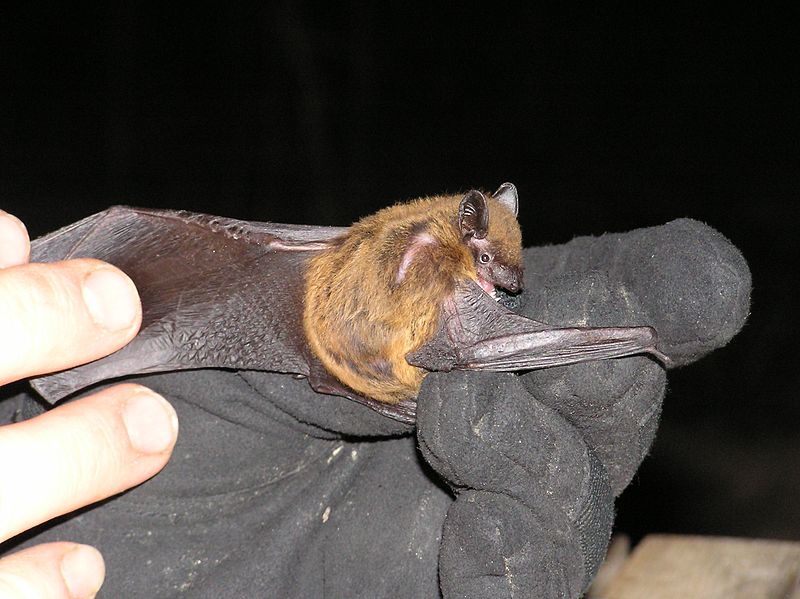
Evening bat
Order : Chiroptera
Family : Vespertilionidae
Subfamily : Vespertilioninae
Species : Nycticeius humeralis
Keywords: fly
The Evening bat is listed as Least Concern (LR/lc), lowest risk. Does not qualify for a more at risk category. Widespread and abundant taxa are included in this category, on the IUCN Red List of Threatened Species
Namings for the evening bat
A young / baby of a evening bat is called a 'pup'. A evening bat group is called a 'colony or cloud'.Some facts about the
Evening bat
Adult weight : 0.01 kg (0.022 lbs)
Maximum longevity : 6 years
Weaning : 30 days
Litter size : 2
Interval between litters : 365 days
Weight at birth : 0.002 kg (0.0044 lbs)
Weight at weaning : 0.003 kg (0.0066 lbs)
Facts about the evening bat
" The insectivorous evening bat (Nycticeius humeralis) is a true forest-dwelling bat, abundant throughout the southeastern U.
Evening bat (Nycticeius humeralis) portrait (#6 of 10) The evening bat (Nycticeius humeralis) is abundant throughout the southeastern U.
The evening bat (Nycticeius humeralis) is present in Missouri only during the spring, summer and early fall.
The evening bat (Nycticeius humeralis) is present in Missouri during the spring, summer and early fall. (Full text)
into Mexico and Florida The Evening bat is an amber brown to dark brown-black colored bat with a plain nose with facial gland pronounced.
The evening bat is essentially a summer resident, migrating southward in fall; there are apparently no winter records for the state. (Full text)
The evening bat is an abundant bat throughout the southeastern United States, northward to the upper Midwest and Ontario. (Full text)
The Evening Bat is one of the 15 species of bats found in Tennessee. (Full text)
Anatomy: The evening bat is one of the smaller bats.
The Evening bat is found to migrate 547 kilometers south.
The Evening Bat is fairly common throughout FL. (Full text)
Meet Our Bats The Evening Bat Nycticeius humeralis Back to Meet Some Bats Evening bats are found throughout the southeastern United States, from southern Pennsylvania to Florida.
Evening Bats are insectivore eating mostly flying insects. (Full text)
The Evening Bat Evening bats are found throughout the southeastern United States, from southern Pennsylvania to Florida.
Distribution in Kentucky: Habitat and Life History: Evening bats are not typically found in caves, and most or all probably winter to the south of Kentucky where they may remain active throughout the year. (Full text)
Evening bats are found in temperate deciduous woodlands or mixed woodlands and open areas. (Full text)
Evening Bats are most abundant in the eastern half of the state.
Evening bats are slightly smaller than the Mexican free tails.
Conservation and Management: Evening bats are highly beneficial consumers of insect pests and they coexist well with humans. (Full text)
Life History The evening bats are insectivorous, with the exception of fish-eating bats. (Full text)
Evening bats are thought to remain active throughout the winter.
More animals beginning with E