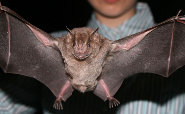
 The Jamaican fruit-eating bat (Artibeus jamaicensis) is also known as the Mexican or Common fruit-eating bat. The Jamaican fruit-eating bat is found in South and Central America. Although not very common, it is found in the Southern Bahamas as well. Its most distinctive feature is that its external tail is missing and it has a U-shaped and a very minimal interfemoral membrane. It has a grayish brown coat and its underside is slightly pale. It leaves mild and soap-like odor and has a nose that looks like its third ear. Unlike other bats, its ears are pointed at the ends. The Jamaican fruit-eating bat is 9 cm (3.5 inches) in length.
It mainly dwells in deciduous scrub or rainforests. With the help of the leaves of Palmae and Araceae plants, it builds a type of tent. It is also found in caves, forest foliage, and hollow trees.
The Jamaican fruit-eating bat belongs to the set of nocturnal animals. As its name suggests, it likes eating fruits. It mainly feeds on cecropias, figs, papayas, bananas, and guavas. Sometimes, when fruits are not available, it also feeds on pollen, nectar, leaves and even insects as well. Sometimes, it has to fly for 10 to 15 miles at a stretch in search of fruit trees. After finding a fruit, it carries the fruit in its mouth and flies off to a dining perch to eat it.
One important fact about the Jamaican fruit-eating bat is that among mammals, it is considered quite efficient in food digestion. It takes this bat just fifteen minutes to process the food. This is the main reason that the small seeds which had been swallowed earlier are left undigested. The seeds are re-released which helps in the dispersing of seeds.
A thorough research is being carried out on the ecology of different bat species on Barro Colorado Island, a natural reserve run by Smithsonian Tropical Research Institute in Panama. Under the supervision of the scientist Elisabeth Kalko, over 10,000 individuals of the bat species were examined, measured and marked for the BCi project on bats being carried out under the supervision of Elisabeth Kalko.
The female of Jamaican fruit bat is known to bear only one young at a time. At higher elevations, the birth takes place only once a year while in Panama, it happens twice a year. Bearing two young ones at a time is very uncommon. February to July is usually the breeding period of the Jamaican fruit-eating bat. Usually, when it is its mating season, the birth of young ones is very rare and there is a very short period in a year when the birth is at its peak. Life expectancy of this species is very short, only two to three years on average.
Picture of the Jamaican Fruit-eating bat by Tobusaru, licensed under Creative Commons Attribution 3.0 Unported.
Keywords: tail , gray , brown , nocturnal
The Jamaican fruit-eating bat is listed as Least Concern (LR/lc), lowest risk. Does not qualify for a more at risk category. Widespread and abundant taxa are included in this category, on the IUCN Red List of Threatened Species
Namings for the Jamaican fruiteating bat
A young / baby of a Jamaican fruiteating bat is called a 'pup'. A Jamaican fruiteating bat group is called a 'colony or cloud'.Countries
Argentina, Barbados, Belize, Bolivia, Brazil, Cayman Islands, Colombia, Costa Rica, Dominican Republic, Ecuador, El Salvador, French Guiana, Grenada, Guadeloupe, Guatemala, Guyana, Haiti, Honduras, Jamaica, Martinique, Mexico, Montserrat, Netherlands Antilles, Nicaragua, Panama, Paraguay, Peru, Puerto Rico, Saint Kitts and Nevis, Saint Lucia, Suriname, Trinidad and Tobago, Venezuela and Virgin IslandsSome facts about the
Jamaican fruit-eating bat
Adult weight : 0.042 kg (0.0924 lbs)
Maximum longevity : 19 years
Gestation : 76 days
Litter size : 1
Weight at birth : 0.006 kg (0.0132 lbs)
Body mass : 0.046 kg (0.1012 lbs)
Temperature : 36.85 °C (98.33 °F)

Custom Search