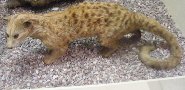
 African palm civets (Nandinia binotata) are most prevalent in East Africa's forests. Obviously, the typical refuge for one is a tree, and here they spend the bulk of their time. They weigh 1.7 to 2.1 kilograms. An African palm civet has a colored coat that is mottled, blending with the trees and the darkness caused by the leaves.. Its eyes are a combination of green and yellow, while the pupils are very near the hairline's area. The African palm civet's tail is not exactly unique, but it sure is a useful thing to them. This tail is as long as its body, and could be used as a brace. The African palm civet's limbs (all 4) are strong, and the joints are flexible. Toes and the palms possess pads, acting as a friction "maker" when the hind limbs carry the weight. All told, a cat and this civet resemble each other, in more ways than one.
They are basically solitary, and they move about from dusk and also few hours prior to dawn, and the only occasion where they would join each other is if the female African palm civet has newborns/young. Records show that there were sightings in the past where a dozen to fifteen members were all together, but from all indications, these were due to the food availability and not really because of any need to socialize.
Interesting fact: A female gives out milk from as many teats as she has newborns. These newborns actually purr when they suck on the nipple, akin to a kitten.
Picture of the African Palm Civet by subhumanfreak, licensed under GFDL
Keywords: white , gray , tail , brown , black , claw , nocturnal , yellow , stripe
The African palm civet, two-spotted palm civet is listed as Least Concern (LR/lc), lowest risk. Does not qualify for a more at risk category. Widespread and abundant taxa are included in this category, on the IUCN Red List of Threatened Species
Countries
Angola, Benin, Burundi, Cameroon, Central African Republic, Congo, Democratic Republic of the, Congo, Republic of the, Cote d'Ivoire, Equatorial Guinea, Gabon, Ghana, Guinea, GuineaBissau, Kenya, Liberia, Malawi, Mozambique, Nigeria, Rwanda, Senegal, Sierra Leone, Sudan, Tanzania, Togo, Uganda, Zambia and ZimbabweSome facts about the
African palm civet
Adult weight : 1.9 kg (4.18 lbs)
Maximum longevity : 21 years
Female maturity :1095 days
Male maturity : 1095 days
Gestation : 64 days
Weaning : 64 days
Litter size : 2
Litters per year : 2
Interval between litters : 182 days
Weight at birth : 0.055 kg (0.121 lbs)
Basal metabolic rate : 6 W
Body mass : 4.27 kg (9.394 lbs)
Temperature : 37.85 °C (100.13 °F)

Custom Search