Subscribe to
"Animal of the day"

AddThis Feed Button
Or subscribe by e-mail

Enter your Email


Powered by FeedBlitz

We hope that reader will gain an increased appreciation of the need for more conservation measure in order to protect the beautiful creatures that inhabit the earth. Our philosophy is that the more we learn about animals, the more we respect them and take better care of them. That is why we update this blog with new animals, We encourage you to syndicate our content by adding "animal of the day" to your own blog! (read more)

About us

Our mission is to get people excited about animals and their welfare by writing articles on these animals. We encourage people to comment on posts and share with others. Don't forget to subscribe to our feed.

Contact us
Copyright notice

Funny animal videos and pictures

Swimming with manatees - harmful or helpful

Last Comments

Erik (Narwhal - The Wha…): Awesome! I had not heard …
Matty (Pudu - smallest d…): Look, I know they are cut…
Doro (Fattest cat in th…): check out fat-animals.com…
dylan barker (Pink fairy armadi…): i acctually think that th…
Lindsay (Fattest cat in th…): this cat is not to fat my…
Tima (Bottlenose dolphi…): J. David Smith, Ph.D., a …
Coda Plant (Pudu - smallest d…): Hey. I live in Northern C…
Michael Newton (Koala video): i love you mr. koala
Tohru (Asian Golden Cat): I hate them too! They are…
tiffany (Asian Golden Cat): i love this cat i’m doing…

Calendar

« November 2009
S M T W T F S
1 2 3 4 5 6 7
8 9 10 11 12 13 14
15 16 17 18 19 20 21
22 23 24 25 26 27 28
29 30          

Archives

Next Archive Previous Archive

01 Nov - 30 Nov 2009
01 Oct - 31 Oct 2009
01 Sep - 30 Sep 2009
01 Aug - 31 Aug 2009
01 Jul - 31 Jul 2009
01 Jun - 30 Jun 2009
01 May - 31 May 2009
01 Apr - 30 Apr 2009
01 Mar - 31 Mar 2009
01 Feb - 28 Feb 2009
01 Jan - 31 Jan 2009
01 Dec - 31 Dec 2008
01 Nov - 30 Nov 2008
01 Oct - 31 Oct 2008
01 Sep - 30 Sep 2008
01 Jul - 31 Jul 2008
01 Jun - 30 Jun 2008
01 May - 31 May 2008
01 Apr - 30 Apr 2008
01 Mar - 31 Mar 2008
01 Feb - 28 Feb 2008
01 Jan - 31 Jan 2008
01 Dec - 31 Dec 2007
01 Nov - 30 Nov 2007
01 Oct - 31 Oct 2007
01 Sep - 30 Sep 2007
01 Aug - 31 Aug 2007
01 Jul - 31 Jul 2007
01 Jun - 30 Jun 2007
01 May - 31 May 2007
01 Apr - 30 Apr 2007
01 Mar - 31 Mar 2007
01 Feb - 28 Feb 2007
01 Jan - 31 Jan 2007
01 Dec - 31 Dec 2006
01 Nov - 30 Nov 2006
01 Oct - 31 Oct 2006
01 Sep - 30 Sep 2006
01 Aug - 31 Aug 2006
01 Jul - 31 Jul 2006
01 Jun - 30 Jun 2006
01 May - 31 May 2006
01 Apr - 30 Apr 2006
01 Mar - 31 Mar 2006
01 Feb - 28 Feb 2006
01 Jan - 31 Jan 2006
01 Dec - 31 Dec 2005
01 Sep - 30 Sep 2005
01 Aug - 31 Aug 2005
01 Jul - 31 Jul 2005

Animal posters
Animal pictures
Mammals.start4all.com
Animal diversity web
Recently extinct animals forum
PetLvr.com
Another chance to see
Happiness is a warm puppy

Miscellany

AddThis Feed Button

« Warthog - Long-legged… | Home | Black-footed cat - sm… »

Asian Palm Civet

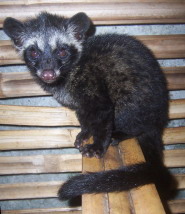
Asian palm civetThe Asian Palm Civet (Paradoxurus hermaphroditus), also called 'Common Palm Civet' or the 'Toddy Cat' can be found as far west as Kashmir and as far east as the Philippines, from Southern China to the Sundas (and its islands). Its habitat is the tropical forest.

Asian Palm Civets feed only at night, and it is believed that its fear of predators during daytime is the principal reason for its nocturnal attitudes. They retire to their shelters just before dawn arrives. These civets have the reputation to choose the tallest trees they can find. Their organization and activity habits are determined by the availability/surplus of food and again, the activities of their feared predators (and I do not only mean humans). The Asian Palm Civet is arboreal, and when feeding in the same area, they use the same trees to rest in.

These civets are basically frugivorous, that means, they survive on pulpy fruits, berries and even palms (of course, as their name implies). Eggs, reptiles and insects however, are also on the menu.

The Asian Palm Civet also, every once in a while, feed on the fruits of coffee trees, and how do they do this? More on that later... The ears are just small, a bit pointed, and so is the nose's structure. Coat is gray to brown, with guard hair all over. Usually, there are 3 rows of dark spots at each side of the body, and the feet/ears/tail's end are all black in color.

Regardless of sex, it has a well-build anal scent gland(s) resembling testes. Nocturnal in nature, this civet hunts by itself. It is an outstanding climber and spends most of the time up in the trees...oh, another thing that you might like to know. Its sap is used by some people to make a liquor kind called toddy, giving this civet its other monicker.

Interesting fact: Coffee seeds make their way (in whole) through the digestive path of this civet, then it is collected by people to be used in coffee, and this is no ordinary coffee. This coffee is in high-demand for its unique flavor and is very expensive.

Picture of the Asian Palm Civet by W. Djatmiko, licensed under GFDL


two comments:

This species lives in a habitat that is fast diminishing
alex (Email) - 23 02 08 - 00:51

That thing is so,so,so,so, CUTE.
chey - 03 02 09 - 02:31

You can help spreading the word about this animal by stumbling it by pressing this link StumbleUpon or
  
Remember personal info?

Emoticons / Textile

To be able to comment you are asked to answer this silly question. This question baffles automated spam bots, but fortunately for you it is a simple question, i hope.
 

  ( Register your username / Log in )

Notify:
Hide email:

Small print: All html tags except <b> and <i> will be removed from your comment. You can make links by just typing the url or mail-address.
Animal of the Day
Subscribe to the
animal of the day
Enter your Email


Powered by FeedBlitz

Add "Animal of the day" to your blog

A new feature has been set up for your
site: "Animal of the Day", you can add this to your website by copying the code. An example of how
this would look like and the code to be added can be found here.

63 comments - Permanent Link