
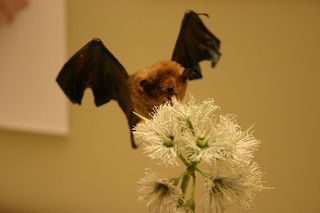
Original source: originally posted to Flickr as Palla's long-tongued bat
Author: Ryan Somma
Pallas's long-tongued bat
Order : Chiroptera
Family : Phyllostomidae
Subfamily : Glossophaginae
Species : Glossophaga soricina
The Pallas's long-tongued bat is listed as Least Concern (LR/lc), lowest risk. Does not qualify for a more at risk category. Widespread and abundant taxa are included in this category, on the IUCN Red List of Threatened Species
Namings for the Pallas
A young / baby of a Pallas is called a 'pup'. A Pallas group is called a 'colony or cloud'.Countries
Argentina, Belize, Bolivia, Brazil, Colombia, Costa Rica, Ecuador, El Salvador, French Guiana, Guatemala, Guyana, Honduras, Jamaica, Mexico, Nicaragua, Panama, Paraguay, Peru, Suriname, Trinidad and Tobago and VenezuelaSome facts about the
Pallas's long-tongued bat
Adult weight : 0.01 kg (0.022 lbs)
Maximum longevity : 11 years
Gestation : 106 days
Weaning : 61 days
Litter size : 1
Body mass : 0.01 kg (0.022 lbs)
Temperature : 35.85 °C (96.53 °F)
Facts about the Pallas's long-tongued bat
" Glossophaga soricina is one of several closely related nectar-feeding bats in the family Phyllostomidae, and it is possible that ultraviolet sensitivity is characteristic of the whole group, said Dumont.
Aerodynamic theory predicts that power output for hovering flight in Glossophaga soricina is 2.
The common long-tongued bat ( Glossophaga soricina ) is also reported to roost in buildings, rock crevices, and hollow trees.
Glossophaga soricina is known to consume parts of at least 34 different species of plants and shows clear preferences locally. (Full text)
4) In summary: The authors demonstrate that a phyllostomid flower bat, Glossophaga soricina, is color-blind but sensitive to ultraviolet light down to a wavelength of 310 nm. (Full text)
Here we show that a phyllostomid flower bat, Glossophaga soricina, is colour-blind but sensitive to ultraviolet light down to a wavelength of 310 nm. (Full text)
More animals beginning with P