 |
 |
 |
 |
 |
 |
 |
 |
 |
 |
 |
Whale-headed Stork
The adult bird is 115-150 cm tall, 100-140 cm long, 230-260 cm across the wings and weighs 4 to 7 kg . The adult is mainly grey while the juveniles are browner. It lives in tropical east Africa in large swamps from Sudan to Zambia.
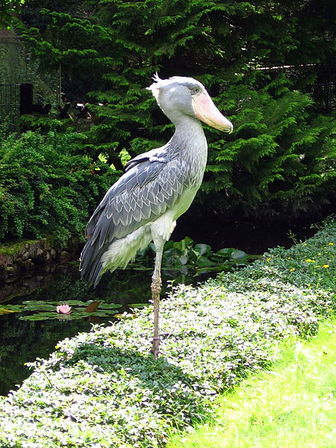

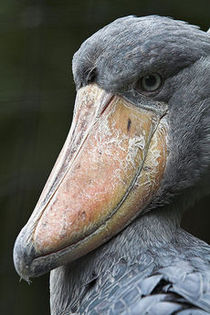
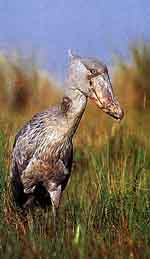 "Abu Markub - father of the shoe" the Shoebill was called by arab explorers several centuries ago. No surprise looking at its bill, which doesn't only look like a shoe but has got its dimensions too. It is up to 20 cm long and almost of the same width. Therefore the Shoebill has got the largest bill among all bird species. Although it is known to science since a long time and surely is among the most impressing and curious birds, there is not much knowledge about the Shoebill. It is still disputed how it should be classified. Probably the "grey giant", which reaches a height of 1,5 metres, is related to storks, but this theory hasn't been confirmed finally yet.
The way Shoebills lead their lives is almost completely unknown too. The large birds inhabit East African swamp regions, which are dominated by papyrus vegetation. These landscapes are not very easy of access and so there are just a few scientists, who have been able to observe Shoebills under natural conditions and study their behaviour and ecology. But it was found out at least that Shoebills are animals of a very restrained temper. They are standing in the shallow water almost motionless for hours, just moving the head or changing the leg, upon which they stand, from time to time. Shoebills become active when fish or frogs come into view. They are grabbed with a quick push and swallowed up. Not very easy with a bill of that size! Shoebills have to stretch their wings to the back when snapping at their prey in order to keep the balance. They lead a solitary life. Only during the breeding season Shoebills can be found in pairs. They build their nests, which are constructed as platforms consisting of swamp grass, on the ground. Normally two eggs are laid and incubated. When birds of prey are flying over the swamps, dozens of smaller birds, like herons and ibises, are gathering around the giant Shoebills, which serve as a "stronghold of security", since they are detering the birds of prey just because of their size.
This article was originally published at magazine.naturspot.de. Link to the original article
The Whale-headed Stork is classified as Vulnerable (VU), considered to be facing a high risk of extinction in the wild.
Original source: su neko
Author: su neko
Permission: Some rights reserved
Family : Balaenicipitidae
Genus : Balaeniceps
Species : rex
Authority : Gould, 1850