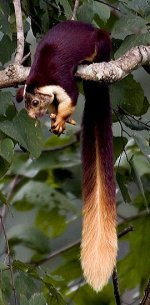
 Indian Giant Squirrels (Ratufa indica) most often stay in trees, and they find refuge within holes of the trees, but here is one amusing bit of truth: they could leap from tree to tree, jumping a span of 6 meters or longer. The Indian Giant Squirrel is found in tropical forests, that includes the rainforests.
An Indian Giant Squirrel has dorsal colors that go from red to brown, but generally, they have a white fur in the belly area. Ears of an Indian Giant Squirrel are round, a pronounced hand with an inner paw that is of course used for gripping. A typical Indian Giant Squirrel weighs about 1.5 to 2 kilograms.
The number of young average to two, and on the average, Indian Giant Squirrels have a gestation period of 31 days. The reproductive particulars for these squirrels are not exactly known, but indications point to the fact that breeding happens all throughout the year. Longevity of these squirrels as far as the wild habitat is concerned, is unknown, but according to records, one in captivity reached two decades. Basically, they are solitary creatures, and they are cautious (with all the predators out there, for good reason).
They are omnivorous, surviving on flowers, fruits, eggs, insects and even bark. It is safe to assume that they escape being killed by their predators by simply going to the trees, plus exercising their agility.
Interesting fact: The Giant Squirrel's large tailis used as a counterweight, to help them keep their balance.
Picture of Indian giant squirrel by Vijay Cavale, Muthodi, Karnataka. India November, 2005 Author: Vijay AT indiabirds.com, licensed under Creative Commons Attribution 2.5
The Indian giant squirrel is listed as Vulnerable (VU), considered to be facing a high risk of extinction in the wild, on the IUCN Red List of Threatened Species
Namings for the Indian giant squirrel
A young / baby of a Indian giant squirrel is called a 'pup, kit or kitten'. The females are called 'doe' and males 'buck'. A Indian giant squirrel group is called a 'dray or scurry'.Countries
IndiaSome facts about the
Indian giant squirrel
Adult weight : 2 kg (4.4 lbs)
Maximum longevity : 20 years
Gestation : 84 days
Litter size : 1

Custom Search